

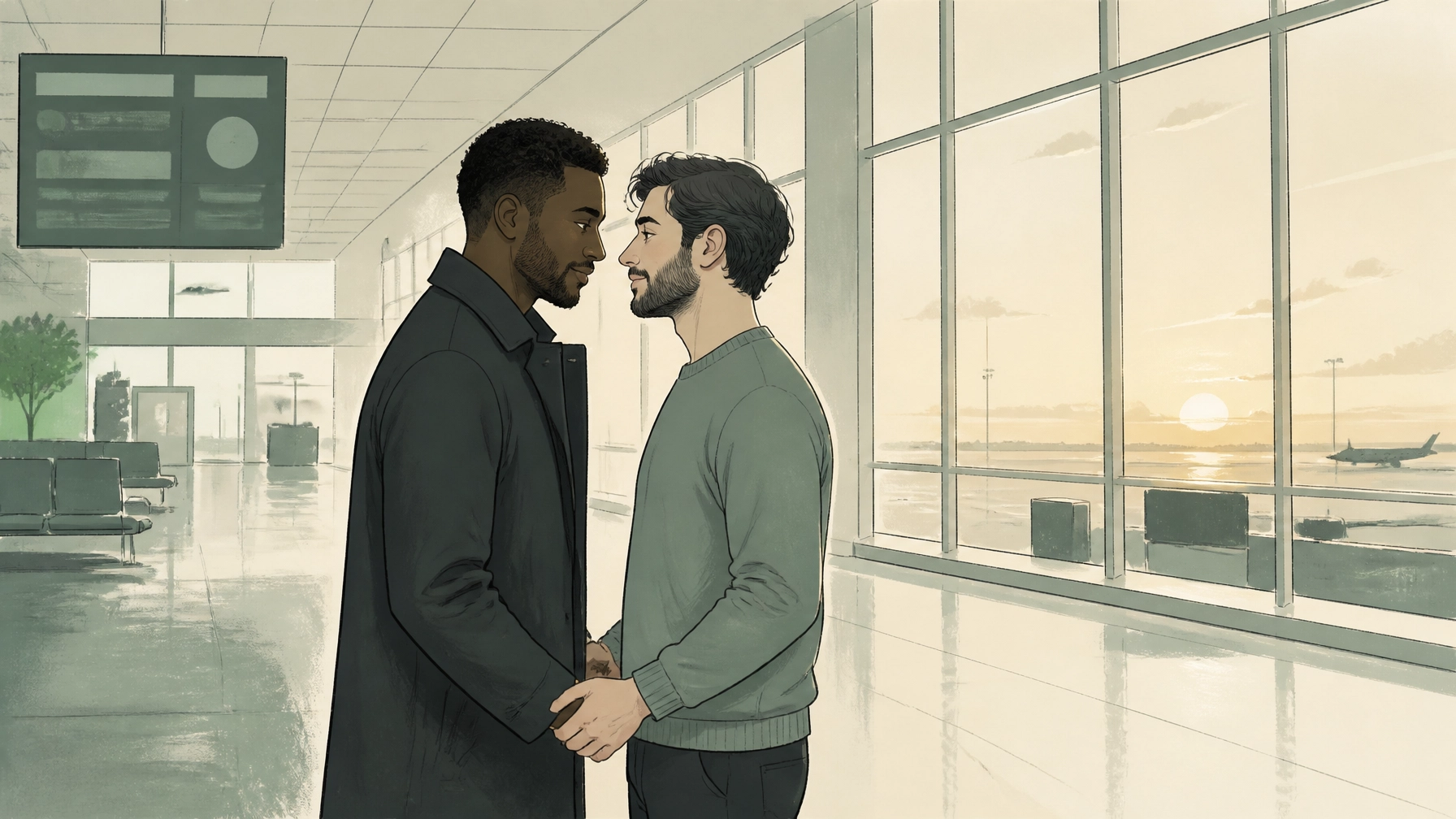
There are places designed for departure that become, unexpectedly, places of beginning.
An airport terminal at dawn is one of them. Before the queues lengthen and the announcements begin to overlap, the building seems to hold its breath. The glass walls turn pearl-grey. Cleaning machines hum across the polished floor. Coffee tastes stronger than it should. Every traveller sits with one hand around a paper cup and the other around whatever they are trying not to lose.
At that hour, nobody is entirely where they belong.
They are between cities, between obligations, between the person they were when they arrived and the person they might become once the plane finally leaves the ground.
For Daniel and Isaac, the delay begins with a flickering notice above Gate 18.
DEPARTURE DELAYED.
Three ordinary words. A small inconvenience. Nothing that should alter the shape of a life.
And yet, sometimes a postponed flight gives two people the time to stop pretending they are travelling alone.
The loneliness of travelling through a crowded place
Daniel has become good at being unnoticeable.
He knows how to sit without taking up too much space. He keeps his headphones around his neck but rarely plays anything. He answers messages with brief, neutral phrases. When someone asks whether he is travelling for work or pleasure, he smiles as if either answer might be dangerous.
He is flying home after six months away. Home is a word he has not yet decided he deserves.
For most of his adult life, Daniel has lived in the careful space between truth and explanation. He has dated men, loved men, and still found himself rehearsing the safest version of his life before family gatherings. He has learned that coming out is not always one grand act of courage. Sometimes it is a sequence of smaller decisions: leaving a photograph visible on a shelf, saying “my boyfriend” without lowering your voice, refusing to turn a beloved man into a vague friend when someone asks who has been calling.
Living openly can be brave.
It can also be exhausting.
Isaac sits two rows away, reading a paperback with a cracked spine. He is the sort of man who seems present even when he is looking elsewhere. His coat is folded across his lap. His suitcase bears the marks of too many journeys, and one of his hands rests protectively over the handle.
Daniel notices him because Isaac is not trying to look comfortable.
He is trying to look composed.
There is a difference.
A delayed flight and an unexpected conversation
The first conversation happens because the coffee machine takes Daniel’s money and refuses to give him coffee.
Isaac witnesses the failure.
“Try the one beside it,” he says. “That machine only accepts optimism.”
Daniel looks over. “I suspected as much.”
“It’s an expensive lesson before sunrise.”
The exchange is small, almost weightless. But Daniel smiles properly, and Isaac notices.
This is how connection often begins: not with a confession, not with an instant certainty, but with the permission to be briefly ridiculous in front of a stranger.
They move to the other machine. It works. The coffee is bitter and too hot. They drink it anyway.
Then the departure board changes again.
The delay stretches from forty minutes to two hours.
Around them, people sigh, call airlines, rearrange meetings, and scroll through bad news. Daniel and Isaac remain beside the window, watching the runway brighten by degrees. The terminal is a world built around movement, yet neither man can go anywhere.
For the first time in months, Daniel does not feel required to make progress.
What it means to be seen
Isaac asks where Daniel is going.
Daniel tells him.
He does not say why.
Isaac does not press.
That restraint becomes its own kind of tenderness.
There is a particular fear in being seen by someone who may understand you. Strangers are easy to deceive because they have no history with you. They cannot compare your present self with the person you used to perform. But someone attentive might notice the pauses, the guarded answers, the way you look at your phone and then turn it face down.
Isaac notices everything, but he does not demand an explanation.
Eventually, he tells Daniel that he is bisexual.
He says it without ceremony, as though offering a fact rather than a defence.
Daniel looks at him. “Do people make you explain that?”
“Sometimes.”
“Do you?”
Isaac considers this. “Sometimes I make myself explain it before anyone asks.”
The terminal lights hum above them.
He tells Daniel that there were years when he thought he had to choose a word that would make other people comfortable. Gay. Straight. Confused. Experimenting. Settled. Each label seemed to come with a set of instructions, and none of them described the full, untidy truth of his life.
“I’m tired of translating myself,” Isaac says.
Daniel understands more deeply than he can say.
Quiet devotion does not need to be loud
Their intimacy grows through practical things.
Isaac notices that Daniel’s phone battery is nearly dead and offers him a charger. Daniel buys a second coffee and remembers how Isaac takes his. When the terminal becomes colder, Isaac gives him the spare scarf from his suitcase without making the gesture feel like charity.
Nothing dramatic happens.
No one runs through the airport. No announcement declares a change of fate. There is no swelling music, no perfect speech prepared in advance.
There is only the steady accumulation of attention.
The kind that says: I saw that you were cold.
The kind that says: You looked frightened, so I stayed.
For emotionally invested MM readers, this is where a gay love story becomes more than a sequence of romantic events. The feeling lives in the details characters might dismiss as insignificant. A hand held beneath the table. A name spoken gently. The decision to wait without asking whether waiting will be rewarded.
This is the heart of character-driven queer fiction: not simply showing who a man desires, but revealing what he fears desire might cost him.
Daniel has spent years mistaking privacy for safety. Isaac has spent years fearing that honesty will turn him into a question other people feel entitled to answer.
Together, they begin to understand that vulnerability does not always look like confession.
Sometimes it looks like staying seated.
The terminal becomes a place of hope
At six forty-five, the first pale sunlight reaches the windows.
It catches in Isaac’s hair and turns the floor beneath them the colour of watered milk. Beyond the glass, aircraft move slowly through the mist. The world is waking, though the two men still feel suspended from it.
Daniel tells Isaac he is afraid of going home.
Not because home is cruel, exactly. Because it is familiar enough to make old habits feel inevitable.
Isaac listens.
Then Daniel asks what Isaac is leaving behind.
“A version of myself,” Isaac says.
“Is that easier?”
“No.”
The answer is honest. It is also enough.
Their flights are eventually reassigned. Different gates. Different destinations. The delay has not erased the distance between their lives. It has not solved the questions waiting for them beyond the terminal doors.
But something has shifted.
Daniel reaches for Isaac’s hand.
The gesture is tentative, almost apologetic.
Isaac turns his palm upward and holds on.
No one applauds. No one needs to.
Hope, in this story, is not a destination printed on a boarding pass. It is not the reward for surviving a difficult journey. It is a place two people make when they decide that fear will not be the only thing shaping their choices.
Their flights may still leave.
Their lives may still be complicated.
But they have learned that being grounded together is not the same as being stuck.
Why unexpected places make powerful MM romance settings
The strongest MM romance unexpected places often begin in environments that seem too public, too temporary, or too impersonal for love. An airport terminal. A hospital corridor. A late-night laundrette. A roadside café in the rain.
These places work because they remove the illusion of control.
Characters cannot curate the moment. They cannot arrange perfect lighting or choose the ideal version of themselves. They are tired, delayed, uncertain, and carrying histories that show through the cracks.
That is where emotional MM romance literary storytelling finds its power.
A man who is afraid of being seen may meet another man who knows the cost of hiding. A man who believes he is difficult to love may discover that devotion is often quiet, patient, and practical. Two strangers may not save each other, but they may offer something more believable: recognition.
For readers who seek gay romance books with emotional depth, queer fiction about authentic internal struggle, and gay love stories that honour tenderness without simplifying pain, the airport at dawn becomes more than a setting.
It becomes a threshold.
A place where two men can ask, perhaps for the first time, what might happen if they stopped treating love as another departure they had to survive.
Discover more emotionally immersive stories and explore Dick Ferguson’s books on Read with Pride. You can also visit the Read with Pride homepage for LGBTQ+ ebooks, gay fiction, MM novels, queer authors, and heartfelt stories of connection.
Three possible next Morning Edition stories
-
The Laundrette at Midnight : Where Two Men Folded Their Lives into the Same Small Circle
A recently divorced man and a younger bisexual artist meet over a broken washing machine, discovering that clean beginnings are rarely as simple as they look. -
The Hospital Vending Machine : Where Two Strangers Learned to Wait Without Asking for Guarantees
Two men keep crossing paths during long nights of uncertainty, sharing crisps, silence, and the fragile courage required to hope. -
The Last Bookshop Before Closing : Where a Forgotten Dedication Changed Everything
A guarded bookseller finds an old inscription in a second-hand novel, while a familiar customer finally admits why he has been returning every Thursday.
Follow us on social media
Follow Dick Ferguson for more lyrical, emotionally charged MM romance, queer fiction, gay novels, and stories about men finding courage in unexpected places:
#MMRomance #GayRomance #QueerFiction #GayFiction #MMNovels #LGBTQBooks #EmotionalMMRomance #CharacterDrivenFiction #GayLoveStories #RomanceInUnexpectedPlaces #LGBTQReading #ReadWithPride #ReadingWithPride #2026GayBooks


Leave a Reply
You must be logged in to post a comment.