

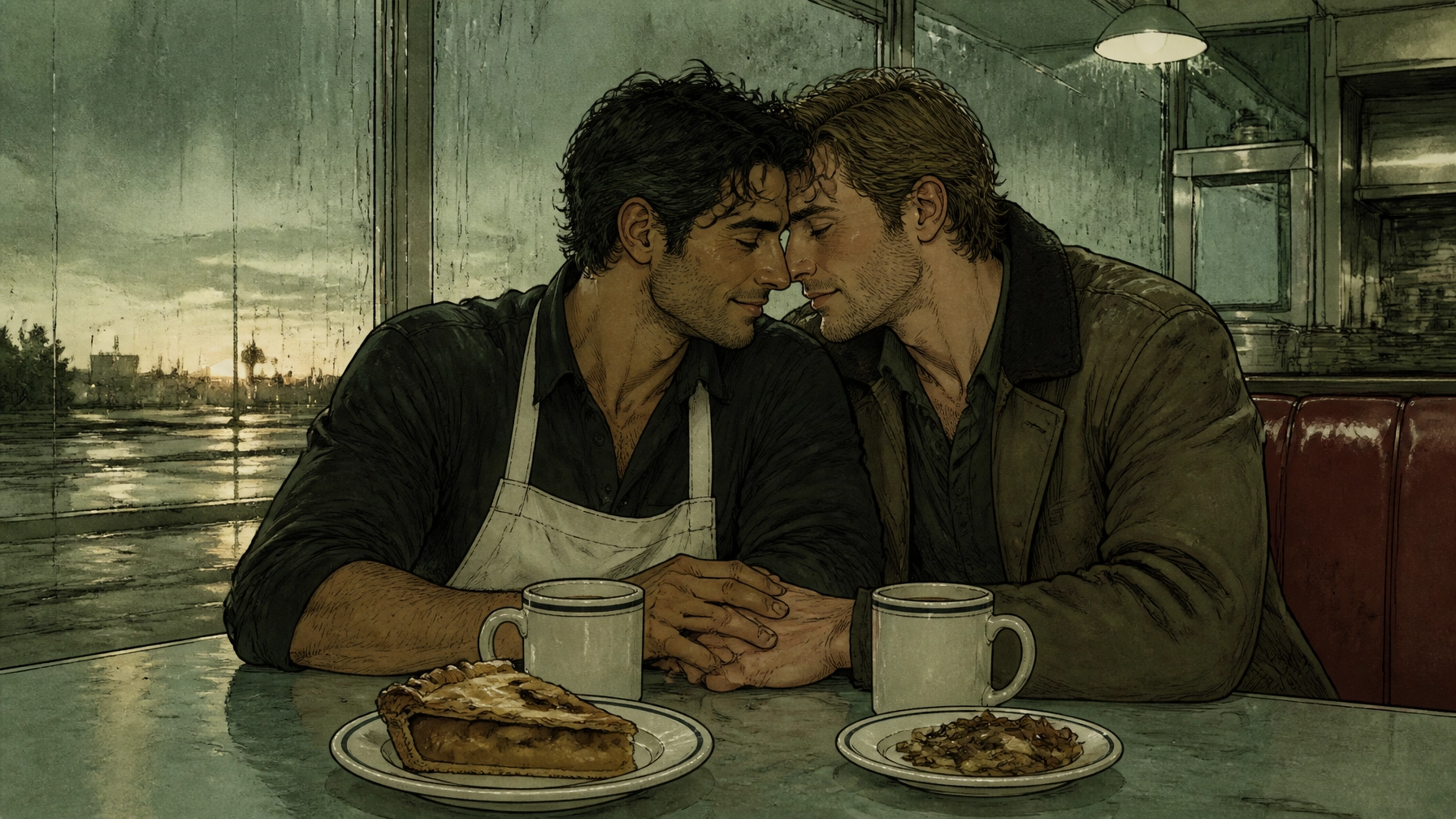
There are places where nobody goes looking for love.
An all-night diner is usually one of them.
People come in because they are hungry, because their shift has ended, because sleep refuses to arrive, because the rain has made the road feel too long. They come carrying paper bags, tired eyes, unfinished arguments, hospital bracelets, work boots, and the private weight of everything they have not yet said.
At three in the morning, nobody pretends to be impressive.
The fluorescent lights are too honest. The coffee is too strong. The windows gather steam at the edges, and the jukebox sometimes plays a song that would sound sentimental in daylight but feels almost unbearable at that hour. Outside, rain slips down the glass in silver lines. Inside, the refrigerator hums beneath the clatter of plates.
Between customers, the diner seems to hold its breath.
That was when Rafael first noticed Marcus.
The Cook Who Had Stopped Asking for Too Much
Rafael worked the night shift because he preferred the hours when the city became less demanding.
During the day, everyone wanted something. An answer. A smile. A version of him that could pass comfortably through a conversation without making anyone wonder where he had come from or what he had survived.
At night, the diner asked only that he keep the grill hot.
He had left his small town after coming out, though “coming out” made it sound cleaner than it had been. There had been no single declaration, no cinematic gathering of loved ones waiting to embrace him. There had been slammed doors, long silences, a mother who had spoken to him through other people, and a father who had decided that not asking questions counted as kindness.
Rafael had driven away with two bags in the boot of his car and the belief that wanting a home was a kind of weakness.
Better to want a room, he told himself.
A room could not reject you. A room did not ask you to explain why you stayed. A room did not become dangerous simply because someone knew you too well.
He became good at the diner’s small mechanics. He knew how long to leave onions on the grill before they softened into sweetness. He could tell when the coffee needed replacing by the faint bitterness rising from the pot. He remembered who liked extra ketchup, who wanted their eggs hard, and who needed to sit alone until the world felt manageable again.
Marcus always ordered the same thing.
Two eggs. Rye toast. Grilled onions. Black coffee.
The first night Rafael saw him, Marcus sat in the third booth beneath the window. He had the broad, slightly stooped posture of a man who had spent years carrying other people’s needs before his own. His coat was damp. His wedding ring was gone, but the pale mark remained.
He ate slowly, as if dinner were an obligation rather than a pleasure.
Rafael did not ask questions.
He simply remembered the order.
The Father Who Came Home to an Empty Apartment
Marcus had recently divorced, though the word still felt too formal for the wreckage it described.
He saw his son on weekends. He knew the exact shape of those days: cereal eaten too quickly, a football left in the hallway, small shoes abandoned beside the sofa, a favourite film watched twice because his son liked the music.
Then Sunday evening arrived.
His son went home, and Marcus returned to an apartment so quiet that the silence seemed to accuse him.
The rooms were not empty in any practical sense. There were books on the shelves, laundry in a basket, photographs turned face down because he could not yet decide what they meant. But every object appeared to be waiting for someone who no longer lived there.
So Marcus began going to the diner.
He told himself it was for the food. Then for the coffee. Then because the apartment’s silence had become difficult to enter before dawn.
The first time Rafael placed the plate in front of him without asking, Marcus looked up.
“You remembered.”
Rafael shrugged. “You order the same thing.”
“That isn’t the same as remembering.”
It was a small exchange. Almost nothing.
But some connections begin as almost nothing. A door left unlocked. A chair pulled out. A name spoken as though it belongs in the room.
After that, Rafael refilled Marcus’s coffee before he asked. Marcus began arriving with a book he never opened. Rafael kept the last slice of apple pie warm beneath the heat lamp, even though Marcus claimed he did not want dessert.
“You’ll let it go cold,” Rafael said.
“I might change my mind.”
“You always do.”
Marcus smiled then. It was the first time Rafael saw how young he could look when he was not trying to be composed.
The Rituals That Became a Language
Their intimacy accumulated through ordinary things.
Rafael learned that Marcus hated the sound of ice sliding around an empty glass. Marcus learned that Rafael hummed when he was worried, though Rafael denied it. Rafael placed the better fork beside Marcus’s plate. Marcus repaired the loose hinge on the cupboard beneath the counter.
Neither of them called this tenderness.
They were men who had learned to mistrust anything that felt too much like hope.
Sometimes they spoke about harmless subjects. The weather. The broken sign above the pharmacy. The city council’s decision to close the public toilets near the bus station. The strange customer who came in every Thursday and insisted on eating soup with a dessert spoon.
Sometimes they spoke about their sons, their fathers, their childhood homes.
Sometimes they said nothing at all.
The diner made silence possible. It gave them a place where quiet was not a punishment but a form of company.
One night, rain struck the windows so hard that the street outside disappeared. The neon sign blurred into a green-red smear across the glass. The jukebox played an old love song with a melody too gentle for the hour.
Marcus stared at his coffee.
“I haven’t told anyone,” he said.
Rafael stopped wiping the counter.
Marcus’s hand tightened around the mug. “Not properly. I mean, I’ve told myself. I’ve thought about it. I’ve tried to say it when I’m alone in the car.”
Rafael waited.
“I’m bisexual,” Marcus said. “I’ve never told anyone that before.”
The refrigerator hummed. Somewhere in the kitchen, oil clicked against the side of a pan.
Marcus laughed once, without amusement. “There. Now it sounds like a confession.”
“It doesn’t have to be one.”
“It feels like one.”
Rafael came around the counter, not too quickly. He sat opposite Marcus in the booth, still wearing his apron, his hands resting flat on the table.
“You don’t owe anyone an explanation for finding out who you are,” he said.
Marcus looked at him. “You don’t think I’m confused?”
“No.”
“You don’t think I’m saying it because my marriage ended?”
“No.”
“You don’t think it makes everything else, ”
“No,” Rafael said again, quietly. “I think it means you’re bisexual.”
The words did not arrive with fanfare. They did not solve Marcus’s life. They did not erase the years he had spent trying to be acceptable in ways that left him lonely.
But they settled between them with the steadiness of something true.
Marcus looked down at their hands. “I’m afraid of wanting this.”
Rafael understood that immediately.
Coming out had taught him that love could be used as evidence against you. Wanting a man could become a reason to leave home, to lose family, to distrust your own hunger for closeness. He had spent years making himself smaller than his longing.
“I know,” Rafael said.
“What do you do with that fear?”
Rafael considered the rain, the empty tables, the pie cooling beneath the lamp.
“Sometimes,” he said, “you let someone sit with you while you have it.”
Marcus’s fingers moved across the table.
Rafael met them halfway.
What the Small Hours Allowed
They did not become fearless.
That would have been an easier ending, and a less honest one.
Marcus still worried about what his son would understand, what his former in-laws might say, what his friends would do with a truth he had kept hidden for so long. Rafael still woke from dreams about his hometown with the old reflex to apologise for existing. There were mornings when both men pulled away, frightened by how quickly a diner ritual had become something they carried beyond its walls.
The difference was that they began speaking about the fear instead of allowing it to make decisions for them.
Marcus told Rafael about the apartment.
“I hate going back there,” he admitted.
“Then don’t go back there tonight.”
“I have work in the morning.”
“Sleep here.”
Rafael pointed toward the narrow staff room, where the sofa was too short and the heating made an alarming noise.
Marcus laughed. “That’s not exactly a home.”
“No,” Rafael said. “But it’s somewhere to start.”
A week later, Rafael went to Marcus’s apartment for the first time. They stood in the kitchen beneath a light that needed replacing. Marcus apologised for the photographs still turned face down.
Rafael did not tell him to put them back.
Instead, he opened the cupboard and found two mugs. He washed one while Marcus made coffee.
It was not a declaration. It was not a promise that the future would be simple. It was two men moving carefully through a room that had once represented failure, making space for something new without pretending the old pain had vanished.
Before dawn, they returned to the diner together.
Rafael still had an hour left on his shift. Marcus sat at the counter, no longer in the third booth. When Rafael placed the coffee in front of him, Marcus reached across and touched his wrist.
Outside, the rain had stopped.
The windows were beginning to clear. Beyond them, the sky was turning the pale green-grey of morning, and the first buses moved along the wet road.
The diner did not look magical.
It looked tired. The floor needed mopping. The coffee machine rattled. One of the ceiling lights flickered above the pie case.
But love does not always arrive in beautiful places.
Sometimes it arrives as a remembered order. A hand held beneath fluorescent light. A truth spoken for the first time while the city sleeps. A man who does not ask you to become less complicated before he stays.
For emotionally invested MM readers, that is the quiet power of an MM romance in unexpected places. The setting does not need to be grand. The feeling becomes grand because the characters are brave enough to remain present inside it.
This is the heart of a gay love story’s emotional journey: not the sudden disappearance of shame, but the slow discovery that shame does not have to be obeyed.
Rafael had once believed he was not allowed to want a home.
Marcus had believed an empty apartment proved he had failed.
By morning, neither man had solved everything.
But Rafael had somewhere to go after his shift. Marcus had someone waiting for him when the coffee was poured. And between them, in the small hours before dawn, they had begun to build a home out of attention.
That was enough for one morning.
It might even be enough for tomorrow.
Three Possible Next Morning Edition Stories
-
The 24-Hour Car Wash: Where Two Men Let the Water Take the Night Away
A detailer working the graveyard shift meets a recently widowed teacher who keeps returning with the same spotless car. Under fluorescent lights and the steady rush of water, they discover that grief and desire can share the same quiet space. -
The Bus Depot at 3 AM: Where Two Strangers Waited for the Courage to Stay
A bisexual man planning to leave the city meets a night dispatcher who has spent years helping other people find their way home. Their connection grows through missed buses, vending-machine coffee, and one impossible decision before sunrise. -
The Public Library During a Storm: Where Two Men Found Shelter Between the Shelves
When a power cut traps a librarian and a regular visitor inside an old public library, they spend the night surrounded by emergency lights, unfinished research, and the books that taught them how to name their loneliness.
For readers drawn to character-driven queer fiction, emotional MM romance literary storytelling, and gay novels that linger on the interior life, discover more LGBTQ+ ebooks, gay books, MM romance, queer fiction, and gay fiction from Read with Pride.
You can also explore Dick Ferguson’s emotional MM romance and gay romance books, where love is complicated, vulnerability matters, and every character is allowed to carry a past.
Follow us on social media
Follow us for new stories, reading recommendations, queer fiction conversations, and updates from Dick Ferguson:
#MMRomance #GayRomance #QueerFiction #GayFiction #LGBTQBooks #EmotionalMMRomance #CharacterDrivenFiction #GayLoveStory #RomanceInUnexpectedPlaces #ReadWithPride #ReadingWithPride


Leave a Reply
You must be logged in to post a comment.