

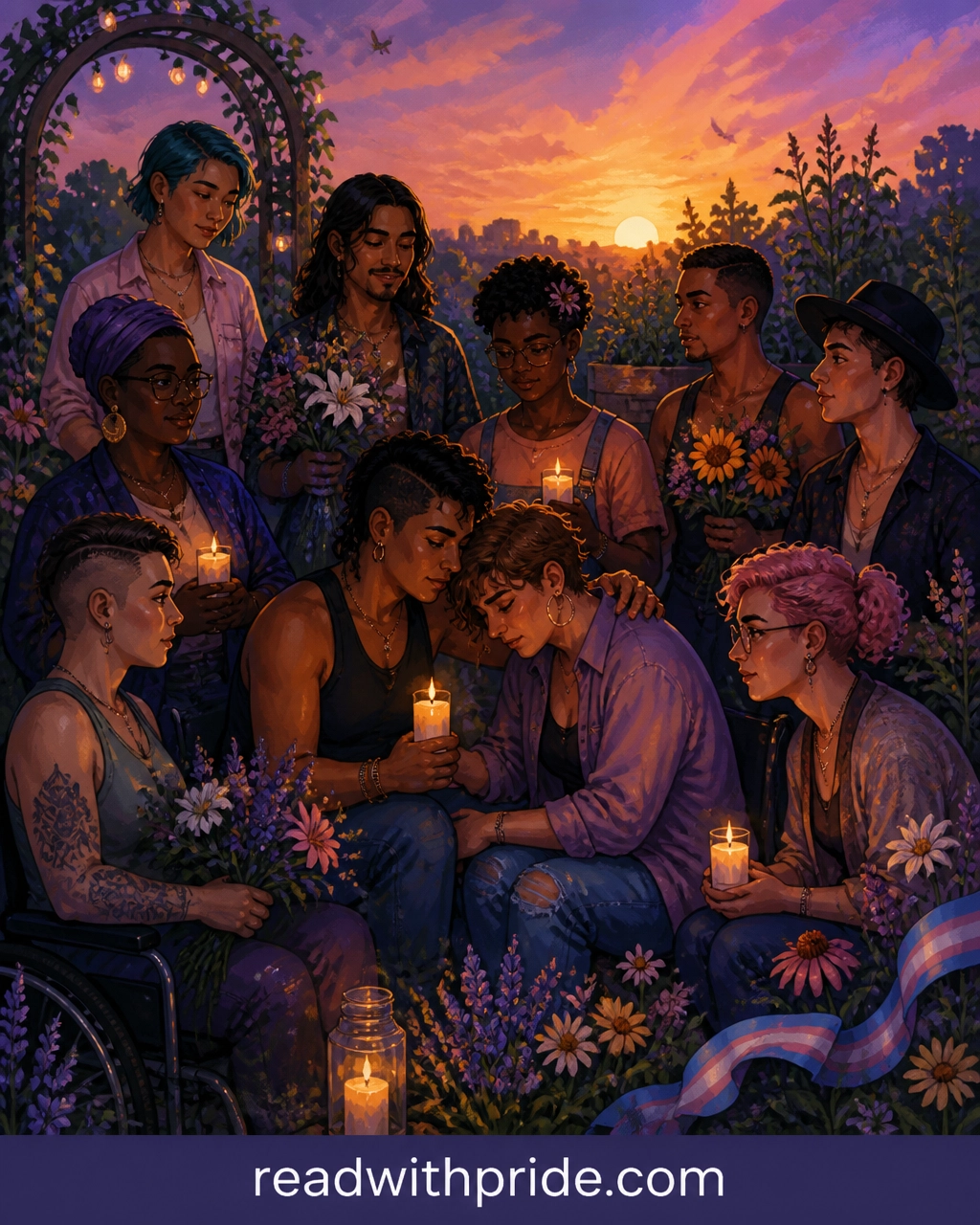
Grief does not always arrive with a clear beginning, a formal goodbye, or a socially recognised place to put it.
Sometimes it follows the death of a partner, friend, relative, mentor, or chosen-family member. Sometimes it grows from a breakup, estrangement, lost home, unsafe community, or years spent hiding parts of yourself. Sometimes it is grief for a future you once imagined but could not reach.
For LGBTQ+ people, loss can carry additional layers. A relationship may not be acknowledged by relatives or institutions. A chosen family member may be treated as “just a friend.” A trans person’s identity may be erased in the language used after their death. Communities may carry memories of the AIDS crisis, hate crimes, displacement, and ongoing discrimination alongside their personal sorrow.
This is why queer healing is not about rushing towards positivity. It is about making room for the whole truth: the pain, the anger, the tenderness, the memories, the laughter, and the stubborn hope that keeps showing up anyway.
When queer grief is not given enough room
There is a term for grief that society fails to recognise: disenfranchised grief.
It describes the pain of losing someone or something important when the people around you do not fully validate that loss. For queer people, this can happen when families refuse to acknowledge a same-sex partner, when a nonbinary person’s identity is ignored, or when friends do not understand why the loss of a community, identity, or imagined future hurts so deeply.
The result can be an exhausting double burden. You are grieving, and you are also explaining why you are allowed to grieve.
That explanation should not be necessary.
A queer relationship is real whether or not every relative approves of it. A chosen-family bond is real whether or not it appears on official paperwork. The loss of safety, belonging, health, possibility, or time deserves care, even when there is no ceremony or socially familiar script to hold it.
As guidance from The Center on community and loss makes clear, LGBTQ+ people may experience grief through both personal bereavement and the wider losses carried by a community. Recognising that complexity is not making grief “too political.” It is telling the truth about where our lives happen.

Healing out loud does not mean performing your pain
The phrase “healing out loud” can sound as though we are expected to share everything publicly. We are not.
Healing out loud can be deeply private. It might mean telling one trusted friend the name you want used for the person you lost. It might mean correcting someone who describes your partner as a flatmate. It might mean lighting a candle, making a playlist, returning to a favourite park, or finally admitting, “This has changed me.”
It can also mean choosing not to explain yourself to people committed to misunderstanding you.
There is no single correct way to mourn. Some people need conversation. Others need silence, movement, art, spirituality, routine, or practical tasks. Some days you may want to talk about the person you lost in vivid detail. Other days, you may only manage toast and a television show you have already watched six times.
All of that can belong to healing.
A useful starting point is asking:
- Who helps me feel understood rather than examined?
- Which names, pronouns, and relationship words feel right for this loss?
- What memories do I want to protect?
- What boundaries would make support feel safer?
- What small act could help me get through today?
There is no prize for grieving in the most impressive way. The goal is not to become inspirational. The goal is to remain connected to yourself while something painful changes the shape of your life.
Chosen family is not a consolation prize
Chosen family is often described as a substitute for biological family. That description misses the point.
Chosen family is family. It is built through trust, care, shared history, mutual protection, and the everyday decision to show up. It may include partners, friends, exes, neighbours, elders, younger people, community members, and the person who always knows when you need food before you do.
During grief, chosen family can provide something essential: recognition.
They know who mattered. They understand why a particular song is impossible to hear right now. They remember the nickname, the ridiculous story, the difficult anniversary, the tiny domestic habit that nobody else noticed. They can help carry practical responsibilities when emotional language becomes too tiring.
Community support does not erase the person who has died or the future that has been lost. It makes the loss less lonely.
Queer communities have always created care in places where formal systems fell short. We have organised, shared homes, raised money, made meals, accompanied one another to appointments, and built spaces where people could be fully known. These practices are not nostalgic details from the past. They remain part of LGBTQ+ resilience today.

Resilience is more than surviving
Resilience is sometimes presented as an individual superpower: endure enough difficulty and emerge stronger, preferably with excellent boundaries and a motivational quote ready to go.
Real LGBTQ+ resilience is more complicated and more collective.
It can look like surviving, certainly. But it can also look like resting before you break. Asking for help. Refusing to minimise what happened. Finding a therapist who understands queer lives. Joining a peer-support group. Returning to creative work. Laughing without feeling guilty. Letting happiness exist beside sorrow.
Research and community guidance increasingly emphasise the importance of identity-affirming bereavement support. Resources such as Evermore’s work on grief, bereavement, and chosen families highlight why support must recognise the real structure of a person’s relationships, not assume that biological relatives are automatically the closest people in their life.
Good support begins with curiosity rather than assumptions. Who was important to you? What did this person mean to you? Which words should we use? Who do you want involved?
Those questions can be quietly transformative. They tell a grieving person: your life is not too unusual to be understood.
The future is part of the healing
Grief can make the future feel unavailable. Plans become painful. Ordinary milestones seem to belong to a life that no longer exists.
But future visions do not have to be grand or perfectly defined. A future can begin with a small image: a safer home, a friend’s spare key, an annual memorial dinner, a community garden, a bookshelf filled with stories that reflect your life, or a morning when getting out of bed feels possible again.
Queer futures are not only about surviving the next crisis. They are about building lives in which joy is ordinary.

Imagine grief care where every form includes chosen family. Where staff do not assume a husband is a wife or a parent is biologically related. Where trans and nonbinary people are remembered by the names and pronouns they lived with. Where queer elders and younger people share stories instead of being separated by silence. Where community spaces are accessible, affordable, and designed for connection rather than crisis alone.
These are not unrealistic dreams. They are practical directions.
They can shape how we organise memorials, write workplace policies, support friends, train professionals, and tell stories. They can influence which histories are preserved and which futures become easier for the next generation to imagine.
Our stories matter here. Queer fiction, gay literature, lesbian romance, and LGBTQ+ ebooks give us language for lives that are still becoming. A heartfelt gay love story can remind someone that tenderness is possible. A lesbian romance can offer a vision of partnership beyond secrecy. An emotional piece of queer fiction can help a reader recognise a feeling they have never been allowed to name.
Stories do not replace community care, but they can help us picture it.
Planting something after loss
Healing does not require forgetting.
In fact, some forms of healing are acts of remembering. We keep a recipe. We tell the story again. We wear the jacket. We visit the place. We speak the name. We carry forward a value, a joke, a political commitment, or a way of loving that someone gave us.

The future does not ask us to leave the past behind. It asks what we will do with what the past has taught us.
Maybe we become gentler about asking for help. Maybe we create the support group we once needed. Maybe we make space for someone else at the table. Maybe we stop treating rest as failure. Maybe we build relationships where no one has to audition for belonging.
That is the heart of future visions: not pretending everything will be easy, but refusing to believe that pain is the only thing we are capable of passing on.
If grief feels overwhelming, unsafe, or impossible to carry alone, consider reaching out to an LGBTQ+-affirming therapist, bereavement service, trusted friend, or local crisis support. You deserve help that respects your identity, relationships, and history.
At Read with Pride, we believe queer stories can hold sorrow and hope in the same hands. Explore our collection of LGBTQ+ ebooks, gay fiction, lesbian romance, MM romance books, and queer love stories: and find a story that helps you feel seen, supported, or a little less alone.
Keep building the future with us
Share this post with someone who needs a reminder that their grief is real and their future is still possible. Then follow Read with Pride on Instagram and Facebook for more LGBTQ+ reading, community conversations, and stories of queer healing.
readwithpride.com
#QueerHealing #FutureVisions #LGBTQResilience #LGBTQFiction #QueerFiction #GayBooks #LesbianRomance #MMRomance #LGBTQReading #ReadWithPride #ChosenFamily #QueerCommunity #HealingOutLoud #QueerJoy

Leave a Reply
You must be logged in to post a comment.