

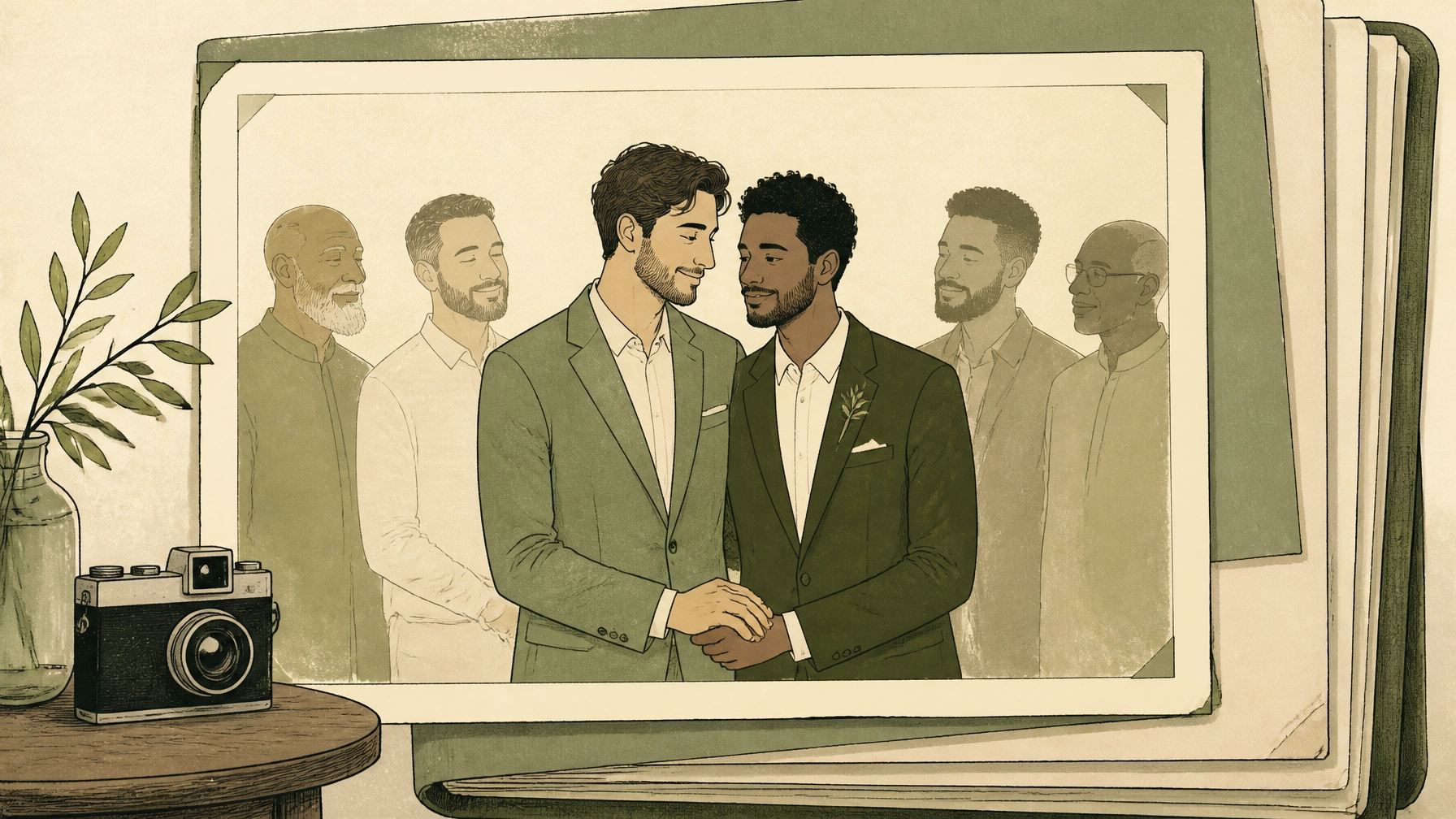
There are family photographs that record an occasion, and then there are photographs that quietly change the meaning of a life.
The first family photograph that includes a gay or bisexual man with his boyfriend can be one of those moments.
From the outside, it may look ordinary. A group of relatives gathered in a sitting room. Someone straightening a collar. Someone else complaining that the camera timer is too short. A parent calling everyone closer together while a phone or camera waits on its tripod.
But for the man standing beside the person he loves, the photograph may carry years of history.
It may hold every image where he stood just outside the frame. Every gathering where he was present but not named. Every relationship that existed only in private. Every family album that showed birthdays, weddings and holidays while quietly leaving out the most truthful parts of his life.
Then, one day, someone says, “You two should stand here.”
Not behind the group. Not in another room. Not with an explanation about who might see the photograph.
Here.
Together.
The years spent just outside the frame
Many queer people understand the strange experience of being physically present but emotionally absent from the family record.
Sometimes the editing is deliberate. A boyfriend is introduced as a friend, if he is introduced at all. A couple avoids touching when a camera appears. A family member takes a group photograph but asks one man to step away before it is shared. A relationship is treated as temporary, embarrassing or too complicated to explain.
Sometimes the editing is internal. After years of learning to be careful, a gay or bi man may automatically move towards the edge of a group. He may assume that family photographs are for other people: the people whose relationships are easy to acknowledge, easy to caption, easy to place within an expected story.
He may even become skilled at disappearing.
A hand slips away from his boyfriend’s. Two bodies become one body and a vague friendship. A shared home becomes “the flat.” A beloved partner becomes “someone from work.” The photograph remains, but the truth has been cropped from it.
That is why being included is more than being allowed to attend.
It is the difference between tolerance and recognition.
The awkward tenderness of arranging everyone
The first inclusive family photograph is rarely perfectly composed. In fact, its awkwardness may be part of what makes it beautiful.
A parent may look at the room and begin rearranging people with sudden determination. A male cousin is told to move left. Someone taller is placed at the back. A chair is dragged across the carpet. The boyfriend, uncertain whether he has misunderstood, asks where he should stand.
Then a father, brother, uncle or grandfather points to the space beside his son.
“Stand with him.”
The instruction may be casual. It may even sound practical. Yet the emotional force of it can be enormous.
The boyfriend moves closer. Their shoulders touch. One man keeps his hands carefully at his sides because he does not want to assume too much. The other reaches back, just slightly, and lets their fingers meet.
The camera counts down.
For one brief second, no one is performing an explanation. There is no need to decide whether the relationship is serious enough, traditional enough or permanent enough to deserve a place. The two men are simply part of the group.
The photograph does not ask them to prove anything.
It records that they were there.
Memory made visible
Family photographs are memory made visible. They give a physical shape to the sentence, “This happened to us.”
For queer men who have spent years being edited out, that visible record can feel almost startling. The image says that the relationship was not imaginary, and it was not merely a private rebellion against family expectations. It was part of the family’s lived reality.
A printed photograph on a mantelpiece can become a quiet declaration.
A framed picture in a parent’s hallway can say, without a speech, “This is my son. This is the man he loves. They belong in our home and in our history.”
The photograph may be seen by neighbours, friends, delivery drivers and visiting relatives. It may sit among pictures of graduations and holidays. It may fade slightly in the sunlight. Years later, someone may take it down to dust behind the frame.
Still, it remains.
That matters because queer identity has so often been treated as something that must be explained in the present but is not allowed to survive into the past. A family may eventually say that they accept a man’s boyfriend, yet acceptance can feel fragile if there is no evidence that the relationship has been woven into the family story.
Inclusion gives the memory somewhere to live.
Being seen without being turned into a symbol
There is a difference between being included and being displayed.
A gay man may not want his relationship turned into a family announcement or used as evidence that his relatives are progressive. He may not want every photograph shared online, every gathering documented for public approval or every act of affection treated as a milestone for someone else.
True inclusion is more intimate than performance.
It means being invited into the frame without being made responsible for what the photograph represents. It means his boyfriend is not a prop, a curiosity or a convenient sign of modernity. He is the person beside him. A loved man. A person with his own history, nerves and hopes.
The same care matters for bisexual men.
A bi man may worry that people will read the photograph as proof of one fixed identity. If he is pictured with his boyfriend, will relatives decide that this relationship explains everything about him? Will they treat the image as evidence that he is “really gay”? Will they forget that bisexuality is not cancelled by love for a man, nor made more valid by any particular relationship?
A photograph can record who is present without claiming to define the whole person.
That distinction is important. The image should say, “These two men love each other,” not, “This is the only identity this man can have.”
Chosen family and the people who keep the record
Not everyone receives this kind of inclusion from biological relatives. Some queer men build their first honest family record with friends, partners, mentors and community members who understand what it means to show up without conditions.
Chosen family photography can begin anywhere: in a crowded kitchen, outside a queer bookshop, at a Pride gathering, in a shared flat or around a table after a difficult week. Someone takes a photograph because they know the evening matters. Someone else prints it because digital images can disappear too easily into an endless camera roll.
These photographs may not look formal. Nobody may be standing in height order. Someone may be laughing with his eyes closed. The couple at the centre may be leaning into one another while their friends crowd around them.
Yet the emotional truth is unmistakable.
This is a family because these people witnessed one another. They remembered birthdays. They answered late-night calls. They brought food after heartbreak. They celebrated the first successful coming-out conversation and sat quietly through the ones that went badly. They knew the relationship before it had a name and stayed long enough to see it become a life.
When biological family will not document your existence, chosen family often will.
That is not a consolation prize. It is a form of authorship.
Why this milestone belongs in queer fiction
The first family photograph belongs in character-driven queer fiction because it contains so much emotional movement in such a small act.
A man steps forward. Another man stands beside him. A relative makes room. A camera captures the change.
For readers who seek an emotionally immersive gay love story, this is the kind of milestone that can reveal a character more powerfully than a grand declaration. We see the old fear in the way he hesitates. We see the new trust in the way his boyfriend reaches for his hand. We see family history shifting through the simple placement of two bodies in a frame.
This is where MM romance can find meaning in unexpected places. The romance is not only in a kiss or a confession. It is in the formal photograph that once seemed impossible. It is in the boyfriend who notices his partner is trembling and stays close. It is in the parent who prints two copies instead of one.
For emotionally invested MM readers, these details create the feeling that a relationship is changing the world around it: not through spectacle, but through permanence.
That is the heart of emotional MM romance literary storytelling: the recognition that love is built from moments other people might overlook. A chair pulled closer. A name written on the back of a photograph. A frame placed where everyone can see it.
A family photograph cannot repair every year of erasure. It cannot return the images that were never taken or undo the relationships that were denied.
But it can mark a beginning.
Two men stand together. The shutter closes. The family record keeps them.
No longer edited out.
Explore more LGBTQ+ ebooks, gay fiction and emotionally rich MM romance through Read with Pride, or visit the Dick Ferguson e-book store on Read with Pride to discover character-driven queer fiction and heartfelt gay love stories.
Follow us on social media
Follow Dick Ferguson and Read with Pride for more queer life stories, LGBTQ+ reading recommendations, gay novels and emotional MM romance:
Suggested next topics in the Queer Life and Identity series
- The First Holiday Card with Two Men in the Photograph: When a Relationship Becomes Part of the Family Greeting
- The First Time His Family Uses “Partner”: The Language of Love, Respect and Belonging
- The Spare Key: When a Parent Gives His Son’s Boyfriend a Place in the Family Home
#QueerLife #LGBTQBooks #GayBooks #MMRomance #GayRomance #QueerFiction #GayFiction #MMFiction #LGBTQFiction #GayLiterature #GayLoveStories #EmotionalMMRomance #CharacterDrivenFiction #ChosenFamily #ReadingWithPride #ReadWithPride

Leave a Reply
You must be logged in to post a comment.