

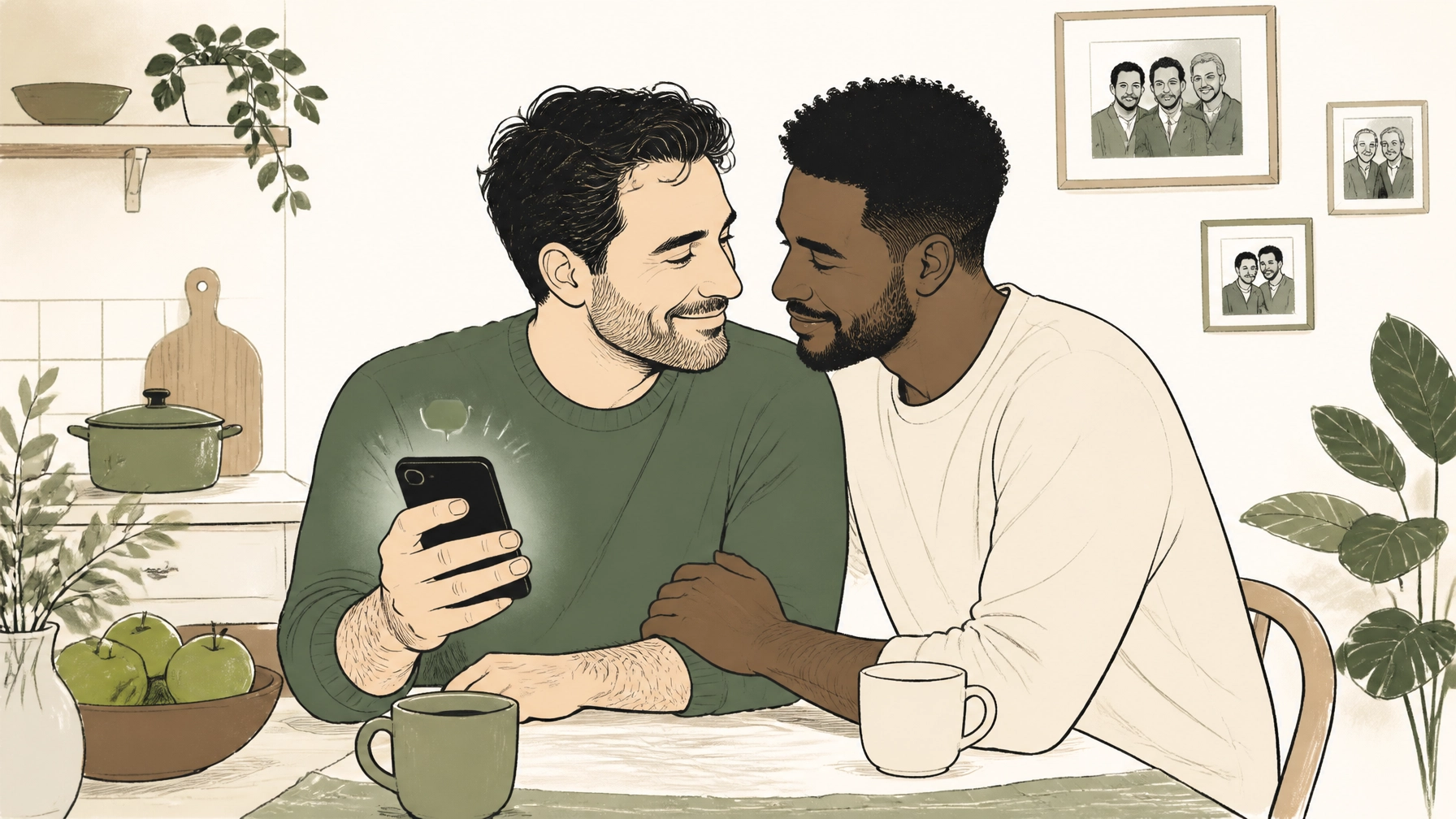
There are grand ways to be welcomed into a family. Someone might give a speech. A parent might say, “We love you exactly as you are.” A partner might be invited to a formal celebration and introduced with unmistakable pride.
And then there are the quiet ways.
The first time your name appears in the family group chat.
Not as an announcement. Not as a carefully planned gesture. Just there, among photographs of someone’s dinner, a reminder about a birthday, an argument about where to meet on Sunday, and a blurry picture of a dog that everyone has already seen three times.
For a queer man, especially one who has spent years wondering whether acceptance would ever feel natural, that ordinary notification can carry enormous emotional weight. It can say: You are part of this. You belong in the daily rhythm of our lives.
That is the heart of this entry in the Queer Life and Identity 2 PM series: the first family group chat, and the way everyday inclusion can feel like coming home.
Belonging often arrives disguised as something ordinary
The most moving moments in character-driven queer fiction are not always dramatic. Sometimes, they are almost painfully small.
A man sees his phone light up while he is making coffee. He expects a message from his partner or a work notification. Instead, it is a new family chat. His brother has added him without making a fuss.
The group already has a name. There are inside jokes he does not understand yet. Someone has sent a photograph from the kitchen. Someone else is asking whether he can make it to lunch.
He stares at the screen longer than he needs to.
Nothing extraordinary has happened. Nobody has delivered a perfect speech. Nobody has suddenly repaired every difficult memory between them. But the shape of the family has shifted slightly, and he is inside it.
That detail matters.
Queer identity is often treated in fiction as something revealed in a single, defining moment: the coming-out conversation, the first kiss, the confrontation with a hostile relative. Those moments can be powerful, but identity also develops through repetition. Through being named correctly. Through being asked to attend. Through having a partner remembered, not ignored. Through receiving the same silly messages as everybody else.
A family group chat can become a symbol of that repetition.
Everyday visibility is different from being tolerated
There is a world of difference between being allowed into a room and being expected there.
Tolerance can sound like, “You’re welcome to bring him if you want.”
Inclusion sounds like, “Are you and Ben coming on Sunday?”
Tolerance may avoid asking questions.
Inclusion remembers the details.
Tolerance keeps a queer man at the edge of the family story, as though his identity is a private subject that should never disturb the wider conversation. Inclusion allows him to be present in the ordinary narrative of family life. His relationship is not hidden in a separate compartment. His partner is not treated as a temporary guest. His happiness is not regarded as an awkward exception.
This is one reason family acceptance in queer fiction can be so emotionally resonant when it is written with care. Readers recognise that acceptance is not only found in declarations. It is found in habits.
The family chat becomes a place where a man is visible without having to explain himself. He can send a photograph from a walk with his boyfriend. He can complain about the weather. He can react to a cousin’s joke. He can be boring, affectionate, distracted, funny, or tired.
He can simply be a son, a brother, an uncle, or a loved member of the family.
That ordinariness can be profoundly affirming.
The emotional power of the first message
For an emotionally invested reader, the group chat scene works because it carries the character’s history beneath the surface.
Perhaps he has spent years editing himself around relatives. He has avoided mentioning the man he loves because he did not want to invite criticism. He has stopped sending photographs from his life because every image felt like a test.
Perhaps his biological family has been loving in some ways but hesitant in others. They may say they support him while still treating his relationship as something they are learning how to acknowledge. Their intentions may be good, but good intentions do not always remove loneliness.
Then comes the message.
It might be a simple question:
What time should we expect you both?
The word both can land with the force of a confession.
In a strong gay novel or character-driven MM romance, the scene would not need to over-explain the moment. The character might reread the message. He might lock his phone and set it down. He might tell his boyfriend, “They asked if we’re coming.”
His boyfriend might understand immediately.
These are the moments when emotional depth comes from what remains unsaid. The reader knows how much courage it took to become visible. They understand why an invitation that looks casual can feel like a door opening.
Chosen family and biological family do not have to compete
Queer people often build chosen families because they need places where they can be fully known. Friends, partners, mentors, neighbours, and community members can become the people who show up in a crisis, celebrate the milestones, and understand the parts of a life that biological relatives may not yet see.
Chosen family is not a consolation prize. It is real family.
For many queer men, it is the first place where they experience uncomplicated recognition. Their friends may know the name of the man they love before their relatives do. They may provide the language, humour, protection, and reassurance needed to survive difficult years.
But finding belonging with chosen family does not always erase the longing for biological family acceptance. A man can be deeply loved by his friends and still hope his father will ask about his partner. He can have a supportive community and still feel a quiet ache when family photographs leave him out.
That is why the first family group chat can be so meaningful. It does not replace chosen family. It adds another circle of belonging.
The most hopeful queer fiction makes room for both. It shows that family can be inherited, created, repaired, expanded, or redefined. Sometimes the people who raised us learn how to love us more honestly. Sometimes our chosen family teaches our biological family what inclusion looks like. Sometimes the two circles overlap until the distinction matters less than the care being offered.
What makes acceptance feel real?
If you are writing or reading an emotional MM romance about family acceptance, look for the details that turn approval into lived belonging.
Real acceptance may look like:
- A parent using the correct name for a queer man’s boyfriend without hesitation.
- A sibling asking how the relationship is going because they genuinely want to know.
- An invitation addressed to both men.
- A family member defending them when somebody makes a cruel remark.
- A photograph shared in the chat that includes them as part of the family’s ordinary life.
- Relatives asking for their opinion, help, or company.
- A loved one remembering an anniversary, a difficult day, or a small preference.
- The queer man no longer feeling that every message requires careful interpretation.
These gestures are not perfect. Families can still misunderstand one another. Acceptance can arrive unevenly. Someone may say the wrong thing and then make the effort to learn. A character may want to forgive but need time before trust feels safe.
That complexity is important. A supportive family does not need to become flawless overnight for the story to feel hopeful. In fact, the most affecting gay fiction often shows acceptance as a practice: something people demonstrate through consistency, accountability, and care.
Why this small moment stays with readers
The first family group chat is memorable because it transforms visibility from a performance into a place.
The queer man is no longer standing before his family, waiting to see whether they will approve of the truth he has brought them. He is already in the conversation. He is not being examined. He is being included.
That difference can change the emotional temperature of an entire life.
For readers of emotional MM books, heartfelt gay fiction, and character-driven queer fiction, these scenes offer something more lasting than a simple happy ending. They show the daily work of belonging. They remind us that love is not only passion, declarations, and dramatic sacrifice. Love can also be a notification at 7:14 in the morning asking whether two men are coming to dinner.
It can be a family learning to make space.
It can be a man looking at his phone and realising he is no longer waiting outside the door.
He is home.
Explore emotionally immersive queer fiction
If you look for MM romance, gay romance books, LGBTQ+ fiction, and gay love stories shaped by emotional depth, identity, family, and genuine character growth, explore Dick Ferguson’s work through the Dick Ferguson collection at Read with Pride.
Read with Pride is also a welcoming place to discover LGBTQ+ ebooks, gay novels, queer fiction, MM novels, gay literature, and new stories about love, resilience, and belonging.
Three possible next entries in the Queer Life and Identity 2 PM series
- The First Time He Says “My Boyfriend” Without Rehearsing It : the quiet freedom of speaking love aloud in an ordinary conversation.
- The Family Photograph He Finally Steps Into : how being visible in a picture can mark a turning point in queer identity and belonging.
- The Friend Who Became Family Before Anyone Else Understood : a character-driven exploration of chosen family, loyalty, and emotional safety.
#QueerLifeAndIdentity #MMRomance #GayRomance #QueerFiction #LGBTQFiction #GayNovels #MMNovels #GayLoveStories #EmotionalMM #CharacterDrivenFiction #FoundFamily #FamilyAcceptance #LGBTQReading #ReadWithPride #ReadingWithPride
Follow us on social media
Follow Dick Ferguson and Read with Pride for more emotionally immersive queer fiction, gay book recommendations, LGBTQ+ reading, and updates about new releases:


Leave a Reply
You must be logged in to post a comment.