

Rare Experience
By the time Daniel reached the observatory, the road had become less a road than a pale interruption in the desert.
Dust moved beneath the tyres in slow, ghostly clouds. The mountains had withdrawn into the distance, their edges softened by the falling dark, while the sky widened above him until it seemed to contain more silence than colour. His phone had lost its signal nearly two hours earlier. The last radio station had faded into static somewhere beyond the final fuel stop.
He had come to record that absence.
Daniel was a sound engineer and field recordist. He collected the sounds most people overlooked: the hollow knock of a loose sign in winter, the low vibration of a bridge at midnight, the hush inside an empty church after everyone had gone. For his latest project, he wanted to capture the silence between deep-space radio transmissions: the moments when the observatory was waiting, listening, holding itself open to something too distant for the human ear.
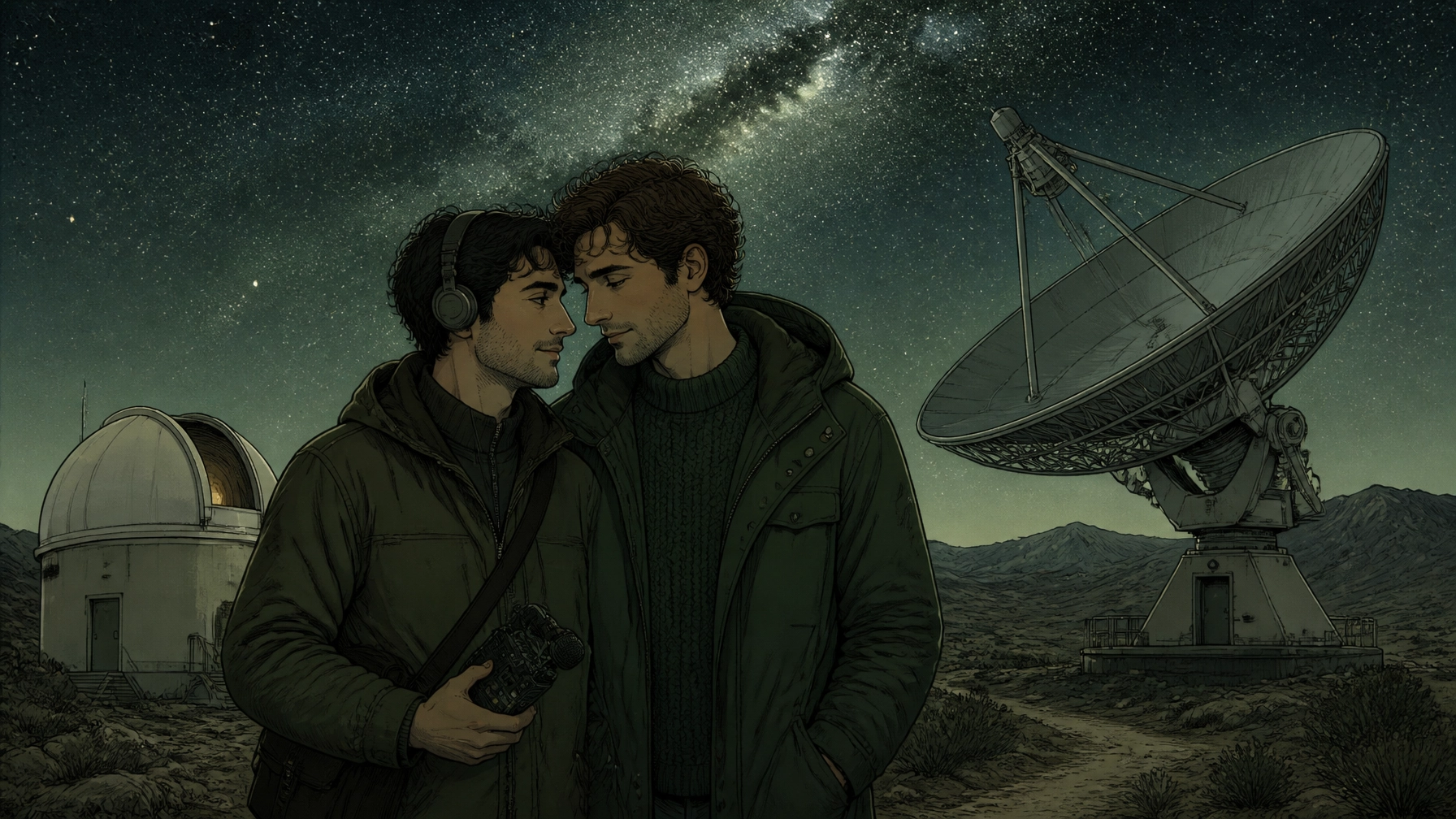
The station stood alone on a high desert plateau, a small cluster of buildings beneath a white observatory dome. A radio telescope dish pointed towards the stars, its metal frame dark against the last green-grey light of evening.
Elias was waiting outside.
He was taller than Daniel had expected, lean beneath a weathered jacket, with a face shaped by cold nights and long attention. He looked like someone who had learned not to waste movement. Even his greeting was quiet.
“You’re late,” he said.
Daniel glanced at the empty horizon. “I thought I was early.”
“Out here, the light makes its own time.”
It was the first thing Elias said that Daniel remembered.
Inside the station, every device seemed to have its own restrained pulse. Cooling fans breathed behind the walls. Screens cast muted colours across the control room. Somewhere beyond the building, the dish adjusted itself with a long mechanical groan, turning towards a signal that had travelled through darkness for longer than either man could imagine.
Elias explained the rules. No wireless devices. No unnecessary transmissions. Keep the doors closed. Do not touch the equipment unless invited.
Then he looked at Daniel’s recorder.
“What are you expecting to hear?”
“I don’t know yet.”
“That’s usually when people hear the most.”
The observatory was Elias’s responsibility. He maintained the systems, checked the dish, monitored the incoming data, and slept in a narrow room at the end of the building. He had been there for nearly three years.
Daniel did not ask why.
There were some questions that needed to be earned.
That first night, they stood outside while Daniel placed his microphones in the dust. The air was dry enough to sting the back of his throat. Each breath felt clean and sharp. The temperature fell quickly after sunset, pulling the warmth from the ground and leaving the world silvered with cold.
“Silence isn’t empty,” Elias said.
Daniel adjusted the recorder. “No?”
“It has layers.”
He pointed towards the dish. “There’s the wind against the structure. The motors cooling. The ground settling. Your coat moving when you breathe.”
Daniel looked at him. “You’ve listened to this place for a long time.”
“I’ve had practice.”
The answer carried something beneath it. Not secrecy, exactly. More like a door left closed because opening it would change the temperature of the room.
Over the next several days, their lives fell into the observatory’s rhythm. Elias worked through the night, reading streams of data and making precise adjustments. Daniel walked the perimeter with his recorder, searching for the spaces between sounds.
He recorded dust skittering over concrete.
He recorded the faint click of cooling metal.
He recorded the low, almost subsonic tremor of the dish turning beneath the stars.
At meals, they spoke about small things. The best way to make coffee at altitude. The difference between wind moving through wire and wind moving through stone. The strange comfort of a building that never became completely quiet.
But attraction lived in the spaces between those conversations.
Daniel noticed the way Elias stood close to the control console, one hand braced against the edge as though the machine might drift away. Elias noticed when Daniel stopped wearing gloves and quietly left an extra pair beside the recorder.
Neither man named what was happening.
Naming a thing gave it weight. Weight gave it the possibility of falling.
On the fourth night, the observatory received a transmission strong enough to alter the room. The signal arrived as a pattern in the data, faint but undeniable, and every piece of equipment seemed to become more attentive.
Daniel sat at the side of the control room with his headphones on. He listened to the recording he had made outside earlier that evening. At first there was only static: a soft, granular wash, like sand moving beneath water.
Then he heard Elias’s footsteps.
One measured step. Then another.
Daniel removed the headphones.
Elias was watching him from the console.
“Something wrong?”
“No.” Daniel hesitated. “I heard you.”
“I wasn’t trying to be quiet.”
“I know.”
The silence that followed was not the kind Daniel had travelled there to capture. It belonged to them. It was closer, warmer, more dangerous.
Elias turned back to the screens. “People think listening means waiting for your turn to speak.”
“What do you think it means?”
“Staying when the sound changes.”
The words moved through Daniel with a force he did not show.
Later, outside, they sat on the steps beneath a sky crowded with stars. The desert was black around them. The observatory dome gleamed faintly in the moonlight, and the radio telescope rested above the horizon like a question no one had finished asking.
Daniel held the recorder between his hands.
“I haven’t said this aloud to anyone here,” he said.
Elias did not turn towards him. That helped. Daniel could look at the stars instead of the face of the man who had begun to matter.
“I’m bisexual.”
The sentence was smaller than the fear surrounding it.
For a moment, there was only the wind. It moved over the plateau and pressed against the building. Somewhere inside, a fan changed pitch.
Elias looked at him then.
“All right,” he said.
Daniel let out a breath that almost became a laugh. “That’s it?”
“That’s not it.” Elias’s voice remained gentle. “It’s just the first thing.”
Daniel looked down at the recorder. “I thought you might ask me to explain.”
“If you want to explain, I’ll listen.”
“And if I don’t?”
“Then I’ll still be here.”
There was no spectacle in his acceptance. No performance of perfect understanding. Elias did not reach for a grand declaration or pretend that one sentence could dissolve every fear Daniel had carried into the desert.
He simply stayed.
Daniel’s eyes began to burn from the cold, though he knew it was not only the cold. “I’ve spent years trying to make it sound less complicated.”
“It is complicated.”
“Yes.”
“You don’t have to make it simple for me.”
The honesty of that nearly undid him.
Elias looked back towards the dish. “Some things are difficult because they’re true.”
Daniel wanted to ask what had brought Elias to the observatory. He wanted to ask what loss had made this isolated station feel safer than the world beyond it. He had seen the evidence in small details: a second mug never used, a folded blanket stored carefully away, the way Elias sometimes looked towards the empty road as if expecting an answer from it.
But Daniel did not ask.
Not yet.
Instead, he reached across the step until his hand rested near Elias’s. Their fingers touched once, briefly. Neither man moved away.
In the morning, Daniel listened to the night’s recordings. The track was filled with imperfections. Wind. Static. The faint scrape of his sleeve. Elias’s breathing, close to the microphone.
It was not silence.
It was proof that someone had been there.
Before Daniel left, Elias walked with him to the vehicle. The desert was pale beneath the early sun. Frost clung to the shadowed side of the observatory, while dust lifted in thin streams across the road.
“You’ll come back?” Elias asked.
Daniel looked at the dome, the dish, the long empty distance.
“I don’t know.”
Elias nodded. He understood that an honest answer could still contain hope.
Daniel placed the recorder on the passenger seat, then turned back. For a moment, neither man spoke. The fear of being known had not vanished. Grief had not loosened its grip on Elias. The miles between them had not become less real.
But Elias lifted his hand.
Daniel took it.
They stood that way beneath the widening sky: not promising permanence, not pretending that listening was the same as saving, but allowing the connection to remain unfinished.
Some truths travelled through silence because silence gave them room.
Some began as a voice saying, This is who I am.
And some became possible when another man answered, quietly and without fear:
I heard you.
Why Rare Experiences Make Powerful MM Romance Settings
A remote radio observatory offers more than an unusual backdrop for an MM romance. It creates a world where every sound matters, every interruption carries meaning, and emotional honesty cannot easily hide behind noise.
That is the strength of MM romance unexpected places. When two men meet somewhere far from familiar routines: a desert station, an isolated research base, a remote lighthouse, or a mountain archive: the setting removes the distractions that usually protect them. They cannot disappear into crowded streets or perform the easier versions of themselves for people who already know their history.
The result can be a deeply affecting gay love story emotional journey, particularly when the romance develops through attention rather than instant certainty. Daniel and Elias do not fall in love because the desert makes life simple. They begin to recognise each other because the desert makes avoidance more difficult.
This is where character-driven queer fiction can be especially powerful. The central conflict is not only whether two men will become a couple. It is whether they can be witnessed honestly: in grief, in uncertainty, in bisexual identity, and in the fear that being fully known might lead to rejection.
For emotionally invested MM readers, rare settings provide a natural pressure chamber for interior change. The environment reflects the characters without overpowering them. Dry air, cold nights, radio static, dust and distant stars become emotional textures. The observatory’s search for signals echoes the men’s own struggle to communicate what they have buried.
That balance is at the heart of emotional MM romance literary fiction. The romance remains intimate, but the themes reach further: coming out, bisexuality, grief, solitude, and the difference between being noticed and being understood.
Readers looking for Read with Pride, LGBTQ+ ebooks, gay romance books, MM novels, queer fiction, gay fiction and LGBTQ+ fiction often want more than a relationship at the end of a plot. They want gay literature with emotional consequence. They want gay love stories that respect hesitation, heartfelt gay fiction that allows characters to be contradictory, and emotional MM books that trust quiet moments to carry real weight.
For readers exploring LGBTQ+ reading or seeking thoughtful gay book recommendations, stories like this can offer a different kind of intimacy. They show queer men not as symbols or lessons, but as complicated people learning how to speak, listen and remain present.
That is why rare experiences matter. A remote setting does not make love more extraordinary by itself. It gives two men enough space to tell the truth: and enough silence to discover what happens after the truth has been heard.
Read with Pride
Discover more LGBTQ+ ebooks, gay romance books, MM romance books, queer fiction and emotionally rich gay novels through Read with Pride.
You can explore Dick Ferguson’s collection of character-driven MM romance and heartfelt gay fiction in the Dick Ferguson e-book store.
Three Possible Next Morning Edition Stories
- The Tidal Power Station : Where Two Men Learned That Love Can Survive the Hours Between High Water
- The Mountain Weather Archive : Where Two Men Learned That Storms Do Not Always Arrive from the Sky
- The Museum of Unclaimed Objects : Where Two Men Learned That Nothing Lost Is Ever Entirely Gone
Follow Us on Social Media
Follow Dick Ferguson for lyrical MM romance, new gay releases, emotional reading recommendations and stories about men finding the courage to be known.
#MorningEdition #MMRomance #GayRomance #QueerFiction #GayFiction #LGBTQPlusFiction #GayLoveStories #EmotionalMMRomance #CharacterDrivenFiction #ReadWithPride #ReadingWithPride #BisexualRepresentation #BisexualVisibility #ComingOutStories #ComingOutRepresentation #LGBTQReading #HeartfeltGayFiction #MMNovels


Leave a Reply
You must be logged in to post a comment.