

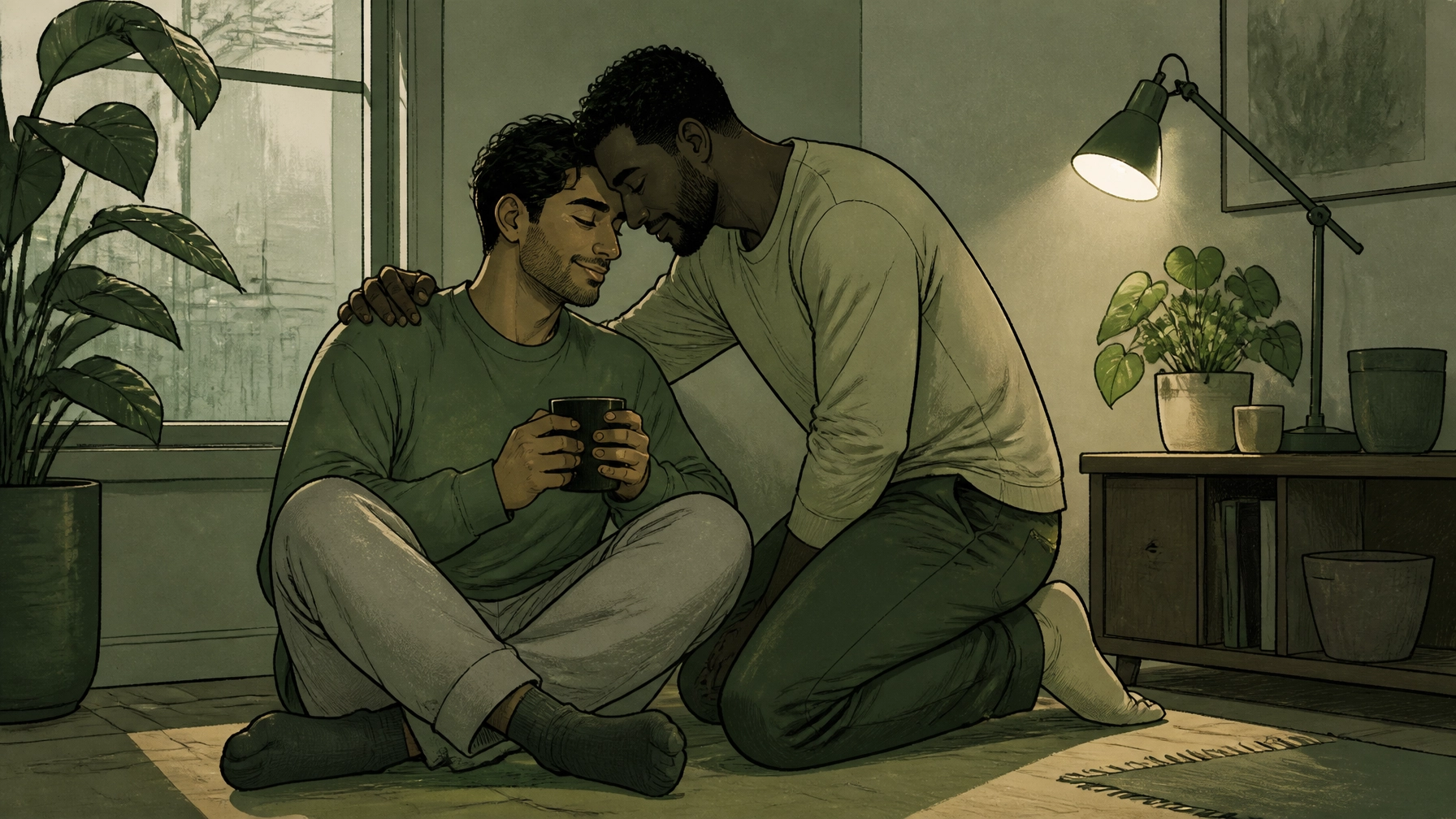
There are some people who meet us after we have learned how to explain ourselves.
And then there are the rare ones who meet us before we have the language.
Before the careful answers. Before the rehearsed version of the story. Before we understand whether we are gay, bisexual, questioning, afraid, or simply exhausted from pretending that nothing feels different.
In the previous instalment of our Queer Life and Identity series, The First Family Group Chat, we explored the strange, funny, tender moment when a relationship becomes visible inside a wider family circle. This time, we are stepping back to an earlier kind of belonging: the friend who became family before anyone else understood.
The person who knew first.
The person who noticed the silence after a phone call. The person who understood that “I’m fine” sometimes meant “Please don’t make me explain this yet.” The person who stayed when the rest of the world seemed to be waiting for a simpler version of the truth.
The friend who sees you before you can see yourself
Let’s imagine two men sitting in a parked car late at night.
One of them has just come from home. Maybe there was an argument. Maybe someone asked too many questions. Maybe nobody asked the right question at all.
He is staring through the windscreen, watching rain gather on the glass. His friend is in the driver’s seat, hands resting loosely on the wheel. The radio is off. Neither man is pretending this is an ordinary journey.
Eventually, the passenger says, “I don’t think I’m who they think I am.”
His friend does not turn the moment into a performance. He does not rush to name it. He does not say, “I knew it,” or demand a confession.
He simply answers, “You don’t have to be who they think you are with me.”
That sentence may not solve anything. It cannot instantly make a family accepting, a workplace safe, or the future less frightening. But it creates a small, steady place where the truth is allowed to exist.
Sometimes that is how chosen family begins: not with a dramatic declaration, but with a person making room.
The friend who knows first may be the one who sits outside the bathroom door. He may keep a spare key. He may learn which subjects are dangerous and which jokes are welcome. He may be the first person to hear a new name, a new label, or a hesitant admission that has been carried alone for years.
He may also be the first person to say, “You deserve to be loved without having to negotiate your existence.”
That kind of loyalty is not always loud. Often, it looks like bringing food when someone is too overwhelmed to cook. Sending a message after a difficult family visit. Sitting through the same anxious conversation for the fifth time. Offering a sofa, a lift, a place at the table, or simply the reassurance that tomorrow still exists.
Biological family and chosen family are not always opposites
It can be tempting to frame biological family and chosen family as opposing forces: one painful, one perfect; one inherited, one freely selected.
Real life is rarely so neat.
For some queer men, biological family becomes a source of genuine love and support. For others, acceptance arrives slowly, unevenly, or with conditions attached. Some families learn. Some apologise. Some remain distant. Some relationships become possible only after years of boundaries and difficult conversations.
Chosen family does not erase those complicated bonds. It gives a person somewhere to stand while navigating them.
A chosen family is built through repeated acts of care. It is the friend who remembers the anniversary of a painful event. The couple who keep a spare room available. The man who accompanies his friend to an appointment because he knows being alone in the waiting room feels impossible. The group that creates its own traditions when old ones no longer feel safe.
These relationships can carry a depth usually associated with relatives. They may involve emotional support, practical help, shared meals, financial assistance, advice, and the kind of everyday reliability that quietly changes a life.
Most importantly, chosen family can provide recognition.
Not approval in the sense of granting permission. Recognition in the sense of saying: I see the whole of you, and I am not frightened away by what I find.
Why this dynamic matters in character-driven queer fiction
In character-driven queer fiction, the friend who becomes family should never be treated as background decoration.
He is part of the emotional architecture of the story.
A romantic relationship between two men may be the central love story, but the friendships surrounding that relationship often reveal what each man believes about safety, loyalty, and his own worth. A character may know how to desire another man long before he knows how to trust him. He may know how to protect himself from rejection but not how to accept care.
The friend who knew first can expose that contradiction.
Perhaps he understands the protagonist’s fear of being abandoned because he has witnessed every earlier retreat. Perhaps he becomes frustrated when the protagonist disappears into a new relationship and stops answering messages. Perhaps he supports the romance but refuses to let “love” become an excuse for isolation.
That tension makes the relationship feel real.
Chosen family should not be written as flawless. The friend who has always been dependable can become tired. The person who helped someone survive can resent being treated as permanently responsible for their wellbeing. Two men can love each other deeply as friends and still misunderstand one another.
In fact, that is where the richest emotional material often appears.
A strong story asks difficult questions:
- What happens when the friend who knew first feels pushed aside by a new boyfriend?
- Can loyalty survive an argument about boundaries?
- What if one man wants to reconnect with his biological family and the other sees that choice as dangerous?
- How does a friendship change when the person who once needed rescue begins to build a life of his own?
- Can chosen family make room for romantic love without treating it as the only love that matters?
These are not simple questions, and they should not have simple answers.
They create space for a more expansive understanding of queer life: one in which an emotional bond between two men can be central, enduring, and life-changing without needing to become romantic to be considered profound.
Emotional safety is shown through action
The phrase “emotional safety” can sound abstract until fiction gives it a body.
It is the friend who does not make a joke when someone finally tells the truth.
It is the man who asks, “Do you want advice, or do you want me to listen?”
It is the person who remembers that coming out is not one event but a series of choices made in different rooms, with different levels of risk.
It is the friend who does not demand gratitude for helping.
It is also the freedom to be ordinary.
A chosen family is not only present during crisis. It is there for takeaway dinners, badly assembled furniture, shared playlists, ridiculous arguments about films, and messages that say, “Have you eaten?” The friendship becomes home because it is not built solely around pain. It contains humour, boredom, irritation, affection, and the comfort of being known in unremarkable moments.
For emotionally invested MM readers, these details matter. They are often what make a gay love story feel like an emotional journey rather than a sequence of romantic milestones. They remind us that queer men do not exist only in relation to rejection or romance. They build networks, routines, loyalties, and futures.
That is why the most affecting MM romance can arrive from unexpected places. The relationship may begin with a friend’s kitchen, a late-night phone call, a spare key, or a man saying, “You can stay here as long as you need.”
The romance between two men may eventually become the great love story. But the chosen family around them often teaches them how to recognise love when it appears.
The person who knew first becomes part of the story’s heart
Some people enter our lives before we are ready to become ourselves.
They meet us in the unfinished years. They see the fear beneath the anger, the loneliness beneath the independence, the longing beneath the jokes.
They may not have all the answers. They may not always get it right. But they remain close enough to learn.
That is the quiet power of chosen family in queer fiction and in life. It is not about replacing every biological relationship. It is about building a circle where care is mutual, identity is respected, and nobody has to earn the right to belong.
The friend who knew first is often the person who helps a queer man understand that family is not only something handed down.
Sometimes family is the person who waits in the car.
Sometimes it is the man who keeps the light on.
Sometimes it is the friend who looks at you before anyone else does and says, “You are safe with me.”
Explore more LGBTQ+ ebooks, gay fiction, queer fiction, and emotional MM romance through Read with Pride. You can also discover Dick Ferguson’s character-driven gay novels and heartfelt MM stories in the Dick Ferguson e-book store.
Follow us on social media
#QueerFiction #CharacterDrivenQueerFiction #EmotionalMMRomance #GayRomance #MMRomance #MMBooks #QueerLife #ChosenFamily #LGBTQPlusFiction #GayLoveStories #GayLiterature #EmotionallyInvestedReaders #QueerAuthors #MMAuthors #ReadingWithPride #ReadWithPride
Fresh next-topic suggestions for the Queer Life and Identity series
- The First Time He Says “My Partner” at Work : Visibility, Risk, and Choosing the Words That Feel Like Home
- Two Men, One Spare Key : The Quiet Emotional Shift from Visiting to Belonging
- When Love Needs Boundaries : Protecting an MM Relationship Without Losing Yourself


Leave a Reply
You must be logged in to post a comment.