

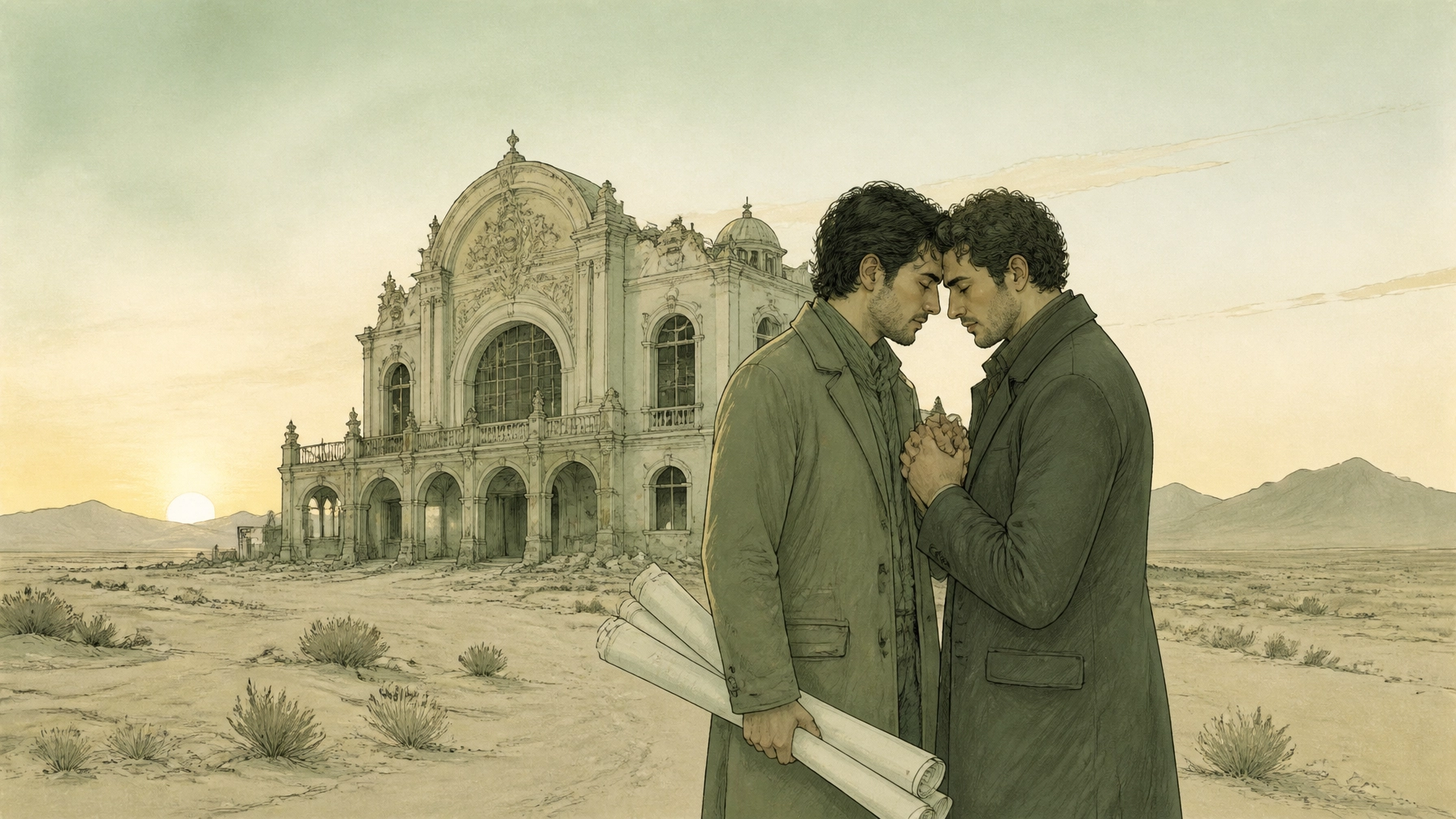
By the time Jonah Vale reached the opera house, the desert had already begun erasing the road behind him.
Wind moved over the flats in long, pale sheets. It lifted dust against the tyres of his truck and worried at the corners of the survey maps on the passenger seat. The town appeared without warning: a row of sun-bleached buildings, a water tower leaning into the sky, a shuttered diner with its sign hanging by one chain.
At the centre of it all stood the opera house.
It was not grand. Not anymore.
Its stucco walls were cracked from foundation to roofline. The painted doors had faded to the colour of old leaves. One upper window was broken, and through it Jonah could see a strip of desert-blue sky.
He had been sent to assess the building, not to save it.
His firm wanted measurements, photographs, structural recommendations, and a professional opinion on whether the theatre could be restored without becoming a financial ruin. Jonah had completed this kind of work in cities where buildings were protected by committees, grants, and people who still remembered why they mattered.
Here, the town had emptied decades ago.
The opera house remained because someone had refused to leave.
That someone was waiting for him in the shade of the entrance.
Elias Rook was a tall, narrow man with silver threaded through his dark hair. He wore a linen shirt buttoned at the throat despite the heat. His face had the composed stillness of someone accustomed to being watched.
“You’re late,” Elias said.
Jonah looked at the empty road. “I’m early.”
“You’re late for the morning.”
It was the sort of answer that might have irritated him in another man. Instead, Jonah noticed the voice. Low, weathered, and resonant. A voice that seemed to carry an entire room inside it.
Elias unlocked the doors.
The opera house smelled of dust, plaster, dry wood, and something faintly sweet beneath it all: perhaps the ghost of old perfume, perhaps only the desert imagining what it had lost.
Inside, the seats waited in uneven rows. Their velvet was faded green. The stage curtains had been drawn back and tied with fraying rope. Along the walls, painted figures watched from their imagined boxes: gentlemen in evening dress, musicians with lifted bows, women in jewels and gloves.
The painted audience never left.
“They were here when I arrived,” Elias said.
“Who?”
“The people in the walls.”
Jonah looked again. “You painted them?”
“No. I only kept them company.”
That was the first thing Jonah learned about Elias: he answered simple questions with the truth hidden somewhere beneath them.
The second thing he learned was that Elias had once sung on stages where the audience had been real.
He had performed in London, Milan, Prague, and places Jonah had only seen printed in airline magazines. His name had appeared in reviews. His voice had been called beautiful, disciplined, dangerous.
“And then?” Jonah asked.
“And then I came here.”
The phrase sounded less like an explanation than a verdict.
Over the next three days, Jonah climbed ladders, tested beams, crawled beneath the stage, and photographed every wound in the building. The opera house had survived heat, neglect, flash floods, and the steady pressure of time. The roof needed urgent work. Several joists had warped. The electrical system was unsafe. The foundations had shifted on one side, causing a long fracture to travel through the plaster like a dark musical staff.
Elias followed him everywhere.
He knew which floorboards complained, which doors stuck, and which ceiling panels trembled when the wind changed. He had lived in the caretaker’s rooms behind the stage for thirty-one years. He cooked on a two-ring stove, collected rainwater, and slept beneath a window that looked towards the dead town.
“You never wanted to leave?” Jonah asked one evening.
Elias stood on the stage, looking out at the rows of empty seats.
“I wanted to leave many times.”
“But you didn’t.”
“No.”
The answer held no pride. Only exhaustion.
That night, the wind rose. It pressed against the building with a low, persistent moan. Jonah found Elias in the auditorium after midnight, sitting alone in the front row.
“You should sleep,” Jonah said.
“So should you.”
“I have a report to write.”
“You have been writing the same sentence for an hour.”
Jonah glanced down at his notebook. He had, in fact, written the same sentence:
*The structure remains viable if: *
If what?
If someone cared enough. If someone had the courage to make the necessary repairs. If a building could be saved by the people who needed it to survive.
Elias turned towards him. In the dim light, his face looked younger and more vulnerable.
“Sing something,” Jonah said.
Elias smiled without warmth. “I don’t perform on request.”
“I wasn’t asking for a performance.”
That changed something.
Elias rose and walked to the stage. He did not switch on the lights. He stood in the grey darkness, one hand resting against the curtain, and began to sing.
The sound was quiet at first. Not polished. Not aimed towards an audience. It moved through the empty room as though it belonged there, touching the painted faces, the broken seats, the exposed beams.
Jonah felt it in his ribs.
Elias stopped before the song had finished.
“Why did you stop?”
“Because you were listening.”
“I thought that was the point.”
“Not for me.”
The silence after his voice was almost physical.
Elias told him the rest in pieces.
He had spent most of his life learning how to become whatever a room required. A son with a respectable future. A singer with a carefully guarded private life. A man who could discuss his work, his discipline, his ambition: but not the tenderness that had frightened him more than failure ever had.
He was bisexual. Saying it now, in the empty opera house, did not sound like a declaration made for applause. It sounded like a door opening in a house where he had lived alone too long.
“I thought coming out would make me honest,” Elias said. “It did, eventually. But first it made me realise how much of my life had been arranged around being understood incorrectly.”
Jonah sat beside him on the edge of the stage.
“Who misunderstood you?”
“Everyone who needed me to be simpler.”
Jonah understood that more than he wanted to.
His own life had been built from acceptable surfaces: the practical career, the rented flat, the careful friendships, the relationships he never described in enough detail to invite questions. He had spent years believing privacy was the same as authenticity.
He had told himself he was waiting for the right person.
Now Elias was beside him, close enough that Jonah could feel the warmth of his shoulder through the fabric of his shirt.
“What are you afraid of?” Elias asked.
Jonah watched the dust drift through the beam of his torch.
“That I’ll be brave only when it no longer costs me anything.”
Elias looked at him then.
The first kiss was not dramatic. There was no music, no sudden light, no audience rising to its feet. Elias touched Jonah’s cheek as if asking permission to believe in the shape of him. Jonah leaned forward.
Their mouths met gently.
Outside, the desert kept its silence.
In the morning, Jonah returned to his measurements. But the building had changed. Or perhaps he had. The cracked plaster was no longer evidence of failure. It was a record of survival. The warped boards were not merely damaged; they had carried footsteps through years when there should have been none.
He revised the report.
He wrote that the opera house was structurally compromised but restorable. He wrote that its cultural value could not be measured in ticket sales or occupancy figures. He wrote that certain places remained necessary precisely because they held what ordinary life had no room to keep.
Elias read the report at the caretaker’s table.
“You’re recommending preservation,” he said.
“I’m recommending a future.”
“For the building?”
“For whoever is willing to stay and make one.”
Elias lowered the pages. “And what will you do?”
Jonah looked through the open door at the white desert, the abandoned town, and the opera house that had waited so long to be heard without pretending.
“Come back,” he said.
This time, Elias did not ask whether he meant it.
They stood together beneath the faded painted audience. Two men with no need to perform their certainty. Two men who had learned that love did not always arrive with applause, and that some of the truest songs were sung only after the audience had gone.
Why Rare Experiences Make Powerful MM Romance Settings
A ghost town opera house is more than an unusual backdrop. It is a pressure chamber for identity.
In familiar romance settings, characters can sometimes hide behind routine. They can leave the room, change the subject, or allow the noise of other people to cover what they feel. An isolated opera house offers none of those easy escapes. Every silence becomes audible. Every locked door carries history. Every empty seat asks who the characters are when nobody is watching.
That is why MM romance unexpected places can create such compelling emotional stakes. The setting does not distract from the relationship; it intensifies it. A desert theatre becomes a natural symbol for the gay love story emotional journey: a place once built for public performance, now revealing what remains when the performance ends.
For emotionally invested MM readers, the appeal lies in more than atmosphere. The strongest stories use their settings to expose character. Here, the opera house reflects Elias’s struggle between being admired and being known. Its restoration mirrors Jonah’s own movement towards honesty. Each repaired beam becomes a small act of emotional courage.
This is the heart of character-driven queer fiction: the external world and the internal world are never entirely separate. A crumbling building can hold grief. A painted audience can represent the expectations that shape a life. A quiet kiss can carry the weight of a long-delayed coming out.
Readers looking for emotional MM romance literary fiction often want precisely this kind of connection between place, language, and feeling. Whether you are exploring gay romance books, MM romance books, queer fiction, or gay fiction, an unexpected setting can help a love story feel singular rather than familiar.
It also gives LGBTQ+ ebooks, gay love stories, and heartfelt gay fiction space to explore experiences that are rarely simple. Bisexuality, for example, should not be treated as confusion or a temporary stage on the way to a more convenient identity. A bisexual man may know exactly who he is and still struggle with the courage to name himself in a world that wants neat categories.
That nuance matters in emotional MM books and MM novels because readers recognise the difference between a label used as a plot twist and an identity treated with empathy. Authentic representation allows characters to be complicated without making their queerness the source of tragedy. It allows grief and desire, fear and resilience, to exist together.
For readers seeking thoughtful gay book recommendations, LGBTQ+ literature, or new ways into gay literature, rare settings can offer a powerful invitation: come for the ruined theatre, stay for the emotional truth. The best gay novels and gay romantic fiction do not simply place two men in an unusual location. They ask what the location makes possible.
Sometimes, it makes honesty possible.
Read with Pride
Discover more thoughtful LGBTQ+ reading through Read with Pride, a home for readers looking for gay eBooks, LGBTQ+ fiction, MM fiction, gay romance books, queer authors, and emotionally resonant stories.
You can explore Dick Ferguson’s work in the Dick Ferguson e-book store, where intimate male/male relationships, lyrical prose, and difficult emotional journeys meet.
Three Possible Next Morning Edition Stories
1. The Lighthouse at the Edge of the Map
A marine archivist arrives at a decommissioned lighthouse to catalogue the keeper’s journals. The lighthouse keeper’s grandson refuses to let the final pages leave the island, especially because they contain a love story between two men separated by decades of silence.
2. The Last Cinema in the Rainforest
An architectural historian is sent to document a collapsing single-screen cinema in a remote rainforest town. The projectionist has spent years showing films to empty seats: and recognises, in the historian, the man he once loved before fear turned them both into strangers.
3. The Alpine Hotel with One Open Room
A grief-stricken hotel owner keeps one room warm in a mountain resort abandoned after a landslide. When a botanist arrives to study the rare flowers growing through the ruins, both men must decide whether a life built around loss can still make room for love.
Follow Us on Social Media
Follow along for new stories, reading recommendations, literary reflections, and updates from Dick Ferguson and Read with Pride:


#MorningEdition #MMRomance #GayRomance #QueerFiction #EmotionalMMRomance #ReadWithPride #GayFiction #MMBooks #LGBTQBooks #GayLoveStories #CharacterDrivenFiction #BisexualRep #GayLiterature #HeartfeltGayFiction #LGBTQReading

Leave a Reply
You must be logged in to post a comment.