

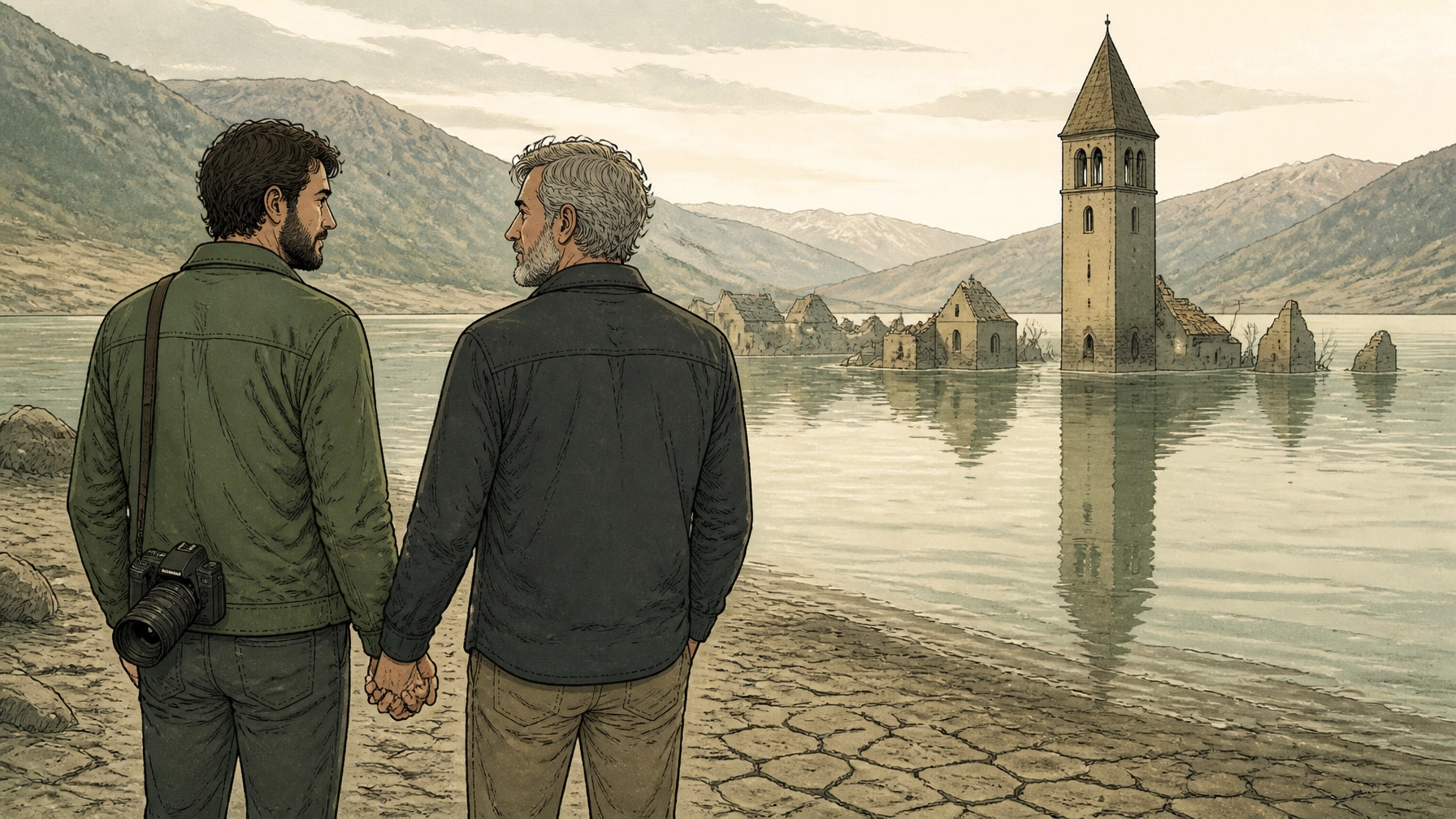
Nathan Cole had built a career around the moment after goodbye.
He photographed melting glaciers in the blue half-light before they broke apart. He photographed cinemas closing their doors for the last time, their red carpets rolled up and their brass letters removed from the façades. He photographed houses marked for demolition, standing empty beneath skies that seemed too large for them.
Places about to disappear.
Endings were easier when he viewed them through a camera. A lens gave him distance. It allowed him to stand near ruin without admitting that he was grieving. It gave him something to do with his hands.
His last relationship had ended for precisely that reason.
“You’re always almost here,” his partner had told him.
Nathan had wanted to argue. He had wanted to say that he was trying, that almost was not the same as absent, that a person could love someone deeply and still be afraid of the weight of staying.
But the truth had been there between them, plain and unphotographed.
He was always almost there.
So when the assignment came from the mountain reservoir, Nathan accepted before asking how long he would be expected to remain.
The drought had lowered the water to levels not seen in sixty years. Beneath the receding surface, an entire medieval village had emerged: stone walls furred with pale moss, cobbled streets coated in silt, the broken outline of a school, and a church tower rising from the shallows like a finger lifted toward a sky that had forgotten how to rain.
The village had been deliberately flooded decades earlier when the dam was built. The families had been moved. The houses emptied. The church stripped of anything considered valuable.
Then the water closed over everything.
Until now.
Nathan arrived in the late morning beneath a white, pitiless sun. The reservoir had retreated so far that the exposed ground stretched in cracked shelves towards the opposite hills. Mud had hardened around stones. Dry reeds whispered along the waterline. The air smelled of dust, iron, and something older, a mineral dampness released from the earth after years of silence.
He saw Silas Marrow standing beside the remains of a low stone wall.
Silas was in his late forties, broad-shouldered without seeming imposing, with silver beginning at his temples and a face weathered by wind, work, and long acquaintance with disappointment. He held a small tin box beneath one arm.
Nathan lifted his camera.
Silas looked directly at him.
Not at the camera. At him.
Nathan lowered it again.
“You’re the photographer,” Silas said.
“That obvious?”
“You’re looking at everything as if it might leave.”
Nathan glanced towards the church tower. “It might.”
“So might you.”
There was no accusation in the words. That made them more difficult to answer.
Silas opened the tin box. Inside lay a collection of old keys, each dulled by age. Some were long and narrow. Others were small enough to belong to cupboards or desk drawers.
“My family lived here,” he said. “We were among the last to leave.”
“What are the keys for?”
“Houses whose owners never came back.”
He said it simply, but Nathan felt the sentence settle between them.
Silas had come to walk the drowned streets one final time before the water covered them again. The reservoir authorities expected the levels to rise with the next season. Perhaps the church would vanish for another sixty years. Perhaps the stone would not survive another cycle of flooding and exposure. Perhaps this was the last time anyone would see the village whole.
A once-in-a-lifetime sight, people called it.
The phrase sounded too small for what stood before them.
Silas led him down the old main street. Their boots disturbed the silt, leaving dark impressions that filled slowly with water. At the edge of one foundation, a rusted hinge protruded from the mud.
“My mother used to keep herbs there,” Silas said. “Sage, rosemary, mint. She said the whole house smelled alive in summer.”
Nathan photographed the hinge, then stopped.
“Do you want me to?”
Silas studied him. “Do I want you to photograph it?”
“Do you want me to remember it?”
For the first time, something changed in Silas’s expression. Not quite a smile. Something more exposed.
“I’ve been carrying the remembering alone,” he said. “I’m not sure what it would feel like to share it.”
They continued towards the church.
Its tower was still upright, though the walls had tilted and the lower stones were stained with a dark tide mark. Water dripped somewhere above them, falling at slow intervals through the bell chamber. The bells had been removed before the flooding. Only what no one wanted had been left behind.
Inside, the church was cooler. Nathan felt the temperature against his face and smelled wet stone, old dust, and silt.
The altar leaned to one side. Saints stood along the walls with their features crusted in pale sediment. A fresco had faded almost beyond recognition. Once, it might have shown a procession of angels or martyrs. Now there were only fragments: a blue curve, a hand, the suggestion of a face looking away.
Light entered through a broken window high in the nave.
The glass had been underwater for sixty years.
It scattered the daylight into a greenish radiance that moved across Silas’s face.
“I was seventeen,” he said.
Nathan did not ask what happened at seventeen. He waited.
“I stood here beneath that window. The same one, I think. The frame was already broken then.” Silas looked up. “There was a boy from the next valley. I knew I wanted him to touch me. Not because I was confused. I wasn’t. I knew exactly what I felt.”
His voice remained calm, but his hand tightened around the tin box.
“I knew I was bisexual before I had the courage to say the word. I knew attraction didn’t become less real because it could move in more than one direction. I knew my feelings for men were not a phase, a rebellion, or a failure to choose.”
Nathan listened.
“My mother accepted me,” Silas continued. “She held my face and told me she loved me. Then she never spoke of it again. That was its own kind of silence.”
The church seemed to deepen around them.
Nathan thought of all the ways people could be loved and still left alone inside the truth of themselves.
“Did you ever tell anyone else?” he asked.
“Some people. Eventually. I had relationships.” Silas looked at him now. “But I became very good at being agreeable. At leaving before I could be left. At saying it was fine when it wasn’t. I learned early that even the ground beneath a village can be taken away.”
Nathan looked down at his camera.
He had believed his work was about preserving evidence. But perhaps he photographed disappearing things because disappearance gave him control. A glacier could not ask him to stay. A cinema could not accuse him of being absent. A condemned house could not reach for his hand.
He had spent years standing close to loss and calling it intimacy.
“I do the same thing,” he said.
Silas waited.
“I photograph endings because they feel safer when I’m behind the camera. If I’m documenting something disappearing, I don’t have to be part of what happens next.”
“Is that why you came here?”
“That’s why I come everywhere.”
The admission left him strangely unprotected.
Outside, a bird cried over the reservoir. The sound travelled through the ruined nave and seemed to come from underwater.
Silas set the tin box on the altar. “I thought coming back would prove I was resilient.”
“Has it?”
“No.” He touched the lid with two fingers. “I think I’ve confused being prepared for loss with surviving it.”
Nathan moved closer.
The distance between them was not large. It had been measured in years, in unasked questions, in the familiar human instinct to make oneself smaller before anyone else could decide to leave.
“You don’t have to be graceful about everything,” Nathan said.
Silas gave a quiet, humourless laugh. “Neither do you.”
“No.”
The light shifted. Dust moved through it like submerged snow.
Nathan reached for him slowly, allowing Silas every chance to step away. His hand rested against Silas’s coat, just above the heart.
Silas did not move.
Their first kiss was quiet.
There was no dramatic music, no sudden storm, no revelation large enough to make the past disappear. Only the taste of dust and coffee, the warmth of Silas’s mouth, and the strange tenderness of being met without having to explain every fear first.
For Nathan, it felt less like falling than arriving.
When they separated, Silas kept his forehead against Nathan’s.
“The water will come back,” he whispered.
“I know.”
“And you’ll leave.”
Nathan closed his eyes.
The old answer would have been to promise nothing. The old answer would have been to make the moment beautiful enough that its ending could be forgiven in advance.
Instead, he said, “I’ll finish the assignment. Then I’ll come back.”
Silas opened his eyes.
Nathan felt the danger of the words. Not danger from Silas, but from the possibility of meaning them. Returning would require more than a ticket and a change of clothes. It would require him to remain visible after the extraordinary moment had ended.
It would require him to stay when there was no ruin to photograph.
Silas looked towards the open doorway, where the dry village waited beneath the hard blue sky.
“I don’t know how to ask someone to stay,” he said.
“You could start by asking.”
Silas’s fingers found Nathan’s.
For a while, they stood together in the church that had spent sixty years beneath the water. The saints watched with their faces worn away. The faded fresco held its unfinished story. Somewhere in the tower, a drop fell and struck stone.
Later, they walked back towards the shore.
Nathan took photographs, but not immediately. First he watched Silas place one hand against the wall of his childhood church. First he watched him close his eyes. First he understood that witnessing someone was not the same as capturing them.
By afternoon, the reservoir glittered below the mountains. The water had already begun its slow return around the exposed streets. The church tower stood at the edge of the shallows, its tip still visible above the surface.
Nathan’s camera hung at his side.
Silas stood beside him, close enough that their shoulders touched.
There was no neat promise between them. No guarantee that fear would vanish, or that old habits would surrender in a single day. Nathan might still be tempted by the next assignment. Silas might still prepare for the moment of departure before the moment had arrived.
But Nathan’s hand moved across the space between them.
It found Silas’s.
No camera between them. No distance. No almost.
Only the water brightening in the afternoon light, the tower keeping its last dark point above the surface, and two men choosing, quietly, imperfectly, to be present for what came next.
Why Rare Experiences Make Powerful MM Romance Settings
Rare experiences create more than beautiful backdrops. They place characters inside moments that cannot be repeated, forcing emotional truths to surface before they can be safely avoided. That is why MM romance unexpected places can feel so powerful: an abandoned village, a remote lighthouse, a winter road, or a church revealed by drought can become an emotional pressure chamber for two men who are accustomed to hiding.
A disappearing landscape mirrors the central tension of a gay love story emotional journey. Nathan has built his life around observing endings from a distance, while Silas has built his around surviving them without asking for more. The exposed village does not merely provide atmosphere. It reflects their fears about displacement, memory, coming out, and the possibility that love may be temporary.
This is the strength of character-driven queer fiction. The setting matters because the characters carry meaning into it. For emotionally invested MM readers, romance is not simply a sequence of attraction and resolution. It is an encounter between histories: the things one man has learned to conceal and the things another has mistaken for strength.
Silas’s bisexuality is part of that emotional truth. It is not confusion, indecision, or a halfway point. His understanding of himself has always been real, even when other people’s silence made it difficult to speak openly. Nuanced bisexual representation belongs within LGBTQ+ fiction because bisexual men deserve stories that recognise the full dignity and complexity of their identities.
The church also gives this emotional MM romance literary setting a strong symbolic centre. It has endured immersion, neglect, and exposure, yet it remains vulnerable. So do Nathan and Silas. Their connection is not presented as a cure for the past. Instead, it becomes a reason to stop treating loss as inevitable.
For readers seeking heartfelt gay fiction, emotional MM books, and gay romantic fiction with genuine internal conflict, rare experiences offer a natural way to explore resilience. A once-in-a-lifetime sight asks an important question: if this moment cannot last, does that make it less worthy of love?
The answer, in the best MM novels and gay novels, is no. Impermanence can sharpen attention. It can teach people to see one another clearly. And sometimes, when the water falls, the truth waiting underneath is not only what was lost, but what two men might still choose to build.
Read with Pride
If you are looking for Read with Pride recommendations, explore readwithpride.com for LGBTQ+ ebooks, gay books, queer fiction, gay fiction, and stories by gay authors, queer authors, and MM authors.
You can find Dick Ferguson’s MM romance, gay romance books, LGBTQ+ romance, gay contemporary romance, MM contemporary, and other emotionally immersive titles in the Dick Ferguson store on Read with Pride.
Whether you enjoy M/M books, gay literature, romantic gay novels, gay love stories, or thoughtful LGBTQ+ reading, Read with Pride is a welcoming place to discover heartfelt fiction, new gay releases, gay eBooks, and meaningful gay book recommendations. Bring a title to your gay book club, share a favourite gay love story, and keep reading with pride.
Three Possible Next Morning Edition Stories
-
The Lighthouse at the Edge of the Map
A marine cartographer returns to the island where his estranged father vanished and finds a gay lighthouse keeper preserving letters never sent. As a winter storm cuts off the ferry, the two men must decide whether some truths are safer in the dark: or finally brought into the beam. -
The Orchard That Blooms Once a Decade
Two men meet at a remote mountain orchard where a rare flowering season draws visitors from across the country. One is a botanist documenting a species threatened by fire; the other is the orchard’s reluctant heir, preparing to sell the land. Their connection grows among falling petals, family memory, and the fear of choosing a future that cannot be controlled. -
The Last Train Through the Snow Tunnel
A railway historian boards the final service through a mountain tunnel scheduled for permanent closure. On board is a former rescue volunteer who knows the line’s hidden history: and the reason he has never returned home. When the train stops between stations, two strangers begin an intimate conversation about courage, displacement, and the places that teach us how to leave.
Follow Us on Social Media
Follow Dick Ferguson for literary MM romance, gay fiction, LGBTQ+ reading recommendations, character-driven queer fiction, and new stories about love, memory, resilience, and identity:
#ReadWithPride #ReadingWithPride #MMRomance #GayRomance #MMBooks #QueerFiction #LGBTQFiction #GayFiction #GayLiterature #GayNovels #MMNovels #EmotionalMMRomance #CharacterDrivenFiction #BisexualRepresentation #Bisexuality #ComingOutStories #GayLoveStories #HeartfeltGayFiction #EmotionalMMBooks #QueerAuthors #GayAuthors #MMAuthors #LGBTQReading #GayBookRecommendations #GayContemporaryRomance #MMContemporary


Leave a Reply
You must be logged in to post a comment.