

The argument began with a question that sounded simple.
“Are you going to tell them this weekend?”
Ellis stood beside the kitchen window, phone in hand. Outside, rain softened the city into blurred lights and dark glass. On the screen was a message from his father: Looking forward to seeing you Sunday. Bring your friend if he’s free.
His friend.
After nearly a year together, Rowan was still a friend to Ellis’s family.
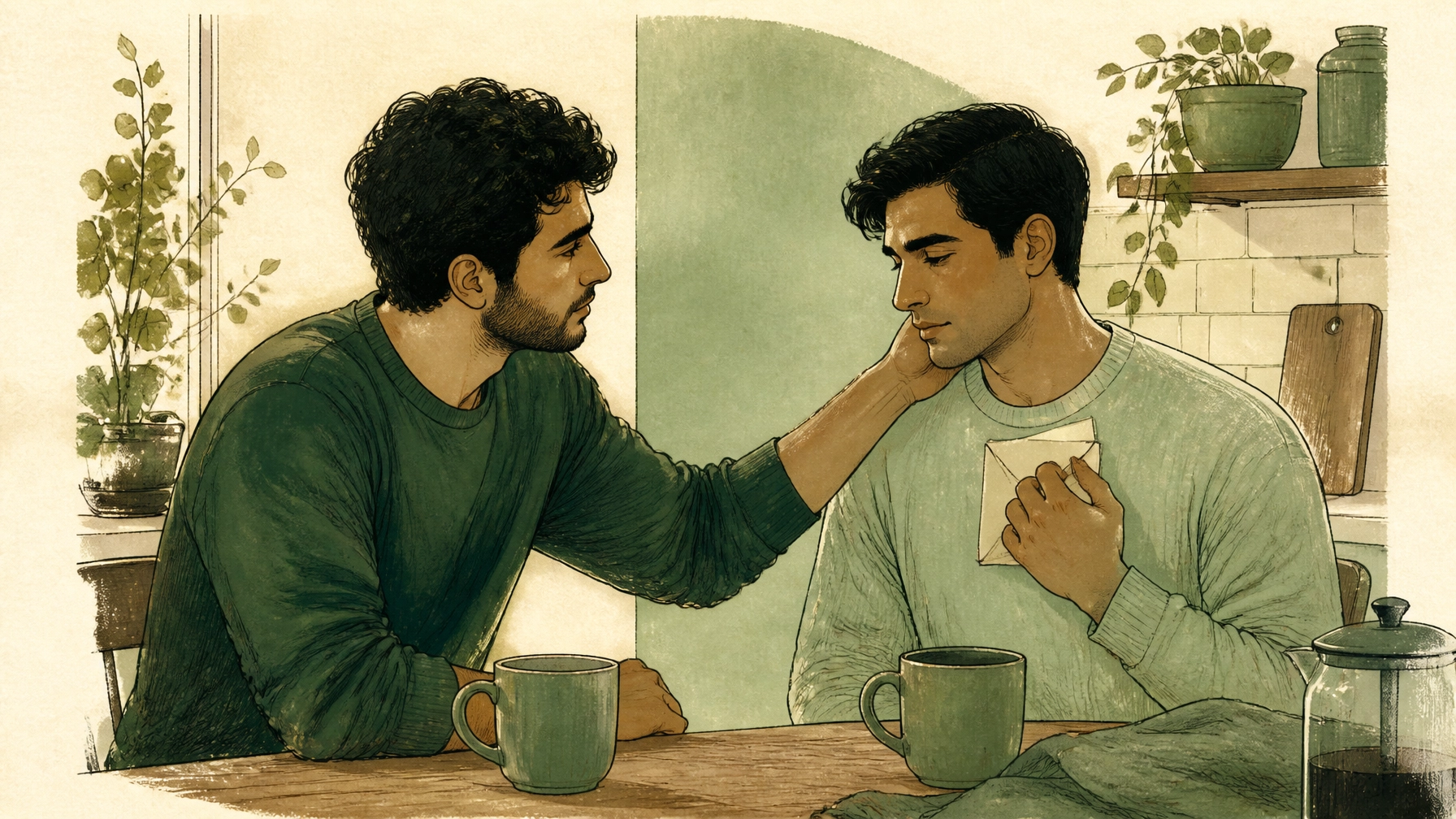
Rowan sat at the table with two mugs between them. He had been quiet for long enough that Ellis knew he was choosing his words carefully.
“I don’t know,” Rowan said.
Ellis turned from the window. “You don’t know if you’re going to tell them about us?”
“I don’t know if I’m ready to tell them yet.”
The hurt arrived before Ellis could stop it. It moved across his face, quick and unguarded.
Rowan saw it. That was the trouble with loving someone who knew you so well. There was no hiding behind a shrug or a change of subject.
“This isn’t about being ashamed of you,” Rowan said.
“I didn’t say it was.”
“You didn’t have to.”
Ellis set his phone on the counter. “I’m not asking you to stand on a stage and announce our relationship. I’m asking whether I can stop pretending I’m spending every weekend with a colleague.”
“You can tell them about yourself.”
“That’s not the same thing.”
“No,” Rowan said softly. “It isn’t.”
The silence that followed was not empty. It held every Sunday Ellis had spent inventing explanations. The spare room where Rowan supposedly slept when he stayed over. The careful way Ellis avoided saying my boyfriend on the phone. The photographs they never posted because someone in his family might see them.
Ellis had come out as gay in his early twenties. It had been frightening, but it had also felt like stepping into his own life. His family had struggled at first, asking awkward questions and making mistakes, but they had stayed. Over time, they had learned.
Rowan’s history was different.
He had identified as bisexual for most of his adult life, though the word had not always felt safe in his mouth. In his family, bisexuality was treated as confusion at best and dishonesty at worst. An uncle had once laughed and said that people who called themselves bi were simply waiting to choose a side.
Rowan had learned to keep some truths private.
Not because those truths were shameful. Because he had spent years measuring the cost of being misunderstood.
“I told them I was seeing someone,” Rowan said. “A while ago.”
Ellis looked at him. “You did?”
“I told my brother. He knows I’m with a man. He doesn’t know everything, and I asked him not to tell our parents.”
“Why didn’t you tell me?”
“I was going to.”
“When?”
Rowan flinched.
The question was fair. That made it worse.
“I wanted to tell you when I had a plan,” he said. “Not in the middle of an argument.”
Ellis pulled out the chair opposite him and sat down. “I don’t need a plan. I need to know whether we’re building a life that can exist outside this flat.”
“We are building that life.”
“Then why does it disappear whenever your family calls?”
Rowan looked at the rain. “Because I’m still trying to work out how much of myself I can give them without losing the part I fought to keep.”
That was the sentence Ellis had not expected.
For a moment, his anger had nowhere to go.
Rowan rubbed his thumb along the rim of his mug. “When I came out as bisexual, my parents decided it was temporary. When I dated women, they used those relationships as proof that I was normal. When I dated men, they acted as if I had suddenly become someone else. I got tired of defending an identity they had already decided was not real.”
Ellis reached across the table but stopped before touching him.
“Are you asking me to stay hidden?” he said.
“I’m asking you not to turn my fear into a deadline.”
“And what about my fear?”
Rowan met his eyes.
Ellis exhaled. “My family knows I’m gay. They know I love you. Or they know I say I love you to someone. Sometimes I feel like I’m standing beside you in my own life, waiting for permission to be visible.”
“I don’t want you waiting forever.”
“But you want me waiting now.”
“Yes,” Rowan said. “For a little longer. And I want us to decide what happens next together.”
The honesty of it unsettled Ellis more than another excuse would have done.
They talked until the tea went cold.
They separated the questions, as Rowan suggested. Was Ellis allowed to tell his own family that he was in love? Yes. Was he allowed to describe Rowan as his partner? Rowan was not ready for that with his parents. Was Ellis allowed to stop hiding his relationship from the rest of the world? Yes, but they needed to agree on what that meant for shared photographs, social gatherings, and unexpected encounters.
Most importantly, Ellis could not tell Rowan’s story for him. He could not announce Rowan’s bisexuality as proof of trust, or use disclosure as a test of love.
That boundary hurt. It also made the conversation safer.
By midnight, they had reached something that was not a perfect solution but felt more honest than either extreme.
Ellis would tell his father that he was in a serious relationship with a man. He would not identify Rowan’s sexuality, share personal details, or assume Rowan would attend Sunday’s lunch.
Rowan would speak to his brother again. If that conversation went well, he would consider telling his parents, not because Ellis had demanded it, but because he wanted the possibility of being known.
They would revisit the question in six weeks.
Not as a threat. Not as a countdown to prove who loved whom more. As a promise to keep talking.
On Sunday morning, Ellis stood in the hallway with his coat on. His father had sent another message: Is your friend coming?
Ellis read it twice.
Then he typed: His name is Rowan. He’s my partner. We’re not sure whether he’ll come today, but I wanted you to know.
His hand shook when he pressed send.
Rowan watched from the doorway.
“Are you all right?” he asked.
“No,” Ellis said. “But I think I’m being honest.”
Rowan crossed the room and took his hand.
“That matters.”
Later, Rowan did not go to lunch. He spent the afternoon walking beside the river, rehearsing what he might say to his brother. He was still afraid. Ellis’s message had not magically made family safe, and love had not erased the years Rowan had spent protecting himself.
But privacy no longer felt like a locked room.
It felt like a door he had the right to open when he chose.
That evening, Ellis came home to find Rowan sitting on the floor beside the sofa, phone in his lap.
“I spoke to my brother,” Rowan said.
Ellis sat beside him. “How did it go?”
“He asked if I was happy.”
“What did you say?”
Rowan leaned his shoulder against Ellis’s. “I said yes.”
It was not the grand revelation either of them had imagined. There was no dramatic reconciliation, no sudden understanding from every relative, no guarantee that the next conversation would be easy.
There was only this: two men learning that love could ask for honesty without demanding surrender. Two histories making room for each other. A gay man who wanted to live openly, and a bisexual man who needed time to decide how visibility could belong to him too.
For them, choosing the right time did not mean waiting until fear disappeared.
It meant refusing to let fear: or pressure: make the choice alone.
Why stories like this matter to emotionally invested MM readers
The strongest MM romance is rarely about a single disagreement. It is about what that disagreement reveals.
For Ellis and Rowan, coming out is not a plot device that can be solved with one brave speech. It touches identity, family history, safety, trust, and the different ways men learn to protect themselves. One partner experiences privacy as painful distance. The other experiences it as necessary control over his own story.
That tension gives a gay love story emotional journey its weight. The romance becomes more than attraction or conflict. It becomes a question of how two men can remain emotionally connected while honouring the places where their experiences do not match.
This is where character-driven queer fiction can offer something especially powerful. It allows readers to sit inside complicated choices without forcing one character to become the villain. Ellis is not wrong to want recognition. Rowan is not wrong to need time. Their relationship has to make room for both truths.
For emotionally invested MM readers, these quiet negotiations can be as compelling as any dramatic external threat. The fear of rejection, the ache of being kept separate from a partner’s family, and the vulnerability of naming bisexuality all create stakes that feel intimate and real.
There is also an important distinction between coming out and being outed. Each person should have control over their own identity and disclosure. A partner may talk about his own sexuality and relationship, but he should not reveal the other man’s bisexuality, history, or private feelings without consent.
That principle gives emotional MM romance a deeper ethical centre. In emotional MM romance literary fiction, love is not measured by how quickly someone performs bravery. It is measured by whether both people can tell the truth about what they need: and listen when the answer is difficult.
Readers looking for MM romance unexpected places may find that the most affecting setting is not always a glamorous destination or dangerous adventure. Sometimes it is a family kitchen, a message left unanswered, or a rainy evening when two men decide that honesty must be built carefully.
These are the stories behind many of the best MM romance books: gay men and bisexual men navigating visibility, belonging, and the fragile work of creating a shared life. They remind us that queer fiction can be tender without being simple, hopeful without ignoring risk, and romantic without pretending love solves everything by itself.
Read with Pride
Discover more LGBTQ+ ebooks, gay books, queer fiction, gay novels, and heartfelt gay fiction from independent voices through Read with Pride.
You can also explore Dick Ferguson’s emotionally immersive MM romance and gay romantic fiction collection, where complex men, difficult choices, and powerful gay love stories take centre stage.
Follow us on social media
Follow Dick Ferguson for new releases, character-driven MM fiction, reading recommendations, and reflections on queer literature:
Three fresh topic ideas for the next instalment
- When One Man Wants to Move Abroad and the Other Fears Starting Over : Ambition, Belonging, and Building a Shared Future in MM Romance
- When His Family Accepts the Relationship but Rejects His Bisexuality : Identity, Biphobia, and Loving Someone Without Erasing Him
- When Two Men Disagree About Marriage : Commitment, Tradition, and What Forever Really Means in a Character-Driven Gay Love Story
#QueerLifeAndIdentity #MMRomance #GayRomance #LGBTQBooks #QueerFiction #GayFiction #MMNovels #EmotionalMMBooks #ComingOut #GayLoveStories #ReadingWithPride #ReadWithPride


Leave a Reply
You must be logged in to post a comment.