

September 4, 2026
There are places where the world seems to hold its breath.
The cenote was one of them.
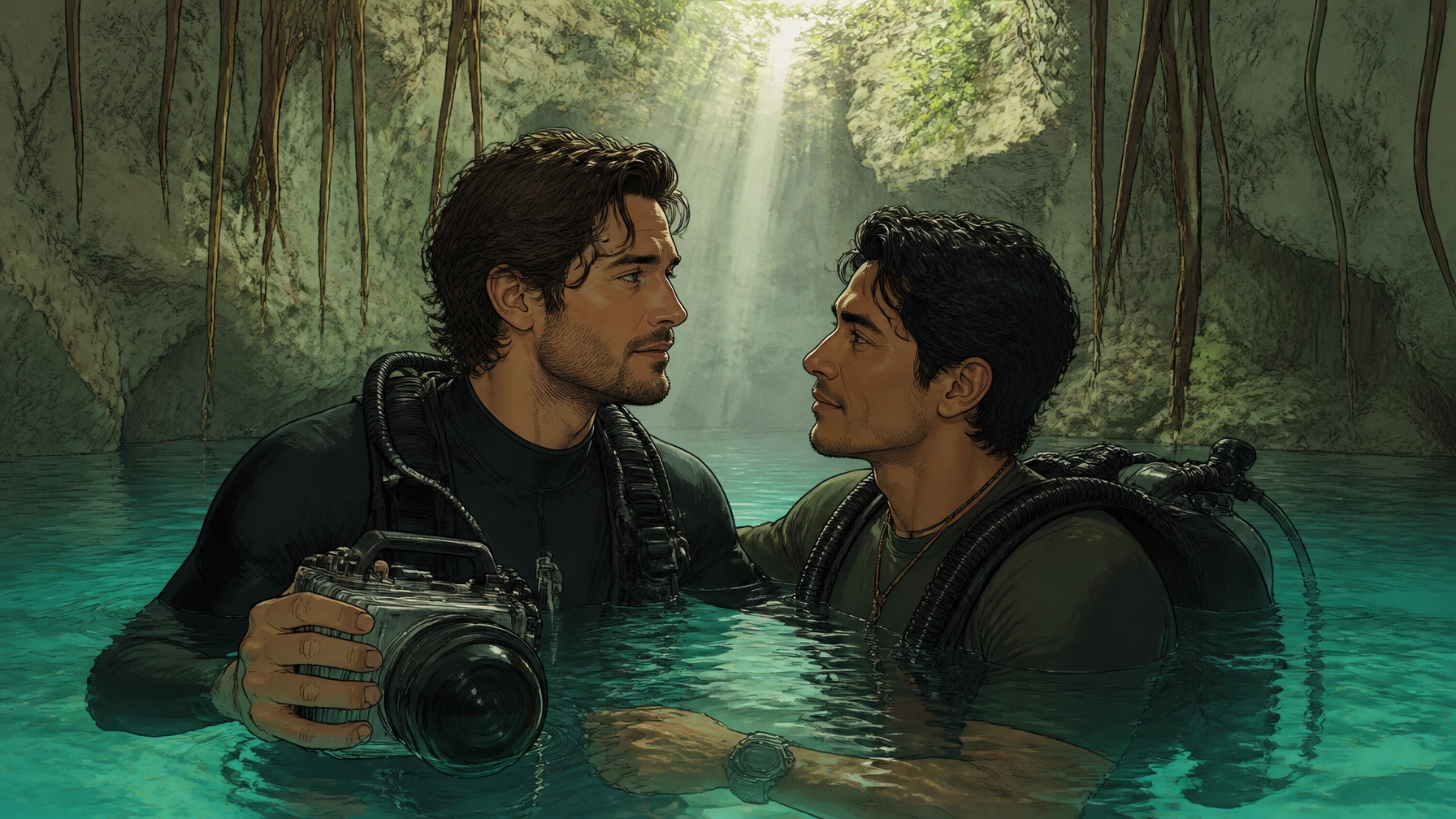
From the jungle above, it looked almost modest: a dark opening between tangled roots, limestone softened by moss, sunlight breaking through the canopy in narrow gold-green shafts. But below the surface, the water widened into a hidden cathedral. Cool turquoise light moved over submerged stone. Roots reached down like fingers searching for something they had lost. Farther in, the cave system opened into chambers where silence gathered with such weight that even a heartbeat seemed too loud.
Wallace had come to photograph that silence.
He had made a life of standing just outside the frame. New York, Montréal, Lisbon, Mérida, he had gone wherever the light was interesting and left whenever a person became more interesting than the place. Behind his camera, he could study beauty without being touched by it. He could preserve a moment without having to remain inside it.
Closeness frightened him.
He was a bisexual man who had learned, slowly and thoroughly, to leave before anyone could leave him. It was easier to call himself restless than afraid. Easier to keep moving than to admit that every departure was an old wound choosing its familiar shape.
Isaías understood departure differently.
He had returned to his Yucatán hometown after a cave-diving accident took the man he loved. The details lived inside him like cold water: the sudden darkness, the broken rhythm of breathing, the failure of a line, the terrible distance between one hand and another.
He blamed himself.
Now he guided visitors through the daylight zone of the cenote, explaining the limestone, the freshwater, the shifting currents. He was calm, careful, and impossible to know. He took people only as far as he trusted himself to go.
He did not dive deep anymore.
Wallace noticed this before Isaías said it.
He noticed the way the guide’s hand paused near the rope. The way Isaías watched the dark passage beyond the last natural light. The way he answered questions with facts but never with memory.
“You photograph everything except people,” Isaías said one morning.
Wallace adjusted the strap of his camera housing. “People move.”
“So does water.”
“Water doesn’t ask what you’re thinking.”
Isaías looked at him then. Not past him, not around him. At him.
For a moment, Wallace felt the dangerous pressure of being seen.
A Cave Made for Emotional MM Romance
Cenotes are among the most evocative settings for MM romance in unexpected places because they make emotional concealment impossible. Above ground, a character can walk away. Beneath the surface, every choice becomes immediate: breathe, trust, follow, return.
The cenote gives this gay love story an emotional journey that is inseparable from its physical landscape.
Its freshwater is clear enough to reveal the smallest details, the pale ribs of limestone, a diver’s trembling hand, the soft movement of silt. Yet clarity does not mean safety. Below the freshwater, saltwater waits. At the halocline, the two meet in a wavering boundary that turns the world strange. Shapes blur. Light fractures. Direction becomes uncertain.
For Wallace and Isaías, the halocline becomes more than a natural phenomenon. It becomes the place where their separate histories begin to mix.
Neither man can remain entirely who he was above it.
Their dive begins cautiously. Isaías leads. Wallace follows, camera held close, his light cutting a narrow path into the blue-green dark. They pass beneath curtains of roots and along walls carved by ancient water. The cave seems alive with patience.
At first, Wallace does what he always does. He photographs.
The beam catches a column of stone. A veil of bubbles. Isaías’ silhouette moving ahead of him, powerful and solitary in the water.
Then the light fails.
Not gradually. Not dramatically. One second Wallace is looking at the pale line of Isaías’ shoulder; the next, darkness folds over him.
His first instinct is to bolt.
His second is to pretend he is not afraid.
Both instincts are dangerous.
He reaches for the guideline, misses, and feels the water change around him. His breathing becomes too fast. The cave presses close. The silence has weight now, not poetic weight, not the beautiful silence he came to capture, but the full physical pressure of being unable to see an exit.
Then Isaías is there.
A hand closes around Wallace’s forearm.
Not hard. Not uncertain.
Present.
Isaías signals for Wallace to breathe. He brings Wallace back to the line, checks his air, and positions himself between Wallace and the darkness. The guide’s own breathing is controlled, but Wallace can feel the effort behind it. Isaías is afraid too.
He has simply learned how to make fear useful.
They move slowly toward the clearer water. At the halocline, the world shimmers. Freshwater and saltwater meet in a wavering veil, blurring the edges of Isaías’ face. For a few seconds, Wallace can see only fragments: an eye, a cheekbone, the pale flash of a hand still holding his.
He thinks of every person he has left.
He thinks of how often he has mistaken distance for freedom.
He thinks of the fact that Isaías could have let go.
Instead, Isaías stays.
The Things They Have Been Running From
They surface in a chamber where a break in the canopy sends a column of daylight into the water.
Wallace removes his mask. He is shaking.
“I thought you didn’t go this far,” he says.
“I don’t.”
“Then why did you?”
Isaías looks toward the passage behind them. “Because you were there.”
It is not a declaration. It is not polished. It does not promise more than he knows how to give.
That is why Wallace believes him.
Later, on the stone ledge beside the cenote, Wallace tells the truth about his leaving. He speaks about men whose names he does not say at first. About the terror of being loved and the worse terror of discovering that love could still end. About how bisexuality had never been the problem, but how often he had allowed other people’s uncertainty, and his own, to make him feel permanently temporary.
“I kept thinking,” Wallace says, “that if I never needed anyone completely, losing them wouldn’t destroy me.”
Isaías sits beside him, close enough that their shoulders touch.
“Did it work?”
Wallace looks at the water. “No.”
Isaías tells him about the accident.
He does not describe it as a tragedy that made him noble. He describes it as a failure he revisits every day, searching for the moment when he should have known more, done more, reached faster. He tells Wallace about the man he loved, not as a ghost, but as a person who laughed too loudly, hated bitter coffee, and always wanted to see what lay beyond the next chamber.
“I came home because I thought staying would be penance,” Isaías says. “I thought fear was what I deserved.”
Wallace turns toward him.
“Fear isn’t a place to live.”
“No,” Isaías says. “But it is a place I know.”
The tenderness between them is not sudden. It has no convenient rescue built into it. Isaías does not stop grieving because Wallace has arrived. Wallace does not become fearless because someone held his arm in the dark.
What changes is smaller, and therefore more lasting.
Wallace stops pretending that his camera is the same as intimacy.
Isaías stops pretending that caution can keep the past from happening again.
When Wallace asks if he can take a photograph of him, Isaías says yes: but only if Wallace puts the camera down afterward.
The photograph is imperfect. Water has softened the light. A root shadows half of Isaías’ face. His expression is guarded, but his hand is resting over Wallace’s.
Wallace keeps the image.
He also keeps the moment after it.
Why the Cenote Makes a Powerful MM Romance Setting
A cenote intensifies a character-driven queer fiction story because the environment mirrors the emotional work of the relationship:
- The surface represents control. It is bright, visible, and easy to leave.
- The cave represents vulnerability. It asks the characters to trust what they cannot fully see.
- The halocline represents emotional change. Two separate worlds meet, distort one another, and become impossible to keep apart.
- The guideline represents connection. It does not remove danger, but it offers a way through it.
- The silence creates honesty. Without the distractions of ordinary life, Wallace and Isaías must listen to what they have avoided saying.
For emotionally invested MM readers, this is the heart of the setting. The cenote is not simply exotic scenery. It is an active force in the romance, pressing two guarded men toward the truths they have spent years avoiding.
This is the appeal of emotional MM romance literary fiction: the setting does not decorate the relationship. It reveals it.
The Decision to Stay
Wallace has a flight booked for the following morning.
He has already begun to think of leaving as an act of kindness. Isaías has grief. Wallace has fear. Surely the decent thing is to avoid making either one worse.
But before sunrise, Wallace cancels the flight.
He does not make a grand promise. He does not claim that he will never leave again. Instead, he tells Isaías he wants to stay long enough to learn the names of the trees around the cenote. Long enough to photograph the water in every kind of weather. Long enough to find out who they might become when neither of them is preparing to disappear.
Isaías listens.
Then he reaches for Wallace’s hand.
Their first kiss happens beside the water, with the jungle waking around them. It is quiet and tentative, more question than conclusion. Wallace feels Isaías pause, giving him room to step away.
He does not.
Some depths only open when you stop holding your breath.
Not because the dark becomes harmless. Not because the past releases its grip. But because, sometimes, another person reaches for you without demanding that you be unafraid.
Sometimes love is not the promise that nothing will be lost.
Sometimes it is the decision to remain present for what can still be found.
Read with Pride
For readers seeking gay books, MM romance books, queer fiction, gay novels, and emotionally immersive LGBTQ+ ebooks, Read with Pride offers a home for stories centered on authentic connection and meaningful representation.
Explore the Dick Ferguson collection on Read with Pride for character-driven gay fiction, heartfelt gay love stories, and emotionally charged MM novels written for readers who want more than a simple romance formula.
You can also visit Read with Pride to discover LGBTQ+ fiction, gay romance books, queer authors, MM authors, and new stories to add to your reading list.
Three Possible Next Morning Edition Stories
-
Morning Edition: The Lighthouse : Where Two Men Learned That Being Seen Is Not the Same as Being Exposed
A guarded marine biologist and a widowed lighthouse keeper face an approaching storm, an unfinished farewell, and the dangerous comfort of staying awake together through the night. -
Morning Edition: The Night Train : Where Two Men Discovered That Some Departures Are Really Beginnings
A restless travel writer and a quiet conductor share one long journey across Europe, carrying separate secrets toward the same unexpected destination. -
Morning Edition: The Orchard in Winter : Where Two Men Found Warmth in the Work of Returning
A city architect inherits a neglected orchard and clashes with the man who has cared for it alone: until grief, frost, and the promise of spring teach them how to build something lasting.
Follow Us on Social Media
Follow Dick Ferguson for more emotionally immersive MM romance, queer fiction, gay literature, and updates from the world of Read with Pride:
#MMRomance #GayRomance #QueerFiction #GayFiction #MMNovels #LGBTQFiction #EmotionalMMRomance #CharacterDrivenFiction #GayLoveStory #ReadWithPride #ReadingWithPride #LGBTQBooks


Leave a Reply
You must be logged in to post a comment.