

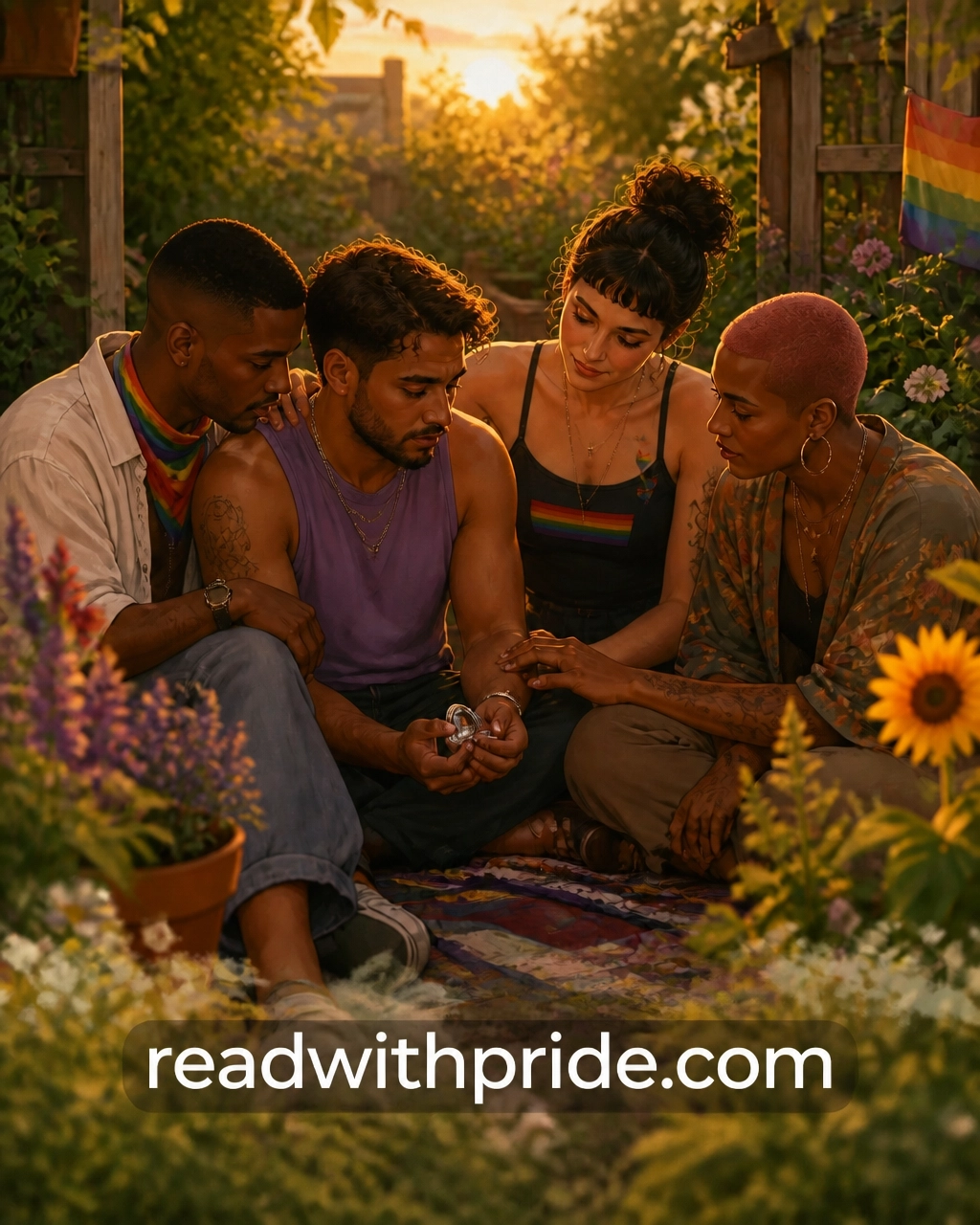
There is a particular kind of strength in continuing to imagine a future while carrying evidence of what you have survived.
For many LGBTQ+ people, healing is not about becoming untouched by grief, rejection, fear, or loss. It is about learning how to hold the full truth of our lives without allowing pain to become the only story available to us. It is about making room for tenderness alongside anger, joy alongside mourning, and hope alongside the very real work still ahead.
This is the heart of queer healing and future visions: asking what we carry, what we are ready to release, and what we might become when our lives are shaped by self-acceptance, chosen family, and joy.
What we carry
Queer communities carry many kinds of grief.
Sometimes it is the loss of a person we loved: a partner, friend, relative, mentor, or chosen-family member. Sometimes it is the loss of a relationship that could not survive rejection or prejudice. Sometimes it is the grief of never being welcomed by the family, faith community, school, or neighbourhood we once hoped would feel like home.
There is also grief for the selves we had to hide.
Many LGBTQ+ people spend years learning how to edit themselves for safety. We become experts at reading a room before entering it. We calculate whether a casual mention of a partner will create discomfort. We learn which parts of our history can be shared and which must remain tucked away.
Those habits may once have protected us. They are not personal failures. They are evidence of resourcefulness in difficult circumstances.
But surviving a hostile environment can leave us carrying more than we realise: hypervigilance, shame, isolation, exhaustion, and the belief that asking for help is dangerous. Even when life becomes safer, the body and mind may still expect the next rejection, the next argument, or the next door to close.
Queer healing begins when we stop judging ourselves for carrying these things. We can look at our grief and say, “This mattered.” We can look at our fear and say, “You were trying to protect me.” We can honour the younger versions of ourselves who did whatever they could to get through.
That is not weakness. It is the beginning of compassion.

Grief does not cancel resilience
There is sometimes pressure on LGBTQ+ people to be endlessly resilient. We are expected to turn every painful experience into a lesson, every loss into activism, and every difficult day into proof that we are strong.
But resilience is not a performance.
You do not have to be inspiring while grieving. You do not have to respond perfectly to loss. You are allowed to be tired, angry, uncertain, quiet, or deeply sad. You are allowed to miss someone and still laugh at a silly message from a friend. You are allowed to feel relief after a painful relationship ends and grief about that same ending.
LGBTQ+ resilience is not the absence of pain. It is the ability to keep reaching for connection, meaning, care, and possibility without denying what hurts.
Sometimes resilience looks dramatic: leaving an unsafe home, speaking openly about your identity, building a new life from scratch. Sometimes it looks incredibly ordinary: eating something, answering one message, making a doctor's appointment, or letting someone sit beside you without pretending everything is fine.
Small acts count. They are often how healing becomes real.
What we release
Releasing does not mean forgetting. It does not require us to forgive people who harmed us, return to unsafe places, or act as though the past no longer affects us.
Releasing means choosing not to let old survival strategies control every part of the future.
We might begin by releasing the idea that we must always be tough. Queer communities deserve softness, rest, pleasure, and care, not only emergency response. We deserve lives that contain more than resistance.
We might release shame that never belonged to us in the first place. Shame can arrive through family rejection, bullying, religious condemnation, racism, transphobia, ableism, or the constant suggestion that queer lives are somehow less valid. Releasing it can be gradual. It might begin with using the name that feels right, loving the person you love without apology, or refusing to explain your identity to someone committed to misunderstanding it.
We might also release compulsory timelines.
There is no single correct way to build an LGBTQ+ life. Your future does not have to follow a traditional script involving marriage, children, career milestones, or a particular kind of home. You can create relationships and communities that reflect your actual needs rather than somebody else’s expectations.
A queer future can be spacious. It can include romance, friendship, solitude, parenthood, creative work, adventure, domesticity, or a beautiful combination of all of them.

What we become
Future visions are not glossy fantasies where nobody struggles. They are practical, hopeful pictures of what life could feel like when safety and dignity are treated as ordinary rights.
In an optimistic queer future, chosen family is not considered secondary or temporary. It is recognised as a source of wisdom, care, celebration, and continuity.
Chosen family might be the friends who remember difficult anniversaries. It might be the ex-partner who still brings soup when you are ill, the neighbour who checks in, the colleague who makes space for your name and pronouns, or the online community that helps you feel less alone.
It is not always perfect. No family is. But it can be intentional. It can be built around mutual respect rather than obligation, and around the simple understanding that everyone deserves to be known as their whole self.
In that future, self-acceptance is not something we earn after becoming more attractive, successful, confident, or useful. It is a place we are allowed to begin.
Joy belongs there, too.
Queer joy can be loud and public, but it can also be wonderfully uneventful: cooking with someone you love, choosing furniture together, reading in bed, sending a voice note, taking a holiday, celebrating a birthday, or waking up beside a partner and feeling at home.
These everyday moments matter because they challenge the idea that queer stories must always centre tragedy. Our communities have endured loss, but we are not defined by loss.
Gentle practices for queer healing
Healing looks different for everyone, and there is no deadline. Still, a few small practices may help you make space for what comes next:
- Name what you are carrying. Write down one grief, fear, or memory that needs acknowledgement rather than dismissal.
- Identify your people. Make a list of those who offer affirmation, practical support, humour, or a safe place to be quiet.
- Create a boundary. Decide what contact, conversation, or online content you need less of right now.
- Make room for pleasure. Read, cook, dance, walk, cuddle, create, or do absolutely nothing without treating rest as a reward.
- Imagine one kind future detail. It might be a peaceful home, a loving relationship, a queer book club, a community garden, or simply a morning when you do not feel braced for bad news.
- Ask for support early. Trusted friends and LGBTQ+-affirming professionals can help you carry experiences that are too heavy to manage alone.
You do not need to design an entire future today. One small, believable possibility is enough.
Stories can help us practise hope
Queer fiction gives us a safe place to explore all these questions. In gay romance novels, MM romance books, lesbian romance, and other LGBTQ+ ebooks, characters are allowed to want things, lose things, choose again, and discover forms of love that feel true to them.
A comforting story cannot erase grief. But it can offer company. It can remind us that a gay love story, a lesbian romance, or a wider queer love story deserves emotional depth, desire, tenderness, conflict, and a hopeful ending when the characters: and readers: need one.
At Read with Pride, you can explore gay fiction, LGBTQ+ novels, queer fiction, gay romance books, and M/M books created for readers who want queer lives at the centre of the page. Browse the Heartfelt MM Romance E-book for a story rooted in emotional connection, or explore the platform for gay eBooks, LGBTQ+ romance, and new gay releases.
Our reading lives can hold many things: coming out stories, family journeys, steamy MM romance, gentle lesbian romance, gay novels, and LGBTQ+ fiction 2026 that imagines more possibilities for queer characters. Even the internet’s search language can be wonderfully chaotic: someone may arrive looking for “C Section 2026,” someone else for “queer healing,” and someone else for comforting gay fiction. However you found this page, you are welcome here.

A future with room for joy
What we carry tells us where we have been. What we release creates breathing space. What we become is not a fixed destination, but a continuing act of choice.
We can choose relationships that make room for honesty. We can choose communities that celebrate our complexity. We can choose rest without guilt and pleasure without permission. We can choose to believe that queer life is not merely something to defend, but something to enjoy.
That is the future vision worth nurturing: a world where LGBTQ+ people are held by chosen family, supported through grief, free to practise self-acceptance, and surrounded by stories that reflect the many ways queer love can thrive.
When you are ready for a little comfort, connection, or hope, explore Read with Pride and find your next queer love story. You can also follow Read with Pride on Facebook and Instagram for LGBTQ+ reading inspiration and community updates.
You do not have to carry everything alone. And you do not have to imagine the future alone, either.
#QueerHealing #FutureVisions #LGBTQResilience #ReadWithPride #MMRomanceBooks #GayRomanceNovels #QueerLoveStories #LGBTQFiction2026 #QueerReading #LGBTQBooks

Leave a Reply
You must be logged in to post a comment.