

There are places that make an outsider of you before anyone has said a word.
A city man can feel it in the gravel beneath his shoes, in the silence between one unfamiliar greeting and the next. He can feel it in the clean, bright wrongness of his coat among worn denim and work shirts, in the way his hands remain empty while everyone else seems to know what to do with theirs.
The barn dance begins at dusk.
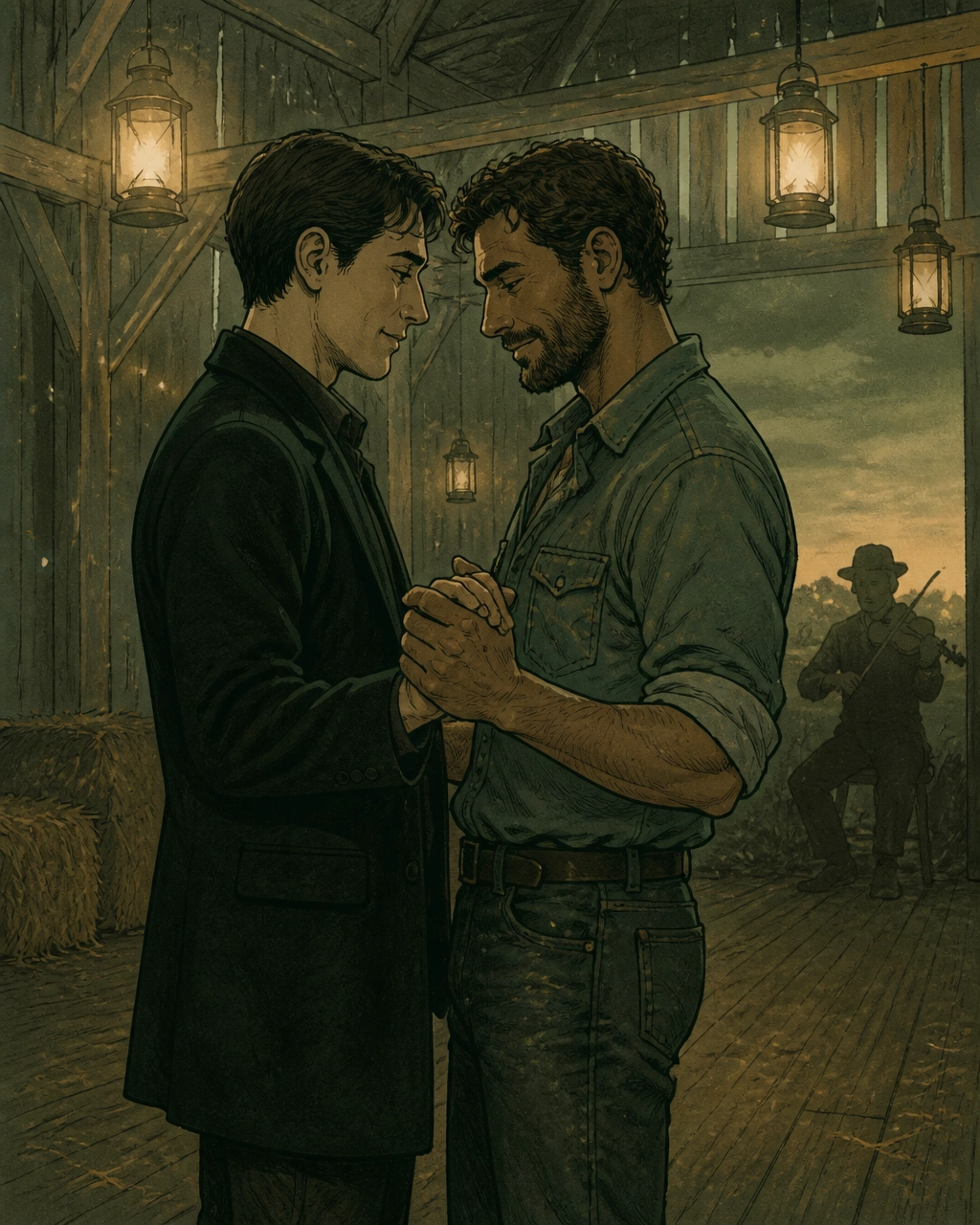
By the time he arrives, the last of the daylight has thinned to a grey-blue seam beyond the fields. Lanterns hang from the beams inside the barn, each one casting a trembling circle of gold across the rough timber. Hay bales line the walls. Dust rises from the floor in small, luminous clouds whenever someone stamps a boot or turns too quickly.
The air smells of dry grass, woodsmoke, cider, and the faint mineral scent of autumn settling over the land.
He stands just inside the doorway, trying to look as though he has chosen stillness rather than been defeated by it.
This is the first truth of an MM romance in an unexpected place: the setting does not have to be dangerous to make a person feel exposed. Sometimes the most frightening room is one filled with warmth. Sometimes a crowd is lonelier than an empty street because everyone else appears to belong.
He knows how to move through a city. He knows how to disappear into the flow of strangers, how to lower his eyes on a crowded train, how to turn solitude into something that resembles independence. He has built a life from exits. He leaves before anyone can ask why he is quiet. He changes the subject before anyone can discover what he wants.
But a barn dance offers no useful corners.
The music starts with a fiddle.
It is not polished in the way he expects music to be polished. The notes arrive bright and fast, carrying the grain of the instrument inside them. A guitar follows. Then the floor begins to answer: boots against boards, heels and laughter, the rough collective rhythm of people who do not need to be persuaded into joy.
A caller raises his voice over the tune, naming the steps. Turn. Pass. Join hands. Move on.
No one seems embarrassed by not knowing everything. The dance makes room for uncertainty. If a person misses a step, someone nearby guides him back into it. If two men arrive late to a set, hands open and space appears.
The city man watches this with a suspicion he does not entirely understand.
In his world, not knowing is something to hide.
Here, it is simply the beginning of the dance.
Across the room, another man looks at him.
Not for long. Not dramatically. There is no sudden stillness, no impossible recognition. The other man glances over while rubbing dust from one palm, then turns back toward the music. He is wearing worn denim and a shirt softened by work and washing. His hands are calloused. His posture carries the quiet steadiness of someone accustomed to lifting, repairing, waiting.
When he looks again, the city man does not look away quickly enough.
That is all.
A glance held for one second longer than safety requires.
The other man comes over between dances. He does not ask whether the city man is enjoying himself. That question would be too large, too easy to answer falsely.
“First time?” he asks.
The city man nods.
“Mine too,” the other man says.
It is clearly not true. He knows the steps. He knows which board near the centre gives a little beneath the left foot. He knows the fiddle player’s habit of leaning into the faster passages.
But the lie is kind. It removes the distance between them.
A new tune begins.
The other man offers his hand.
The city man looks at it before taking it. He notices the rough skin across the knuckles, the pale mark near the thumb, the small signs of a life lived in contact with the world. His own hand, by comparison, feels too carefully kept. Too unused to being needed.
He places it in the other man’s palm.
Nothing extraordinary happens.
No lightning. No rescue.
Only warmth.
That is often how a believable gay love story emotional journey begins, not with certainty, but with a small permission. A hand held without interrogation. A body allowed to remain in the room. The gradual discovery that closeness does not always arrive to take something away.
The dance carries them apart almost immediately.
They pass one another, turn toward different partners, circle back. For a few minutes, the city man is part of a pattern too old and too simple to care about his fear. He follows the instructions as best he can. His shoulder brushes the other man’s. Their fingers meet and separate. Each contact is brief enough to dismiss, yet each one leaves a mark.
He begins to understand why the music feels different when he is moving.
The fiddle is no longer merely loud. It is inside his ribs. The rhythm travels through the boards and up through his legs. Hay dust settles on his sleeves. His polished shoes lose their argument with the floor.
He laughs once when he gets the turn wrong.
The sound surprises him.
The other man hears it and smiles, not triumphantly, not as though he has managed to unlock something, but with an answering softness that makes the city man want to laugh again.
This is the emotional centre of character-driven queer fiction: not the grand declaration, but the moment a guarded person becomes briefly visible to himself. The moment he recognises that his defences have not vanished. They have simply loosened enough to let something living through.
Later, when the crowd grows louder, they step outside.
The night has sharpened. Beyond the barn, the fields lie dark beneath a scattering of stars. Music continues behind them, muffled by timber and distance. The lanterns in the windows glow like small, patient fires.
The city man leans against the wall.
“I thought I’d hate this,” he says.
The other man stands beside him, close enough that their sleeves touch.
“Most people do,” he replies.
The city man turns to him.
“Most people?”
“Most people who think they have to be good at it.”
The answer settles between them.
He thinks of all the things he has believed he needed to perform correctly: confidence, desire, belonging, even loneliness. He has treated intimacy as a test he would eventually fail. He has mistaken self-protection for self-knowledge.
The other man does not ask him to explain.
That may be the first kindness.
The second is the way he stays.
Inside, the fiddle changes to something slower. The caller’s voice fades. A few couples continue to dance, turning beneath the lanterns while the rest of the room gathers at the walls. Through the open barn door, the city man can see the floor shining with dust and reflected light.
“Do you want to go back in?” the other man asks.
Fear rises in him, familiar and efficient.
He could leave now. He could return to the rented room, the unfamiliar bed, the old loneliness waiting with its coat already on. He could tell himself that nothing happened, which would be almost true.
Instead, he says, “Yes.”
The other man offers his hand again.
This time, the city man takes it without looking down.
They do not return to the centre of the room. They stay near the edge, where the light is softer and the crowd less demanding. The other man places one hand carefully at his shoulder. The city man rests his own hand against the worn fabric of the denim shirt.
For a while, neither of them speaks.
The song is not perfect. The floor shifts beneath them. Someone nearby misses a step and laughs. The fiddle catches on a note before finding its way forward.
Still, something in the music opens.
The city man feels the other man’s breathing. He feels the strength in the hand holding him, not gripping, not claiming: simply present. He lets his weight move closer by degrees, waiting for the moment when closeness will become too much.
It does not.
He has spent years imagining that being held would mean surrendering the parts of himself he fought hardest to protect. Here, in the lantern-lit barn, he learns something gentler. Being held can mean remaining himself while someone else makes room for him.
That distinction changes everything.
An emotional MM romance literary story does not need to promise that fear disappears. It only needs to show fear being answered. Not conquered in a single night, but met by patience, honesty, and the steady pressure of another person’s hand.
Outside, autumn gathers at the edges of the fields.
Inside, the song continues.
The city man came to the barn believing he was too conspicuous to belong and too lonely to be reached. He leaves with hay dust on his coat, the taste of cider on his tongue, and another man walking beside him beneath the darkening sky.
Their hands remain joined.
Not because the future is certain.
Because, for once, uncertainty does not feel like an exit.
For readers drawn to character-driven queer fiction, gay romance with an emotional journey, and MM romance in unexpected places, stories like this matter because they understand that love rarely arrives as a clean transformation. More often, it begins in the body: a hand accepted, a shoulder leaned against, a song endured until it becomes beautiful.
Explore more emotionally immersive LGBTQ+ ebooks, gay novels, and literary MM romance through Read with Pride.
Three possible next Evening Edition topics
- The Last Train Home : how two men discover that a delayed journey can become an unexpected confession.
- The Lighthouse in November : a lonely coastal caretaker learns that being found is not the same as being rescued.
- The Bookshop After Closing : two men, one unfinished conversation, and the quiet intimacy of staying late.
Follow us on social media
For more reading with pride, emotional gay fiction, queer literature, and new MM romance, follow Dick Ferguson and Read with Pride:
#MMRomance #GayRomance #QueerFiction #GayFiction #MMNovels #LGBTQPlusFiction #GayLoveStories #EmotionalMMBooks #CharacterDrivenFiction #LiteraryMMRomance #GayRomanceBooks #MMRomanceBooks #ReadingWithPride #ReadWithPride


Leave a Reply
You must be logged in to post a comment.