

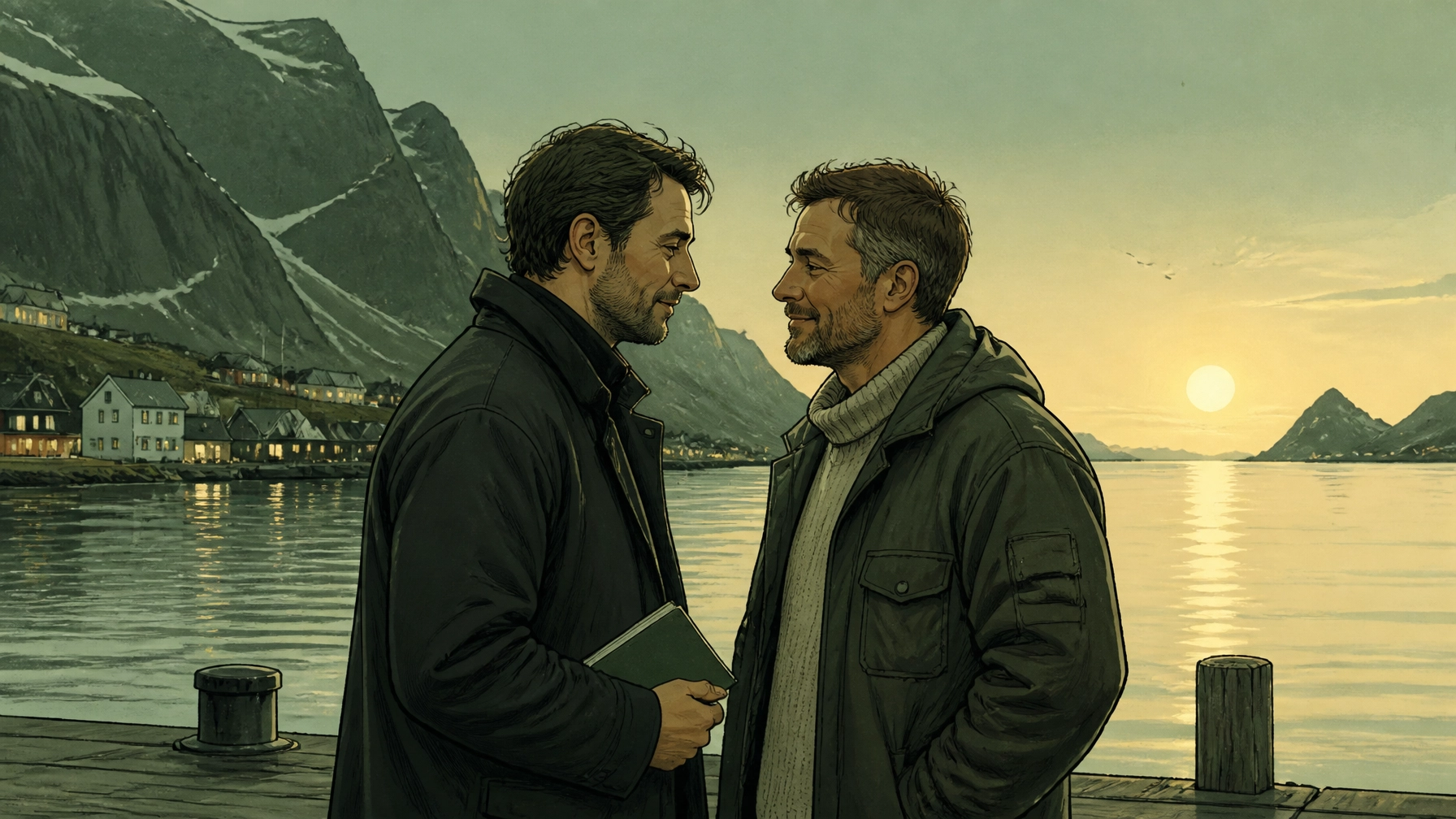
The Island That Refused to Sleep
At 2:07 in the morning, the sun was still above the water.
It hung low beyond the harbour, pale gold at its centre and rose-coloured around the edges, as though evening had begun but could not find the courage to end. The mountains stood dark and watchful against the brightness. Gulls moved through the sky with the lazy confidence of creatures who had forgotten what midnight meant.
Ezra stood on the ferry deck with one hand around his notebook and the other pressed against the cold rail.
He had come from London to study sleep.
More precisely, he had come to study what happened to human rest when the sky never properly darkened. Above the Arctic Circle, in June, the sun did not set. It skimmed the horizon and returned, again and again, without ever giving the landscape over to night.
Ezra understood the science. He had built a career around the distance between exhaustion and surrender. He knew how light affected circadian rhythms, how the body searched for darkness, how the mind became unsettled when morning and evening dissolved into one continuous brightness.
What he did not know was what his own sleeplessness had been trying to tell him.
For years, he had treated insomnia as a problem to be measured. A pattern to be logged. A private disturbance that could be managed with data, discipline and enough distance from other people.
He had never admitted that the hours before dawn contained grief.
Or that he still thought about the man whose love he had ended because being truly known had begun to feel more frightening than being alone.
The ferry shuddered against the harbour.
Sander was waiting on the pier.
He was taller than Ezra had expected, broad-shouldered beneath a weathered navy jacket, with silver beginning at his temples and a face shaped by wind, salt and years of paying attention. He watched the ferry arrive with the quiet patience of someone who had spent his life understanding tides.
“You’re the sleep researcher,” he said when Ezra stepped ashore.
“Is it that obvious?”
“You brought three notebooks.”
Ezra glanced down at them. “Only three.”
Sander’s mouth moved, almost a smile.
He was the island’s ferry captain. He carried supplies, medicines, mail and people between the village and the mainland. He knew which engines needed coaxing, which channels turned dangerous in bad weather, and which residents would insist they had no need of help while quietly waiting for someone to offer it.
Years ago, Sander’s partner had died in a winter storm.
The island had carried on because islands always did. Boats still needed fuel. Children still needed transporting. Nets still needed mending. Someone had to keep the ferry moving through the dark months, and Sander had become that person.
He had survived by making himself useful.
He had grieved in the small hours, when winter gave him darkness enough to hide inside. In summer, when the light refused to leave, he kept his sorrow behind blackout curtains and closed doors.
Until Ezra arrived with his notebooks and sleepless eyes.
Coffee at 2 a.m.
Their first ritual began without either man naming it.
Sander made coffee in the harbour house kitchen because he was awake. Ezra came in because he was awake too.
The clock said 2:11. Outside, the sun traced a thin line across the sea.
“You’ll never sleep if you keep drinking that,” Ezra said.
Sander placed a mug in front of him. “You’ll never sleep if you keep studying it.”
Ezra looked at him.
There were answers he could have given. Scientific ones. Professional ones. He could have explained that observation did not cause insomnia, that caffeine was not the only variable, that his research required accurate records.
Instead, he said, “I’m not very good at stopping.”
Sander sat opposite him.
“Neither am I.”
It was not a confession. Not yet.
But something in the room shifted.
The harbour house smelled of coffee, warm bread and old timber. Beyond the window, the village rested beneath its endless daylight. Ezra could hear the gulls, the faint knock of rigging against masts, and Sander’s breathing across the table.
He wrote nothing in his notebook.
The next morning, he found himself remembering the exact shape of Sander’s hands around the mug.
The Work of Being Seen
On the fourth day, a mooring line came loose.
Sander was halfway down the pier when Ezra saw the rope snap against the post. The ferry moved sharply in the water, tugging at its restraints.
“Hold this,” Sander called.
Ezra dropped his notebook and grabbed the line.
The rope was wet and rough beneath his palms. It burned through the skin almost immediately. Sander worked beside him, close enough that Ezra could feel the heat of his shoulder each time they pulled together.
The task demanded concentration. No cleverness. No professional distance. Just two men leaning into the same strain, breathing through the same effort.
When the line finally held, Ezra’s hands were shaking.
Sander noticed.
“You all right?”
“I’m fine.”
“You say that like a man trying to convince a locked door.”
Ezra looked at him.
The sun rested behind Sander’s head, turning the edges of his hair bright.
“My former partner used to say I made a home out of being unavailable,” Ezra said.
Sander did not move.
“I thought he was accusing me,” Ezra continued. “Maybe he was only asking me to come inside.”
The harbour seemed to widen around them.
Sander looked towards the water. “People ask for things when they’re afraid they won’t get them.”
“And what did you ask for?”
“More time.”
“Did you get it?”
Sander’s face changed then, not dramatically. There was no theatrical breaking open. Only a quiet loosening, as though something held too tightly for too long had finally been allowed to rest.
“No,” he said. “Not enough.”
That evening, they ate at the long table in the harbour house with the rest of the village. Fish stew. Dark bread. Butter softened in a dish. Someone passed around berries preserved from the previous summer.
Sander sat beside Ezra.
Their knees touched beneath the table.
Neither man moved away.
This is why a remote island beneath the midnight sun creates such a powerful backdrop for MM romance unexpected places. The setting is not merely beautiful. It places emotional pressure on the characters. There is nowhere for them to disappear into ordinary darkness. No convenient night in which to postpone an uncomfortable conversation. No city crowd large enough to swallow a confession.
The landscape makes concealment difficult.
The ferry routes, the long table, the narrow paths between houses : everything draws people into contact. Survival is practical and communal. You borrow tools. You share meals. You notice who has not come home. You learn that independence can keep you alive, but it cannot always keep you well.
For Ezra, the endless light strips away the systems he has used to avoid himself. He cannot tell himself that he will deal with grief tomorrow when tomorrow has already arrived. He cannot hide behind research when the man beside him has begun to recognise the difference between his professional calm and his private fear.
For Sander, summer exposes what winter allowed him to conceal. His grief is not erased by daylight. It becomes visible, even to him. The presence of another man does not replace the partner he lost. It asks him to acknowledge that love can follow loss without diminishing it.
That is the heart of a gay love story emotional journey: not the promise that the past can be repaired, but the possibility that the future can still be entered honestly.
It is also what makes this character-driven queer fiction. The romance grows through attention rather than spectacle. Coffee. Rope. Shared meals. A hand placed carefully over another hand at the exact moment it is needed.
The most important shifts happen internally.
What the Light Reveals
Ezra’s final week on the island arrived too quickly.
His research was complete. His recordings were organised. His sleep data was clean enough to satisfy the university. He had evidence, graphs and conclusions about the effects of continuous summer light on human rest.
What he did not have was a plan for leaving Sander.
They stood together at the end of the pier on Ezra’s last night. The sun was low, but there was no darkness waiting beyond it. The sea reflected a long road of trembling gold.
“I’ve been thinking about going back,” Ezra said.
Sander looked at him. “To London?”
“Yes.”
“That makes sense.”
The words were reasonable. That was the problem.
Ezra had spent years making reasonable decisions at the precise moment his heart required something riskier.
“I’m afraid,” he said.
Sander’s expression softened. “Of the ferry?”
“Of being known.”
The confession came without preparation. It did not arrive beautifully. It arrived tired and plain.
Sander reached for his hand.
“My partner knew me,” he said. “Not everything. No one knows everything. But enough.”
Ezra held his fingers.
“Does it get easier?”
“No.”
The answer hurt, but it did not feel cruel.
“Then what changes?”
Sander looked towards the bright horizon.
“You stop thinking the fear is proof you should leave.”
Ezra closed his eyes.
For once, he did not try to analyse the moment. He did not measure his pulse or name the response in his body. He allowed himself to stand beneath the impossible light with another man’s hand in his own.
He allowed the future to remain uncertain.
When he opened his eyes, Sander was still there.
Some light never asks permission to stay.
It simply enters through the curtains, crosses the floor and reveals what has been waiting in the room all along.
For emotionally invested MM readers, this is where the story finds its deepest promise. Ezra and Sander do not save one another from grief. They do not pretend that love makes fear disappear. They choose something more difficult and more believable: to be witnessed while still carrying it.
That is the quiet power of emotional MM romance literary storytelling. The resolution is not a perfect ending. It is a shared decision to stop surviving alone.
Read with Pride
Stories about men who find love in unexpected landscapes remind us that queer romance can hold vast emotional territory. It can unfold in cities, on ferries, beside winter lakes, beneath foreign suns and in the bright, sleepless hours above the Arctic Circle.
At Read with Pride, readers can discover LGBTQ+ ebooks, gay novels, MM romance books, queer fiction and heartfelt gay fiction created for those who want more than a passing love story.
For readers searching for emotionally rich gay romance, character-led MM novels and literary stories about grief, vulnerability and connection, there is always another journey waiting.
Read with pride. Love without limits.
Three Possible Next Morning Edition Stories
1. The Lighthouse Keeper’s Second Signal
A solitary lighthouse keeper on a storm-battered Scottish island receives a distress call from a man who vanished from his former life years ago. As the two men repair the lighthouse together, old guilt rises alongside the tide.
2. The Orchard at the Edge of Winter
A city archivist travels to a remote mountain village to catalogue the letters of a deceased poet. The orchard’s caretaker knows more about the poet’s final years than he is willing to reveal : and the archivist begins to suspect that the most important love story was never included in the archive.
3. The Last Seat on the Night Ferry
Two strangers meet on the final ferry crossing before a remote island is cut off by winter weather. One is running from a public scandal. The other has spent years waiting for someone who promised to return. The crossing lasts six hours. The choices they make could last much longer.
Follow Us on Social Media
Follow Dick Ferguson for more emotionally immersive gay love stories, MM romance, queer fiction and updates for readers who believe the best stories leave a light on.
#MMRomance #GayRomance #QueerFiction #GayFiction #MMNovels #LGBTQBooks #EmotionalMMRomance #CharacterDrivenFiction #GayLoveStory #ReadWithPride #ReadingWithPride #GayLiterature #LGBTQFiction #EmotionallyInvestedReaders


Leave a Reply
You must be logged in to post a comment.