

The Things People Say When They Think They Are Being Kind
By the time Noah met Adrian’s family, he had already rehearsed three different versions of himself.
The first was the quiet version: smile when Adrian’s father asked about work, laugh at the right moments, avoid correcting anyone, and let the evening pass without turning his identity into a subject.
The second was the brave version: say, clearly and without apology, “I’m bisexual,” whenever the conversation found its way near the word gay.
The third was the tired version, which was the one he expected to use most.
He would say nothing.
Adrian knew about all three versions. He knew because Noah had told him in the car, parked outside his family’s house with the engine ticking gently beneath them.
“I don’t want to spend the whole night educating them,” Noah said.
“You shouldn’t have to.”
“That’s not the same as saying I can’t.”
Adrian turned in his seat. The porch light painted one side of Noah’s face gold and left the other in shadow. “What do you want me to do?”
The question mattered. Adrian could have answered it himself. He could have promised to challenge every careless remark, every joke, every assumption. He could have rushed in with the kind of protection that made the protected person disappear.
Instead, he waited.
Noah looked down at their joined hands. “Ask me first. If I want to answer, let me. If I don’t, don’t leave me alone with it.”
Adrian nodded. “I can do that.”
“And don’t call them out just so you can feel like the good man in the room.”
That hurt because it was true enough to be useful.
“I can do that too.”
Inside, Adrian’s family welcomed Noah with the generous enthusiasm they had shown from the beginning. His father shook Noah’s hand and then pulled him into a brief, surprising hug. His brother had remembered which beer Noah liked. Someone had made too much food. Someone else had arranged the chairs so Noah sat beside Adrian at the table.
There was no hostility.
That was what made it difficult.
Hostility had edges. You could point to it. You could name it, leave it, refuse it.
This was softer. This arrived wearing a smile.
After dinner, Adrian’s father raised his glass. “To the two of you,” he said. “It’s lovely to see Adrian finally settled.”
Noah smiled politely.
His brother laughed. “He was always going to end up with a man. All that talk about being bisexual was just him taking the scenic route.”
The table laughed.
Not cruelly. Not loudly.
Still, Noah felt the words settle against him like dust.
Adrian’s father waved a hand. “We knew he was gay all along. People just need time to figure themselves out.”
Noah looked at Adrian.
For one second, Adrian’s face went completely blank. Then he glanced at Noah, remembering the car, the question, the promise.
Ask me first.
Noah took a breath.
“I didn’t figure out that I was gay,” he said. “I figured out that I was bisexual.”
The room became very quiet.
His brother leaned back in his chair. “You’re with Adrian, though.”
“Yes.”
“So… what’s the difference now?”
Noah felt the old pressure gather behind his ribs. The pressure to provide a neat answer. The pressure to make his identity easy for people who had already decided it was a temporary inconvenience.
“The difference is that being with Adrian doesn’t erase anything about me,” he said. “It means I love Adrian.”
His voice shook slightly, but it did not break.
Adrian’s father frowned, not in anger but confusion. “Nobody is trying to erase anything.”
“I know,” Noah said. “That’s why it’s hard to explain.”
The words were small. They landed anyway.
Later, in the spare room, Noah sat on the edge of the bed and stared at the carpet. Adrian closed the door behind him.
“I should have said something sooner,” Adrian said.
Noah gave a tired laugh. “You waited for me to speak.”
“I waited because you asked me to.”
“I know.”
“Was that wrong?”
“No.” Noah rubbed his hands together. “It was right. I just hated that I had to be the one to make it real for them.”
Adrian sat beside him, leaving a little space between their knees.
Noah had spent years learning that bisexuality made people suspicious. Some assumed he was confused. Some assumed he was greedy. Some treated every relationship as evidence against the last one. Now he was sitting in a room where people liked him, wanted him there, and still could not quite allow him to exist as himself.
“They accept us,” he said.
“They do.”
“They accept me as your boyfriend.”
“They do.”
“But they don’t accept the whole truth of me.”
Adrian looked at him. “Then I need to help change that.”
Noah turned sharply. “Not change me.”
“I know.”
“Not make them understand on command.”
“I know.”
“And not speak for me.”
Adrian reached for his hand. “Then tell me what advocacy looks like.”
The question opened something between them. Not a solution. A way forward.
Noah thought about it.
“It looks like you correcting them when I’m not in the room,” he said. “It looks like you not laughing along because the joke is easier than the argument. It looks like you remembering that my bisexuality isn’t only relevant when I’m explaining it.”
Adrian nodded.
“And when I do speak,” Noah continued, “you stand beside me. Not in front of me.”
“I can do that.”
“I know you can.”
The next morning, Adrian spoke to his father alone. Noah did not ask for a report, but Adrian told him anyway.
“I said that bisexual doesn’t mean halfway to gay,” Adrian said. “And it doesn’t mean you were waiting to become someone else. It means you are bisexual.”
Noah looked at him across the kitchen.
“How did he take it?”
“He said he hadn’t realised the jokes were hurting you.”
“That doesn’t make them harmless.”
“I told him.”
Noah reached across the table. “Thank you.”
Adrian took his hand, thumb moving slowly over Noah’s knuckles.
The family did not transform overnight. There were still awkward questions. There were still moments when someone called Noah “basically gay” and had to be corrected. Acceptance became less like a door swinging open and more like a path people had to keep choosing.
But the jokes became fewer.
The apologies became more specific.
And when Adrian’s brother once said, “You’re lucky you found your side,” Adrian answered before Noah had to.
“No,” he said. “He found the person he loves. That’s different.”
Noah looked at him then, not because Adrian had rescued him, but because he had remembered the difference between standing beside someone and standing over them.
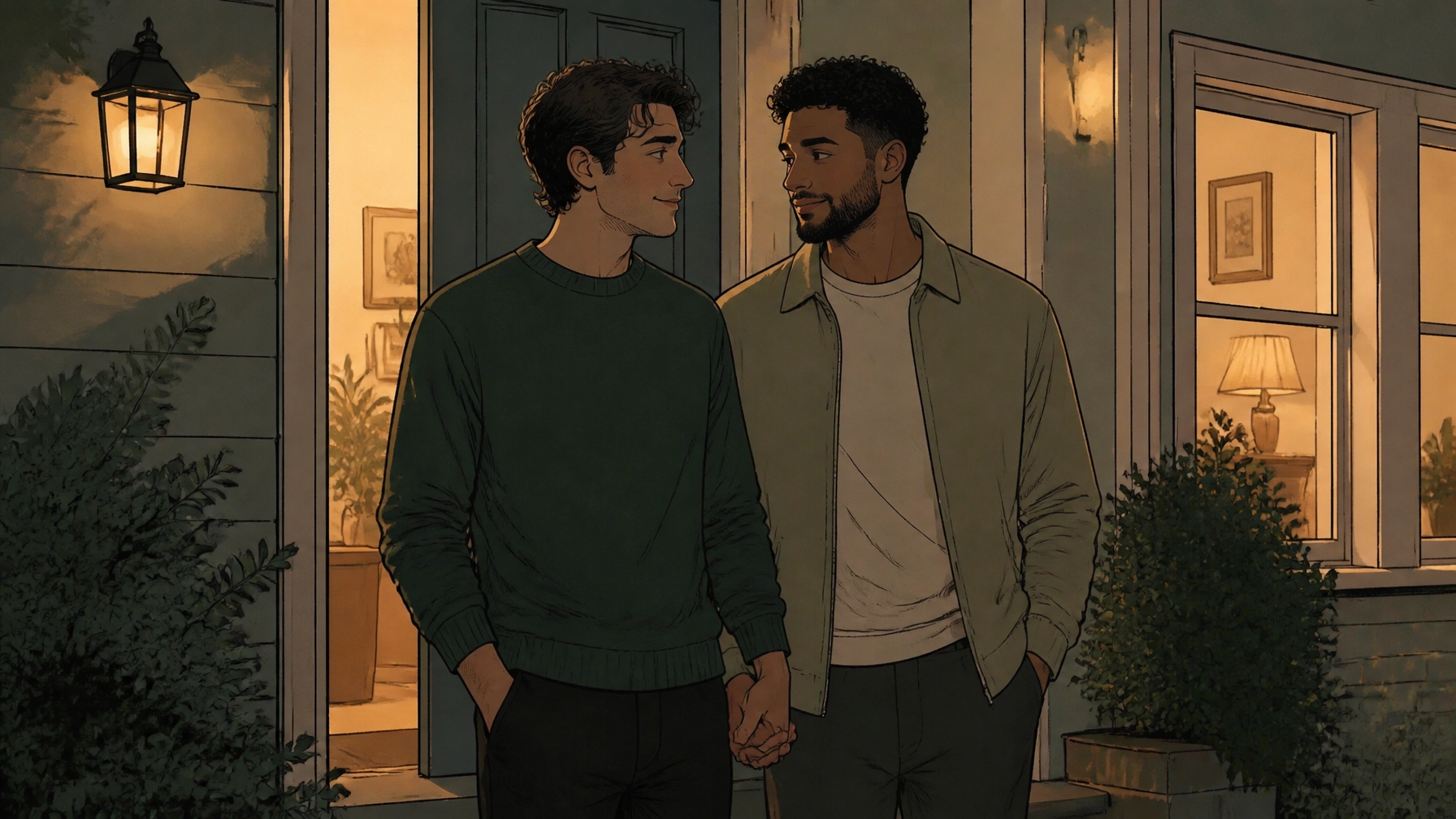
That night, walking home beneath a sky the colour of wet slate, Noah slipped his hand into Adrian’s.
He was still bisexual.
He was still loved.
Neither truth needed to cancel the other.
A Reflection on Bisexuality, Biphobia, and Being Seen
This kind of biphobia can be difficult to recognise because it often arrives disguised as acceptance. A family may welcome a man’s relationship with another man while refusing to acknowledge that he is bisexual. They may call it a phase, suggest he was “really gay all along,” or treat his current relationship as proof that his identity has changed.
But bisexuality is not determined by a person’s current partner. A man in an MM relationship is not less bisexual because he loves another man. His identity does not need to be debated, tested, or made more convenient for other people.
For emotionally invested MM readers, these quieter conflicts can carry enormous weight. A gay love story emotional journey is not always about external rejection. Sometimes it is about the pain of being welcomed conditionally: and the tenderness of loving someone without asking him to become simpler.
That is part of what makes character-driven queer fiction so powerful. In an emotional MM romance literary story, the central question may not be whether two men love each other. It may be whether they can build a relationship where both men remain fully visible inside that love.
Sometimes MM romance grows in unexpected places: around a crowded family table, in a difficult conversation, or in the silence after a joke that should never have been made. These are MM romance unexpected places, where identity, loyalty, and emotional courage meet.
Read with Pride
Read more LGBTQ+ stories, gay fiction, queer fiction, MM novels, gay love stories, and emotional MM books at Read with Pride.
You can also explore Dick Ferguson’s available MM romance and LGBTQ+ ebooks, created for readers who value lyrical prose, complicated characters, and emotionally honest relationships.
If you missed the previous instalment in this series, read “When One Man Wants to Move Abroad and the Other Fears Starting Over”.
Three Fresh Ideas for the Next Instalment
-
When His Partner’s Friends Treat Bisexuality as a Threat : two men confront suspicion, jealousy, and the fear that a bisexual identity must mean an unstable relationship.
-
When Coming Out Happens Again and Again : an MM couple navigates the exhaustion of correcting assumptions in a new workplace, neighbourhood, and friendship group.
-
When His Family Apologises but Still Wants Him to Stay Quiet : a bisexual man decides what genuine acceptance requires, while his partner learns that reconciliation cannot come at the cost of silence.
Follow us on social media
Follow Dick Ferguson for more character-driven queer fiction, gay romance books, MM fiction, LGBTQ+ reading, and emotionally immersive stories:
#Bisexuality #Biphobia #BisexualErasure #MMRomance #GayRomance #QueerFiction #GayFiction #LGBTQFiction #MMFiction #GayLoveStories #EmotionalMMRomance #CharacterDrivenFiction #QueerLifeAndIdentity #LGBTQReading #ReadWithPride #ReadingWithPride


Leave a Reply
You must be logged in to post a comment.