

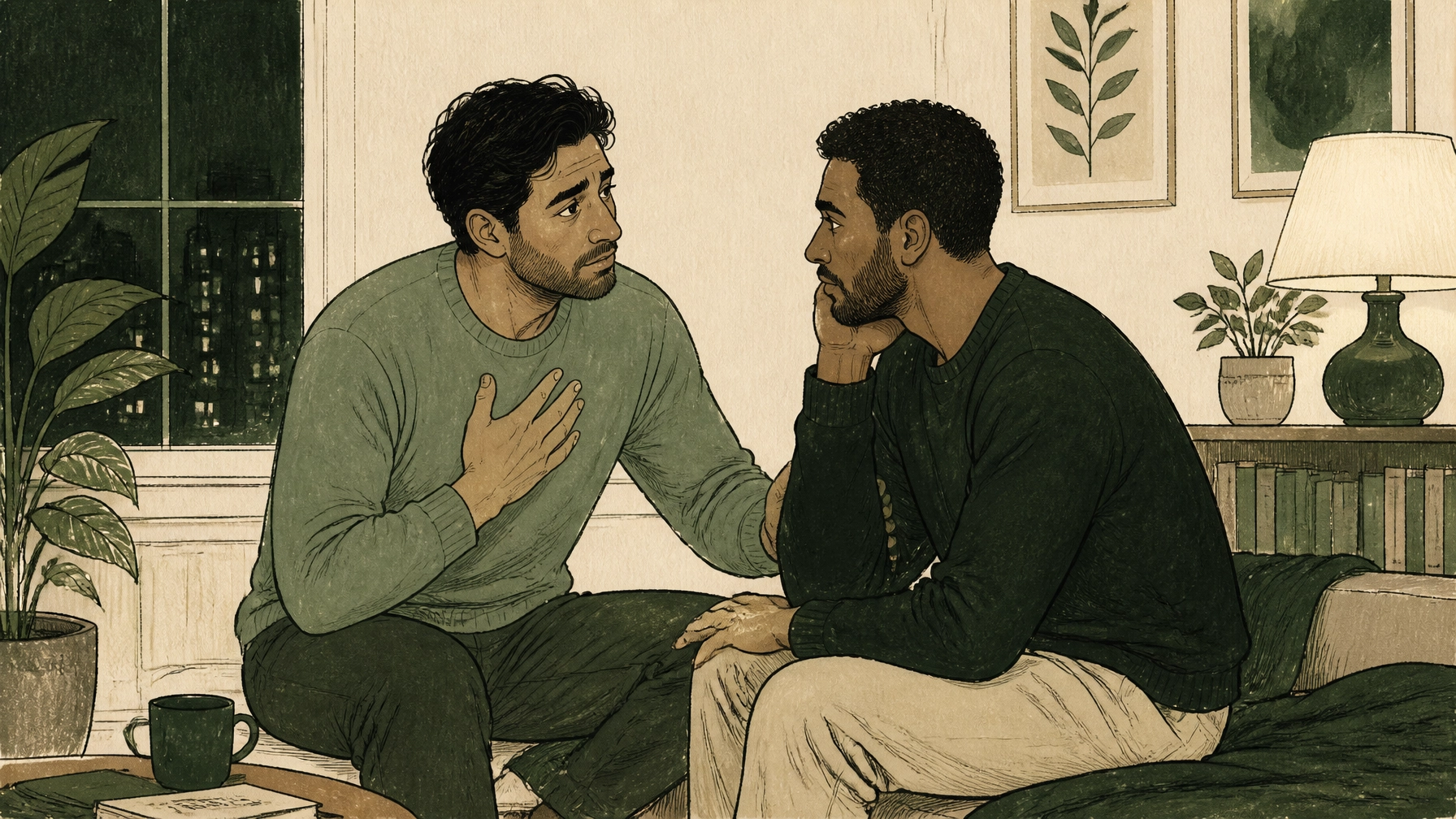
By half past nine, the rain had turned the windows into mirrors.
Eli could see the room reflected in the dark glass: the abandoned wineglass on the table, the lamp burning low beside the sofa, the blue-grey shape of Rowan standing with his back to him. Beyond the window, the city was all wet pavement and smeared lights. Inside, there was only the silence they had made together.
It had begun with something small.
A name on Rowan’s phone. A message Eli had glimpsed while Rowan was washing his hands. Nothing intimate, nothing secretive, only a line from someone they both knew, followed by a laughing emoji. The kind of ordinary exchange that should have passed unnoticed.
Instead, jealousy had entered the room like smoke.
Eli had asked too quickly. Rowan had answered too calmly. That calmness had felt like dismissal, and dismissal had reached into the oldest, most tender part of Eli’s pride.
Then came the accusation.
Then the raised voice.
Then the sentence Eli wished he could pull back into his mouth and bury.
“You like making me feel replaceable.”
Rowan had gone still.
Not angry at first. Just wounded. The sort of wounded that did not announce itself. The sort that lowered its eyes and began quietly gathering every broken piece.
Now, three hours later, Rowan stood by the window with his arms folded across his chest.
Eli sat on the edge of the sofa, his palms damp against his knees. He had spent the last hour constructing arguments. He could explain where the fear had come from. He could describe the old betrayals, the years of being made to feel too much and never enough. He could tell Rowan that the message had touched a nerve, that jealousy was not proof of mistrust but proof of how deeply he cared.
Every explanation had sounded, in the privacy of his mind, like a defence.
And beneath every defence waited the same small, ugly word.
But.
I’m sorry, but you were distant.
I’m sorry, but you knew how that looked.
I’m sorry, but I was afraid.
The word stood between them like a locked door.
The pride that keeps us from saying sorry
Pride rarely feels like pride when we are inside it.
It feels like dignity. Self-protection. The right to be understood before we are expected to understand anyone else. It tells us that if we apologise first, we will lose something. Authority. Safety. The upper hand.
For Eli, pride had always worn the disguise of self-respect.
He had told himself he was refusing to beg. He had told himself that Rowan should be the one to come closer, because Rowan was the one who had caused the insecurity. He had told himself that love did not mean accepting every discomfort without protest.
All of those things contained a fragment of truth.
None of them changed what he had done.
He had turned his fear into an accusation. He had made Rowan responsible for reassuring him while offering no tenderness in return. He had used the sharpest version of his hurt as though pain gave him permission to cause more of it.
The difficult part was not recognising his jealousy.
The difficult part was admitting that jealousy had become an action.
It had become the way he spoke. The way he watched Rowan. The way he searched for evidence after the evidence had disappeared. The way he had made love feel like a room where Rowan had to prove he belonged.
Eli looked down at his hands.
“Rowan.”
Rowan did not turn around.
Eli felt the familiar impulse to fill the silence. To explain. To say something clever enough to soften what had happened. Instead, he breathed through the pressure in his chest.
“I’m sorry.”
The words sounded smaller than he expected.
Rowan’s shoulders moved, barely.
Eli kept his eyes on the floor. “I’m sorry I accused you. I’m sorry I treated an ordinary message like evidence of something you were hiding. I’m sorry I made you defend yourself against something that wasn’t happening.”
The rain tapped against the glass.
“I was jealous,” Eli continued. “I was frightened, and I let that fear become cruel. I said something designed to hurt you because I wanted you to feel how afraid I was. That was wrong.”
His throat tightened.
“I made you feel distrusted and replaceable. I know you didn’t deserve that. I take responsibility for it.”
There it was again: the open space where but might have gone.
Eli could feel it waiting behind his teeth.
He did not let it out.
A true apology leaves room for the other person
Rowan turned then.
His face was tired. The anger had not vanished. Neither had the hurt. Eli understood, suddenly, that a sincere apology was not a key that opened the door to immediate forgiveness. It was not a transaction. It did not purchase closeness.
It simply stopped making the wound deeper.
“You always say you were afraid,” Rowan said.
“I know.”
“And then you make your fear my fault.”
Eli nodded once. “I know.”
The answer cost him more than any explanation would have.
Rowan’s mouth tightened. “You don’t get to call it love when you’re punishing me for being loved by other people.”
Eli looked up.
There were a hundred ways to resist that sentence. He could say Rowan had misunderstood him. He could point out that he had never meant to punish him. He could insist that his jealousy came from devotion, not malice.
Instead, he said, “You’re right.”
The room seemed to change shape around them.
Not because everything was repaired. It was not. The hurt remained, visible in Rowan’s face and in the careful distance between them. Yet the argument had stopped asking to be won.
“I don’t want to keep doing this,” Eli said. “I don’t want to make you smaller so I can feel secure. I don’t want you to have to manage my fear for me.”
Rowan sat in the armchair opposite the sofa. He did not invite Eli to come closer, and Eli did not move.
“What will change?” Rowan asked.
It was the question beneath every apology.
Not Do you regret hurting me?
Will I have to survive this again?
Eli considered the easy answers. I’ll do better. I’ll trust you. It won’t happen again.
They were promises without architecture.
“I need to stop treating the first feeling I have as the truth,” he said. “When I feel jealous, I’m going to tell you I’m scared instead of accusing you. If I’m too angry to speak without attacking, I’ll say I need time and come back to the conversation. I’ll find someone to talk to about where this comes from, because I can’t keep asking you to carry it.”
Rowan watched him carefully.
“And if I make a mistake?”
“Tell me. I’ll listen without trying to win.”
The promise felt frightening because it was specific. It gave him nowhere to hide.
Staying is harder than walking away
There is a particular temptation in leaving after a fight.
Walking away can look like strength. It can preserve the fantasy that we were the wronged one, the reasonable one, the person who loved more honestly. Distance can polish the story until we are innocent inside it.
Staying is less flattering.
Staying means remaining in the room while the other person describes the damage. It means hearing the parts of ourselves we prefer to call misunderstandings. It means allowing love to become more important than the performance of being right.
For Rowan, staying did not mean forgetting.
For Eli, apologising did not mean being absolved.
They sat in the same room with those truths.
At last, Rowan said, “I need you to understand something. I can reassure you. I can tell you where I am and what I feel. I can be patient. I cannot prove my love every time your fear asks for evidence.”
Eli nodded. “You shouldn’t have to.”
“And I won’t accept being spoken to like that again.”
“You shouldn’t.”
Rowan looked toward the rain-streaked window. “I’m still angry.”
“I know.”
“I’m still hurt.”
“I know.”
“I love you.”
Eli closed his eyes for a moment.
The words did not erase the argument. They did not turn the evening beautiful. They arrived with the weight of something chosen carefully, something offered without surrendering the truth.
“I love you too,” Eli said.
This time, when silence came, it was not a weapon.
It was a place for both of them to breathe.
The apology that changes the shape of love
A clean apology does not ask the injured person to comfort the person who caused the injury. It does not hide an accusation inside an explanation. It does not say, I’m sorry you felt that way, or I’m sorry, but you made me do it.
It names the action.
It recognises the impact.
It accepts responsibility.
Then it makes room for change.
That does not guarantee reconciliation. Some relationships cannot be repaired, and no one owes forgiveness simply because an apology has been offered. But where love remains — and where both people are willing to be honest — an apology without excuses can become a turning point.
Not a grand gesture.
Not a dramatic promise.
A quieter thing.
A man sitting across from the person he loves, swallowing his pride, and refusing to make his fear someone else’s punishment.
Later, Rowan moved to the sofa.
He did not touch Eli immediately. First, he sat beside him, leaving a careful space between their shoulders. The distance was still there, but it no longer felt like a wall. It felt like a boundary. A truth. Something they could cross slowly, if they treated each other gently.
After a while, Rowan placed his hand on the cushion between them.
Eli looked at it.
Then he placed his own hand beside it, not over it. An offering rather than a claim.
Rowan closed the distance.
Outside, the rain kept falling. The city carried on with its bright windows and restless traffic. Inside, two men sat together in the difficult aftermath of honesty, learning that staying was not the absence of fear.
It was what they did with fear once it arrived.
And sometimes love began again in the space after the word but.
For more emotionally immersive MM romance, heartfelt gay fiction, character-driven MM novels, and LGBTQ+ ebooks for readers who value tenderness alongside conflict, visit Read with Pride. You can also explore Dick Ferguson’s books on Read with Pride.
Three Evening Edition ideas for your next read
-
The First Morning After Forgiveness : Two men wake after reconciliation and discover that forgiveness is not a finish line, but a new way of speaking.
-
The Jealousy That Asked to Be Named : A character-driven MM romance about the difference between wanting reassurance and demanding proof.
-
The Door He Left Unlocked : When one man finally stops running from difficult conversations, his partner must decide whether trust can be rebuilt one honest moment at a time.
Follow us on social media
Follow us for new writing, emotionally charged gay novels, LGBTQ+ fiction, MM romance books, and reading recommendations:
#MMRomance #GayRomance #QueerFiction #GayFiction #LGBTQPlusFiction #MMNovels #GayLoveStories #EmotionalMMBooks #AngstRomance #CharacterDrivenRomance #GayLiterature #ReadingWithPride


Leave a Reply
You must be logged in to post a comment.