

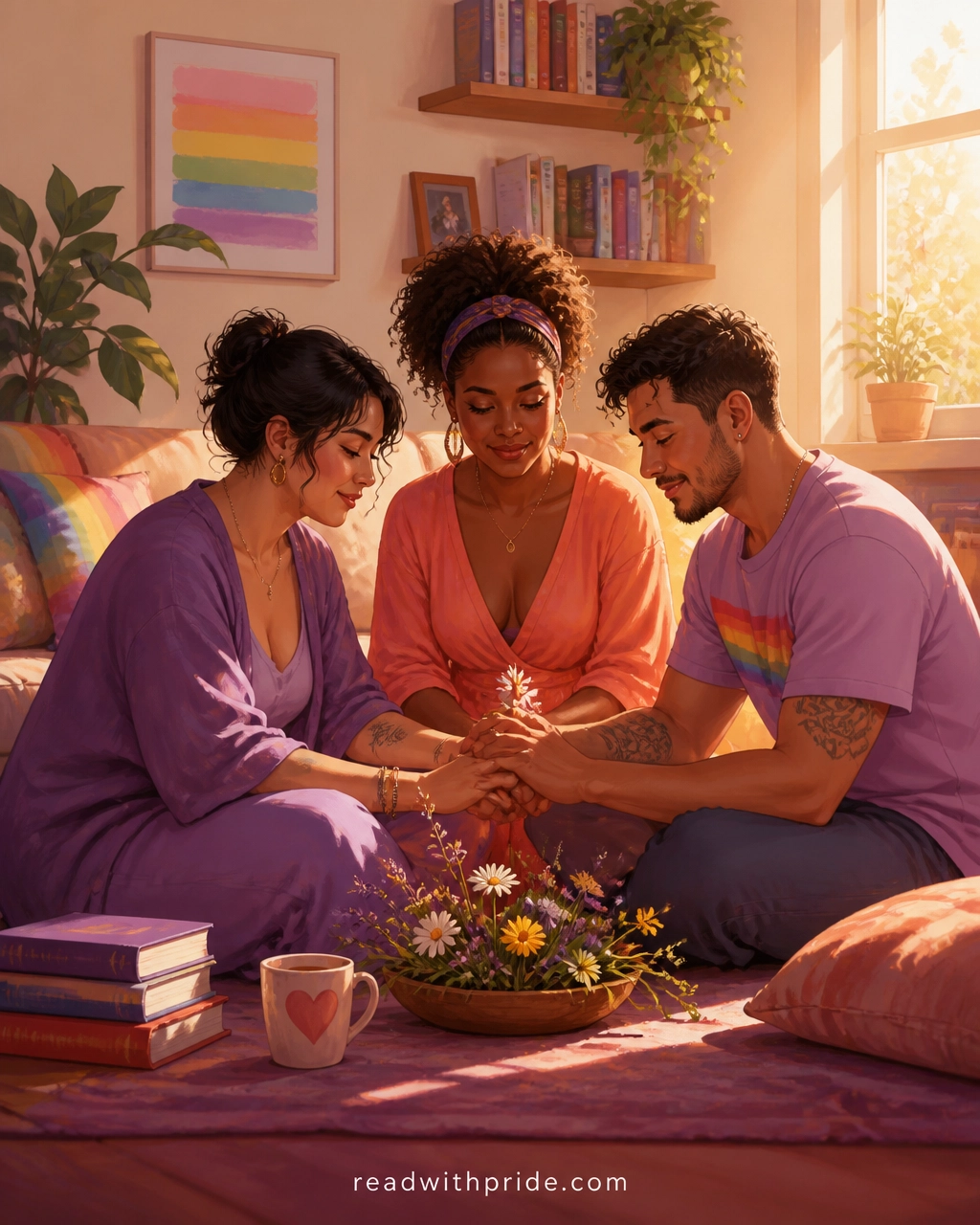
Sunday can feel like a room with the lights turned low. The week has finally stopped demanding answers, but the quiet may leave more space for what we have been carrying: a goodbye, an old wound, a family relationship that never became what we hoped, or the ache of a future that once seemed possible.
This is where queer healing begins, not with pretending everything is fine, but with making room for the truth.
Grief is not a failure of optimism. It is evidence that something mattered. A person, a relationship, a home, a version of yourself, a dream of safety: when we grieve, we are acknowledging the shape of what we loved and lost.
For LGBTQ+ people, grief can be complicated by the losses that are visible and the ones that are not. We may grieve time spent hiding, the support we should have received, the family we had to leave, or the years we spent believing that a fulfilling life was not meant for us. Sometimes we grieve while still sharing a room with the people who hurt us. Sometimes we grieve a version of ourselves who did the best they could with very little information and even less protection.
There is no perfect timetable for any of this.
Let grief be sacred without letting it become the whole story
“Sacred grief” does not have to mean solemn rituals or a particular kind of spirituality. It can simply mean treating your sadness with respect.
It means saying: This mattered to me.
It means not rushing to tidy up the feelings because someone else is uncomfortable. It means understanding that healing does not require you to turn a painful experience into a neat lesson before you are ready.
You can be grateful for where you are now and still miss what, or who, you lost. You can be proud of your survival and exhausted by the work of surviving. You can be hopeful about the future while having a difficult Sunday.
That complexity is not a contradiction. It is a very human form of LGBTQ+ resilience.

A gentle Sunday practice for queer healing
If today feels tender, try this small, low-pressure ritual. You do not need special supplies. A cup of tea, a notes app, or the back of an old envelope will do.
1. Name one grief
What loss is asking to be acknowledged?
You do not need to explain it perfectly. Try a simple sentence:
- “I miss the person I thought I would become.”
- “I am grieving the family support I deserved.”
- “I am sad that this relationship could not be safe.”
- “I miss feeling at home in my own life.”
Naming grief can make it feel less like a fog filling the whole room. It gives the feeling an outline. Sometimes that is enough for one day.
2. Name one source of care
Who or what helps you feel a little more held?
It might be a chosen family member, a partner, a neighbour, a therapist, a group chat, a pet, a walk, music, prayer, art, or a story that makes you feel less alone. Care does not have to be dramatic to count. Someone remembering your pronouns counts. Someone making you food counts. Turning off your phone before you reach burnout counts.
Rest is not a reward you have to earn.
3. Name one future possibility
This is not a five-year plan. It is not a demand to become a shining, fully healed version of yourself by next Thursday.
Choose one small possibility:
- A home where you can relax without explaining yourself.
- A friendship that feels mutual and dependable.
- A body-neutral morning routine.
- A boundary you are ready to practise.
- A creative project that belongs only to you.
- A Sunday meal shared with people who understand.
These small possibilities are the building blocks of future visions. They help us imagine queer futures that are not only about resisting harm, but about experiencing pleasure, safety, belonging, and ordinary joy.
The future does not have to be perfect to be worth building
When we talk about hopeful queer futures, it can be tempting to imagine a flawless world where nobody is rejected, misunderstood, lonely, or afraid. That vision can be beautiful, but it can also feel impossibly far away when your nervous system is tired.
A more useful future vision might be smaller and more specific.
Imagine a future where queer people can grow older without being treated as disposable. Where trans and nonbinary people are affirmed in every stage of life. Where disabled LGBTQ+ people are included in community spaces. Where coming out stories are not always framed as a dramatic final chapter, because coming out can be ongoing, ordinary, joyful, complicated, or not part of someone’s life at all.
Imagine a future with more room for queer rest.
A future with community care that does not depend on one endlessly generous person doing all the emotional labour. A future where mental health support is accessible, culturally aware, and affirming. A future where chosen families are respected as families, not treated as substitutes.
This is the heart of LGBTQ+ resilience: not simply enduring what happens to us, but creating conditions where fewer people have to endure it alone.

Stories can help us practise a more spacious future
Reading cannot erase grief. A book cannot replace community, professional support, or the practical work of making life safer. But stories can give language to feelings that have been difficult to name.
That is one reason queer fiction matters.
A tender novel can remind us that queer people deserve softness, not only survival plots. A complicated character can make space for anger, desire, uncertainty, and change. A romance can show love as something built through communication and care, not a prize awarded to the most self-sacrificing person in the room.
At Read with Pride, readers can find gay fiction, LGBTQ+ novels, lesbian romance, MM romance books, and gay romance novels that explore connection in all its messy, hopeful forms. Some stories offer escape. Some offer recognition. Some offer the emotional equivalent of sitting beside a friend and saying, “Yes. I understand why that hurt.”
There is room for every kind of queer reading life: queer love stories, coming out stories, joyful adventures, difficult family narratives, steamy romances, and reflective books that stay with you long after the final page.
Whether you are looking for LGBTQ+ fiction 2026, browsing for a queer book club pick, or following a wonderfully specific search such as C Section 2026, curiosity is allowed to lead the way. There is no single correct way to be a queer reader.

A future postcard for the person you are becoming
Before the day ends, try writing a postcard from one ordinary future day.
Do not make it grand. Describe a morning when you feel safe enough to be unguarded. Who is nearby? What does your home sound like? How is your name spoken? What are you eating? What makes you laugh? What has become easier: not perfect, just easier?
Maybe your future self is sitting at a crowded table with chosen family. Maybe you are living alone and loving the quiet. Maybe you are in a relationship, or maybe you are delighted not to be. Maybe you are reading, creating, travelling, gardening, dancing, resting, or learning how to receive care without immediately trying to repay it.
Let the vision belong to you.
The point is not to use hope to skip over grief. The point is to let grief and hope sit beside each other without either one having to apologise. One tells you what mattered. The other reminds you that your story still has room to grow.
On this Sunday, may you be gentle with what you carry. May you find one person, practice, or page that helps you feel less alone. And may the tomorrow you are building be spacious enough for your whole self.
Ready to find a story that meets you where you are? Explore Read with Pride for LGBTQ+ ebooks, heartfelt gay fiction, lesbian romance, MM romance, and more queer stories made for readers who want representation, emotional depth, and room to imagine what comes next: readwithpride.com.
You can also follow the conversation on Facebook and Instagram.
#QueerHealing #FutureVisions #LGBTQResilience #ReadWithPride #MMRomanceBooks #GayRomanceNovels #QueerFiction #LGBTQFiction2026 #QueerBookClub #ComingOutStories #GayFiction #LGBTQNovels #QueerLoveStories #CSection2026

Leave a Reply
You must be logged in to post a comment.