

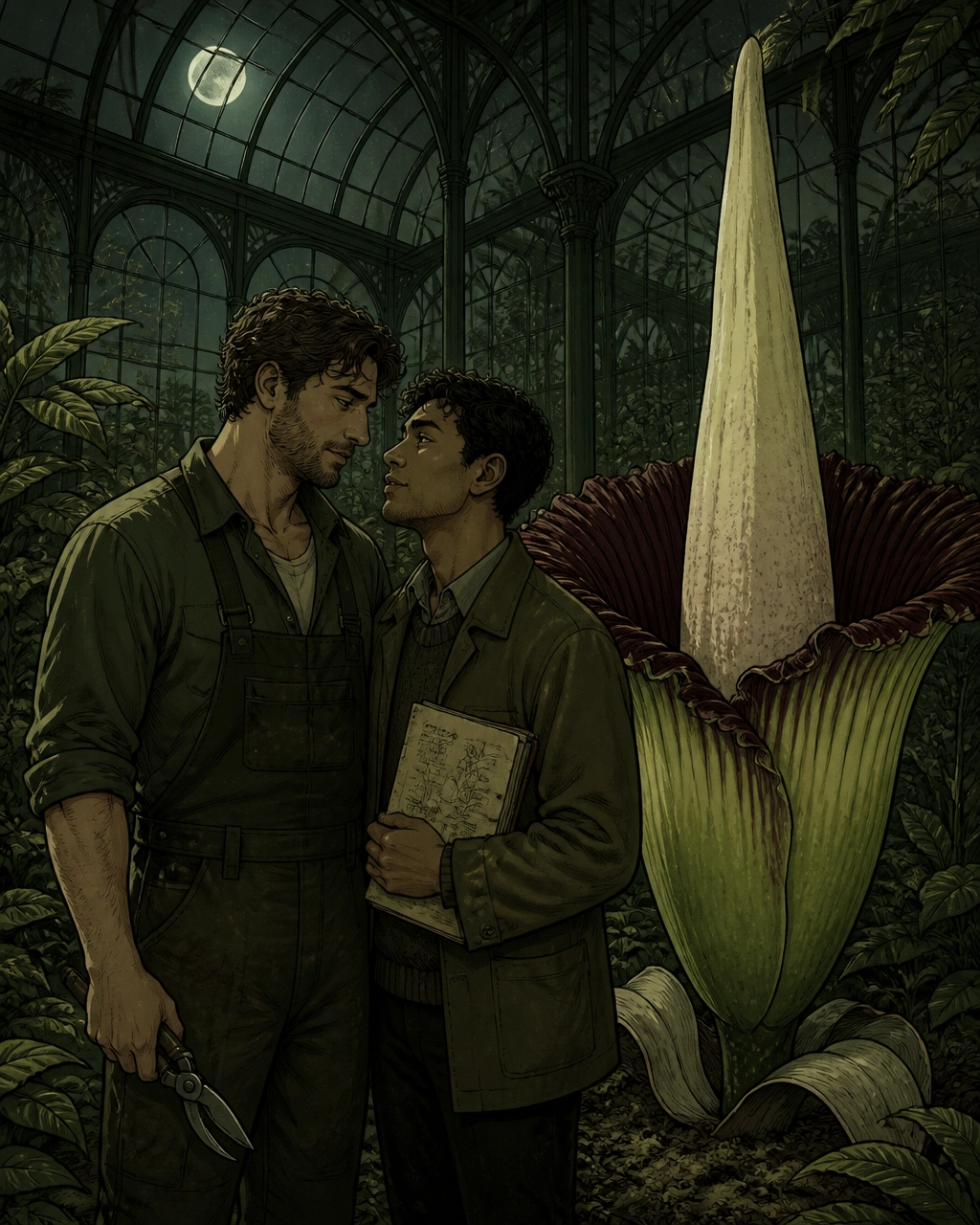
The conservatory after midnight
At night, the old city conservatory belonged to the plants.
The daytime visitors had gone. The school groups, the tourists, the couples taking photographs beneath the iron ribs of the glass roof, all had dissolved into the streets beyond the gates. What remained was the soft machinery of survival: condensation slipping down panes, pipes ticking as they cooled, leaves breathing in the dark.
Elian preferred it that way.
He worked the night shift in the rare-plant wing, where the air was kept warm and damp and every shadow seemed to contain a secret. He knew which orchids opened only after sunset. He knew how much water a fern could hold before its roots began to suffer. He knew how to recognise a plant in distress by the angle of a leaf.
Plants were easier than people.
Plants did not ask him to explain the parts of himself he had spent years concealing. They did not look at him with sudden understanding and make him wonder what, exactly, they had seen.
For most of his life, desire had been something to hide. His bisexuality had remained a locked room inside him, a fact without a witness. Wanting men had taught him that being seen could be dangerous. Wanting anyone at all had seemed like an invitation to be wounded.
So Elian had learned to tend living things without allowing them close.
Then the corpse flower began to prepare itself for blooming.
The promise left behind
Jonah returned to the conservatory carrying his father’s old field notebook.
The notebook was swollen from years of use, its corners softened and darkened by weather. Inside were sketches of leaves, measurements of stems, observations written in a narrow, patient hand. The final pages belonged to the titan arum: Amorphophallus titanum, the corpse flower that Jonah’s father had planted nearly a decade earlier.
His father had always promised they would watch it bloom together.
“Some things need time,” he used to say. “You can’t hurry a living world.”
Jonah had believed him. He had believed there would be another season, another birthday, another conversation at the kitchen table. He had believed grief belonged to some distant future.
Now his father was dead, and the plant was pushing upward through its long darkness.
The conservatory announced that the bloom might open within days. Jonah came after closing, when Elian found him standing outside the rare-plant wing with the notebook pressed against his chest.
“You can’t stay in here overnight,” Elian said.
“I know.”
Jonah looked at the flower’s tightly furled spathe, the tall bud wrapped in green and waiting beneath the glass.
“My father planted it,” he said. “He wanted to see this.”
Elian glanced at the notebook.
“Then you should.”
It was not permission. Not quite.
But he unlocked the door.
The waiting room of the living
For three nights, nothing happened.
The flower grew by inches. Its protective bracts dried and loosened. The maroon edge beneath them became visible, dark as bruised fruit. Elian recorded the changes in his logbook. Jonah sat on the wooden bench nearby and copied his father’s notes into the margins of the old notebook.
They became companions by increments.
Elian brought coffee. Jonah brought bread wrapped in paper. They shared the quiet without trying to fill it. Sometimes the conservatory seemed less like a workplace than a waiting room built for the living: a place where time slowed, where the body could admit what the mind had postponed.
Jonah spoke first about his father.
“He understood plants better than he understood me,” he said one morning.
Elian looked across the bench. “That sounds painful.”
“It was. He could name every weakness in a stem. He could tell when a leaf had been damaged before it unfurled. But when I tried to tell him about myself, I always felt like I was speaking in a language he hadn’t learned.”
The confession settled between them.
Jonah had come out quietly, in pieces. A friend. A message. A conversation that ended before he had said everything he meant to say. His father had known something was changing, perhaps, but death had arrived before certainty.
“I don’t know whether he would have understood,” Jonah said. “That’s the part I can’t forgive. I don’t know if I was brave enough to tell him, or if I was only waiting for him to make it safe.”
Elian’s hands tightened around his coffee cup.
“I know something about waiting for safety,” he said.
What the flower asks of them
On the fourth night, the spathe began to open.
The rare-plant wing filled with a colour that seemed almost alive: deep wine, black-red, the shade of a wound remembered too long. The tall spadix rose from its centre like a pale column. Beneath the spectacle, the plant’s hidden flowers waited to perform their brief, necessary work.
The corpse flower was not delicate.
It did not offer beauty politely. It announced itself through heat and smell. The spadix warmed inside the conservatory, and the air took on an unmistakable scent of decay, rotting fish, sour earth, something animal and ancient.
Jonah covered his mouth.
Elian laughed softly for the first time.
“That’s the city coming to see it,” he said.
Beyond the glass, distant footsteps gathered. The bloom had drawn people from across the city, all of them willing to stand in the presence of something beautiful precisely because it was strange, temporary and a little repellent.
The flower’s perfume travelled through the old building like a challenge.
Look at me.
Look at what I am.
Do not ask me to become sweeter before you call me beautiful.
Jonah turned toward Elian.
“Is that why you like plants?”
Elian’s expression closed.
“I like that they don’t need me to pretend.”
“People ask you to pretend?”
“Sometimes they don’t ask. Sometimes you learn to do it before they have the chance.”
For a while, there was only the smell and the soft hum of the conservatory.
Then Elian said, “I’ve wanted men. I’ve wanted women. I’ve spent years acting as if wanting either one made me dangerous.”
Jonah did not reach for him immediately. That was part of the mercy.
Instead, he said, “You’re not dangerous because you can feel something.”
Elian looked at him as if the sentence had entered through a locked door.
The first morning
The bloom lasted less than two days.
At its peak, the city seemed to lean toward the conservatory. The flower’s heat faded. Its scent thinned. The maroon spathe began to fold inward, its grandeur collapsing with the quiet inevitability of a tide going out.
Jonah stood beside Elian in the grey light before dawn.
“My father thought the bloom was the reward,” he said.
“Wasn’t it?”
“I think he was wrong.”
Elian waited.
“The waiting was part of it. The years when nothing seemed to happen. The plant gathering what it needed in the dark.”
Elian looked at the folded flower. “That doesn’t make the dark good.”
“No,” Jonah said. “But it means it wasn’t empty.”
The words reached somewhere in Elian that had remained untouched for years.
He had thought his hidden life was wasted time. He had mistaken silence for failure. He had believed that if love did not arrive openly, it did not count as love at all.
Jonah’s hand found his.
Not dramatically. Not like a declaration made for an audience. Their fingers simply met beside the dying bloom, warm and uncertain, and stayed together.
Some love asks to be witnessed before it feels real.
Some love arrives where no one expected to find it: beneath old glass, among wet leaves and the sour breath of a flower designed to imitate death. This is the heart of an MM romance in unexpected places: not the promise that pain will disappear, but the possibility that two men can stop disguising the shapes their lives have taken.
The corpse flower would sleep again.
It might take years to gather enough strength for another bloom. But the dark beneath the soil would not be nothing. It would be preparation. Memory. A patient insistence on becoming.
And when the time came, it would open without apology.
Read with Pride
For readers drawn to a gay love story with an emotional journey, character-driven queer fiction, and emotional MM romance literary in tone, this Morning Edition story is a reminder that the deepest transformations are rarely witnessed at the moment they begin.
Explore more LGBTQ+ ebooks, gay novels, MM fiction and queer fiction through Read with Pride. You can also discover Dick Ferguson’s emotionally immersive stories in the Dick Ferguson e-book store, where emotionally invested MM readers can find heartfelt gay fiction, gay romance books and literary MM novels shaped by vulnerability, longing and resilience.
Three Possible Next Morning Edition Stories
-
The Last Lighthouse Fog Signal
Two men meet at a remote coastal archive where one is cataloguing the final recordings of a lighthouse that has already gone dark. As they listen through years of weather and warning, they confront the messages they never sent to the people they loved. -
The Museum of Unclaimed Voices
A guarded sound-restoration specialist and a grieving visitor spend one night preserving anonymous cassette recordings found in a demolished apartment building. Among the voices, they discover fragments that echo their own hidden histories. -
The Orchard That Blossomed in Winter
Two men shelter overnight in a historic glasshouse where a single ancient fruit tree has flowered months out of season. As snow gathers outside, they consider whether a life that blooms late is any less true.
Follow us on social media
Follow Dick Ferguson for new reflections, literary MM romance, gay book recommendations and updates from the world of Read with Pride:
#ReadWithPride #ReadingWithPride #LGBTQBooks #GayBooks #MMRomance #GayRomance #QueerFiction #GayFiction #GayNovels #GayLoveStories #MMNovels #LGBTQFiction #GayLiterature #MMFiction #GayRomanceBooks #MMRomanceBooks #LGBTQRomance #GayAuthors #QueerAuthors #MMAuthors #EmotionalMMRomance #CharacterDrivenFiction #LiteraryRomance #GayBookRecommendations


Leave a Reply
You must be logged in to post a comment.