

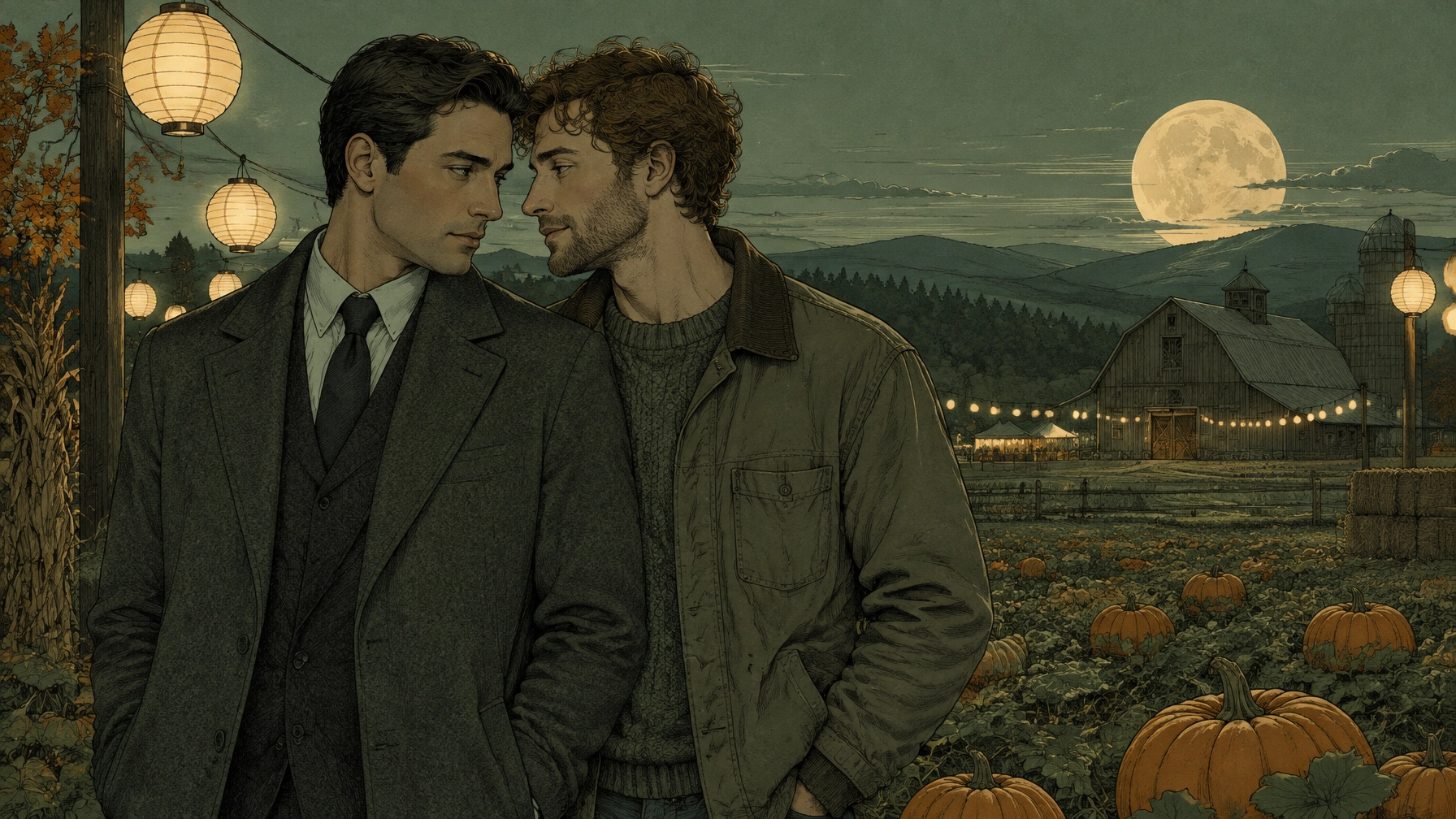
There were two kinds of darkness between the city and the farming town.
The first belonged to the road: the long, unbroken black beyond the headlights, where fields gathered at either side and the occasional farmhouse showed one amber window before vanishing again.
The second belonged to Daniel.
He carried it with him in the passenger seat, polished and expensive, like everything else he owned. It lived in the careful way he chose restaurants, in the way he answered difficult questions before anyone had finished asking them, in the quiet panic that rose whenever something he loved appeared vulnerable.
Tonight, the vulnerable thing was Rowan.
Rowan lived in a town that had one high street, two churches, a feed store, and a bakery whose windows fogged before sunrise. He made woodcuts, repaired old furniture, grew herbs behind his rented cottage, and sold his work at markets whenever the weather allowed. He had built his life in increments: one repaired chair, one commissioned illustration, one careful payment at a time.
Daniel loved him for that.
He also feared it.
At the edge of town, lanterns swung from ropes between apple trees. Their light moved over faces, stalls, baskets of late tomatoes, carved pumpkins, jars of honey, and hand-painted signs. The annual Harvest Moon Festival had begun before sunset, but the real celebration came later, when the moon rose over the fields and everyone gathered near the bonfire.
Rowan met Daniel beside a row of hay bales, wearing a dark green jacket with sawdust still caught at one cuff.
“You came,” he said.
It was a simple sentence, but Daniel heard everything beneath it: I hoped you would. I wasn’t sure you would. I wanted you here.
“I said I would.”
“You say a lot of things.”
Daniel smiled, but Rowan was already looking past him towards the stalls.
The town had dressed itself in abundance. There were red apples polished to a shine, pumpkins stacked like small orange planets, jars of cider warming over a portable stove, and tables crowded with things made by hand. Knitted scarves. Ceramic bowls. Woven baskets. Candles shaped like pears. Little paintings of barns under impossible skies.
Rowan’s own table stood near the fiddle players. His prints were clipped to a wooden frame, each one showing some fragment of the town: the river in winter, the old grain elevator, a fox crossing the road at dusk.
Daniel saw the loose corner of the tablecloth. He saw the battered cash box. He saw the way Rowan counted the first few notes he earned and slipped them into a separate envelope.
He saw the problem.
He immediately wanted to solve it.
“You should let me buy the whole display,” Daniel said.
Rowan looked at him. “Why?”
“Because I like them.”
“That isn’t what I asked.”
Daniel picked up a print of the river. “I could frame these properly. Put them in the apartment. Or the office. I know a gallery owner who, ”
“Daniel.”
The warning in Rowan’s voice was quiet. That made it worse.
Daniel set the print down. Around them, the festival continued: fiddle music rising and falling, people laughing beside a cider stand, children carrying lanterns shaped like stars. A gust moved through the trees, bringing the smell of woodsmoke and damp earth.
“I’m trying to help,” Daniel said.
“I know.”
There it was. The phrase that should have reassured him, and did not.
Daniel had always believed help was love with its sleeves rolled up. He paid bills before they became urgent. He arranged cars, called advisers, found better lawyers, sent money without being asked. When he came out, years ago, his first instinct had been to control the conditions of the disclosure: the right restaurant, the right words, the right person sitting opposite him.
He had thought safety could be purchased.
Later, when he understood that he was bisexual, he had carried a different kind of fear. Not fear of loving men. Fear of being accused of using them as an experiment, or an escape, or another private luxury. Rowan knew this. He knew how hard Daniel had worked to become honest.
But honesty did not automatically make him gentle.
Daniel moved through the festival as though it were a series of emergencies. He bought Rowan’s cider before Rowan could reach for his wallet. He offered to pay a farmer for the repair of the community barn roof. He asked how much Rowan owed on his studio tools, then said the amount was “manageable”.
At a stall near the bonfire, he saw a quilt folded over a chair.
It was made from scraps of green, rust, cream, and faded blue. The stitches were uneven in places, but the pattern had a quiet, stubborn beauty.
“How much?” Daniel asked.
Rowan’s face changed.
“Don’t.”
“I’m asking the seller.”
“You’re not buying that.”
“Why not?”
“Because I made it.”
Daniel turned back to him.
Rowan touched the quilt with two fingers. “It took me four months.”
“Then I’ll pay you fairly.”
The words landed between them like something dropped and broken.
The fiddle music carried on. Someone cheered near the pumpkin toss. The moon, pale and enormous, had begun to lift above the dark line of the fields.
Rowan folded the quilt carefully.
“You think I’m a problem you can afford,” he said.
Daniel felt heat rise beneath his collar. “That’s not fair.”
“No. It isn’t.” Rowan looked at him fully now. “You come here and see the things I’m struggling with. You see the rent, the tools, the work that doesn’t sell quickly enough. You see me refusing to ask you for money, and instead of hearing that refusal, you treat it like an obstacle.”
“I’m not trying to control you.”
“You don’t have to try.”
The truth of it moved through Daniel with a coldness that the night could not explain.
Rowan stepped away from the lantern light. Daniel followed him past the stalls and into the pumpkin field, where the festival sounds softened behind them. The ground was uneven beneath their shoes. Rows of vines curled through the soil, their leaves silvered by moonlight.
“I love you,” Daniel said.
Rowan looked towards the bonfire. “I know.”
“Then why does everything I do feel wrong?”
“Because you keep giving me things I haven’t asked for.”
Daniel had no answer.
Rowan’s shoulders lowered. Anger had left him tired. Beneath it was something more fragile.
“When I came out,” he said, “I lost my family’s idea of who I was. Not everyone. Not all at once. But enough. I learned very early that accepting help could become a debt. A place to sleep became an obligation. A favour became a reason someone believed they could make decisions for me.”
Daniel listened.
“I built this life because I needed to know it was mine,” Rowan continued. “The studio. The prints. The quilt. Even the stupid table that wobbles. I know it doesn’t look like much to you.”
“It looks like everything.”
“Then stop trying to improve it before you understand it.”
Daniel looked down at his hands. They were clean, manicured, unmarked by the work Rowan did every day. He thought of all the times he had mistaken his ability to pay for proof that he was capable of caring.
“I was jealous,” he admitted.
Rowan frowned. “Of what?”
“Of this place. Of the people who know you here. Of the fact that you belong to something I can’t buy my way into.” He swallowed. “I thought if I made myself useful, you wouldn’t notice how afraid I am that you’ll realise you don’t need me.”
Rowan’s expression softened, but he did not move closer.
“Needing someone isn’t the same as loving them,” he said.
“I know.”
“Do you?”
Daniel looked towards the moon. It had cleared the treeline now, bright enough to reveal the paths between the pumpkins.
“No,” he said. “But I want to learn.”
For a while, neither man spoke.
Then Daniel asked, “What would help?”
Rowan studied him. “That’s better.”
“Is it?”
“It’s a beginning.”
They returned to the bonfire together. Daniel did not buy the quilt. He did not buy the prints. He did not offer to repair the table or pay for the studio.
Instead, he asked Rowan whether he could sit beside him.
Rowan said yes.
Later, when the fire had burned down to a bed of red coals, Rowan placed the quilt across both their knees. The fabric held the faint scent of cedar, wool, and the soap he used at home. Its weight was modest. It did not transform the night. It did not solve the future.
It simply rested there.
Daniel understood, at last, that this was the difference between rescue and intimacy. Rescue arrived with an answer. Intimacy arrived with attention.
A gift given without a question could become a demand in disguise: See what I have done for you. Let me decide what you need. Let my generosity prove that I am safe to love.
But love was not a transaction. It was not a performance of usefulness. It was the willingness to offer, then remain free to hear no.
Rowan leaned against him as the last fiddle song began.
Daniel did not reach for his wallet.
He reached for Rowan’s hand.
And this time, Rowan reached back.
A Note from Read with Pride
For readers who love emotional MM romance, character-driven gay novels, heartfelt gay love stories, and queer fiction that explores identity, vulnerability, jealousy, and the difficult work of learning to love well, discover more from Dick Ferguson through the Dick Ferguson e-book collection on Read with Pride.
Read with Pride celebrates LGBTQ+ ebooks, gay literature, MM fiction, LGBTQ+ romance, gay romance books, and stories about men finding the courage to live honestly. Visit the Read with Pride home page to explore more queer authors, gay eBooks, LGBTQ+ fiction, and new gay releases.
Three Possible Next Evening Edition Stories
-
The Lighthouse Keeper’s Key : How Two Men Learned That Being Let In Is Not the Same as Being Rescued
A guarded city architect arrives on a storm-battered island and discovers that the lighthouse keeper he loves will not mistake concern for ownership. -
The Night Market in Marrakech : When Jealousy Finally Admitted It Was Afraid
Two bisexual men navigate old insecurities, crowded lantern streets, and the danger of confusing a partner’s freedom with a threat to their relationship. -
The Winter Orchard : How a Former Runaway Learned That Home Can Be Offered Without a Lock
After years of refusing permanence, a man returns to the rural orchard where his boyfriend has been quietly waiting, and must decide whether staying can be an act of independence too.
Follow us on social media
Follow Dick Ferguson for more emotionally immersive MM romance, gay fiction, queer stories, and literary reflections:
#ReadWithPride #ReadingWithPride #MMRomance #GayRomance #QueerFiction #GayFiction #GayNovels #GayLoveStories #MMNovels #LGBTQFiction #GayLiterature #MMFiction #GayRomanceBooks #MMRomanceBooks #EmotionalMMBooks #HeartfeltGayFiction #LGBTQRomance #GayAuthors #QueerAuthors #MMAuthors #GayBookRecommendations #LGBTQReading #ComingOutStories #BisexualRepresentation #HighAngstRomance #CharacterDrivenRomance #HarvestMoonFestival #EveningEdition
Images


Leave a Reply
You must be logged in to post a comment.