

There is a particular kind of hurt in being invited somewhere and still being shown that you do not quite belong.
It does not always arrive as an argument. Sometimes it is quieter than that. A pause before someone introduces your boyfriend. A family photograph arranged so you are standing at the edge. A question about whether he is “staying long.” A seat placed somewhere that makes the message unmistakable: you may be present, but you are not being welcomed as an equal.
For Adrian, the message came in the form of a small wooden table beside the bookcase.
His father had invited him home for Sunday dinner. More than that, he had told Adrian to bring Tomas.
“Your boyfriend is family too,” Martin had said on the phone. “It’s time everyone got together properly.”
Adrian had carried those words with him all week.
He repeated them to Tomas while they drove across town, turning them over as though they were something fragile. Tomas listened with one hand resting on Adrian’s knee.
“That sounds promising,” Tomas said.
Adrian smiled, but his fingers tightened around the steering wheel.
Promising was not the same as safe. It was not the same as accepted. Still, he wanted to believe his father meant what he had said.
The invitation is not the welcome
Martin’s house looked exactly as it always had: clipped hedges, clean windows, a brass knocker polished bright enough to reflect the afternoon sky.
Adrian’s younger brother, Cal, opened the door. He hugged Adrian quickly, then nodded at Tomas.
“Good to see you,” Cal said.
Not good to see you both. Not Tomas, come in. Just good to see you, directed vaguely between them.
It was a small thing. Adrian told himself it was a small thing.
Inside, the house smelled of roast potatoes, gravy, and furniture polish. Martin appeared from the dining room wearing a white shirt with the sleeves rolled to his elbows. He shook Tomas’s hand for a fraction too long, his smile polite but strained.
“So,” Martin said, “you’re the famous Tomas.”
Tomas smiled. “I’m not sure about famous, but I’m pleased to meet you properly.”
“Adrian talks about you.”
Adrian waited for his father to say something warmer. He waited for my son’s partner or even Adrian’s boyfriend. Instead, Martin looked past Tomas towards the dining room.
“Dinner’s nearly ready.”
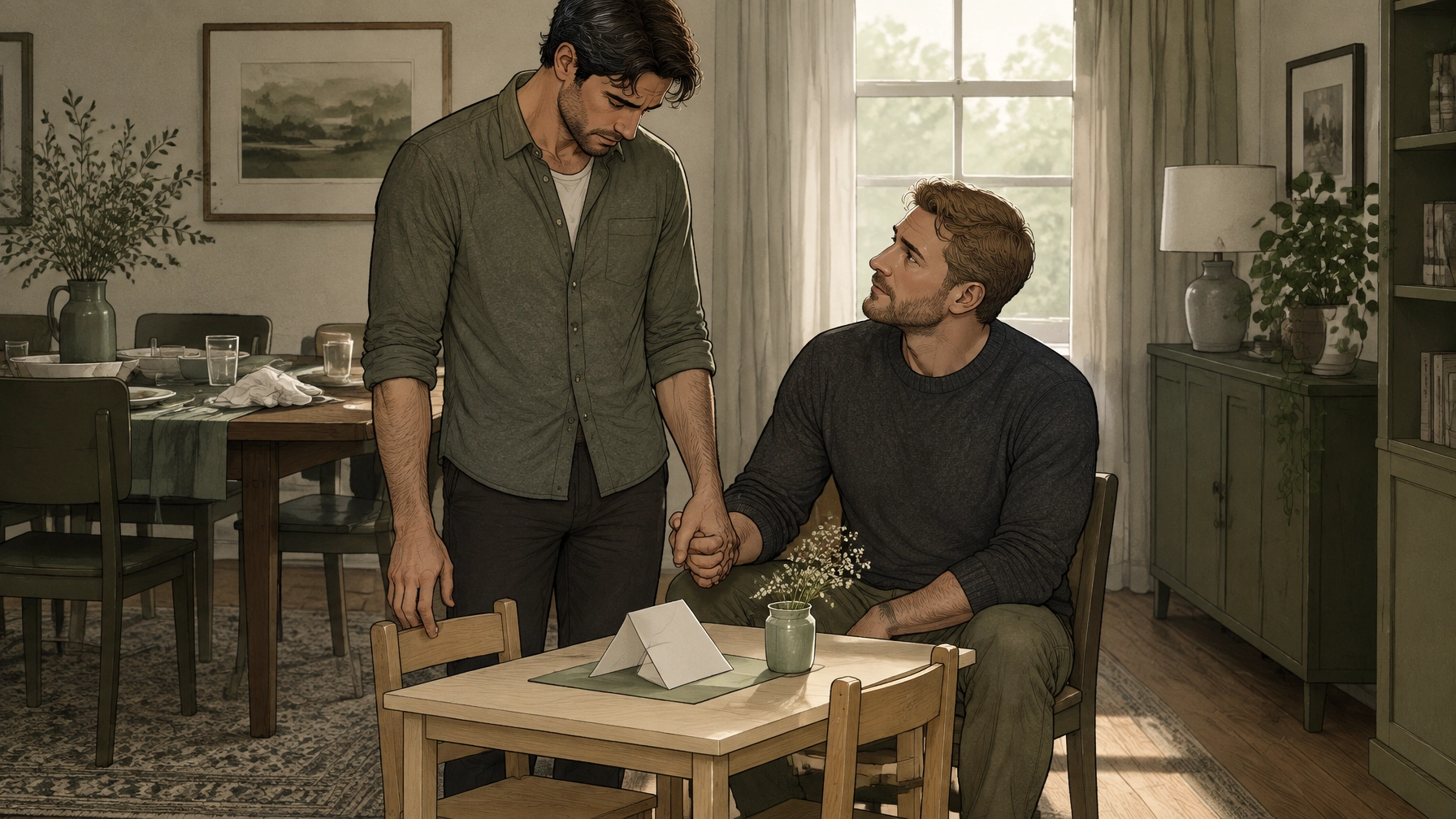
The table had been laid for four. Martin sat at one end. Cal sat opposite him. Adrian’s place was beside the window.
Tomas’s place was not at the table.
Adrian noticed it before anyone else did. A small chair had been pulled up beside the bookcase, near a low wooden table scattered with old colouring pencils and a stack of picture books. There was a plate waiting there, along with a folded paper napkin printed with cartoon animals.
For a moment, nobody moved.
Then Cal cleared his throat.
“We thought that might be more comfortable for Tomas,” he said. “The main table’s a bit tight.”
Tomas looked at the children’s table. Then he looked at Adrian.
The room seemed to contract around that glance.
Adrian’s first instinct was to laugh. If he made it a joke, perhaps the humiliation would become less real.
“Right,” he said. “Very spacious.”
Martin frowned. “Don’t start, Adrian.”
That was the beginning of the familiar fear: the fear of making a scene.
Adrian could already imagine how the evening would be described afterwards. He would be the difficult one. The sensitive one. The son who could never let anything go. His father would say they had tried. Cal would say it had only been a seating arrangement. Tomas might insist he was fine, and then Adrian would be accused of causing a problem on his behalf.
So Adrian swallowed.
“Tomas can sit beside me,” he said.
Martin’s expression hardened. “There isn’t really room.”
“There’s room for another chair.”
“We planned this before we knew he was coming.”
Adrian felt the words land.
Before we knew he was coming.
But Martin had invited him.
Small humiliations are still humiliations
Tomas placed his coat over the back of the small chair. He did not sit down immediately.
He was a tall man, broad-shouldered and quietly composed, with dark curls that never quite stayed in place. He had spent the drive asking Adrian whether he wanted to bring flowers, whether his father preferred red wine, whether they should arrive early enough to help.
He had prepared himself to be nervous.
He had not prepared himself to be reduced.
“I’m happy to stand for a moment,” Tomas said gently. “Perhaps we can work out the seating.”
Martin sighed. “Nobody is reducing you. This is a family dinner, not a political statement.”
The sentence was so familiar that Adrian felt cold.
Tomas’s face remained calm, but Adrian saw the slight movement of his jaw. He saw him choose dignity rather than anger.
That quietness hurt more than a raised voice might have done.
They sat down. Adrian kept his chair angled towards Tomas, leaving as much space beside him as possible. Tomas took the children’s chair after all, because refusing it would turn the evening into an argument before the first course had been served.
The meal began with questions aimed at Adrian.
How was work? Was the new flat more expensive? Had he heard from his old school friend?
Tomas was included only when someone needed information about him. Where did he live? What did he do? How long had he known Adrian?
When Tomas answered, Martin looked at him as though assessing a candidate for a position.
At one point, Cal reached across the table for the bread and said, “You two aren’t planning to make this all about yourselves, are you?”
Adrian stared at him.
“We’re eating dinner,” Tomas said.
“Exactly.”
There it was again. The invisible rule. Their relationship could be acknowledged only if it remained still, silent, and decorative. They could attend, but not take up emotional space. They could be invited, but not behave like a couple.
This is the painful territory explored by the best character-driven queer fiction: the gap between what families say and what their actions communicate. A person can say, “I accept you,” while arranging every detail of a gathering to keep your relationship at the margins.
For emotionally invested MM readers, these moments often carry more weight than a dramatic confrontation. A small chair can hold an entire history.
The courage to leave the room
Dessert was served at the main table.
Martin placed a slice of apple pie in front of Adrian, then carried a smaller plate to Tomas.
“Don’t worry,” he said. “There’s plenty.”
Tomas looked at the plate. “Thank you.”
Adrian could barely taste his coffee.
He wanted to protect Tomas. He also wanted Tomas to know that he had not missed what happened. But every possible response seemed dangerous.
If he spoke, he might expose Tomas to more attention. If he stayed quiet, he would be helping his family pretend the evening was normal.
Finally, Adrian placed his spoon beside his saucer.
“I’m going to go.”
Martin looked genuinely surprised. “You’ve only just had dessert.”
“I know.”
“Don’t be ridiculous.”
Adrian stood. His legs felt unsteady, but his voice did not.
“Tomas was invited here as my partner. He was not invited to sit beside the children’s table while everyone else ate together.”
Cal shook his head. “Nobody said he had to sit there.”
“You put the chair there.”
“It was just a chair.”
“No,” Adrian said. “It was a message.”
The room fell silent.
Tomas rose beside him. He did not rush Adrian. He did not speak over him. He simply picked up his coat and waited.
That was his quiet dignity: not passivity, not surrender, but the refusal to let Adrian’s family turn his pain into a performance.
Martin’s face reddened. “You’re making an enormous fuss over nothing.”
Adrian looked at his father and felt something inside him settle.
“Maybe it feels like nothing to you,” he said. “It doesn’t feel like nothing to me.”
Then he and Tomas left.
The conversation in the car
They sat in silence for several minutes.
Rain had begun to fall, softening the streetlights and blurring the windows. Adrian kept both hands in his lap. He was afraid to start the engine. Leaving would make the evening final, and some part of him was still waiting for his father to come outside and apologise.
Tomas reached across the console.
“You don’t have to explain it,” he said.
“I should have said something sooner.”
“You were trying to get through dinner.”
“I let you sit there.”
“You didn’t put me there.”
“But I stayed.”
Tomas turned towards him. “You were put in an impossible position.”
Adrian looked down at their joined hands.
“I wanted them to welcome you.”
“I know.”
“I kept thinking if I was calm enough, grateful enough, easy enough, they would understand.”
Tomas rubbed his thumb across Adrian’s knuckles.
“Love shouldn’t require you to become smaller.”
The words broke something open.
Adrian began to cry, quietly at first. Not because he had suddenly discovered that his family could be cruel, but because he had spent so long translating cruelty into misunderstanding. He had called it awkwardness. He had called it tradition. He had called it a difficult adjustment.
He had accepted invitations as proof of progress, even when the welcome stopped at the front door.
Tomas leaned over the console and held him. In the close darkness of the car, there was no children’s table, no careful family language, no need to pretend that being tolerated was enough.
Their gay love story emotional journey was not about winning one perfect dinner. It was about learning that tenderness could be a place to stand. It was about recognising that love did not ask either man to endure humiliation in silence.
Setting a boundary together
They did not decide to cut Adrian’s family off that night.
Real life is rarely that simple. Families contain history, affection, guilt, hope, and old patterns that do not disappear after one conversation. Adrian still loved his father. Tomas understood that.
But they did decide on a boundary.
The next morning, Adrian sent Martin a message. Tomas read it before Adrian pressed send.
“Thank you for inviting Tomas yesterday. I need to be clear about what happened. Asking him to sit separately from the family table made it clear that he was not being treated as my partner or as a welcome guest. I will not attend future family meals where he is expected to accept a lesser place. If you want us there, we need to sit together and be treated with the same respect as everyone else.”
Tomas nodded.
“Add one more thing,” he said.
“What?”
“That we’ll leave if it happens again.”
Adrian considered the sentence. It frightened him. A boundary was not a wish. It was a decision about what he would do.
He added it.
They sent the message together.
That small act mattered. Adrian was no longer trying to persuade his family that Tomas deserved a place. He was choosing where he and Tomas would spend their time, their energy, and their love.
For readers seeking emotional MM romance literary fiction, these are the moments that make a story linger: not only the grand declarations, but the quiet decisions made in parked cars and shared kitchens. The understanding that MM romance can emerge from unexpected places, including family tension, difficult conversations, and the brave work of defining home.
Conditional welcome teaches people to be grateful for crumbs.
Real welcome makes room.
Read with Pride
If you are drawn to queer fiction about complicated families, emotionally charged relationships, and men finding the courage to ask for more than tolerance, explore Dick Ferguson’s work through Read with Pride.
These are stories for emotionally invested MM readers who want heartfelt gay fiction, complex characters, and gay love stories shaped by vulnerability, resilience, and honest connection.
Three fresh next-topic ideas
- Queer Life and Identity: When His Parents Call His Boyfriend “Just a Friend” at Every Family Gathering — Naming the Relationship Without Begging for Permission
- Queer Life and Identity: When His Brother Makes a Joke About Their Engagement — The Silence That Follows and the Choice to Answer
- Queer Life and Identity: When His Family Welcomes Him After He Breaks Up With His Boyfriend — Recognising Acceptance That Depends on Being Alone
Follow us on social media
Follow Dick Ferguson for more emotionally immersive queer fiction, gay novels, MM romance, and LGBTQ+ reading recommendations:
#QueerLifeAndIdentity #MMRomance #GayRomance #QueerFiction #GayFiction #MMFiction #LGBTQBooks #GayLoveStories #EmotionalMMBooks #CharacterDrivenFiction #LGBTQReading #GayAuthors #QueerAuthors #ReadingWithPride


Leave a Reply
You must be logged in to post a comment.