

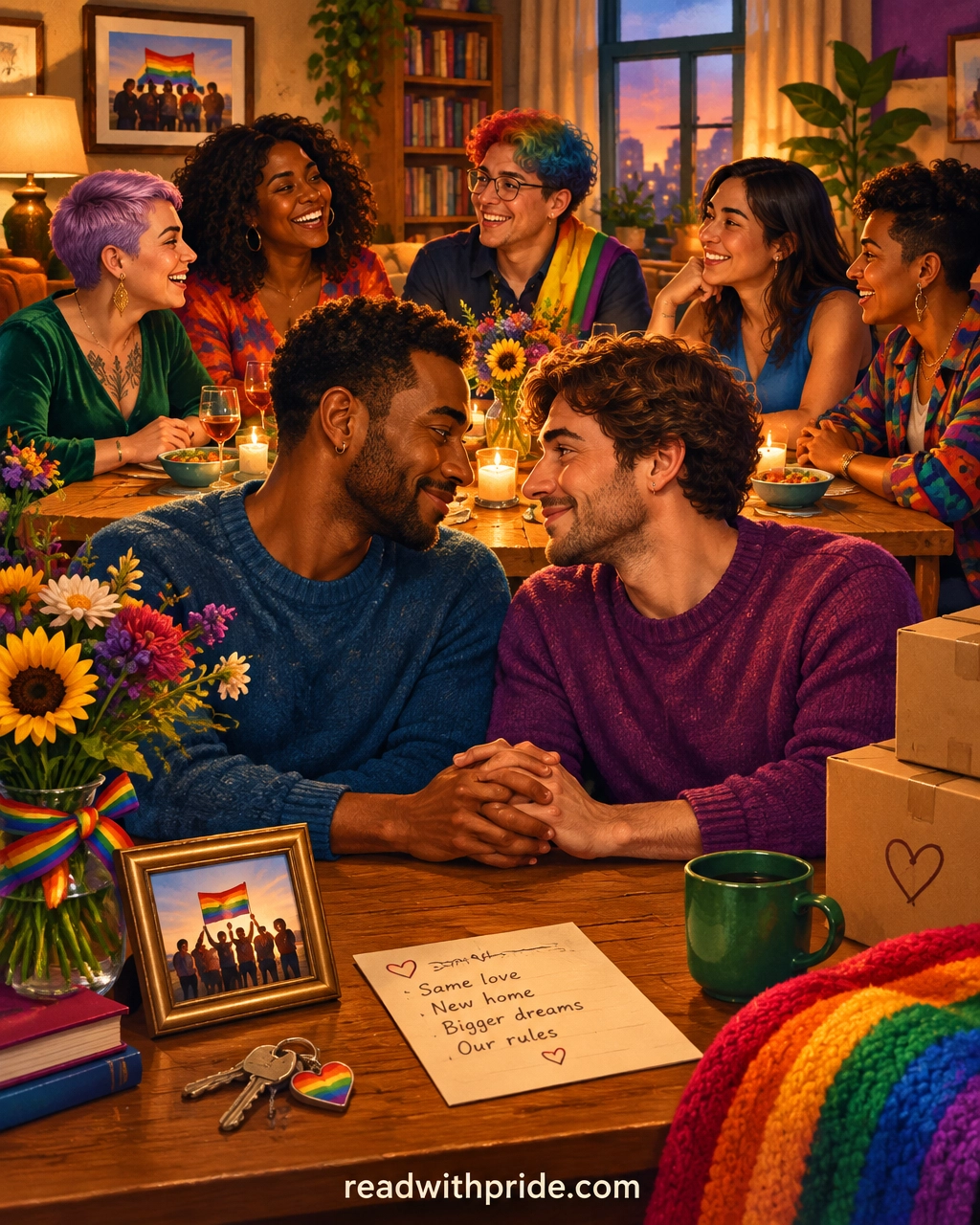
There is a particular kind of pressure attached to life milestones. We are often handed a neat little checklist: come out, find “the one,” move in, get married, buy a home, start a family, live happily ever after.
Lovely in theory. Slightly suspicious in practice.
For many LGBTQ+ people, life does not unfold in a straight line: and neither do queer relationships. Coming out may happen at sixteen, forty-six, or in several chapters across a lifetime. A partnership might mean monogamy, polyamory, an open relationship, separate homes, a shared home, or a deeply committed bond that does not need a conventional label at all.
The important thing is not following someone else’s blueprint. It is building a life that feels honest, safe, consensual, and genuinely yours.
That is one reason queer fiction matters so much. The best MM romance books, lesbian romances, and wider LGBTQ+ novels do more than deliver chemistry and a satisfying happy ending. They explore the conversations, compromises, chosen families, and brave decisions that make love sustainable.
Coming out is a milestone, not a deadline
Coming out stories are often presented as one dramatic reveal: a single conversation, a gasp, a tear, and then the credits roll.
Real life is rarely that tidy.
Coming out can mean first coming out to yourself. It can mean trying a new name or pronouns, telling one trusted friend, joining a queer community, or deciding that a particular person does not need to know yet. Safety, culture, family, faith, work, finances, and geography can all shape the timing.
There is no universal “correct” way to come out. Some people announce themselves proudly. Others share their identity gradually. Some never make a formal announcement because their life simply becomes more authentically theirs over time.
In queer relationships, coming out can also become an intimate milestone between partners. Two people may share their earliest memories of attraction, the names they once used, the fears they carried, or the moments when they finally felt seen. These conversations can deepen trust: but they should never be demanded as proof of love.
A partner is not entitled to every detail before you are ready. Healthy intimacy leaves room for privacy as well as vulnerability.
In gay romance novels and other queer love stories, this is where the emotional stakes often live. The romance is not only about whether two characters will kiss. It is about whether they can be known without being controlled, supported without being rescued, and loved without having to become less complicated.
Chosen family: the people who help us become ourselves
For many LGBTQ+ people, chosen family is not a trendy phrase. It is a practical, emotional, sometimes life-saving reality.
Chosen family may include friends, ex-partners, neighbours, community elders, co-parents, colleagues, or the person who answered the phone at 2 a.m. when everything felt impossible. These relationships can become especially important when biological relatives are unable: or unwilling: to offer acceptance.
Chosen family milestones can be wonderfully ordinary:
- Spending a first holiday with people who make you feel safe
- Introducing a partner to your queer community
- Creating traditions that have nothing to do with biological family expectations
- Building a home where friends can arrive without performing respectability
- Showing up for one another through illness, grief, celebration, and questionable DIY decisions
The Read with Pride collection includes stories that understand family as something expansive and lived rather than something defined by paperwork. Single Dads LGBTQ+ Club: Love, Hugs, & Second Chances explores blended families, co-parenting, and the “village” that helps two fathers build a home together. Meanwhile, Raising Rainbow Kids brings together fifteen true stories of LGBTQ+ families across the world, including parents navigating adoption, fostering, fertility, faith, and community support.
These are not side plots. They are life.
Monogamy is a choice: not the default setting
Monogamy can be beautiful. So can polyamory. Neither relationship structure is automatically more progressive, more committed, or more emotionally mature than the other.
The crucial question is whether the arrangement is freely chosen and honestly negotiated.
In a monogamous relationship, partners might define exclusivity around sex, romance, dating apps, emotional intimacy, or something more specific to their connection. “Monogamous” does not mean every couple has identical boundaries. It means the people involved have discussed what commitment means to them.
That discussion is often one of the most significant life milestones in a queer relationship. It may happen after the first date, after a period of uncertainty, when moving in together, or when an existing agreement no longer fits.
Good relationship conversations sound less like courtroom verdicts and more like ongoing check-ins:
- What does commitment mean to each of us?
- What do we want to keep private, and what can we share?
- How do we handle friendships, flirting, and emotional closeness?
- What happens if one of us changes our mind?
- How will we talk about safer sex and sexual health?
- What support do we need when jealousy or insecurity appears?
There is no prize for pretending everything is effortless. In fact, a little awkward honesty is often more romantic than polished certainty.
The Intimacy Gambit: A Game for Curious Couples is designed around this kind of conversation. With 52 chapters exploring trust, desire, vulnerability, and shared decision-making, it offers a playful way for couples to move beyond logistics and talk about the deeper architecture of their relationship.
Polyamory and the courage to write a bigger story
Polyamory is not “more love with fewer rules.” It is often more love with more conversations, more calendars, and a heroic commitment to checking the group chat.
At its healthiest, polyamory is grounded in informed consent, transparency, emotional responsibility, and respect for everyone involved. Partners need space to express desire and uncertainty without turning another person into a villain.
For some people, polyamory becomes part of their relationship from the beginning. For others, it emerges through careful conversations within an established partnership. Some relationships involve a central partnership; others resist hierarchy. Some people date as a group, while others have independent connections that overlap through community and shared life.
There is no single polyamorous model. The same is true of monogamy.
What matters is that nobody is pressured into a structure they do not want. “Open” should not mean “one person reluctantly agreed because they were afraid of losing the relationship.” “Monogamous” should not mean “we never discuss our feelings.” Consent must be ongoing, enthusiastic, and allowed to change.
Queer fiction can give readers room to imagine these possibilities. It can show relationships that do not rely on secrecy, possession, or the idea that love is a limited resource. It can also show mistakes, conflict, repair, and the work required to make non-traditional relationships emotionally safe.
That imaginative space is valuable, whether you are exploring polyamory in your own life or simply reading beyond familiar romantic scripts.
How MM romance explores relationship shapes
MM romance is especially rich territory for exploring identity, visibility, and partnership because its characters are often navigating several layers of expectation at once.
A story may begin with a closeted relationship, as in The Unspoken Chapter: A Second Chance MM Romance, where Alex and Liam must confront the secrets and family rejection that shaped their first love. Their second chance is not simply about rekindling attraction. It is about deciding what honesty and commitment look like now.
Other MM romance themes focus on partners who refuse to let external pressure define their future. The Campaign for Us follows Andrey and Sam through workplace conflict, public exposure, and the decision to build a life: and a business: on their own terms.
For readers drawn to tension, The Protocol of Passion brings together forced proximity, slow burn, professional rivalry, and a secret relationship that gradually becomes something more durable.
These stories reflect a wider truth: queer romance is not limited to one emotional register. There are steamy MM romance books, tender second-chance stories, family-centred narratives, lesbian fantasy romance, trans love stories, and heartfelt gay fiction about people at every stage of life.
The happy ending is not always a wedding. Sometimes it is coming home. Sometimes it is being introduced to someone’s chosen family. Sometimes it is saying, “This is what I need,” and discovering that the right person listens.
Your milestones do not need to look like anyone else’s
Maybe your biggest milestone was surviving a difficult year. Maybe it was attending Pride with a partner, finding your first queer book club, or telling a friend the truth about who you are. Maybe you have been married for decades. Maybe you are happily single. Maybe you are raising children, caring for friends, dating several people, or building a life that does not fit neatly into any category.
All of it counts.
The point of queer relationships is not to replace one rigid script with another. It is to make space for many ways of loving, belonging, and becoming.
That spirit sits at the heart of LGBTQ+ fiction 2026, from intimate gay fiction to ambitious queer literary novels and romantic stories that let their characters write their own rules. It is also the heart of C Section 2026: making room for conversations about identity, connection, family, and the complicated beauty of being fully human.
At Read with Pride, you can explore curated LGBTQ+ ebooks, gay romance books, lesbian romance, gay love stories, and queer fiction that celebrates relationships in all their messy, meaningful variety.
Follow Read with Pride on Facebook and Instagram for more recommendations, reflections, and new ways to read with pride.
Your life is not late. Your relationship is not invalid because it looks different. Your family does not need to be understood by everyone to be real.
There is no single shape of us.
There is only the shape we create together.
#ReadWithPride #LGBTQFiction2026 #MMRomanceBooks #GayRomanceNovels #QueerRelationships #ChosenFamily #Polyamory #Monogamy #ComingOutStories #QueerLoveStories #QueerBookClub #LGBTQBooks #CSection2026

Leave a Reply
You must be logged in to post a comment.