

Evening Edition: The Farm Auction : How a City Man Learned That Some Things Are Kept by Being Let Go
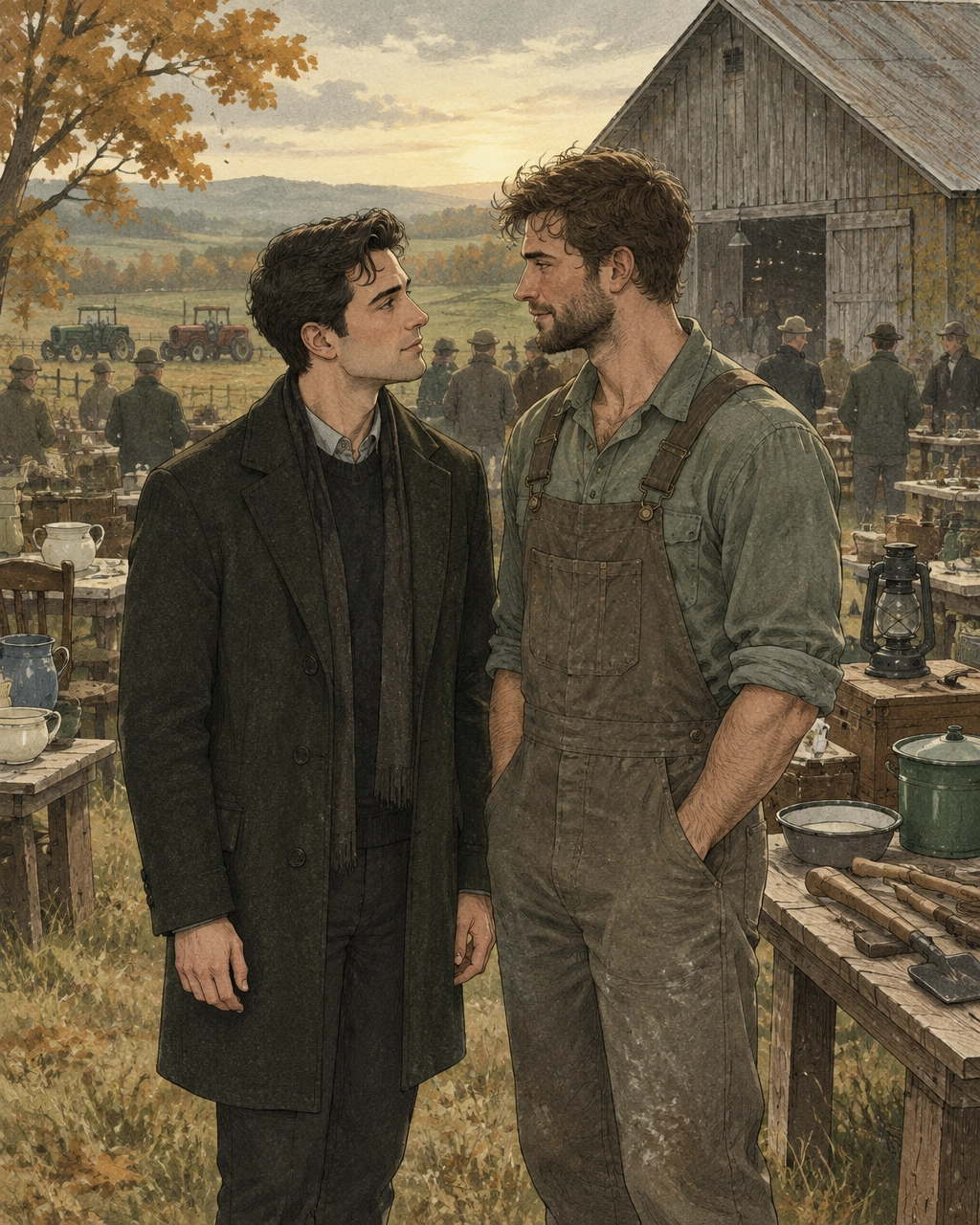
By late afternoon, the farm had begun to smell of endings.
Old wood held the dry sweetness of the year’s weather. Diesel lingered in the air beneath the sharper scents of fallen leaves, cold metal, and damp grass. The fields beyond the barn had already been cut down to stubble, their patient green gone gold and brown beneath the low autumn light.
Neighbours moved between tables spread across the lawn. Household goods sat beside hand tools, enamel bowls, cracked crockery, seed trays, lamps, framed pictures, and boxes whose contents had outlived the names of the people who once used them. A tractor stood near the barn with its bonnet lifted, as if waiting for one last conversation.
Kai walked through the crowd with his hands in the pockets of his work jacket.
Leo walked beside him.
Not ahead. Not close enough to crowd him. Not so far behind that it looked like reluctance.
Beside him.
It was a position Leo had been practising for months.
The Auction at the End of Harvest
The auctioneer stood on a wooden platform near the barn doors, calling the first lots in a rapid, rhythmic chant.
“Now then, twenty to start, twenty bid, twenty-five, would you go twenty-five? Twenty-five there, thank you, thirty now…”
The words gathered speed until they seemed less like speech than weather. A bright, insistent current flowing over the lawn. People raised their hands, nodded, pointed, or simply caught the auctioneer’s eye. Somewhere behind Leo, someone laughed. A dog barked once and was hushed. A child climbed onto the step of an old trailer while two men argued amiably about the age of a plough.
The auction was business, but it was also memory.
Every object had belonged to someone. Every object had been lifted, repaired, wiped clean, put away, found again. There were years hidden in the scratches on the workbenches and the worn handles of the tools. There were meals in the bowls, winter evenings in the lamps, arguments and reconciliations in the chairs.
Leo understood the value of things.
That was part of the problem.
He understood what they cost. He understood how quickly money could solve a practical difficulty. He understood that a better roof, a new van, a replacement wheel, or a repaired studio door could change the shape of a person’s week.
He understood these things so well that he had begun to confuse usefulness with love.
His instinct was always to reach for his wallet before anyone had asked for his hand.
Kai had noticed.
Of course Kai had noticed.
Kai noticed everything: a crooked fence post, a change in the wind, the difference between a painting that was unfinished and one that was finished but uncertain. He could look at Leo across a kitchen table and see the moment generosity turned into fear.
Leo had spent years making himself indispensable.
He had paid for dinners before anyone could offer. He had solved problems before they became conversations. He had built a life around being the person other people could not manage without.
It had seemed safer that way.
If he was needed, he could not be left.
But Kai had never asked to be managed.
Kai wanted help when he wanted help. He wanted his independence to remain visible even when someone stood beside him. His farm, his paintings, his battered equipment, and his silences were not invitations for Leo to take over. They were parts of a life Kai had built with his own hands.
Leo loved those hands.
He loved their paint stains, their small scars, the way they held a brush with both precision and impatience. He loved the strength in them. He loved that they could mend a gate but would not be persuaded to mend a feeling before it was ready.
At the next table, Kai stopped.
His gaze settled on a wooden toolbox.
It was long and narrow, its lid darkened by years of use. One brass hinge hung slightly loose. The handle had been polished by a hundred journeys from shed to field and back again.
Leo felt the familiar movement inside him.
He could buy it.
He could lift his hand. Catch the auctioneer’s attention. Offer more than anyone else. Make sure the toolbox went home with Kai.
The thought arrived dressed as kindness.
It was not kindness.
Not entirely.
What Leo Wanted to Keep
The auctioneer moved on to a collection of old hand tools.
A plane. Two chisels. A rust-coloured hammer. A set of screwdrivers with the names of long-gone manufacturers stamped into their handles.
Kai leaned closer.
Leo watched him, watched the slight narrowing of his eyes as he examined the tools. Kai did not touch them. He rarely touched anything at an auction before deciding whether it belonged to him.
“Do you want them?” Leo asked.
Kai glanced at him. “Wanting is complicated.”
The answer was so perfectly Kai that Leo almost smiled.
“Would they be useful?”
“Yes.”
“Do you need them?”
“No.”
The auctioneer’s chant rose over the crowd.
“Ten to start, ten there, fifteen now, fifteen, thank you, twenty…”
Leo could feel his own hand beginning to move.
He stopped it.
The decision was small. Nearly invisible. But inside him, something strained against it.
He could buy the tools. He could give them to Kai later, make the gesture casual, pretend he had only been thinking ahead. He could watch Kai’s expression soften and tell himself that this was what love meant: noticing, providing, anticipating.
But if Leo bought every object Kai paused over, what would remain of the pause?
What would remain of Kai’s choice?
The tools went to a farmer from two villages away.
Kai watched them leave.
His expression did not change. He only placed both hands more deeply into his jacket pockets.
Leo waited for disappointment. He expected to feel responsible for it.
Instead, Kai said, “Thank you.”
“For what?”
“For not bidding.”
The words landed more sharply than anger would have.
Leo looked across the yard. “I wanted to.”
“I know.”
“I thought you might regret not having them.”
“I might.”
“And that was difficult for me.”
Kai turned towards him fully. The crowd moved around them, neighbours stepping past with bidder cards and paper cups of tea. The auctioneer’s chant continued, brisk and bright, turning another forgotten object into a number.
“Why?” Kai asked.
Leo swallowed.
Because I wanted to be the person who gave them to you.
Because I wanted your regret to become my opportunity.
Because if I could replace every loss before you felt it, perhaps you would never discover you could live without me.
He said, “Because I wanted to make the disappointment disappear.”
Kai’s face softened, though not with pity.
“Some disappointments are allowed to stay.”
Leo looked down at the grass.
It was scattered with leaves and scraps of straw. A small metal washer lay near his boot. He imagined picking it up, repairing something with it, finding a purpose.
Kai said, “You don’t have to turn every feeling into a problem you can solve.”
“I’m learning.”
“You are.”
There was no accusation in it. That made it harder.
The Things That Cannot Be Bought
Later, a framed landscape came up for auction.
The painting was modest. A field under a white sky, a line of bare trees, a narrow road disappearing beyond them. The artist had worked in thin, uncertain strokes, but the longer Leo looked, the more he saw: distance, weather, the loneliness of a place waiting for spring.
Kai looked at it for a long time.
Leo knew that look. He had seen it in galleries and in Kai’s studio, when a painting became less an object than a conversation.
“You like it,” Leo said.
Kai shook his head. “I recognise it.”
The auctioneer called for bids.
A woman near the barn raised her card. Then a man in a waxed jacket. The price climbed in small, steady steps.
Leo watched Kai’s face.
“Would you hang it?” he asked.
“Maybe.”
“Would you paint over it?”
“Absolutely not.”
That made Leo laugh.
The sound surprised him. It came out unguarded, warm enough that Kai smiled too.
The painting sold to the man in the waxed jacket.
Kai followed it with his eyes as the auction assistant carried it away.
This time, Leo did not feel compelled to do anything.
He did not bid. He did not make a promise. He did not say that there would be other paintings, better paintings, paintings Kai could choose from a gallery where no one shouted numbers over them.
He simply stood beside him.
The afternoon light thinned around the farm. It caught the edges of the barn roof and turned the dust above the auction tables briefly gold. The old wooden boards looked almost tender. Even the diesel smell had softened, mingling with coffee, cold air, and the faint sweetness of crushed apples beneath someone’s boots.
Kai reached for Leo’s hand.
Not because he needed balance.
Not because Leo had fixed anything.
Because he wanted to.
Leo let their fingers meet.
The gesture was quiet. No one applauded. Nothing changed hands. No receipt was printed. No debt was created.
Still, Leo felt something inside him loosen.
He had always believed keeping meant securing. Buying. Holding tightly enough that loss could not get through.
But love was not a locked room.
It was not a deed, a favour, or a possession placed carefully on a shelf.
Love was Kai looking at him and knowing he could walk away.
Love was Leo knowing the same thing and staying anyway.
What Is Kept by Being Let Go
The last lots were smaller: jars, a battered lantern, lengths of rope, a box of books with swollen spines. The crowd had begun to thin. Trucks pulled away along the lane, their tyres pressing dark tracks into the wet ground.
Kai and Leo remained near the edge of the field.
“What happens to the things nobody buys?” Leo asked.
“Some go home with the family. Some get donated. Some are thrown away.”
“Even if they mattered?”
“Especially then, sometimes.”
Leo considered this.
The question had never been whether something mattered. The question was whether its meaning could survive without being kept exactly as it was.
Kai squeezed his hand once.
“You can’t save everything,” he said.
“I know.”
“You can’t save me.”
“I know.”
“And I’m not asking you to.”
Leo turned to him. “What are you asking?”
Kai looked towards the fields. Beyond the bare trees, evening had begun to gather, blue at the edges and green in the shadows.
“For you to stand here,” he said. “Without making yourself necessary.”
Leo breathed in the cold air.
Then he nodded.
It was not a grand promise. It was not a vow that he would never reach for control again. He knew himself too well for that. There would be other moments when fear disguised itself as generosity. Other times when he would want to spend, repair, arrange, and acquire his way out of uncertainty.
But he could learn to pause.
He could learn that Kai’s freedom was not a threat to their love.
He could learn that a person was not kept by being surrounded with everything they might want. A person was kept by being trusted to remain free.
Together, they walked back towards the house.
Behind them, the auction tables stood in the fading light, half-empty and waiting to be folded away. The tools had gone to other hands. The painting had gone to another wall. The old toolbox would belong to someone else.
Yet the afternoon would remain.
The smell of wood and diesel. The auctioneer’s impossible music. Kai’s hand finding his. The clean ache of wanting to give and choosing, instead, to witness.
Some things were kept by being carried home.
Some things were kept in memory.
And some things: dignity, freedom, love: were kept only when no one tried to own them.
Continue Reading with Pride
Discover more emotionally immersive MM romance, gay fiction, queer fiction, and character-driven LGBTQ+ ebooks through Read with Pride. You can also explore Dick Ferguson’s available MM romance books and gay novels in the Read with Pride e-book store.
If you enjoy heartfelt gay fiction, emotional MM books, gay love stories, and lyrical LGBTQ+ literature, return to Read with Pride for more reading with pride, new gay releases, and thoughtful gay book recommendations.
Follow Us on Social Media
Follow Us on Social Media for more literary MM romance, character-driven gay fiction, and updates from Dick Ferguson:
#ReadWithPride #MMRomance #GayRomance #LGBTQBooks #EmotionalMMBooks #CharacterDrivenMM #FarmAuction #RuralFiction #UrbanRuralContrast #GayFiction #QueerFiction #MMFiction #GayLoveStories #LGBTQFiction #GayLiterature #HeartfeltGayFiction #GayAuthors #MMAuthors #LGBTQReading


Leave a Reply
You must be logged in to post a comment.