

There are places on Earth that seem less discovered than remembered.
The McMurdo Dry Valleys are one of them: a landscape of bare rock, blinding snow and wind so dry it seems to scrape the moisture from the body. The cold cracks the skin around the knuckles. It catches in the throat. It leaves every breath feeling borrowed.
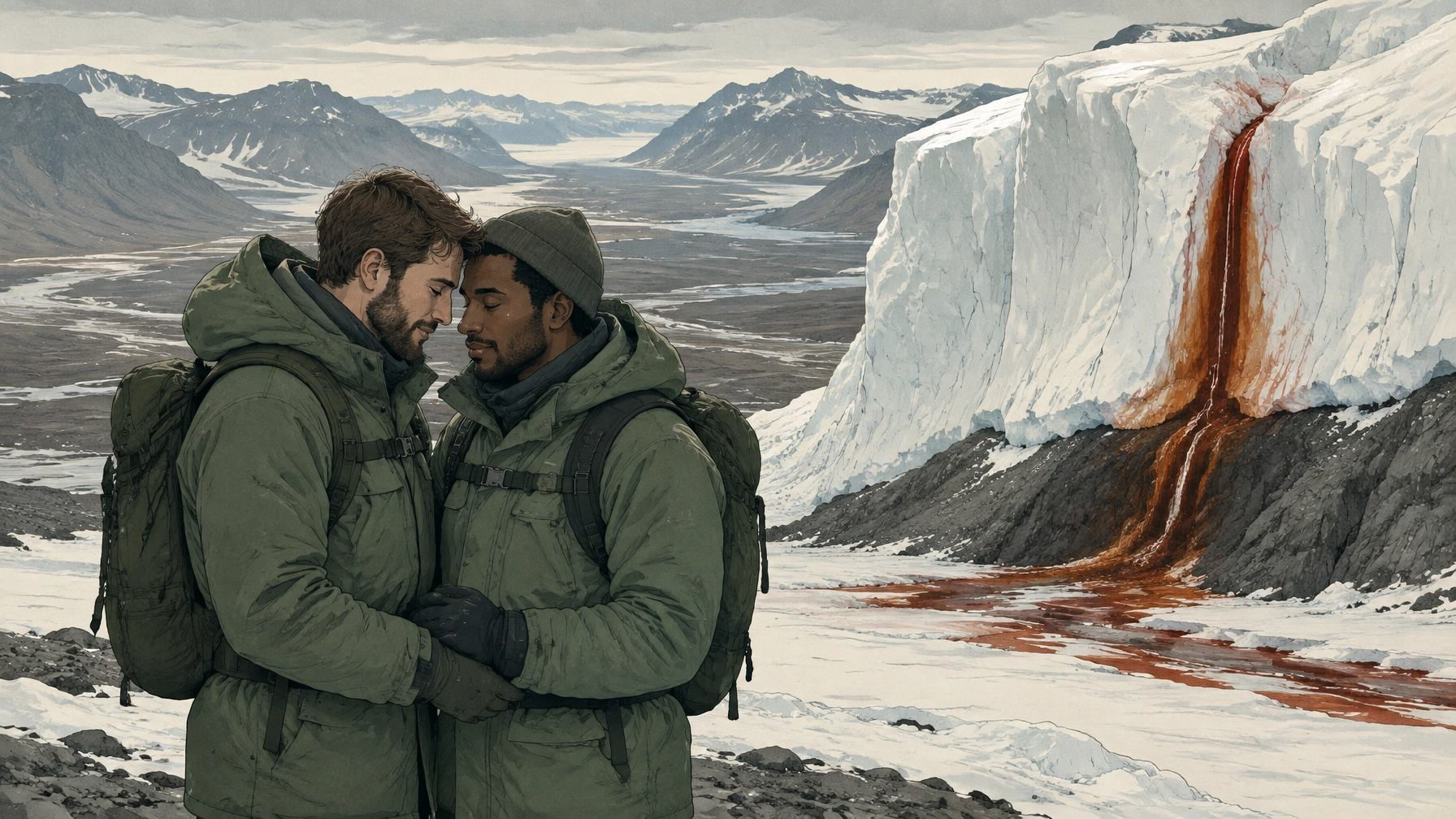
And then, at the edge of Taylor Glacier, the ice begins to bleed.
Blood Falls is not a waterfall in the ordinary sense. It is a narrow, iron-rich seep emerging from beneath the glacier and staining the white ice a startling rust red. The water has been trapped in darkness for roughly 1.5 to 2 million years, sealed inside an ancient subglacial reservoir.
It is hypersaline, oxygen-poor and cold enough to seem impossible as liquid. Yet it moves.
For two men standing before it, the sight becomes more than a scientific marvel. It becomes a language.
A wound in the ice
Elias had spent most of his life learning how not to be noticed.
He had become good at the quiet forms of disappearance: the carefully measured answer, the harmless smile, the habit of changing the subject before anyone reached the place where the truth lived. From a distance, he appeared composed. Competent. Almost untouched.
Underneath, everything remained frozen.
His shame had not vanished with time. It had simply hardened around him, layer by layer, until he could mistake endurance for healing. He had built a life that looked flawless from the surface, like the glacier itself: solid, pale and impenetrable.
Jonah knew there was something beneath that surface.
He did not know its shape. He did not know how long Elias had carried it. But he had learned that love did not always begin with answers. Sometimes it began with remaining present when the other person had run out of ways to pretend.
They had come to Antarctica for the work, for the rare privilege of seeing a landscape that seemed to belong to another planet. They had come with instruments, insulated clothing and enough provisions to make the journey practical.
Neither had expected the glacier to make confession feel inevitable.
The first thing Elias noticed was the colour.
Against the otherwise blinding white, the red was almost violent. It did not look decorative or beautiful. It looked exposed. A dark, mineral wound opening in a body that had held its silence for millennia.
The second thing he noticed was the smell: faintly metallic, like wet iron or old coins warmed between the fingers.
Jonah stood beside him without speaking.
That silence mattered.
What Blood Falls keeps hidden
The mystery of Blood Falls is not that the water is red. The red is the final stage of a much older story.
Beneath Taylor Glacier lies a briny aquifer or reservoir derived from ancient seawater. It became isolated beneath the ice long ago, when the landscape changed and the glacier advanced. In that sealed environment, the water remained dark, intensely salty and almost entirely without oxygen.
When the brine reaches the surface, dissolved iron encounters the air. It oxidizes, forming iron compounds that stain the ice red.
What is invisible below the surface becomes vivid only when it touches open air.
That fact lodged in Elias more deeply than he wanted it to.
He had spent years believing that whatever was buried inside him would remain buried if he kept still enough. He had treated silence as a kind of protection. If he did not name the old fear, perhaps it could not grow teeth. If he did not speak about the shame, perhaps no one could use it against him.
But the glacier offered another possibility.
Perhaps exposure did not always mean destruction.
Perhaps some truths changed when they met the light.
Research published through institutions including NASA’s Earth Observatory has shown how Blood Falls is sustained by extraordinary chemistry. Microbial life survives in the ancient brine without sunlight, drawing energy from iron and sulfur compounds in the darkness.
Even there, life has found a way to continue.
The cost of living glacially
The silence around them was so vast that Elias could hear his own heartbeat.
It sounded intrusive. Too loud for the landscape. Too human.
“I should have told you before we came,” he said.
Jonah turned towards him. The wind moved between them, carrying powdered snow across the ice.
“Told me what?”
Elias almost laughed. The question was gentle, which made it harder.
He had imagined this moment many times, but never in a place so empty. Never beneath a sky that made every private fear seem small and every honest word seem enormous.
He told Jonah about the years he had spent dividing himself into acceptable and unacceptable parts. About the things he had believed would make him difficult to love. About how easily a man could become an expert at withholding: not only from other people, but from himself.
He did not tell the story beautifully. He did not arrange it into a clean emotional journey. His sentences broke. Some details stayed locked behind his teeth.
Jonah did not interrupt.
That was the first kindness.
The second was not to tell Elias that he should have spoken sooner.
There is a particular cruelty in being told that your silence has hurt someone when you have already spent years punishing yourself for it. Jonah understood that the truth required space before it required explanation.
He reached for Elias’s hand.
The gloves made the gesture clumsy. Nearly childish. But Elias felt the pressure of his fingers all the way through the layers.
The glacier gave a low grinding sound in the distance.
It was not dramatic. It did not resemble thunder. It was slower than that, older. The sound of immense weight moving because it had no choice but to move.
When the buried reaches the light
An emotional MM romance is often described through its visible moments: the first kiss, the confession, the decision to stay.
But the most important changes can happen before either man says what he wants.
They happen in resistance.
In the pause before a difficult answer. In the instinct to retreat, followed by the exhausted decision not to. In the moment one man realises that being known may be frightening, but being permanently unknown is its own kind of loneliness.
For Elias, recognition came first.
He recognised himself in the red water: sealed away, altered by pressure, carrying a history that had not disappeared simply because no one could see it.
Resistance came next.
He told Jonah that it was too much. That he had made a mistake. That they should return to the station before he said anything else.
Exposure was not graceful. It was not a single brave act. It was the humiliating, tender process of remaining present after the secret had been spoken.
And then came the strange grace of being seen at last.
Jonah did not look at Elias as if he were damaged. He did not turn the confession into a test of his own goodness. He simply stayed close, his hand still around Elias’s, while the red seep marked the ice in front of them.
The colour was not proof that the glacier had failed.
It was proof that something long-contained had found a route outward.
Love in an unexpected place
The best MM romance unexpected places are not only about dramatic scenery. The landscape must press against the characters until they can no longer remain unchanged.
Antarctica does that.
It removes distraction. There are no crowded streets to disappear into, no familiar rooms where a difficult conversation can be postponed indefinitely. There is only the wind, the ice and the person standing beside you.
That does not make honesty easy. It makes avoidance harder to maintain.
For emotionally invested MM readers, the power of a gay love story lies in the internal journey as much as the romance itself. Love is not merely the reward waiting at the end of suffering. It is the presence that makes suffering speakable. It is the risk of allowing another man to witness the places you have kept frozen.
Blood Falls offers a powerful image for character-driven queer fiction because it refuses the idea that hidden things are dead.
The brine is not empty. Beneath the ice, microbial life persists in darkness. The water is not clean or clear, yet it is alive. The iron does not become something else when it reaches the air; it becomes visible.
So does Elias.
The truth does not make him perfect. It does not erase the years he spent afraid. It does not promise that Jonah will understand everything immediately.
But it gives him a future that is no longer built entirely around concealment.
That may be the first real warmth either man has felt in a very long time.
A final note on the science and the story
Blood Falls reminds us that the world is full of hidden systems: ancient water beneath moving ice, organisms living without sunlight, chemical reactions waiting for air.
Human beings are no less mysterious.
A man can carry love beneath shame. He can protect a wound until the protection becomes another wound. He can appear untouched while an entire history moves slowly beneath the surface.
And still, something can emerge.
Not cleanly. Not without pain. But vividly.
The red stain remains on the white ice.
The glacier continues to grind.
Two men stand together in the dry Antarctic cold, and one of them has finally stopped mistaking silence for safety.
For more emotionally immersive LGBTQ+ fiction, gay novels and character-driven MM romance, explore Read with Pride or visit the Dick Ferguson collection.
Three possible future Morning Edition topics
- The Door to Hell: Two Men Beneath the Burning Crater of Turkmenistan : a story about desire, fear and the places we keep feeding with oxygen.
- The Singing Sands of the Sahara: An MM Romance About Voices Lost and Found : two men cross a shifting landscape where the dunes hum beneath their feet.
- The Blue Grotto of Capri: A Gay Love Story in a Cave Made of Light : an emotionally charged journey into secrecy, beauty and the courage to be seen.


#MMRomance #GayRomance #QueerFiction #ReadWithPride #CharacterDrivenMM #LGBTQBooks #GayBooks #MMBooks #QueerLiterature #EmotionalRead #GayLoveStory #LGBTQFiction #GayNovels #EmotionalMMBooks
Follow us on social media
Follow Dick Ferguson for more emotionally charged gay love stories, LGBTQ+ fiction and MM romance:

Leave a Reply
You must be logged in to post a comment.