

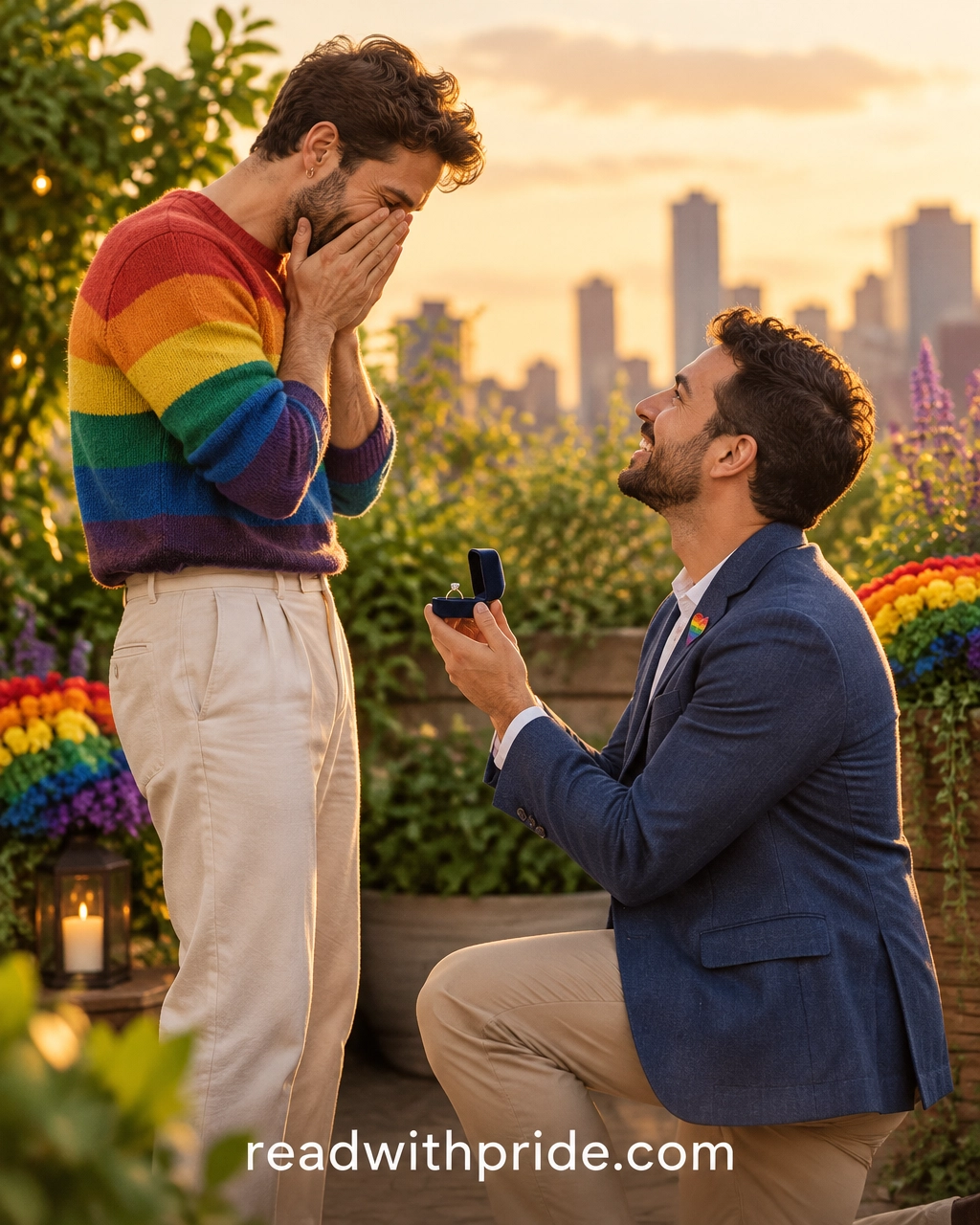
There is a particular kind of emotion in watching someone you love realise what is happening.
The hand over the mouth. The laugh that arrives before the tears. The stunned pause while the person being proposed to looks from the ring to their partner and back again, as if the universe has just made an unexpectedly beautiful administrative decision.
For many LGBTQ+ people, proposals carry all of that joy , plus history.
Some of us spent years watching friends get engaged while marriage equality remained uncertain, unavailable, or unsafe. Some grew up assuming that the life milestone of “putting a ring on it” belonged to other people. Others wanted the commitment but not the traditional script: not the staged kneel, the permission-seeking, or the pressure to turn a private promise into a public performance.
Queer proposals make room for all of it: romance, nerves, chosen family, practical conversations, and the occasional panic about whether the ring will fit.
The proposal script was never written for us
In a traditional engagement story, the roles are often assigned before anyone enters the room. One person asks. One person answers. Someone asks a father for permission. A ring appears. The couple announces the news.
Queer relationships have always had to question those assumptions.
Who asks whom? Do both partners propose? Is there one ring, two rings, matching rings, or no rings at all? Is the proposal a surprise, or has the couple discussed marriage so thoroughly that the only surprise is the restaurant booking?
There is no single correct way to answer those questions. That is the gift of a queer engagement: the opportunity to build a ritual that actually belongs to the people involved.
Some couples plan a simultaneous proposal. Some decide together and later create a symbolic moment to mark it. Some exchange jewellery, watches, tattoos, handwritten vows, or objects connected to their shared history. Some quietly agree, “Yes, this is forever,” while washing dishes and then spend six months deciding whether to tell anyone.
That last one is still valid. Romance does not require a photographer hiding behind a shrub.
The years we had to wait
For couples who came of age before marriage equality, or who live somewhere that still does not recognise their relationship, engagement can carry a complicated weight.
It may be joyful and bittersweet at the same time. A couple might celebrate the legal right to marry while remembering the years when their relationship was treated as less real. They may think about older LGBTQ+ people who held commitment ceremonies without legal protection, or who introduced a lifelong partner as a “friend” or “roommate” because honesty could cost them housing, employment, safety, or family.
That history can make the proposal feel bigger than a single question. It can feel like claiming a future that previous generations were denied.
But no one is required to make their engagement a political statement. Sometimes it is simply two people choosing one another in a quiet room. Sometimes it is a public act of courage. Sometimes it is both.
The meaning belongs to the couple.
Engagement when not everyone knows
One of the quiet realities of queer engagement is that a couple may be engaged while still not being out everywhere.
A partner may be openly gay with friends but not at work. Someone may be out to siblings but not parents. A trans or bisexual person may face different levels of safety across different parts of their life. A couple may be able to share a photograph online while still avoiding certain relatives, neighbours, colleagues, or communities.
That can make the engagement period feel strangely split.
In one room, someone is calling you “fiancé.” In another, people are still asking whether your partner is your roommate. You may have a ring on your finger but still be editing your language depending on who is listening.
This does not make the engagement less real. It means visibility is complicated. A public announcement should never be treated as a test of love, bravery, or commitment.
A queer engagement can be celebrated privately first. It can be shared with chosen family before biological family. It can remain just between two people for as long as needed.
Asking the family , or choosing your own people
The tradition of asking a partner’s family for permission can feel tender, awkward, meaningful, or completely wrong.
For some couples, speaking to a parent or relative is a loving gesture. It acknowledges the family’s importance and creates a special memory. For others, the idea feels too close to seeking approval from a structure that once rejected queer love.
There is no universal answer.
A partner might ask a mother, father, sibling, grandparent, or close friend for their blessing. They might ask nobody. They might ask the people who helped them survive. They might invite chosen family to help select the ring, hide the flowers, write the speech, or stand nearby with tissues and an emergency snack.
Chosen-family involvement can be especially powerful for LGBTQ+ couples. The person who helped you come out, offered you a sofa, defended your relationship, or taught you that queer love could be ordinary and extraordinary at once may be the person you want beside you when the question is asked.
An engagement is not a referendum on who counts as family. It is a chance to honour the people who have shown up.

What MM romance books understand about the big question
Proposal scenes in MM romance books work because the best ones are rarely only about the ring. They are about the emotional journey that made the ring possible.
That is why familiar mm romance themes remain so satisfying:
- The enemies-to-lovers couple finally admits that all that arguing was, inconveniently, attraction.
- The slow burn reaches its payoff after months of small gestures, near-confessions, and one very obvious “we are definitely just friends” denial.
- The second-chance couple realises that getting back together is not enough; they must choose a future deliberately.
- The workplace romance couple navigates a secret engagement, stolen glances in meetings, and the unique challenge of pretending not to be thrilled when your fiancé sends a calendar invite.
- The couple who once thought marriage was impossible creates a proposal that says, “We are not waiting for permission anymore.”
These stories resonate because queer love stories often involve negotiation: with family, society, safety, identity, and our own expectations. A proposal becomes the moment when private certainty steps into the light , even if that light is only coming from the fridge at midnight.
You can explore more queer storytelling through the Read with Pride blog, browse the store listing, and find LGBTQ+ ebooks from queer authors and publishers in one welcoming space.
Sapphic proposals, lesbian engagements, and every version of forever
Sapphic and lesbian couples also get to decide which traditions feel affirming and which can be left on the metaphorical pavement.
Some women propose to one another in carefully planned, spectacular ways. Some exchange rings during a weekend away. Some choose a shared piece of jewellery. Some have one partner ask and the other immediately respond with, “I thought we were both going to ask.”
The same is true for bisexual, non-binary, trans, and gender-expansive couples. An engagement does not need to make anyone perform a gender role they do not recognise. It does not need to look heterosexual to be romantic.
The most meaningful proposals often reflect the couple’s actual relationship: their humour, history, culture, chosen family, private language, and hopes for the future.
The long engagement and the quiet in-between
Not every engagement leads quickly to a wedding.
Some couples need time to save money, plan safely, move countries, navigate family relationships, or decide whether marriage is even the next step. Others enjoy being engaged without rushing towards a ceremony. A long engagement can be its own life milestone, not merely a waiting room.
There may be ordinary mornings when the ring catches the light while you make coffee. There may be difficult conversations about finances, surnames, legal documents, or who gets invited. There may be moments when the world still fails to read your relationship correctly.
You may be engaged and still be asked if you are sisters.
You may be engaged and still have to explain that, no, your best friend is not “just a friend.”
You may be engaged and discover that commitment is less about one dazzling moment than the hundreds of small decisions that follow: correcting someone kindly, checking in after a hard day, making room for each other’s families, and deciding what your shared future should actually look like.
That is the real romance.
A ring, a promise, and a story of your own
The proposal is one moment. The engagement is the space that follows.
For queer couples, that space may hold relief, delight, grief, complicated family feelings, chosen-family celebrations, private jokes, public courage, and the profound pleasure of finally being able to say, “This is my future spouse,” if that is the language that feels right.
There is no single queer timeline. Some people propose after three months. Some after twenty years. Some never marry but still make lifelong promises. Every version can be meaningful.
The point is not to recreate somebody else’s milestone. It is to make a commitment that reflects your relationship : your history, your boundaries, your joy, and your very specific ability to turn a life-changing moment into an argument about who gets to keep the ring box.
That is the beauty of queer engagement: we inherit the old symbols, question the old rules, and make something more honest.
And if you are looking for more gay romance novels, gay fiction, LGBTQ+ novels, and emotional relationship stories to read during your own happily-ever-after era, visit Read with Pride. Join the conversation through the Read with Pride Facebook page and follow @read.withpride on Instagram.
Whether you are searching for coming out stories, the best gay romance novels, new LGBTQ+ fiction 2026, or a welcoming queer book club community, there is room here for your story.
Even if your search history contains the mysterious phrase C Section 2026. We are not here to judge.
#ReadWithPride #QueerRelationships #QueerProposals #QueerEngagement #MMRomanceBooks #GayRomanceNovels #LGBTQFiction2026 #GayFiction #LGBTQNovels #QueerLoveStories #ComingOutStories #QueerBookClub #LifeMilestones #SapphicRomance #LesbianRomance #QueerFiction

Leave a Reply
You must be logged in to post a comment.