

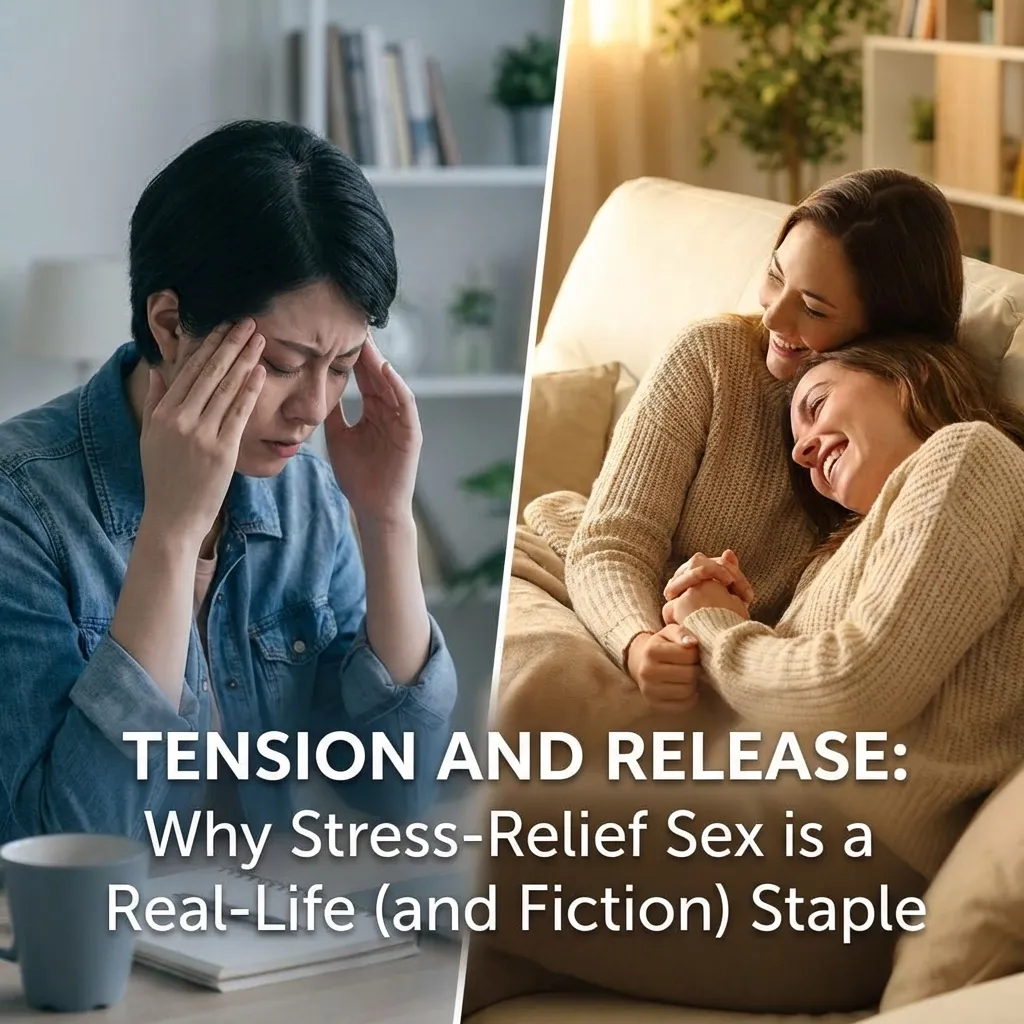
You know that scene in your favourite MM romance where the characters have been through absolute hell, a near-death experience, a devastating argument, a life-changing revelation, and they practically fall into each other's arms? The tension breaks, clothes come off, and suddenly everything feels like it's going to be okay, at least for a moment?
Yeah, that's not just a narrative device. That's biology, baby.
Stress-relief sex is one of the most authentic tropes in gay romance books, and there's a damn good reason why it shows up so often in both fiction and real life. It's raw, it's real, and it actually works, at least temporarily. Let's talk about why this high-stakes intimate moment resonates so deeply with readers and why it's more than just a convenient plot point.
The Science Behind the Steam
When you're stressed, your body goes into fight-or-flight mode. Cortisol and adrenaline flood your system, your heart races, your muscles tense up, and your brain is basically screaming "DANGER! DANGER!" at full volume. It's exhausting, and frankly, it's not sustainable.
Enter sex.

During sexual activity, your body releases a cocktail of feel-good chemicals that actively counteract that stress response. Oxytocin, often called the "bonding hormone", floods your system, lowering stress levels and calming your nervous system. It's the same hormone that makes you feel emotionally connected and safe with your partner, which is why post-sex cuddling feels so damn comforting.
Then there are endorphins, your body's natural pain relievers and mood boosters. These bad boys create that euphoric feeling and help you relax. Dopamine joins the party too, giving you that sense of satisfaction and pleasure that makes everything feel a bit brighter. And after orgasm? Prolactin kicks in, increasing by about 400% after partnered sex compared to solo sessions, essentially telling your body, "Okay, we're done. Time to rest now."
Meanwhile, those stress hormones, cortisol and adrenaline, drop significantly. Your body shifts from "everything is on fire" mode to "actually, we're pretty chill right now" mode. It's a complete biological reset, and it feels amazing.
Why It Hits Different in Gay Relationships
For gay men specifically, this stress-relief connection can carry extra weight. Many of us have experienced stress that's unique to navigating the world as queer people, coming out anxiety, discrimination, relationship visibility concerns, or just the general exhaustion of existing in a world that doesn't always make space for us.
Physical intimacy becomes more than just pleasure; it's reclaiming safety, connection, and vulnerability in a way that society doesn't always allow us. When MM romance writers capture that moment where two men find solace in each other after a crisis, they're tapping into something deeply authentic. It's not just about the sex, it's about finding a harbour in the storm, someone who sees you and wants you and makes the world feel a little less hostile for a while.

That scene where the closeted character finally has a moment of authentic intimacy after years of hiding? Or when the couple reunites after a dangerous separation and the relief pours out through physical connection? Those aren't just steamy scenes, they're emotional releases that readers recognize because many of us have lived some version of that experience.
The Fiction Factor: Why We Love Reading It
The best MM romance books understand that stress-relief sex isn't just about bodies, it's about emotion, vulnerability, and timing. It's why this trope shows up in everything from contemporary romance to historical fiction to high-stakes thrillers.
When characters turn to each other in moments of crisis, it creates:
Emotional authenticity: We see characters at their most vulnerable, stripped of their usual defenses (literally and figuratively). It's intimate in ways that go beyond the physical.
Tension payoff: If the author has been building romantic or sexual tension for chapters, a high-stress moment provides the perfect catalyst for that release. It feels earned, not rushed.
Character development: How characters seek comfort, whether it's desperate and urgent or slow and reassuring, tells us so much about who they are and what they need from each other.
Realism: Because this happens in real life, it grounds even the most fantastical stories. Whether your characters are spies, royalty, or small-town bakers, this human response to stress is universal.
The spicy MM romance that does this well doesn't just write a sex scene, it writes an emotional earthquake where intimacy is both the tremor and the aftermath.
The Real-Life Application
Research backs up what readers instinctively know: sex really does reduce stress. Studies show that on days when couples engage in sexual activity, they report significantly lower stress levels compared to days without it. This benefit applies regardless of relationship satisfaction or other factors, it's about the biological response.

For gay men in relationships, this can be particularly valuable. Whether it's the stress of work, family dynamics, social pressures, or the million other things that create tension in modern life, physical intimacy offers a tangible way to reconnect and decompress together.
But here's where it gets interesting, and where gay romance books that handle this trope well tend to get it right.
The Limitations (That Good Writers Acknowledge)
Here's the thing: stress-relief sex is temporary. Like, really temporary. Research shows that while sex reduces stress on the day it happens, those benefits don't carry over to the next day. It's an immediate release valve, not a long-term solution.
Even more importantly, motivation matters. Studies have found that couples who have sex specifically to avoid dealing with relationship conflict actually experience increased stress levels 24 hours later. In other words, if you're using sex as a band-aid to avoid having a difficult conversation, it's going to backfire.
The most authentic MM romance books understand this nuance. They don't pretend that one steamy encounter solves all the characters' problems. Instead, they use these moments as part of a larger emotional arc. The sex might provide temporary relief and connection, but the characters still have to face their issues, have those hard conversations, and do the actual work of building their relationship.
When authors get this right, you get stories that feel real and emotionally satisfying. The intimacy matters: it creates space for vulnerability, it reinforces connection, it reminds the characters why they're fighting for each other: but it doesn't magically erase the problems. That's what makes it compelling rather than contrived.
Finding the Balance
So what does healthy stress-relief sex look like, both in life and in fiction?
Communication matters: Even in urgent, desperate moments, there's acknowledgment of consent and desire. The best sex scenes show characters checking in with each other, even if it's just through body language and breathless questions.
It's a beginning, not an ending: The intimacy opens doors for emotional honesty rather than closing them. Characters might have their most vulnerable conversations after sex, in that post-coital space where defenses are down.
Context is everything: The stress that led to the encounter doesn't disappear. Good writing acknowledges that complexity rather than treating sex as a magic cure-all.
Emotional authenticity wins: Whether the encounter is desperate and urgent or slow and comforting, it should feel true to both the characters and the moment. Readers can tell when it's genuine versus when it's just plot mechanics.

Why This Trope Endures
At its core, the stress-relief sex trope in gay romance books endures because it captures something fundamentally human: the need for connection when everything else feels like it's falling apart. It's about finding comfort in another person's body when words aren't enough. It's about choosing intimacy and vulnerability even: especially: when the world feels unsafe.
For queer readers, it's also about seeing gay characters claim that space for themselves. Stress, desire, connection, release: these are universal experiences that LGBTQ+ people deserve to see reflected in fiction without shame or apology.
When you're curled up with a spicy MM romance and hit that scene where the characters finally break down their walls and reach for each other, you're not just reading escapism. You're reading a reflection of real human psychology, wrapped up in compelling storytelling and authentic emotion.
And honestly? That's pretty damn powerful.
Whether you're seeking comfort in fiction during your own stressful times or you're exploring the depths of human connection through storytelling, MM romance offers a unique space to experience these high-stakes intimate moments authentically. Because sometimes, the best way to process the chaos is to find your person and hold on tight: even if it's just for that moment, just for that release, just for that reminder that you're not facing the storm alone.
Looking for more emotionally authentic MM romance that explores intimacy in all its forms? Check out our curated collection at Read with Pride, where every story celebrates connection, desire, and the beautiful complexity of queer love.
Follow us for more:
#MMRomance #GayRomanceBooks #SpicyMMRomance #LGBTQBooks #ReadWithPride #QueerFiction #GayFiction #MMNovels #BestMMRomance #GayLoveStories #LGBTQRomance #QueerRomance #GayBooks #MMBooks #LGBTQReads #PrideReading #AuthenticLove

Leave a Reply
You must be logged in to post a comment.