

readwithpride.com
When you think about the Mediterranean, your mind probably goes to sun-drenched beaches, ancient ruins, and that perfect plate of fresh seafood. But for LGBTQ+ folks in Greece and Albania, this stunning region tells a much more complicated story, one where legal progress races ahead while family dinner tables remain battlegrounds, and where crossing a border might mean crossing into an entirely different reality.
Let's talk about what it's actually like to be queer in the cradle of Western civilization and its neighboring Balkan state, because the gap between what's written in law books and what happens in your grandmother's living room? That gap is huge.
When the Law Says Yes But Yiayia Says No
Here's something wild: In 2024, Greece became the first predominantly Orthodox Christian country to legalize same-sex marriage. Full stop. Not civil unions, not "registered partnerships", actual marriage, complete with adoption rights. On paper, that's absolutely groundbreaking. Greece essentially told centuries of tradition to take a seat while love took center stage.
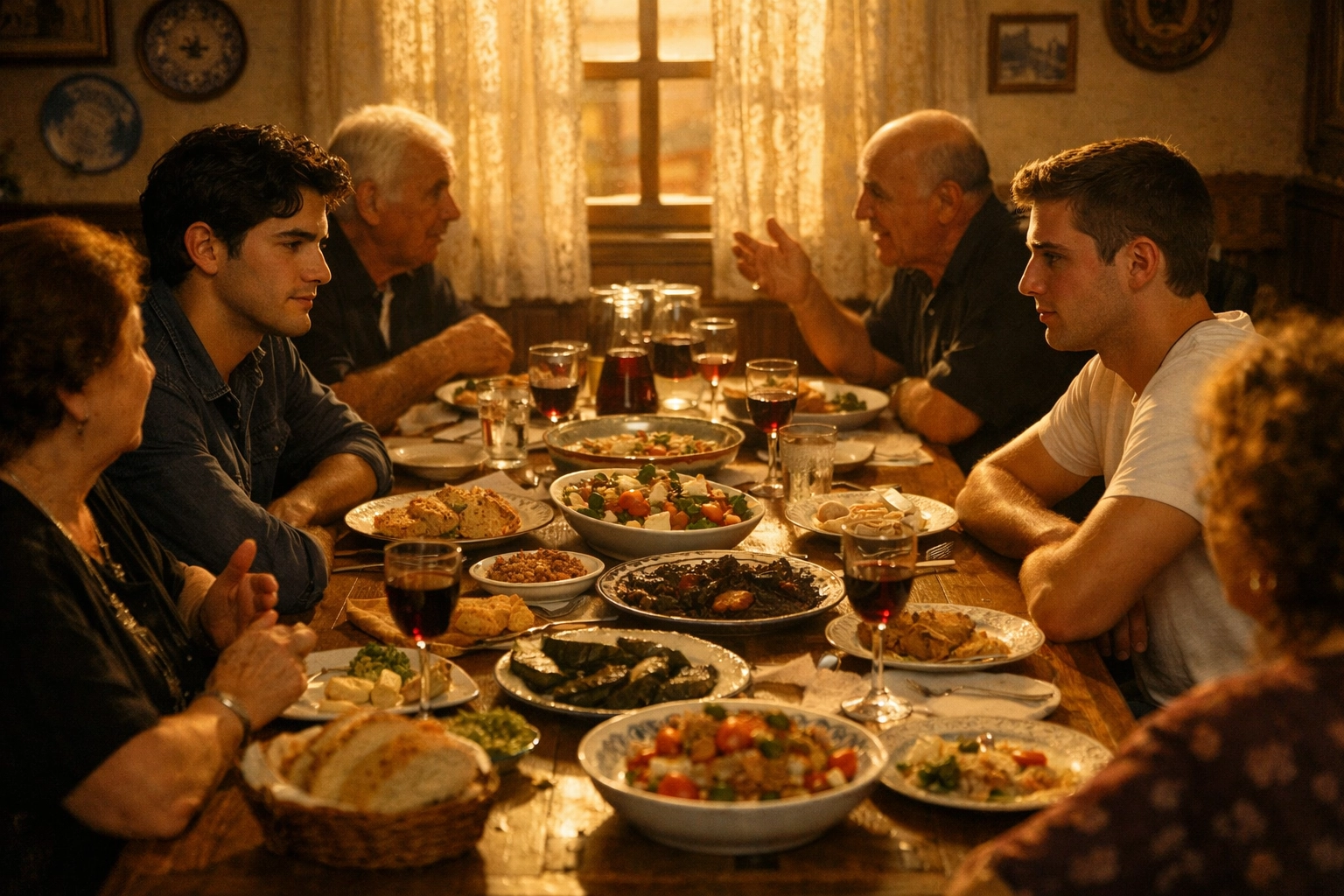
But if you're a 22-year-old guy from Thessaloniki trying to bring your boyfriend home to meet your parents, that legislative victory might feel pretty abstract. Because while Parliament was voting yes, the Orthodox Church was (and still is) firmly voting no. And in a culture where your grandmother's opinion might carry more weight than any prime minister's, that creates some seriously awkward family gatherings.
The disconnect is real and it's painful. Young Greeks are living in this bizarre limbo where they can legally get married but might lose half their family in the process. Urban Athens and Thessaloniki? Those cities are building vibrant queer scenes, with bars, community centers, and genuine visibility. But venture into rural areas or the islands, and you're often back to hiding, to coded language, to carefully managing who knows what about your life.
Albania: The Neighbor That Time (Almost) Forgot
Now let's talk about Albania, because if Greece is complex, Albania is next-level complicated. This is a country that was under one of the most isolating communist regimes in history until 1991. For context, that's not ancient history: that's people who are now in their forties growing up in a country that was essentially sealed off from the world.
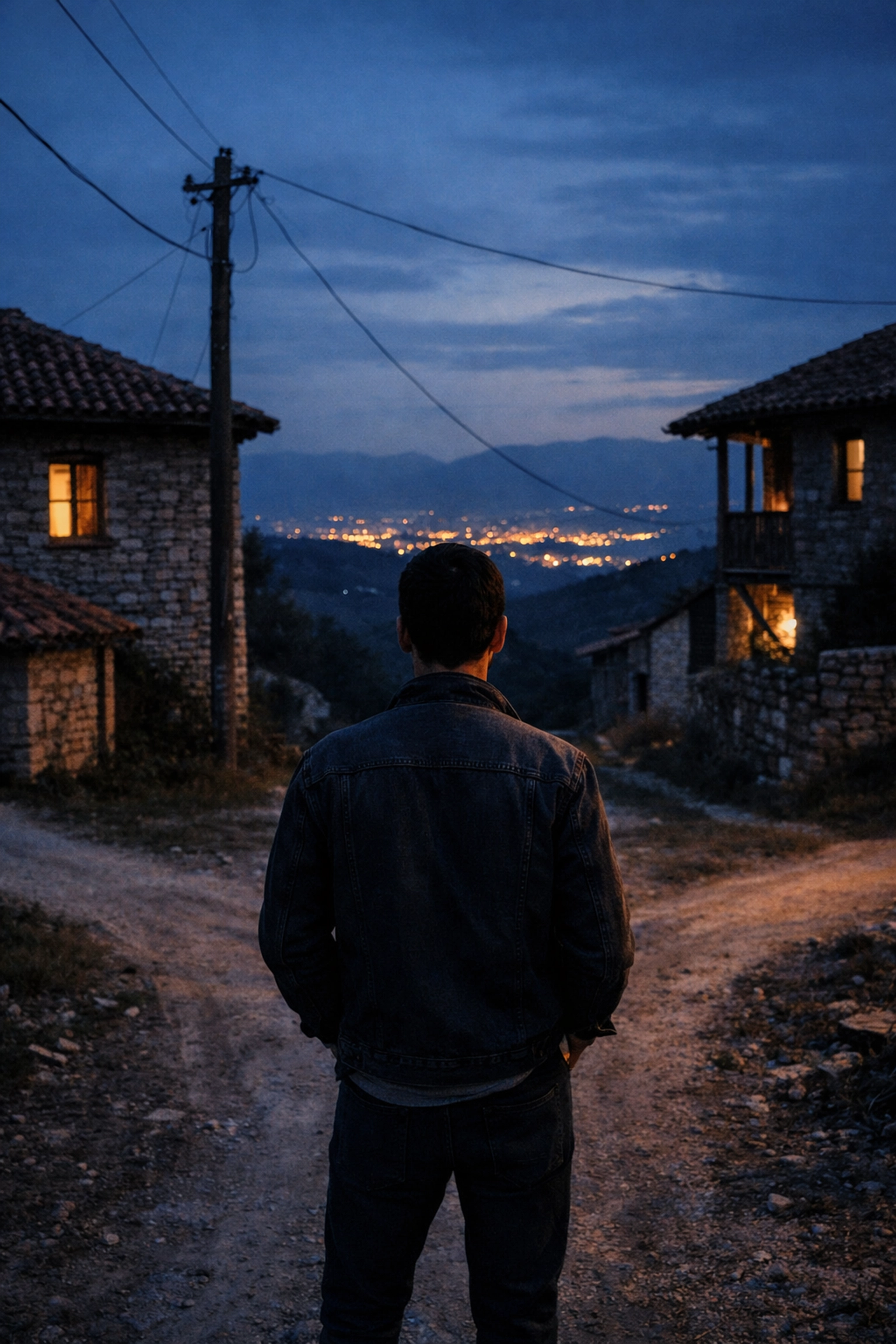
Today's Albania has decriminalized homosexuality and technically has some anti-discrimination protections. But here's the brutal reality: cultural acceptance is nearly non-existent outside of tiny pockets in Tirana. The concept of being openly gay is so foreign in many Albanian communities that there literally isn't vocabulary for it beyond slurs. Family honor culture runs deep, especially in the north, and coming out can mean social death: or worse.
For Albanian LGBTQ+ folks, the closet isn't just a safety precaution; it's often the only viable option. Marriage to someone of the opposite sex is still expected, full stop. Having kids is non-negotiable. The idea of living your truth? That's considered a Western import, a betrayal of family and tradition.
The urban-rural divide here makes Greece's look tame. In Tirana, there's a small but growing underground scene. Secret parties, carefully vetted social circles, encrypted apps doing the heavy lifting of connection. But one village over? You might as well be on a different planet.
Cross-Border Romance: When Love Speaks Multiple Languages
Here's where things get interesting: and where some genuinely beautiful stories emerge. The internet has done what physical borders couldn't prevent: it's connected Greek and Albanian LGBTQ+ folks in ways that would've been impossible just fifteen years ago.
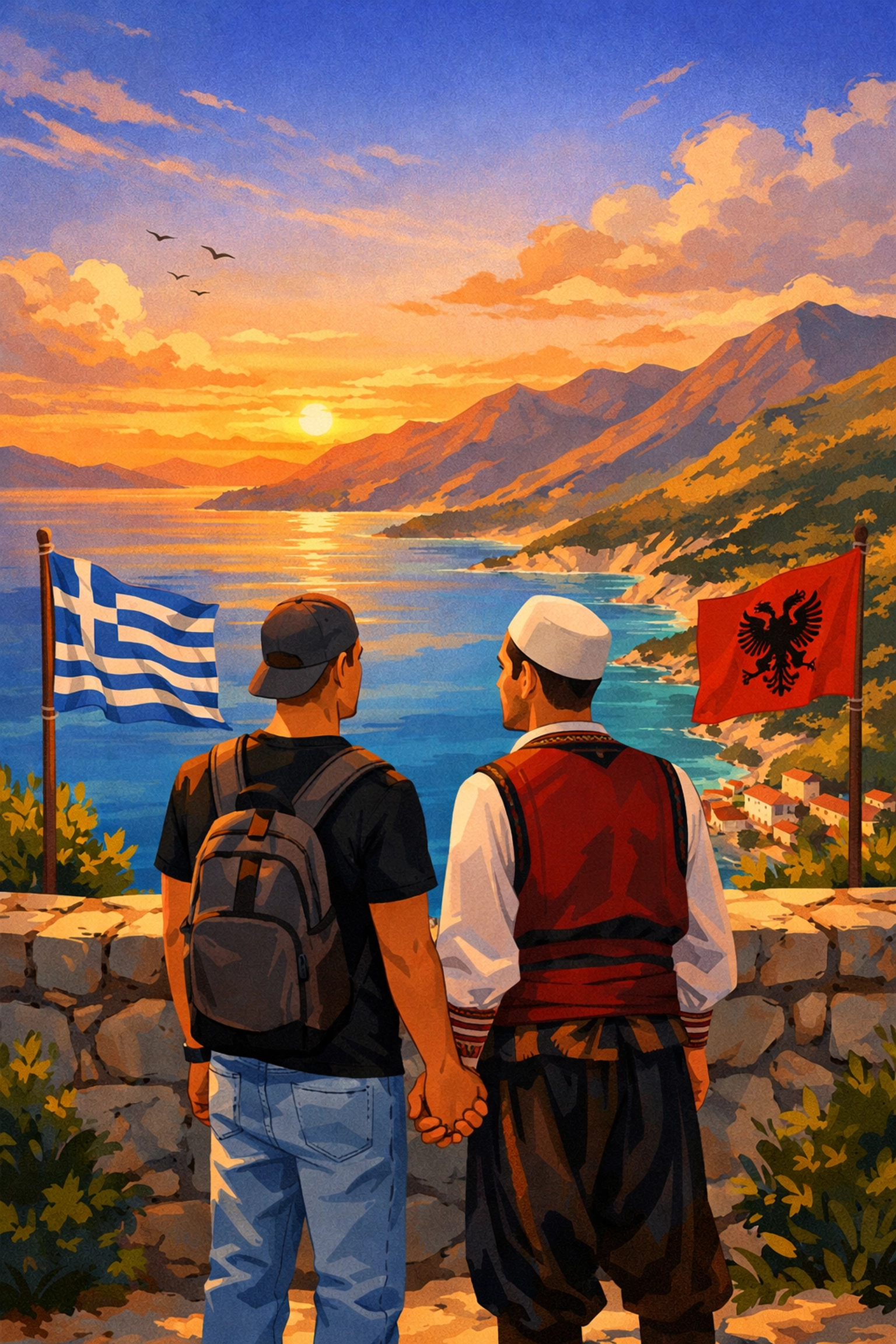
These cross-border relationships are their own unique beast. You've got a Greek guy who can (theoretically) be openly partnered meeting someone from Albania who might never be able to introduce him to family. You've got the complexity of different legal realities, different cultural expectations, different levels of what "out" even means.
But these relationships also offer something powerful: perspective. A Greek person dating someone from Albania gains instant appreciation for their own privileges, however limited. An Albanian person connecting with the Greek queer community gets to see what's possible, what life could look like with just a bit more freedom.
And let's be real: there's something undeniably compelling about the forbidden nature of it all. The MM romance novels practically write themselves: secret border crossings, families who can't know, navigating two different worlds while trying to build a life together. It's enemies-to-lovers on a geopolitical scale.
The Weight of Family: Choose Your Hard
One thread runs through both Greek and Albanian queer experiences: family is everything, until it isn't. Mediterranean culture is fundamentally family-centric. Your identity is tied to your family's identity. Your choices reflect on your entire extended clan. Independence the way Americans or Northern Europeans understand it? That's not really a thing.
So when you come out, you're not just telling your parents about yourself. You're potentially disrupting an entire social network that's been operating a certain way for generations. You're asking them to rewrite their understanding of their own identity as much as yours.
Research shows that family acceptance is absolutely crucial for LGBTQ+ youth wellbeing. It protects against depression, substance abuse, and suicidal ideation. But in cultures where family acceptance requires bucking massive social and religious pressure, asking for that acceptance feels like asking someone to jump off a cliff with you.
The Greek experience offers slightly more hope here. As more young people come out and as visibility increases in media and politics, some families are slowly, painfully evolving. You're seeing more parents attend Pride (even if they're nervous about being photographed). You're hearing more stories of gradual acceptance, even if it takes years.
Albania? That's a tougher road. The families who do accept their LGBTQ+ kids often can't show it publicly without facing their own social consequences. Love becomes this secret thing, tucked away in private while everyone maintains appearances in public.
Finding Community When Geography Fails You
So what do you do when your actual physical location isn't serving you? You build virtual communities and you travel when you can.
The rise of LGBTQ+ tourism has been a game-changer for both Greek and Albanian queers. Greece's islands: especially Mykonos, which has been a gay destination for decades: offer temporary refuges. For a week or a weekend, you can just be, without the weight of your hometown's judgment following you around.
Albanian LGBTQ+ folks who can afford it often make trips to Tirana, Athens, or further afield to experience what openly queer spaces feel like. Those experiences become touchstones, proof that another life is possible.
Online spaces have become crucial organizing tools. Facebook groups, Instagram communities, Discord servers: these are where people find each other, share resources, vent frustrations, and occasionally plan in-person meetups. For folks in isolated areas, these digital communities might be their only connection to other LGBTQ+ people.
And here's something worth noting: the MM romance community has become its own form of connection. Reading gay love stories: especially ones set in culturally similar contexts: provides both escape and validation. When you can't see yourself represented in your daily life, finding yourself in fiction matters enormously. That's why platforms like Read with Pride aren't just entertainment; they're lifelines.
The Long Game: Progress Measured in Generations
Look, we're not going to pretend there's a neat, happy ending here. The reality is that being LGBTQ+ in Greece and Albania in 2026 is still really hard. It's choosing between authentic life and family acceptance. It's managing multiple closets for different contexts. It's watching legal rights expand while cultural attitudes lag decades behind.
But here's what's also true: change is happening. Every Greek couple who gets legally married chips away at the old assumptions. Every Albanian kid who secretly connects with others online plants seeds for future visibility. Every cross-border relationship proves that love doesn't give a damn about geopolitics.
The Mediterranean queer experience is one of tension: between tradition and progress, between family and self, between who you're supposed to be and who you actually are. But it's also increasingly one of resilience, community, and quiet revolution.
For those navigating these waters, whether in Athens or Tirana or some small village where nobody talks about these things: you're not alone. Your story matters. And increasingly, there are spaces: both physical and digital: where you can find your people and your voice.
Want more stories that reflect the real, complex experiences of LGBTQ+ life around the world? Check out our collection of gay romance novels and MM fiction at readwithpride.com. From contemporary love stories to historical fiction, we're building a library that sees you.
Follow us for daily LGBTQ+ content and community:
- Facebook: facebook.com/readwithpride
- Instagram: @read.withpride
- X/Twitter: @Read_With_Pride
#MMRomance #GayRomance #LGBTQBooks #ReadWithPride #QueerFiction #GayLoveStories #MMBooks #LGBTQFiction #GayNovels #ContemporaryRomance #CrossBorderRomance #MediterraneanRomance #ComingOutStories #LGBTQTravel #QueerCommunity #2026Books #BestGayRomance #MMRomanceBooks #GayRomanceNovels #LGBTQReading

Leave a Reply
You must be logged in to post a comment.