

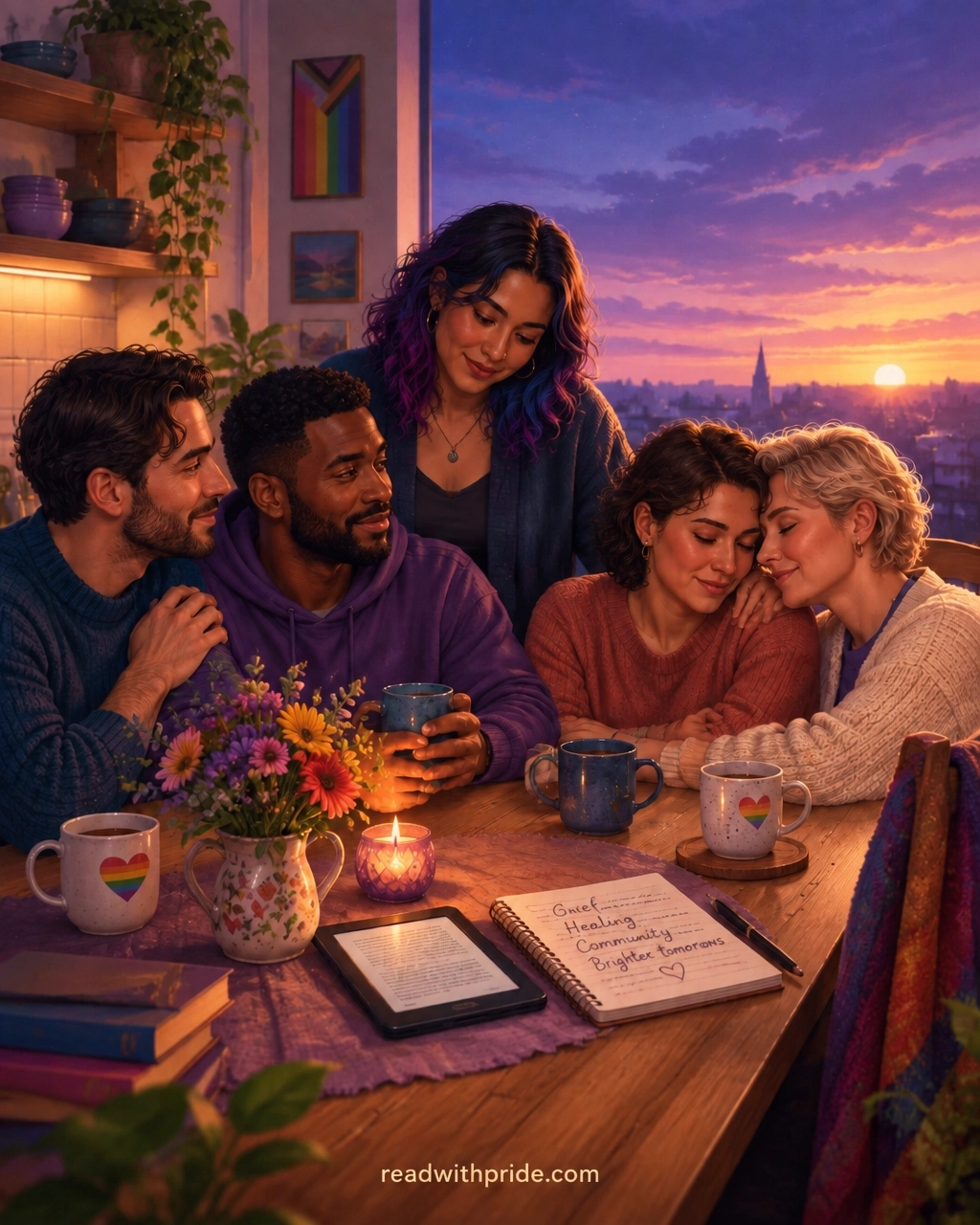
Content note: This article discusses grief, family rejection, estrangement, hidden years, community loss and emotional healing. Please take what feels useful and leave anything that feels too close to the bone today.
There is no single shape to queer grief.
Sometimes it follows the death of a partner, friend, chosen-family member, queer elder or community organiser. Sometimes it arrives after a relationship ends, a family member rejects you, or a place that once felt safe no longer does.
Sometimes grief is about the years spent hiding.
You may mourn the person you could have been if you had felt safe enough to come out earlier. You may grieve the family acceptance you hoped would arrive, the relationship that had to stay private, or the ordinary milestones you were told would happen in a neat, predictable order.
And sometimes grief simply appears on a Tuesday while you are trying to find your keys. Emotions have never been especially respectful of calendars.
This is where queer healing can begin: not by pretending that pain did not happen, but by making room for the full truth. We can acknowledge what has been lost while imagining future visions shaped by safety, tenderness, belonging and choice.
Grief is not something you have to get over
The phrase “getting over it” suggests that grief is an obstacle between you and your proper life. It implies that healing means returning to who you were before the loss.
But queer healing may not be about going back.
You may be becoming someone new: someone with clearer boundaries, deeper self-knowledge, stronger community, or a better understanding of the care you need. You may be learning how to carry the past without allowing it to make every decision about the future.
That does not mean the past stops hurting.
A family rejection can still ache years later. A coming out story that ended badly can influence how safe honesty feels in future relationships. The death of someone from your chosen family may bring up not only personal sadness, but the pain of a world that did not always recognise the importance of your bond.
You are allowed to name these losses.
You are allowed to say:
- This mattered to me.
- I was hurt by what happened.
- I miss who I was before I had to survive this.
- I am not ready to forgive.
- I want something different now.
Healing is not a performance. You do not need to transform your grief into an inspirational speech, a lesson or a public act of strength. Sometimes healing is therapy. Sometimes it is setting a boundary. Sometimes it is cancelling plans, eating something simple, crying in the shower or watching a familiar show until your nervous system remembers that not every moment is an emergency.
LGBTQ+ resilience does not mean being indestructible
The word resilience can be powerful, but it can also become another demand placed on LGBTQ+ people.
Be strong. Stay positive. Keep going. Make your suffering meaningful.
That is a lot to ask of anyone.
LGBTQ+ resilience is not the absence of pain. It is not coping alone, and it is not proof that difficult circumstances did not affect you. It is the ability to keep reaching for connection, care, meaning and possibility while remaining honest about what hurts.
Resilience can look dramatic: leaving an unsafe home, starting again in a new city, speaking openly about your identity or building a new life after rejection.
It can also look incredibly ordinary:
- Answering one message.
- Asking for help before reaching crisis point.
- Resting without treating rest as a reward.
- Blocking an unsafe relative.
- Making a doctor’s appointment.
- Letting a trusted person sit beside you without trying to fix everything.
- Laughing at a perfectly timed meme ten minutes after crying.
Soft resilience counts.
So does uncertainty. You do not have to know what comes next in order to deserve support while you find out.

Chosen family makes healing practical
Hope can sound abstract until it has a face, a phone number, a spare key or a message that says, “Have you eaten?”
Chosen family is not a decorative extra in queer life. For many LGBTQ+ people, it is a vital source of safety, recognition and continuity. It may include friends, partners, ex-partners, neighbours, colleagues, mentors, queer elders or online friends who have become part of your everyday support system.
Chosen family can offer:
- Witnessing: remembering what you have survived.
- Affirmation: treating your identity and relationships as real.
- Practical care: meals, lifts, childcare, company at appointments or somewhere safe to sleep.
- Emotional room: letting you cry, vent, be quiet or change the subject.
- Continuity: helping you imagine growing older and still belonging.
- Joy: shared meals, birthdays, reading, dancing and doing nothing together.
Chosen family does not need to be perfect to be real. No family is perfect. What matters is mutual care, respect, honesty and the freedom to show up as your whole self.
You can explore stories about belonging and the many ways families are created in Read with Pride’s Alternative Family collection. Queer futures are not only about major political victories. They are also about kitchens where everyone is welcome, birthdays where nobody is erased and someone remembering exactly how you take your tea.
Small future visions are still future visions
When life has required constant vigilance, imagining the future can feel surprisingly vulnerable.
What if you hope for something and lose it? What if the world changes again? What if you are not equipped for the life you want?
You do not need a ten-year plan. You do not need a colour-coded vision board or a perfectly curated future self. Start with one gentle question:
What would make tomorrow feel a little more like home?
The answer might be big:
- Safe housing.
- Affirming healthcare.
- Family acceptance.
- Legal protection.
- Freedom from violence.
- A community where queer elders are valued.
- A world where trans and queer young people do not have to spend their childhood defending their right to exist.
It might also be wonderfully ordinary:
- Waking up without bracing yourself before checking your phone.
- Sharing a home with people who respect your boundaries.
- Reading openly in a public place.
- Having friends who come over without needing a special occasion.
- Seeing your partner introduced correctly.
- Growing old surrounded by people who know your history.
- Keeping a bookshelf full of gay fiction, lesbian romance and queer love stories.
These images are not too small. Ordinary safety is a radical future when so many people have been taught to expect rejection.

Stories help us practise possibility
Books cannot erase grief, and reading is not a substitute for therapy, community support or meaningful social change. But stories can offer language, recognition and company.
A thoughtful piece of gay fiction can help name feelings that have been difficult to explain. Coming out stories can remind us that there is no single correct timeline for becoming visible. Lesbian romance can make room for desire, humour, conflict and tenderness between women.
And MM romance books and gay romance novels can offer emotional shelter of their own.
A slow-burn romance can remind us that intimacy does not have to happen instantly. A second-chance story can make room for repair. A found-family narrative can help us notice the people already showing up in our lives. A steamy story can remind us that queer bodies and desires are not problems to solve.
At Read with Pride, readers can explore LGBTQ+ ebooks, M/M books, queer fiction, gay fiction, LGBTQ+ novels and emotionally rich queer love stories. Whether you are searching for comfort, catharsis, a new release or a story that imagines a more generous world, representation can expand the map of what feels possible.
If you are looking for a shared way into that reading life, try starting a queer book club. You do not need a large group or a flawless reading schedule. A few people, one book, snacks and a willingness to discuss the emotional damage caused by fictional people can be enough.

A gentle practice for today
If you have the energy, take five minutes with a notebook or your phone and complete these sentences:
- I am grieving…
- Something helping me heal is…
- A future I want to make room for is…
Try to be specific.
“I am grieving the years I spent hiding.”
“Something helping me heal is my friend checking in every Sunday.”
“A future I want to make room for is a home where everyone can be honest.”
You can also write a short future postcard. Describe one ordinary day in a life where you feel supported enough to relax.
Who is nearby? What are you reading? What can you hear? What no longer takes up all your mental space?
Your answer does not need to be grand. “I have a kitchen where nobody comments on my mugs” is a perfectly valid queer utopia.
If writing feels like too much, choose a song, take a walk, make tea, text someone safe or read a few pages of something comforting. Reflection should be gentle, not another task you have to complete correctly.
The future is something we build together
Hope does not erase grief.
You can miss someone and still build a beautiful life. You can be angry about injustice and still laugh with your friends. You can carry complicated memories and still fall in love, make art, change careers, start a family or join a queer book club.
Our future visions do not need to be perfect. They need to be more spacious.
A hopeful queer future includes rest as well as resistance. It includes queer elders, accessible care, chosen family, honest relationships, creative freedom and ordinary joy. It includes LGBTQ+ people being allowed to be complicated, ambitious, boring, funny, sensual, tired, loved and fully themselves.
That future is built through everyday care: a boundary, a meal, a check-in, a story, a shared laugh, a community space or a book that helps someone feel less alone.
And if your search history is currently a chaotic mix of “LGBTQ+ fiction 2026,” “C Section 2026,” “best MM romance books” and “coming out stories”, you are still welcome here. The internet is mysterious. Queer care can meet us in unexpected corners.
Explore Read with Pride’s LGBTQ+ ebooks, including MM romance books, gay romance novels, lesbian romance, gay fiction and wider LGBTQ+ novels. Read more reflections in the LGBTQ+ blogs and articles collection.
Follow Read with Pride on Facebook and Instagram for LGBTQ+ reading inspiration, queer authors, new releases and conversations about queer life.
You do not have to carry everything alone. You do not have to imagine the future alone, either.
#QueerHealing #FutureVisions #LGBTQResilience #ReadWithPride #MMRomanceBooks #GayRomanceNovels #ComingOutStories #QueerBookClub #LGBTQFiction2026 #CSection2026 #GayFiction #LGBTQNovels #QueerLoveStories #QueerFiction #LGBTQReading #ChosenFamily #QueerJoy

Leave a Reply
You must be logged in to post a comment.