

Queer Experiences and Stories | MM Romance | LGBTQ+ Fiction
The bags at the door
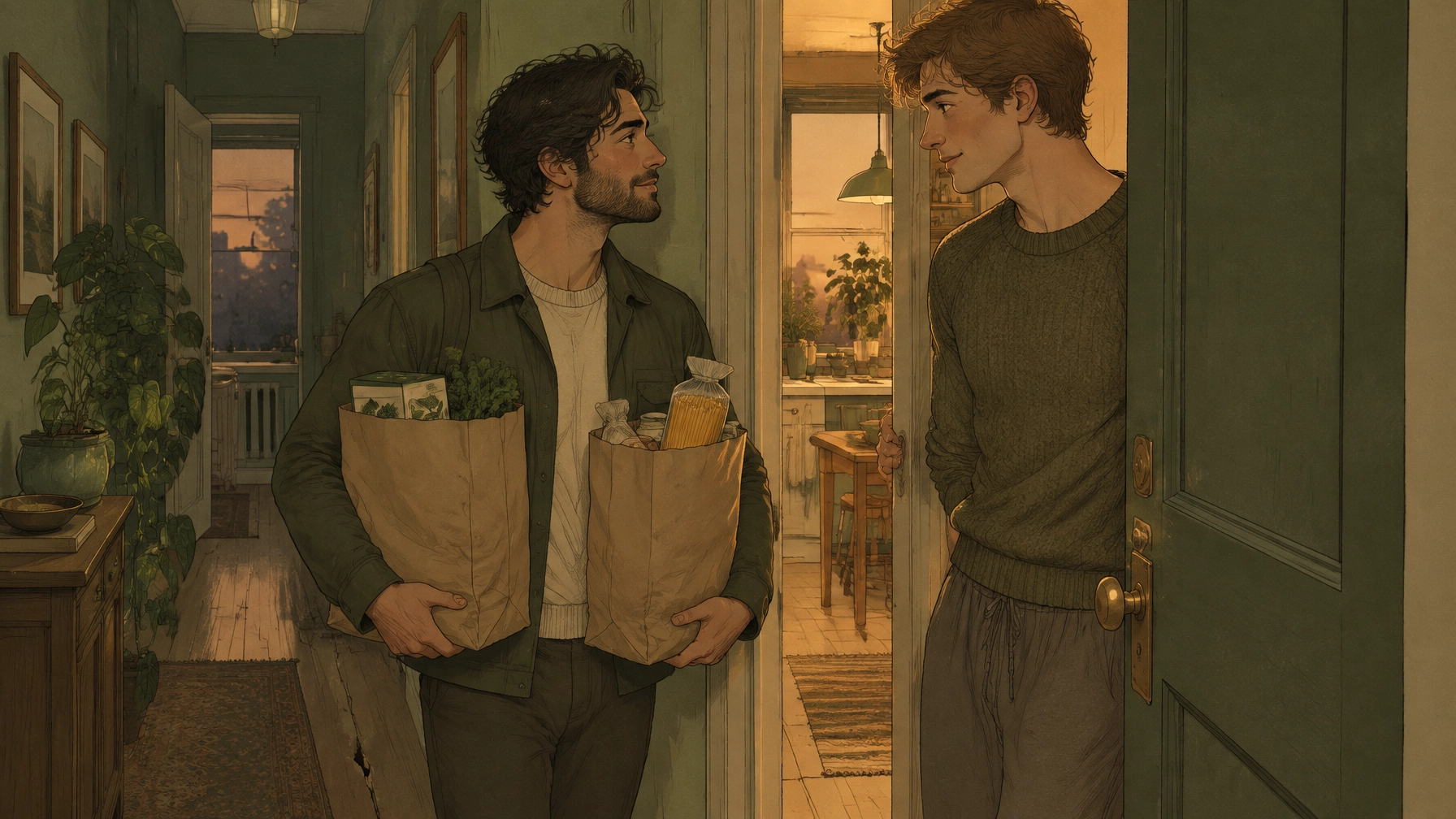
Elias arrived without warning, which was not unusual.
The grocery bags were.
Julian opened the door and found him standing on the landing with two canvas bags cutting red lines into his fingers, his coat damp at the shoulders, and an expression that suggested he had either come bearing good news or accidentally purchased an entire supermarket.
The creaky hallway floorboard complained beneath him.
“Before you say anything,” Elias said, “I was in the area.”
“You live forty minutes away.”
“I was in the wider area.”
“You live in another postcode.”
“The postcode was emotionally nearby.”
Julian looked into the bags. “Is that pasta?”
“It is.”
“Why is there so much of it?”
“I panicked.”
“That’s not how pasta works.”
“It is how I shop.”
Julian stepped aside, and Elias came in, carefully avoiding the floorboard as if it had personal grievances. He had been given a key. He had been asked to use it. He still knocked most of the time, as though the difference between welcome and intrusion might be hidden in the sound.
The blue toothbrush was still in the ugly duck mug beside the bathroom sink.
The mug remained, as Julian had described it, “an insult to both ceramics and waterfowl.”
Nothing about it had improved.
Elias carried the groceries into the kitchen and began unpacking before Julian could ask whether he needed help. Bread. Tomatoes. Yoghurt. Butter. A lemon. Biscuits Julian pretended not to like and somehow finished whenever Elias brought them. Then came the pasta.
Not just pasta. The correct pasta.
“You remembered I hate spirals,” Julian said.
“You said they hold sauce badly.”
“I said they look like tiny edible springs.”
“You were very passionate.”
“I have principles.”
“You have opinions about carbohydrates.”
“They’re important opinions.”
Elias placed the packet on the counter with great care. Then he reached into the second bag and brought out a box of tea.
Julian stopped.
It was the tea.
The specific tea. Cinnamon and orange. The one he only bought when he was being kind to himself, which meant he bought it roughly three times a year and treated each box as if it had been smuggled across a border.
“You found it,” Julian said.
“I looked.”
“That is not the same thing.”
“It was behind several boxes of something called ‘Mindful Meadow.’”
“That tea tastes like a cushion.”
“I know. I rejected it on your behalf.”
Julian touched the box with two fingers. “You didn’t have to bring this.”
“I know.”
“And the biscuits.”
“I know.”
“And the pasta.”
“I am beginning to suspect you think I did this deliberately.”
Elias gave him a look.
Julian leaned against the counter. “Did you?”
Elias glanced at the full fridge. Then at the cupboards, which were already stocked. Then at Maurice, the plant by the window, whose leaves had drooped theatrically toward the light.
Maurice had survived three missed waterings, a move across town and one incident involving a radiator. He was dramatic, resilient, and, according to Julian, “takes after you.”
“I thought you needed things,” Elias said.
“I have things.”
“You were low on biscuits.”
“I was emotionally low on biscuits.”
“That counts.”
Julian smiled, but his attention stayed on Elias. That was the problem with Julian. He noticed the thing beneath the thing. He had noticed the blue toothbrush. He had noticed Elias using the middle shelf without asking. He had noticed that Elias always sat on the left side of the sofa, even when it meant leaning awkwardly around the lamp.
He noticed now that the fridge was already full.
Care, control and the things left unsaid
Elias had always shown love by anticipating needs.
He knew when someone would be cold before they admitted it. He carried spare chargers, painkillers, plasters and the particular brand of crisps his friends liked. He remembered birthdays, allergies, train times and which subjects were best avoided after two glasses of wine.
It was useful. It was thoughtful.
It was also a way of never having to ask for anything.
If he could make himself necessary, he did not have to risk being wanted.
Julian picked up the tea and turned it over in his hands.
“You brought me everything except the thing you want,” he said.
The sentence landed softly. That made it worse.
Elias looked toward Maurice. Maurice, unhelpfully, appeared to be listening.
“I don’t want anything.”
“That’s not true.”
“It could be.”
“It isn’t.”
“I want you to stop interrogating me about groceries.”
“That is not a thing you want. That is a thing you want me to stop doing.”
“Fine. I want you to stop doing that.”
Julian waited.
Elias sighed. “You see why I don’t talk?”
“Because you’re exhausting?”
“That’s one theory.”
“The leading theory.”
Julian moved closer, taking the tea box from Elias’s hand before Elias could put it somewhere sensible and escape into arranging the cupboards.
“I’m not saying this is bad,” Julian said. “The tea is lovely. The biscuits are suspiciously accurate. The pasta is a personal attack, but I admire the commitment.”
“I can take it back.”
“I know.”
“I can take all of it back.”
“I know.”
“That wasn’t meant to sound—”
“Like a threat?”
“Like an option.”
“It can be both.”
Elias laughed, though it came out thin. He looked down at his hands.
“I’m not good at wanting things out loud,” he said.
Julian’s expression changed. Not dramatically. There was no music, no sudden transformation, no great cinematic shift in the lighting. Just a little less amusement and a little more understanding.
“Why not?”
“Because then someone can say no.”
“That is generally how asking works.”
“I’m aware.”
“And if they say no?”
“I’ll survive.”
Julian tilted his head. “Will you?”
Elias looked at him then.
The question was not cruel. That was what made it possible to answer.
“I usually make sure I don’t have to find out.”
The wrong pasta and the right question
They cooked dinner because Julian believed that emotional conversations were less dangerous when there was something on the hob.
Elias believed emotional conversations were less dangerous when he was allowed to chop vegetables.
They compromised by doing both.
The pasta went wrong almost immediately. It stuck together in one large, determined mass, despite Julian’s repeated assurances that he had “watched a video.”
“You watched a video?”
“A short one.”
“About pasta?”
“About preventing pasta from sticking.”
“Did the video include water?”
“It included confidence.”
“That explains a lot.”
By the time they served it, the sauce had separated, the tomatoes had collapsed into a condition Julian called “philosophically soft,” and one of the pasta clumps resembled a small beige asteroid.
They ate it on the sofa, on the left side, because Julian had claimed the other cushion was “structurally less optimistic.”
Maurice watched from the windowsill.
The ugly duck mug sat on the coffee table, filled with water for the plant because Julian had forgotten the watering can again.
“Your mug is doing important work,” Elias said.
“It has found its purpose.”
“An insult to both ceramics and waterfowl.”
“You remembered.”
“I remember a lot.”
Julian’s knee touched his.
The tea came afterwards. Cinnamon and orange. Elias made it carefully, using the ugly duck mug for Julian and his own black tea in a plain white cup. The kettle clicked off. The flat settled around them: pipes ticking, traffic passing below, the faint complaint of the hallway floorboard whenever the building shifted.
Julian took a sip.
“This is good,” he said.
“You say that like you weren’t expecting it.”
“I was expecting you to somehow improve it.”
“I could have added salt.”
“You nearly did that last time.”
“That was an experiment.”
“It was a cry for help.”
Elias smiled into his cup.
For a while, neither of them spoke.
Then Julian placed his tea on the table.
“Ask me,” he said.
Elias frowned. “Ask you what?”
“What you want.”
“That seems unnecessarily direct.”
“Yes. I’m trying it out.”
Elias looked at him, then at the tea, then at the middle shelf where the two boxes would soon sit together. His black tea beside Julian’s cinnamon and orange. Not replacing it. Not taking over. Just there.
“I want…” He stopped.
Julian waited.
Elias tried again.
“I want you to ask me to stay.”
Julian’s face softened.
“I’m here now,” Elias added quickly. “I know that. I mean. I don’t want you to assume I’ll stay because I have a key or because I brought groceries or because I’m already sitting on your sofa like a badly organised houseguest.”
“You are a badly organised houseguest.”
“I want to be asked.”
Julian reached for his hand.
“Elias,” he said, plainly, “will you stay?”
It was such an ordinary question.
That was why it mattered.
Elias looked down at their joined hands. His thumb moved once across Julian’s knuckles.
“Yes,” he said. “I’d like that.”
Small declarations are still declarations
Later, Elias put the tea on the middle shelf.
Julian made room without making a ceremony of it. He shifted two jars, moved a packet of rice and placed the cinnamon-orange box at the front.
The black tea went beside it.
The arrangement was not perfect. The boxes did not line up. One leaned slightly into the other.
Julian said that was probably a metaphor.
Elias said it was probably poor cupboard management.
Maurice lost another leaf overnight but remained alive out of spite.
The blue toothbrush stayed in the ugly duck mug.
And Elias stayed.
Not because he had anticipated the invitation. Not because Julian had assumed he would remain. Not because he had made himself useful enough to earn a place.
He stayed because Julian had asked, and because he had answered.
That is the quiet power of character-driven queer fiction: the emotional turning point does not always arrive through a grand declaration. Sometimes it appears in a grocery bag, a badly cooked meal, or a question asked without disguise.
For this couple, love was not becoming effortless. It was becoming survivable.
For emotionally invested MM readers
The best MM romance unexpected places often begins with moments that look almost too ordinary to carry meaning: a toothbrush left behind, a familiar mug, a favourite tea remembered from one passing conversation.
But ordinary objects can hold an entire emotional history.
For emotionally invested MM readers, Elias and Julian’s gay love story emotional journey is compelling because neither man is learning how to love for the first time. They are learning how to be visible inside love. They are learning that care should not require mind-reading, and that being needed is not the same as being chosen.
That is the heart of emotional MM romance literary storytelling: tenderness with friction, humour beside fear, and two men finding language for what they have previously tried to communicate through actions alone.
Sometimes the brave thing is not bringing everything someone might need.
Sometimes it is saying what you want, then allowing the other person to answer.
Read with Pride
Discover LGBTQ+ ebooks, gay books, MM romance, queer fiction, gay novels and emotionally rich gay love stories through Read with Pride.
Three possible next instalments
Queer Experiences and Stories: The Morning Julian Finds Elias Has Used the Last of the Good Coffee
Queer Experiences and Stories: The Afternoon Elias Meets Julian’s Neighbour and Forgets How to Behave Normally
Queer Experiences and Stories: The Night Julian Asks What Elias Keeps in the Locked Drawer
Follow us on social media
Follow Dick Ferguson for more character-driven queer fiction, emotional MM romance and LGBTQ+ reading recommendations.
#QueerExperiencesAndStories #MMRomance #LGBTQPlusFiction #GayRomance #QueerFiction #GayLoveStories #MMFiction #EmotionalMMRomance #CharacterDrivenFiction #LGBTQReading #GayLiterature #EmotionallyInvestedReaders #ReadWithPride #ReadingWithPride #GayNovels #QueerAuthors


Leave a Reply
You must be logged in to post a comment.