

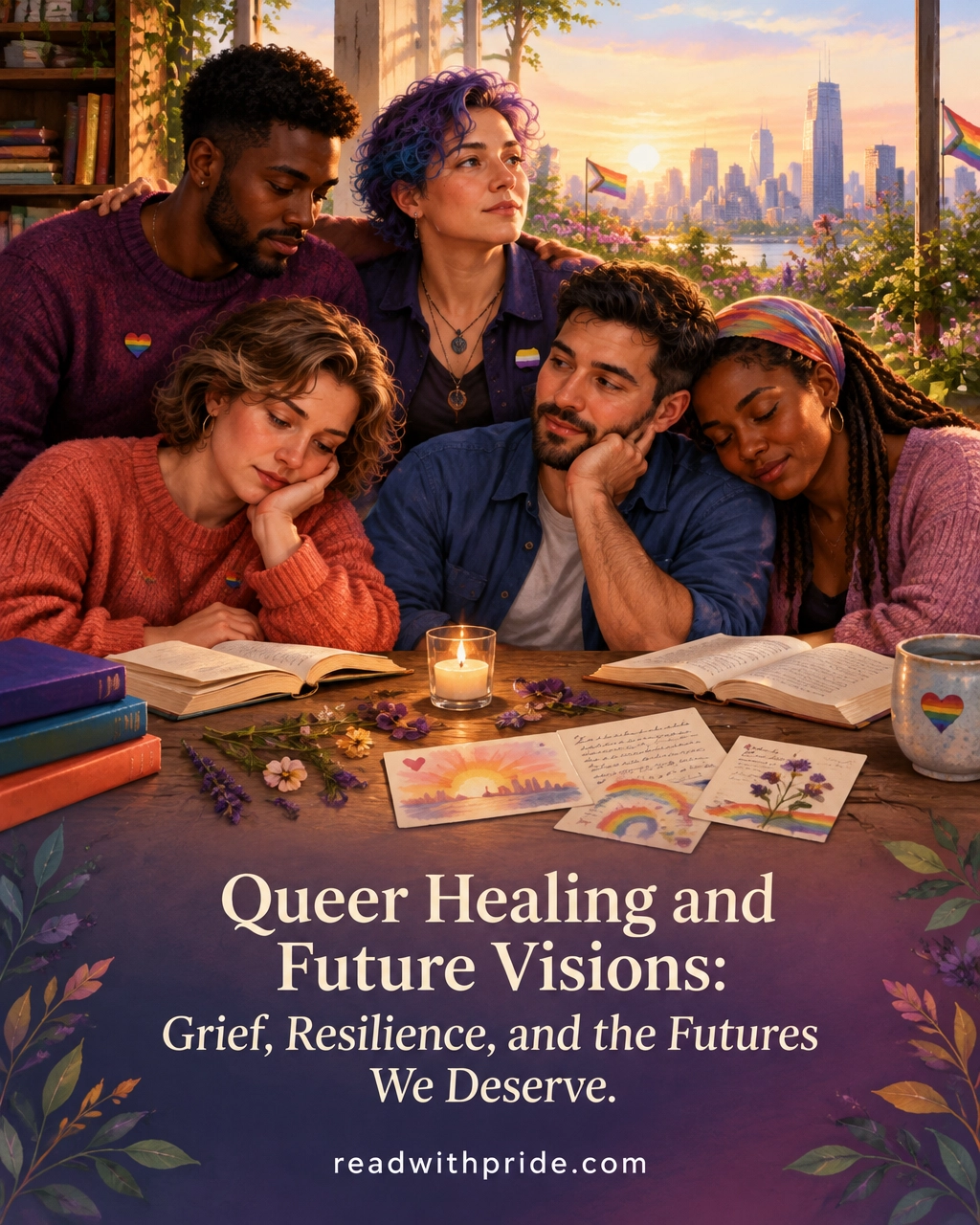
Content note: This article discusses grief, loss, family rejection, loneliness, and emotional healing. Please take what feels useful and leave anything that feels too close to the bone today.
There are days when hope feels easy to discuss.
Then there are days when grief sits beside you at breakfast, follows you through the afternoon, and takes up the entire sofa by evening. On those days, “look on the bright side” can feel less like support and more like someone quietly closing a door.
Queer healing asks for something more honest.
It allows us to acknowledge what hurts while still making room for what may become possible. It reminds us that LGBTQ+ resilience is not about being endlessly strong, cheerful, or untouched by loss. It is about finding ways to remain connected to ourselves and one another, even when the future is difficult to see.
That is where future visions begin: not in pretending everything is fine, but in imagining what becomes possible when queer people are allowed safety, tenderness, belonging, rest, and joy.
Grief is part of queer life and history
LGBTQ+ people carry many kinds of grief.
Sometimes it is the loss of a partner, friend, relative, mentor, chosen-family member, or queer elder. Sometimes it is the loss of family support, a relationship, a home, a community space, or a sense of safety.
There is also grief for the years spent hiding.
Many queer people become skilled at editing themselves for survival. We learn to read a room before mentioning a partner. We calculate whether a family gathering will be safe. We decide which parts of our identity can be shared and which need to remain private.
Those strategies are not personal failures. They may have protected us.
Still, surviving rejection, bullying, discrimination, racism, transphobia, ableism, or religious condemnation can leave a lasting mark. Even after life becomes safer, the body may continue expecting the next argument, the next rejection, or the next door to close.
There is grief in coming out stories that ended with rejection. There can also be grief in coming out stories that were joyful but complicated by everything that came afterward. You might mourn the childhood you did not get, the relationship your family refused to recognise, or the version of yourself who did not yet know they were allowed to want a happy life.
These losses count.
You do not need a ceremony, public acknowledgement, or anyone else’s permission to prove that something mattered. You are allowed to say: This relationship was real. This loss changed me. My love mattered.
Queer healing is not a straight line
Healing is often described as a journey, but real healing is rarely tidy. It is more like a queer dance floor: circular, surprising, sometimes joyful, sometimes chaotic, and occasionally involving an unexpected encounter with a chair.
You may feel steady for weeks and then be caught off guard by a song, photograph, date, smell, or ordinary Tuesday afternoon. You may laugh one evening and cry the next morning. Neither response cancels the other.
Grief and joy can share the same day.
You can miss someone and still fall in love again. You can feel angry about injustice and still dance in your kitchen. You can be grateful for your chosen family and still mourn the family acceptance you hoped for.
Healing does not require you to become untouched by what happened. It may simply mean learning how to carry the truth without allowing pain to become the only story available to you.

Resilience does not mean coping alone
The word “resilience” can be useful, but it can also become another demand placed on marginalised people.
You do not owe anyone an inspirational recovery story. You do not have to turn every painful experience into a lesson. You do not need to be calm, articulate, productive, or positive every day.
LGBTQ+ resilience may look like:
- Asking someone to stay with you.
- Resting without treating rest as a reward.
- Setting a boundary without writing a three-page apology.
- Taking medication or attending an appointment.
- Muting the news when the world feels too loud.
- Answering one message instead of disappearing completely.
- Letting someone bring you food.
- Saying, “I cannot carry this alone today.”
Receiving care is not a failure of resilience. Sometimes it is resilience.
Queer strength has never been built through individual effort alone. It lives in chosen families, group chats, community centres, mutual aid, support groups, creative spaces, dance floors, kitchens, and living rooms where someone can finally exhale.
A friend who remembers a difficult anniversary is part of that strength. So is the neighbour who checks in, the colleague who uses your name correctly, and the person who sends a message that says, “No pressure to reply. I’m thinking of you.”
Community care does not erase grief. It makes grief less lonely.
Chosen family makes hope practical
Hope can sound abstract until it has a face, a phone number, or a spare key.
Chosen family turns care into something practical. It may include partners, close friends, ex-partners, neighbours, colleagues, mentors, queer elders, or online friends. It can be made up of people who understand your boundaries and do not require you to explain your identity before offering kindness.
Chosen family can provide:
- Witnessing: remembering what you survived and why it mattered.
- Affirmation: treating your identity, relationships, and grief as real.
- Practical support: meals, lifts, childcare, company at appointments, or somewhere to rest.
- Emotional safety: making room to cry, be quiet, vent, or change the subject.
- Joy and ritual: shared meals, birthdays, reading nights, holidays, and ordinary afternoons.
- Continuity: helping you imagine growing older while still belonging.
A queer book club can become part of that ecosystem, too. It offers conversation, connection, and a low-pressure way to meet people who understand why one fictional kiss can ruin your evening, in the best possible way.
For more reflections on community and belonging, explore the Read with Pride LGBTQ+ blogs and articles.
Future visions begin with small details
When people talk about a better queer future, the phrase can sound enormous. We might imagine legal protection, affirming healthcare, secure housing, freedom from discrimination, and meaningful representation, and we should.
But future visions can also begin much closer to home.
Imagine:
- Waking up without immediately bracing for bad news.
- Sharing a home where everyone respects one another’s boundaries.
- Having a partner who knows when to sit beside you and when to make tea.
- Attending a family gathering where nobody asks you to explain your existence.
- Seeing queer elders treated with dignity and care.
- Growing up knowing that LGBTQ+ identities are not problems to solve.
- Reading openly in a public place.
- Building a bookshelf full of LGBTQ+ novels that make you feel seen.
- Finding a community where disability, race, class, gender, and sexuality are treated as connected parts of people’s lives.
These are not small ambitions. They are the details that make safety feel like a life rather than a slogan.
Try writing a future postcard to yourself. Describe one ordinary day in a future where you feel safe enough to relax. Who is nearby? What can you hear? What are you reading? What no longer occupies your thoughts?
It does not need to be poetic. “I have a kitchen where everyone is welcome and nobody comments on my mugs” is a perfectly valid utopia.

Stories help us practise possibility
Books cannot erase grief, and they are not a replacement for therapy, medical care, financial support, or a safe place to live. But stories can offer language, recognition, and companionship while we move through difficult seasons.
A coming out story can remind us that identity unfolds differently for everyone. Lesbian romance can offer tenderness, desire, humour, and complexity between women. MM romance books and gay romance novels can show men learning to trust, communicate, ask for reassurance, and build a life beyond survival.
Across gay fiction, queer fiction, LGBTQ+ novels, and other queer love stories, characters are allowed to want things. They can make mistakes, grieve, begin again, and experience joy that is not presented as a reward for suffering.
That matters.
At Read with Pride, you can explore LGBTQ+ ebooks, gay books, lesbian romance, MM fiction, LGBTQ+ romance, gay literature, and emotionally rich stories that place queer lives at the centre of the page. Browse the Read with Pride store listing for more stories from queer authors and publishers.
Whether you are looking for heartfelt gay fiction, steamy romance, coming out stories, new releases, or LGBTQ+ fiction 2026 that imagines more hopeful possibilities, reading can become part of a wider practice of care.
And if you arrived here after searching “C Section 2026,” the internet remains a wonderfully unpredictable place. You are welcome anyway.

Hope does not erase grief
There is a difference between hope and pretending.
Pretending says everything is fine. Hope says things are not fine, and we can still work towards something better.
Hope does not ask us to be grateful for suffering. It does not turn trauma into a motivational slogan. It does not insist that every painful experience made us stronger.
Sometimes terrible things happen and we simply deserve support. Sometimes surviving the day is enough.
Over time, hope can become a practice. We practise it by checking in on friends, supporting queer creators, sharing useful resources, making accessible spaces, protecting our joy, and telling stories that allow LGBTQ+ people to be complicated and fully alive.
We practise it by imagining a future where queer people are not merely surviving the news cycle, but growing older, making art, raising families, falling in love, changing their minds, resting, laughing, and being gloriously ordinary.
That is queer futurity at its warmest: not perfection, but possibility.
A gentle reflection for today
If you are carrying grief right now, you do not need to solve everything before bedtime. If you have the energy, ask yourself:
-
What am I grieving?
Name it without judging the size or shape of the loss. -
What helps me carry it?
This might be a person, ritual, memory, song, movement, therapist, community, or story. -
What future detail would I like to make room for?
Keep it small if you need to: a safer conversation, a good meal, a new book, or a message to someone you trust.
If grief feels overwhelming or connected to immediate concerns about your safety, please reach out to a trusted person, LGBTQ+-affirming professional, or crisis service. UK readers can contact Switchboard LGBT+ Helpline, explore support from LGBT Foundation, call Samaritans free on 116 123, or visit the NHS guidance for LGBTQ+ mental health support. If you are elsewhere, please look for local LGBTQ+-affirming support in your region.
You deserve care that respects every part of who you are.
Carry what matters. Make room for what comes next.
We do not have to choose between remembering and imagining.
We can carry our losses with care while still reaching towards joy. The people we have lost can remain part of the futures we build. The rejection we survived can deepen our commitment to welcome. The years we spent hiding can make us fiercely protective of someone else’s freedom to be seen.
That is not a neat ending. It is an ongoing practice.
Read a story that helps you feel understood. Share a queer love story with a friend. Start a queer book club. Make a home where people can be honest. Rest when you need to. Dream beyond survival when you can.
When you are ready, explore Read with Pride for MM romance books, gay romance novels, lesbian romance, gay fiction, LGBTQ+ ebooks, queer fiction, and stories celebrating the many ways queer love can thrive.
Follow Read with Pride on Facebook and Instagram for LGBTQ+ reading recommendations, community reflections, queer authors, and new releases.
Your future does not have to erase your grief.
It can hold your grief, and still make room for joy.
#ReadWithPride #QueerHealing #FutureVisions #LGBTQResilience #MMRomanceBooks #GayRomanceNovels #ComingOutStories #QueerBookClub #LGBTQFiction2026 #CSection2026 #GayFiction #LGBTQNovels #QueerLoveStories #QueerFiction #LGBTQReading #QueerJoy

Leave a Reply
You must be logged in to post a comment.