

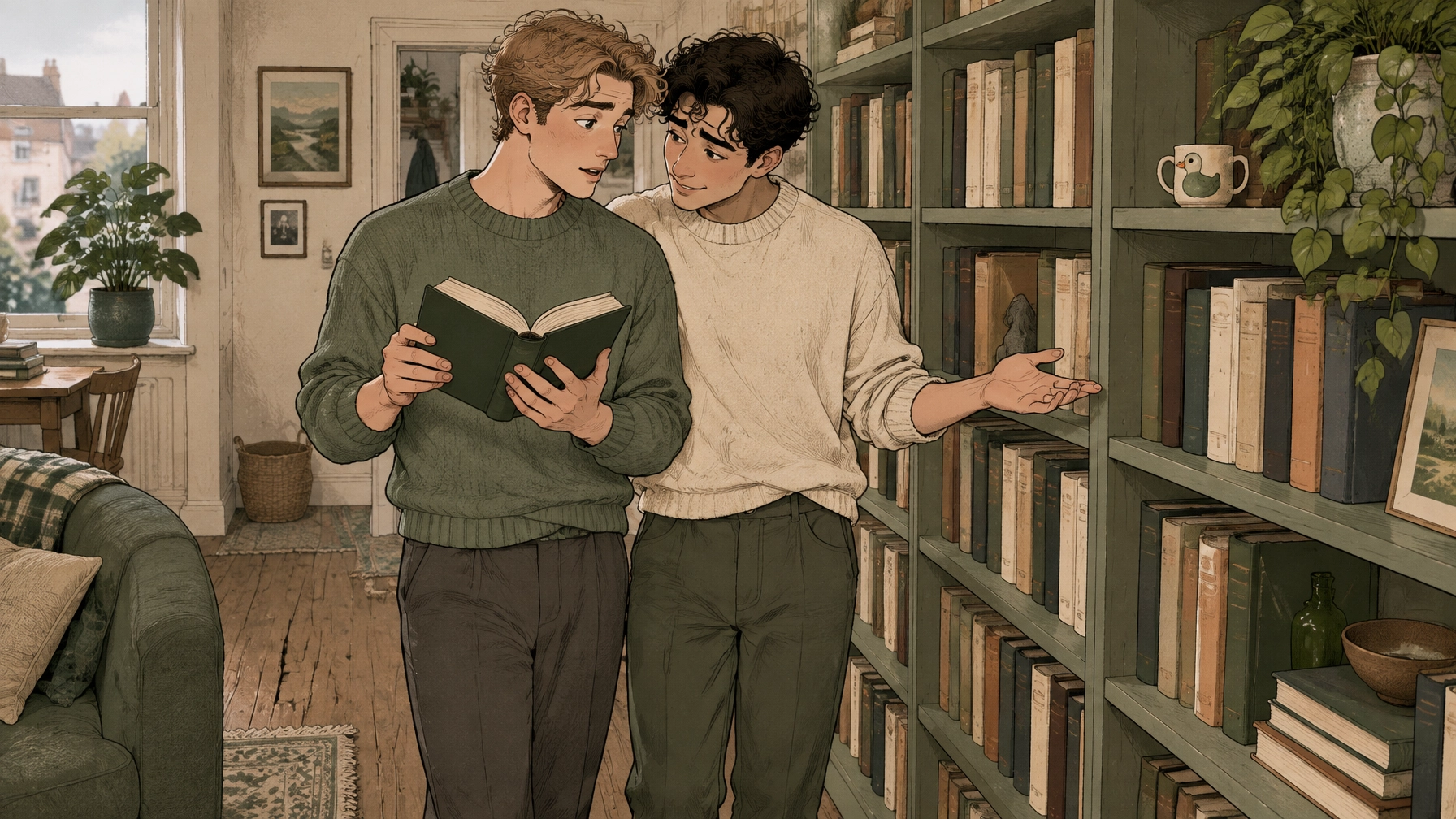
Saturday afternoon arrived with the quiet confidence of a day that had no intention of becoming complicated.
Julian came home early carrying two bags of bin liners, a packet of biscuits he had not needed, and the last of the woodland-finish coffee balanced precariously in one hand.
He knew something was wrong before he opened the front door.
Not because the flat was too quiet. Maurice the plant had developed a dramatic lean towards the window, the upstairs neighbours were arguing about a washing machine, and the creaky floorboard near the entrance gave its usual warning groan beneath Julian’s shoe.
No. Something was wrong because the door opened too easily.
“Elias?”
No answer.
Julian stepped inside.
Then he stopped.
The bookshelves had moved.
Not physically. The shelves were still against the same wall, still carrying the same faint dust marks and the same slightly warped middle shelf. But every book on them had been rearranged.
Alphabetised.
Julian stared at the first shelf.
Then the second.
Then the third.
His whole life had been reorganised while he was buying bin bags.
The first feeling was not the real feeling
His first thought was territorial and immediate.
Absolutely not.
His second thought was less articulate but involved the words what have you done to my books?
The poetry had been separated from the history. The paperbacks had been placed spine-to-spine in suspiciously tidy rows. Julian’s books (the books he had collected through university, bad jobs, rented rooms, and various periods of believing that he might one day become an entirely different sort of person) had been moved to eye level.
Elias’s books had been placed on the bottom shelf.
The bottom shelf.
Julian put the coffee down on the little table beside the ugly duck mug and walked closer.
There it was: the book his dead friend had left him, now positioned between two novels about architecture. Its cover was slightly faded. One corner had been repaired with clear tape. It had always lived on the middle shelf, tilted at a particular angle because the shelf itself dipped in the centre.
Now it was standing upright.
Perfectly upright.
“Elias,” Julian said again.
From the kitchen came the unmistakable sound of a cupboard closing too carefully.
Elias appeared holding a tea towel, which was not a good sign. He only held a tea towel when he was nervous, cooking, or attempting to look as if he had been doing something harmless.
“Before you say anything—”
“I’m going to say several things.”
“I alphabetised them.”
“I can see that.”
“Not by title. By author.”
“I can also see that.”
“And I grouped the essays separately from the fiction because otherwise there were too many sections, and then the sections looked unbalanced, so I moved the travel books, but only temporarily, and then I realised the travel books were mostly written by men whose surnames began with letters that—”
“Elias.”
“I did not throw anything away.”
“That is not the standard you want to lead with.”
“I did not damage anything.”
Julian looked at the dead friend’s book.
Elias followed his gaze. “I dusted it.”
“You dusted it?”
“It was dusty.”
“It was meant to be dusty.”
Elias’s mouth tightened. “I knew you were going to say that.”
Julian wanted to be angry. Anger would have been easier. Anger came with clear edges. It gave him something to hold, something to push against.
But Elias looked so earnestly concerned that the anger began to lose its shape.
This was not a careless rearrangement. Elias had not shoved everything aside to make room for a television or a speaker or some new object he had decided mattered more.
He had taken every book down.
He had touched every one.
He had made a plan.
That was worse.
A character-driven queer story about the shelves we inherit
In a character-driven queer fiction story, the argument is rarely only about the visible thing.
The bookshelf was not only a bookshelf. It was Julian’s history made physical: his mother’s handwriting on a flyleaf, the novels he had bought with money he could not spare, the book his friend had left behind, and the shallow dent where one particular hardback had rested for years.
It was also Elias’s attempt to become part of that history without asking directly.
That was what made it difficult.
Julian had expected care to arrive loudly. He understood grand gestures, declarations, even arguments that went on too long because both men were frightened of what would happen after the shouting stopped.
He understood the left side of the sofa. He understood the ugly duck mug. He understood Elias stealing the blanket and then pretending the blanket had migrated of its own accord.
He did not understand this.
He did not understand someone quietly making room for him.
“You put my books at eye level,” Julian said.
Elias glanced at the shelves. “They’re the books you reach for most.”
“And yours are on the bottom.”
“I don’t mind.”
“That isn’t the point.”
“I know.”
The answer landed more softly than Julian expected.
Elias folded the tea towel over itself. Once. Twice.
“I was trying to make it look like I belonged here,” he said.
Julian looked at him.
Elias gave a small, embarrassed laugh. “Not look. That sounds manipulative.”
“You’re allowed to be manipulative about bookshelves. It’s not a crime.”
“I was trying to earn a shelf.”
The room seemed to grow quieter around them.
Outside, a bus sighed at the kerb. Maurice’s leaves trembled in the window. Somewhere beneath Julian’s foot, the creaky floorboard complained as if it had been listening.
Elias kept his eyes on the bottom shelf.
“I thought if I made everything neat, and useful, and easier, then maybe I’d stop feeling like I was borrowing the flat,” he said. “Like I was staying somewhere until you changed your mind.”
Julian’s first instinct was to say, I’m not going to change my mind.
The words rose quickly and brightly, almost ready.
But he stopped.
Because Elias was not asking for reassurance in the easy way. He was telling the truth about a fear that had been living underneath all the small domestic things: the coffee, the sofa, the mug, the books.
Elias had never been allowed to assume he got to stay.
Making space is not the same as giving up space
Julian sat down on the edge of the sofa, carefully avoiding the place where the cushion had collapsed towards the left side.
Elias remained standing.
“You didn’t have to earn a shelf,” Julian said.
“I know that now.”
“Do you?”
“No,” Elias admitted. “But I’m working on knowing it.”
That made Julian laugh despite himself.
Elias looked relieved, as though laughter was a kind of permission.
Julian picked up the book his friend had left him. The cover felt familiar beneath his palm. He thought about the handwriting inside: three words, a date, and a joke that had stopped being funny only because the person who wrote it was gone.
“I don’t want this one moved without asking,” he said.
“I’m sorry.”
“And the dent matters.”
“The dent?”
“Where it lived.”
Elias came closer. “The dent in the shelf?”
“Yes.”
“You’re emotionally attached to a piece of damaged wood.”
“I’m emotionally attached to the evidence that the shelf has survived me.”
Elias considered this. “That is the most Julian thing you’ve ever said.”
“You alphabetised my books.”
“I was frightened.”
That quieted him again.
There were things Julian had mistaken for possessiveness because possessiveness was easier to name. He had thought his attachment to the old order meant he wanted everything to remain untouched. But the truth was more complicated. He wanted to keep the marks that proved his life had happened. He wanted to know that change would not erase the people and places that had come before.
Elias, meanwhile, had mistaken care for payment.
He thought usefulness could buy permanence.
Neither of them had invented those fears alone.
“Your books can be here,” Julian said.
Elias nodded.
“Not because you sorted mine.”
“I know.”
“Not because you made the shelves look like they belong in a catalogue.”
“They do look better.”
“They look like a catalogue written by a man with no sense of humour.”
Elias smiled. “There are categories.”
“There are no categories in this house.”
“There are absolutely categories.”
“There is a book about urban planning next to a cookbook called Small Plates for Large Feelings.”
“That was your arrangement.”
“It had emotional logic.”
“It had no alphabetical logic.”
“It had excellent emotional logic.”
For a moment, the old rhythm returned between them. The bickering. The warmth beneath it. The reassurance that neither of them had left the room.
The shelf above
They began with the bottom shelf.
Elias apologised for putting his books there. Julian apologised for assuming that the apology meant Elias wanted the whole bookshelf. Elias said he had not assumed that. Julian said he had clearly assumed it, because he had alphabetised three shelves and created a subsection for literary criticism.
Elias said literary criticism deserved dignity.
Julian said it deserved a warning label.
Together, they took the books down.
They found a receipt from a bakery in Brighton, a pressed leaf that had turned the colour of old tea, and one of Julian’s socks behind the hardbacks. Elias held up the sock between two fingers.
“Was this part of the emotional logic?”
“It was supporting the shelf.”
“With one sock?”
“It was a very committed sock.”
They kept the old dent.
They put Julian’s friend’s book back in its place, slightly crooked, with the cover leaning towards the middle shelf as it always had. Julian’s mother’s handwriting returned to the eye-level section, though Elias asked before touching the book.
Then Julian lifted Elias’s novels and placed them on the shelf above his own.
Elias watched him.
“Above?” he asked.
“Above.”
“Are you sure?”
“No,” Julian said. “But I’m choosing it.”
The distinction mattered.
Making space was not the same as giving up space. Julian did not have to empty himself out to prove that Elias belonged. Elias did not have to become useful enough to justify staying.
There could be two histories in the room.
Two ways of arranging a life.
A shelf above. A shelf below. A middle shelf that remained gloriously uneven.
An ordinary ending for an extraordinary feeling
By the time they finished, the bookshelves looked less tidy than before.
They also looked more honest.
The categories had partly survived, but not completely. Some books still stood in their old places. Some had moved. A handful had been placed sideways because the shelves were too full. Elias’s books were above Julian’s, although one had slipped forward slightly, as if it were eager to be noticed.
They agreed on one rule.
Nothing moved without a conversation.
“Even the sock?” Elias asked.
“Especially the sock.”
“And Maurice?”
“Maurice can move if he wants to.”
“Maurice has never wanted to do anything.”
“Maurice is a plant. His standards are different.”
Elias went to the kitchen and came back with the woodland-finish coffee. It had gone lukewarm.
Julian poured it into the ugly duck mug.
Elias watched him take a sip.
“Well?”
“It tastes like a forest floor with ambitions.”
“You said that yesterday.”
“I’ve had time to reflect.”
Elias sat beside him, leaving the usual space between their shoulders. After a moment, Julian closed it.
Not dramatically.
He simply leaned over until their arms touched.
The flat was allowed to keep changing, they decided. The shelves could shift. Maurice could lean. The middle shelf could remain a little crooked. The left side of the sofa could continue to belong to whoever got there first.
But the changes would be spoken about.
And when one of them was afraid, the other would try not to mistake fear for ownership.
That afternoon, Julian learned that an emotionally invested MM romance does not always need a grand declaration to show love. Sometimes it is a man standing in front of a bookshelf, admitting he wants to stay. Sometimes it is another man making room without disappearing.
Sometimes it is two men putting the books back badly, together.
Read with Pride
For readers who enjoy a gay love story emotional journey, emotionally layered domestic moments, and emotional MM romance literary fiction, the ongoing Queer Experiences and Stories series follows Elias and Julian as they learn how love changes the shape of an ordinary life.
Discover more character-driven queer fiction and MM romance unexpected places through Dick Ferguson’s books at Read with Pride.
Three possible next instalments
-
The Evening Elias Finds Julian Has Kept the Wrong Takeaway Menu — A small kitchen mistake opens a conversation about memory, comfort, and why some people hold on to useless things.
-
The Sunday Julian Learns Elias Has Named Every Neighbour’s Cat — A walk to the corner shop becomes unexpectedly personal when Elias reveals how much he has been observing the life he hopes to join.
-
The Night the Creaky Floorboard Finally Gives Way — A minor household disaster leaves the two men sitting on the floor, sorting through old fears while trying to repair something neither of them wants to replace.
Follow us on social media
Follow Dick Ferguson for more queer experiences, gay love stories, character-driven MM fiction, and updates from the 6 PM series:
Instagram: https://www.instagram.com/dickfergusonwriter
X: https://www.x.com/DickFergus94902
Facebook: https://www.facebook.com/profile.php?id=61572869844598
www.readwithpride.com
#QueerExperiencesAndStories #MMRomance #GayRomance #QueerFiction #GayFiction #MMFiction #LGBTQBooks #CharacterDrivenFiction #EmotionalMMRomance #GayLoveStory #EmotionallyInvestedReaders #ReadWithPride

Leave a Reply
You must be logged in to post a comment.