

Category: Unexpected Places / Rare Experiences
The field beyond Gryfino
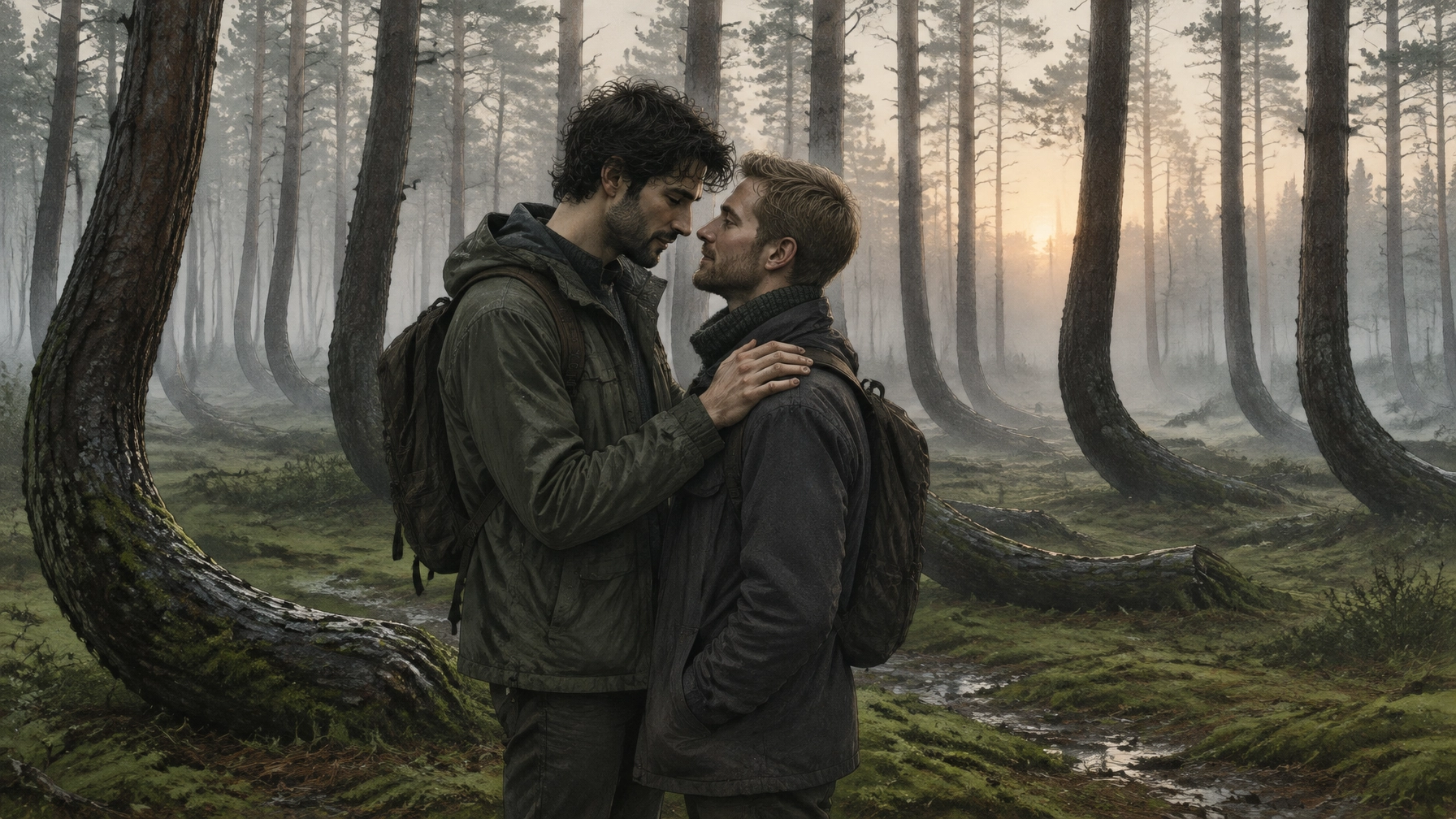
By the time Evan and Marek reached the fence, the morning had turned the colour of old glass.
Fog lay low across the ground. It gathered in the hollows between the trees and clung to the moss in pale ribbons. Beyond the field, somewhere near Nowe Czarnowo, the Dolna Odra power plant breathed a distant mechanical thunder into the damp air.
Marek stopped beside the entrance.
“Still want to go in?”
Evan looked through the fence.
At first, the trees seemed ordinary. Scots pines, dark-barked and tall, their crowns dissolving into the mist. Then he saw the first bend.
The trunk rose only a short distance from the forest floor before curving sharply northward, almost horizontally, like a body forced into a bow. A metre farther on, it turned upward again and continued into the sky.
Then he saw another.
And another.
The low forest floor was crowded with them: trunks bent in the same direction, each curve permanent, each tree straightening above it as though nothing unusual had happened.
Evan put both hands into his coat pockets.
“They look hurt,” he said.
Marek glanced at him. “They look alive.”
A forest shaped by a mystery
The Crooked Forest, or Krzywy Las, lies near Gryfino in western Poland. The grove was planted around the early 1930s, and historical records describe roughly 400 deformed Scots pines arranged in orderly rows.
Today, only around 100 of the famous crooked trees are generally reported to remain. The grove is protected, fenced and treated as a natural monument. Visitors are asked to stay respectful of the site, because these trees are old, vulnerable and impossible to replace quickly.
Every surviving pine has a similar story written into its lower trunk. The bend begins somewhere between 10 and 50 centimetres above the ground. The trunk travels northward for as much as three metres before turning straight again. Some curves reach almost 90 degrees.
No one knows exactly how they were made.
The most widely accepted theory is that young trees were deliberately damaged, cut or restrained so that they would grow into useful shapes. Curved timber might have been intended for furniture, boat-building, barrels, carts or other forms of carpentry. Another theory suggests that heavy snow, machinery or other mechanical damage bent the saplings while they were still young.
The forest offers no final answer.
It offers evidence: the repeated shape, the shared direction, the careful spacing of the original planting. It offers the old scars in the bark. It offers hundreds of trees that were once soft enough to be changed and strong enough to continue growing afterward.
Marek had grown up in the nearby village. He had visited the grove as a child, then as a teenager with a bicycle and a bruised knee, then later with friends who wanted to show the strange trees to people from outside the region.
He had never thought of the forest as damaged.
“People come from all over to see them,” he said.
“That doesn’t mean they had a good beginning.”
“No,” Marek said. “But it means the beginning isn’t the whole story.”
Evan looked away.
What was done to him
Evan had spent most of his adult life apologising for the shape of himself.
He apologised when he spoke too intensely. He apologised when he became quiet. He apologised for wanting reassurance, for needing time, for being unable to turn certain memories into harmless anecdotes.
He had learned early that some parts of him made other people uncomfortable. The shame had not arrived as one great event. It had accumulated gradually, like snow on a young branch.
A teacher’s laugh.
A parent’s silence.
A friend who said he was too sensitive and another who said he was making things difficult.
By thirty-six, Evan had become skilled at appearing undemanding. He could make himself smaller in a room. He could hide the angle of his feelings behind careful jokes. He could leave before anyone had the chance to decide he was too much.
Marek had never asked him to do that.
That was part of the problem.
Marek noticed things. He noticed when Evan lied about being tired. He noticed when he stopped eating because a conversation had gone badly. He noticed the way Evan’s shoulders tightened whenever someone looked at him for too long.
In the forest, Marek leaned toward one of the trunks.
“There,” he said. “You can see the old cut marks.”
Evan stepped closer.
The bark was wet beneath his fingers. Moss gathered in the deep folds where the tree had been bent. Above the curve, the trunk was thick, high and straight, carrying its crown into the grey morning.
“Someone did this,” Evan said.
“Probably.”
“Someone got it wrong.”
Marek’s hand fell away from the bark. “Maybe someone wanted something from it.”
“That’s worse.”
“Is it?”
Evan turned on him. “You don’t understand.”
“I understand that you think anything done to you before you were old enough to choose is still the truest thing about you.”
The words landed too accurately.
For a moment, there was only the soft drip of water from the branches.
The fear of being loved for the wrong reason
They walked deeper into the grove.
Marek moved easily among the trees. He knew where the ground dipped, where the mud gathered, where the older trunks had died and been left to return to the forest.
Evan followed, watching Marek’s back.
“You like them,” he said.
“The trees?”
“You talk about them as if they’re special.”
“They are special.”
“Because they’re damaged.”
Marek stopped.
Evan regretted the words immediately, but regret had never been enough to make him take anything back.
Marek turned. “Is that what you think I see when I look at you?”
Evan stared at the wet ground.
He had wanted Marek for months before he admitted it. Wanted his steadiness, his dry humour, the warmth of his shoulder in a crowded café. Wanted the way Marek never treated queerness as a confession that needed forgiveness. Wanted the quiet certainty with which he spoke about home, family and the men he loved.
But wanting him had made Evan afraid.
What if Marek only loved the wounded parts? What if Evan’s history had become the thing that made him interesting? What if, without the damage, there was nothing left worth staying for?
“I don’t know,” Evan said.
Marek took a breath.
“I don’t love what happened to you,” he said. “I love you. I hate that you had to survive certain things. That isn’t the same as loving the hurt.”
Evan finally looked at him.
Marek’s face was open but not soft. He was not offering a cure. He was not asking Evan to become grateful for the experiences that had shaped him.
“I don’t want to be someone’s lesson,” Evan said.
“You’re not.”
“I don’t want you to look at me and see a beautiful tragedy.”
“I don’t.”
“What do you see?”
Marek stepped closer. “A difficult man who thinks he’s easier to leave than he is to know.”
Despite himself, Evan laughed once. It broke strangely in his chest.
“That’s not very romantic.”
“No. It’s accurate.”
History, not damage
Near the centre of the grove, the trees stood closest together.
Their trunks rose from the earth like questions. Some curved gently; others seemed almost to kneel before finding their way upward. The fog had thinned now, and small pieces of blue showed through the canopy.
Marek pointed north.
“All of them,” he said.
Evan followed his gaze.
The curves were not random. They moved together, a congregation of bent backs and raised arms. The trees had been shaped by a force no one could now name with certainty: human intention, snow, machinery, weather or some combination lost to time.
Yet every one of them had continued.
Not unchanged. Not untouched.
Continued.
Evan placed his palm against the nearest trunk. The bark was ridged and cold. Under it, the tree was still working: carrying water, widening, holding itself upright.
“I’ve been calling it damage,” he said.
Marek waited.
“For years. The whole shape of my life. The things people did. The things I let happen. I thought if I could straighten myself enough, nobody would know.”
Marek did not interrupt.
Evan looked at the curve beneath his hand.
“But this is history,” he said. “It’s still there. I can’t pretend it isn’t. I don’t have to pretend it made me beautiful, either.”
“No,” Marek said. “You don’t.”
The honesty mattered more than comfort would have.
Evan’s fingers tightened against the bark.
“I’m still angry.”
“You should be.”
“I’m still ashamed.”
“I know.”
“I might be for a long time.”
“I know that too.”
Marek reached for him, slowly enough that Evan could have moved away. Evan did not.
Their hands met between the trees.
Two men standing in the field
By late morning, the fog had begun to lift.
Sunlight found the upper branches first, turning the needles silver-green. It touched the wet bark and brought out colours Evan had missed in the mist: rust, charcoal, lichen-white and deep moss.
The Crooked Forest was not a place where everything became clear.
For emotionally invested MM readers, this is what makes MM romance unexpected places so unforgettable: a landscape that quietly mirrors a gay love story emotional journey. The grove’s mystery deepens the character-driven queer fiction at the heart of Evan and Marek’s connection, giving the piece the reflective pull of emotional MM romance literary storytelling.
Theories remained theories. The original purpose of the trees was still uncertain. The people who shaped them had left no reliable explanation behind. The grove itself was ageing, and some of the pines would eventually fall.
Protection could preserve a living thing.
It could not reverse time.
Evan and Marek stood beyond the densest part of the grove, where the ground opened into a field. Behind them, the curved trunks rose and straightened, carrying their green crowns into the morning.
Marek squeezed Evan’s hand once.
Evan squeezed back.
Neither of them promised that he would stop flinching. Neither promised that love could erase the early years or turn every old wound into wisdom.
They only stood there together.
Bent does not mean broken.
Sometimes it means the shape of what happened is still visible. Sometimes it means the tree, the man, the heart has carried the mark and grown tall anyway.
And sometimes, if someone looks closely without trying to correct you, history can become something you are allowed to live with.
Not a cure.
Not a clean beginning.
Just two men in a field full of trees that grew anyway.
Continue reading with Read with Pride
For readers drawn to emotionally immersive MM romance, heartfelt gay fiction, complex gay love stories and character-driven LGBTQ+ fiction, discover Dick Ferguson’s work through the Dick Ferguson e-book store on Read with Pride.
Follow us on social media
Follow Dick Ferguson for more literary MM romance, emotional gay novels, queer fiction and reading recommendations:
#MorningEdition #CrookedForest #Gryfino #MMRomance #GayRomance #QueerFiction #GayFiction #LGBTQBooks #MMNovels #GayLoveStories #EmotionalMMBooks #CharacterDrivenMM #LGBTQLiterature #ReadingWithPride
Three fresh Morning Edition ideas for tomorrow
- The Door to the Sea at St. Michael’s Mount — Where Two Men Learned That Leaving Can Be an Act of Love
- The Singing Sands of Ynyslas — Where Two Men Discovered That Silence Can Still Say Everything
- The Abandoned Sanatorium of Beelitz-Heilstätten — Where Two Men Faced the Rooms They Had Spent Years Avoiding


Leave a Reply
You must be logged in to post a comment.