

Content note: This article discusses grief, loss, family rejection, estrangement, community loss, and emotional healing. Please take what feels supportive and leave anything that feels too close today.
There is no tidy timeline for grief. It does not complete its paperwork, return its library books, and politely leave after a few weeks. Sometimes it arrives loudly. Sometimes it settles quietly into an ordinary Tuesday, waiting beside your coffee while you try to remember what you came into the room for.
For LGBTQ+ people, grief can have many layers. We may be mourning a person we loved, a relationship that was never publicly recognised, a family connection that became unsafe, or years spent hiding parts of ourselves. We may be grieving a community space that closed, an estrangement that still aches, or the loss of a future we once thought we would have.
Queer healing begins with telling the truth about those losses without demanding that we become inspirational about them.
And alongside that truth, we can make room for future visions: hopeful, practical pictures of queer life beyond survival. A safe home. A chosen family who knows how to show up. A joyful queer elderhood. A bookshelf full of stories that make belonging feel possible.
That is part of LGBTQ+ resilience: not being untouched by pain, but continuing to build connection, meaning, and possibility together.
Queer grief is real, even when other people do not understand it
Some losses are easy for society to recognise. Others are treated as though they should not hurt.
Perhaps relatives described your partner as “just a friend”. Perhaps a friendship changed after you came out, transitioned, set a boundary, or began living more openly. Perhaps you lost contact with family but still carry the complicated ache of wanting them to have been different.
There is also grief for the years we did not get to live freely. The childhood we spent second-guessing ourselves. The coming out stories that ended in rejection. The coming out stories that never felt safe enough to begin. The relationships we kept private because visibility carried real risks.
These losses count.
You do not need a certificate, ceremony, or family approval to prove that someone mattered. You do not need to make your grief easier for other people to understand. You are allowed to say:
This relationship was real. This loss changed me. I am allowed to mourn it.
LGBTQ+ communities also carry collective grief. We remember people and possibilities lost to discrimination, illness, violence, poverty, shame, and silence. We inherit stories from queer elders who survived when safety was even harder to find. We also inherit their courage, creativity, humour, and determination to keep making room for one another.
Grief and gratitude can exist in the same room. So can anger and love.
Healing is not a straight line, thankfully
Healing is often described as a journey, but that can make it sound far too organised. Real healing is less like following a neat route on a map and more like a queer dance floor: circular, surprising, occasionally chaotic, and sometimes involving an unexpected encounter with a chair.
You may feel steady for weeks and then be surprised by a song, photograph, date, or familiar smell. You may laugh in the afternoon and cry the next morning. Neither response cancels the other out.
You can miss someone and still fall in love again. You can be angry about what happened and still imagine a beautiful future. You can need help and still be resilient.
In fact, asking for help may be one of the clearest expressions of LGBTQ+ resilience. So is resting. So is setting a boundary. So is saying, “I cannot carry this alone today.”

Healing does not need to look impressive from the outside. It might be:
- Answering one message instead of disappearing completely.
- Eating something warm.
- Taking medication or attending an appointment.
- Muting notifications when the world feels too loud.
- Asking someone to sit with you without trying to fix anything.
- Letting yourself laugh without deciding that joy means you are “over it”.
- Reading a few pages of gay fiction until your nervous system remembers that not every moment is an emergency.
Small acts of care still count. Sometimes they are the whole plan.
Chosen family makes healing collective
Queer healing is not an individual performance. We should not have to prove our strength by coping alone.
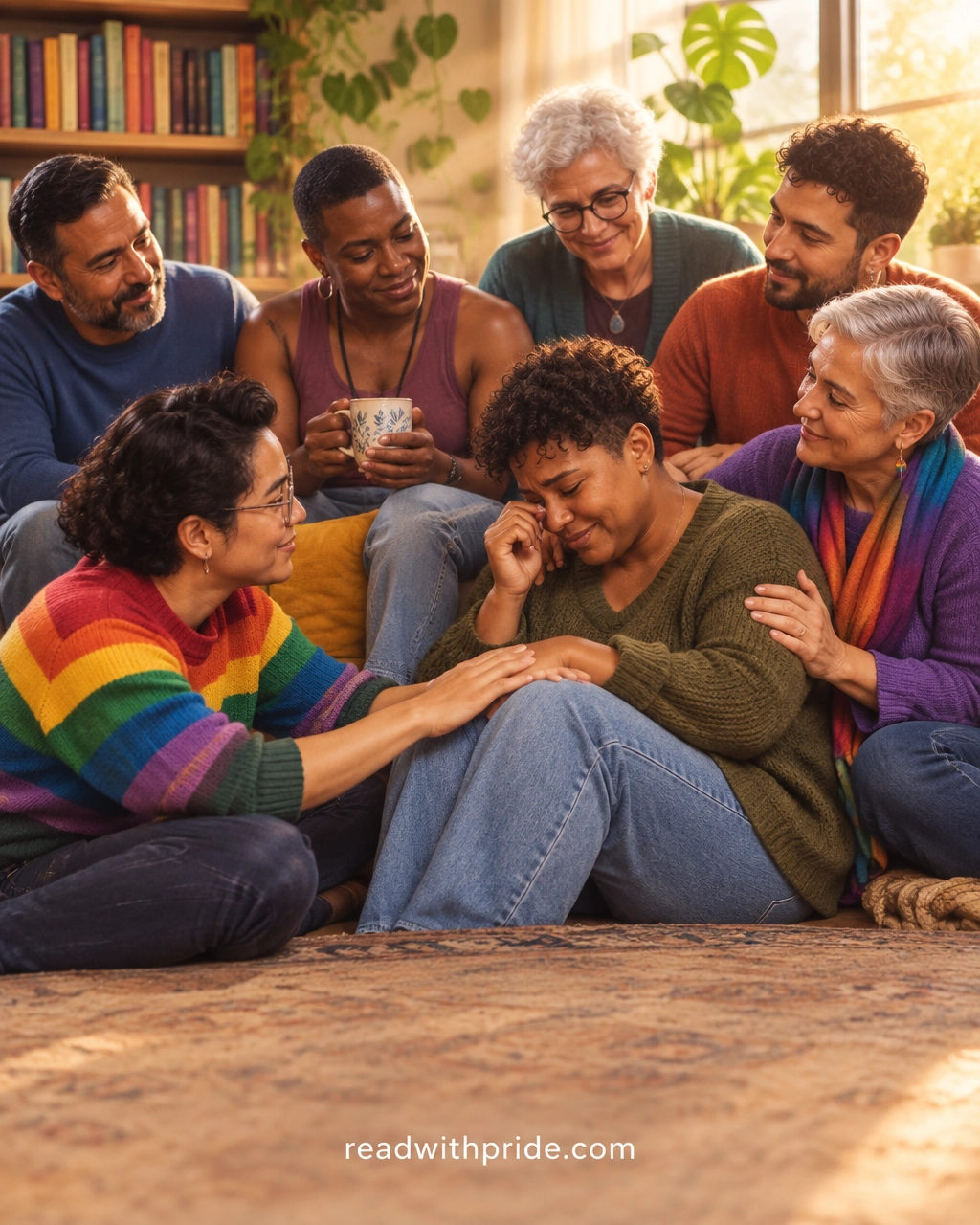
Chosen family makes care practical. It may include partners, close friends, ex-partners, neighbours, colleagues, mentors, queer elders, online friends, or the person who knows you need food before you have worked out how to ask.
Chosen family can offer:
- Witnessing: remembering what you have survived and why it mattered.
- Affirmation: treating your identity, relationships, and grief as real.
- Practical support: meals, lifts, childcare, company at appointments, or a safe place to rest.
- Emotional safety: room to cry, vent, be quiet, or change the subject.
- Joy and ritual: shared meals, birthdays, reading nights, dancing, and doing nothing together.
- Continuity: helping you imagine growing older and still belonging.
A queer book club can become part of that ecosystem. So can an online reading circle, community garden, monthly dinner, creative group, or group chat with one perfectly timed voice note and a meme that is far too specific.
Community care does not erase grief. It gives grief somewhere to go.
Reading can offer companionship and possibility
Books cannot solve every problem, and reading is not a replacement for professional care, medical support, financial help, or a safe place to live. But stories can offer language and company when ordinary conversation feels impossible.
A queer love story can remind us that tenderness is possible. A lesbian romance can offer connection, desire, humour, and complexity between women. MM romance books can show men learning to trust, communicate, ask for reassurance, and build a life beyond survival.
The best gay romance novels do not pretend that love erases every difficult thing. They let characters carry history, fear, family complications, desire, and hope at the same time. That emotional honesty can feel surprisingly companionable.
At Read with Pride, our LGBTQ+ ebooks include gay fiction, LGBTQ+ novels, M/M books, lesbian romance, queer love stories, and stories about identity, family, courage, and becoming.
For readers looking for emotional connection and second chances, The Unspoken Chapter: A Second Chance MM Romance explores old wounds, forgiveness, and the possibility of beginning again.
For readers drawn to big future visions, The Majority Rule: Love in 2150 explores identity, found family, parenthood, power, memory, and the consequences of turning social categories into systems of control.
And Raising Rainbow Kids offers fifteen stories about LGBTQ+ families, resilience, challenges, and unconditional love: a reminder that queer futures include not only romance, but care across generations.
Future visions start with ordinary details
A better queer future can sound enormous. We might imagine affirming healthcare, legal protection, safer housing, freedom from discrimination, and communities where every identity is respected. These ambitions matter.
But future visions also begin much closer to home.
What would make tomorrow feel a little more like home?
Perhaps it is:
- A bedroom where you can display the flag you were once afraid to own.
- A partner who knows when to sit beside you and when to make tea.
- A family gathering where nobody asks you to explain your existence.
- A school where LGBTQ+ families are treated with dignity.
- A care home where queer elders never have to return to the closet.
- A bookshelf filled with LGBTQ+ fiction that reflects many ways of living.
- A morning when you wake up without immediately bracing for bad news.
- A queer book club where you are expected, welcomed, and saved a seat.

These details are not small ambitions. They are the building blocks of a life that feels safe enough to enjoy.
Future-making can be wonderfully ordinary. It can look like sharing recipes, caring for an elder, leaving a spare key with a trusted friend, telling a child that their family is beautiful, or making a home where nobody has to shrink themselves to keep the peace.
A future worth building is not one where LGBTQ+ people are merely allowed to survive. It is one where we have time to be curious, rested, creative, ridiculous, ambitious, ordinary, and free.
Hope does not erase grief
Hope is not pretending everything is fine. Hope says things are not fine, and we can still work toward something better.
You do not have to turn every painful experience into a lesson. You do not have to be grateful for suffering. Sometimes the bravest thing you do is survive the day without making meaning from it.
Over time, though, hope can become a practice. We practise it by protecting our joy, supporting queer creators, learning our histories, checking in with friends, sharing resources, and choosing stories that make space for complicated LGBTQ+ lives.
Every boundary plants honesty. Every shared meal plants belonging. Every queer love story that allows its characters to be ordinary, funny, ambitious, imperfect, and loved expands the map of what is possible.
Even a future vision that begins with “I want a kitchen where everyone is welcome and nobody comments on my mugs” is a valid utopia. Frankly, it sounds excellent.

A gentle invitation for today
If you are carrying grief right now, you do not need to solve everything before bedtime. Try naming:
- One thing you are grieving.
- One person, practice, or story helping you carry it.
- One future possibility you are brave enough to imagine.
That possibility can be small. A safer conversation. A good meal. A new book. A message to someone you trust.
If grief feels overwhelming, affects your ability to stay safe, or makes daily life feel impossible, please reach out to a trusted person or an LGBTQ+-affirming professional or crisis service in your area. You deserve support that respects every part of who you are.
Explore the Read with Pride collection for MM romance books, gay romance novels, lesbian romance, gay fiction, LGBTQ+ novels, coming out stories, and LGBTQ+ fiction 2026. Follow Read with Pride on Instagram and join the conversation on Facebook.
Whether you arrive looking for queer healing, future visions, LGBTQ+ resilience, or even a wonderfully specific search such as “C Section 2026”, there is room here for curiosity, comfort, and unexpected discoveries.
Read with pride. Carry what matters. Make room for what comes next.
#ReadWithPride #Readwithpride #QueerHealing #FutureVisions #LGBTQResilience #MMRomanceBooks #GayRomanceNovels #ComingOutStories #QueerBookClub #LGBTQFiction2026 #CSection2026 #GayFiction #LGBTQNovels #QueerLoveStories #QueerJoy #ChosenFamily #LGBTQReading #QueerFiction

Leave a Reply
You must be logged in to post a comment.