

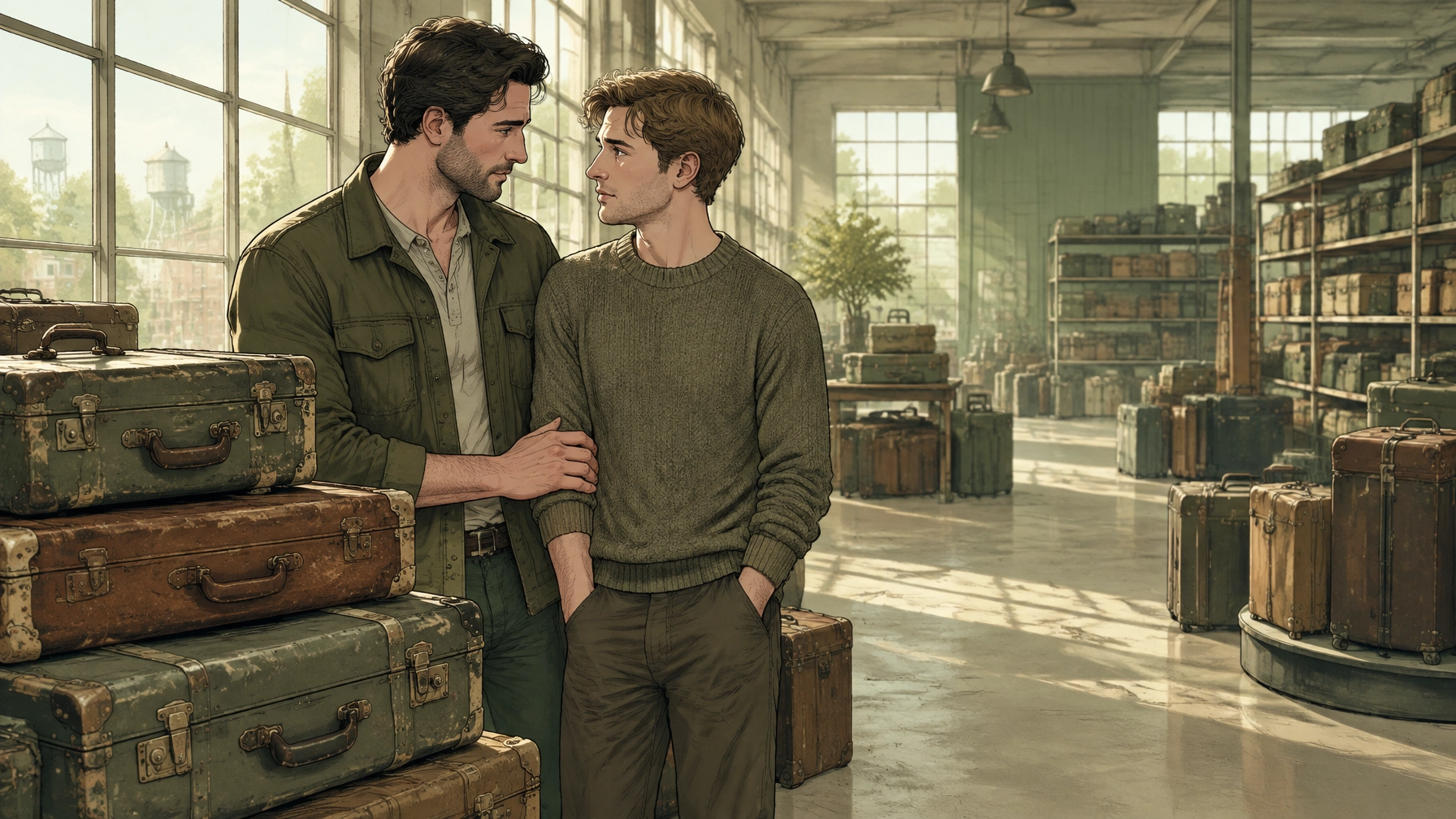
The place where lost things wait
By nine in the morning, the unclaimed baggage store in Scottsboro, Alabama, already smelled of coffee, cardboard, and the faint rubber scent of suitcase wheels.
The building seemed too large to hold so much absence. Rows of luggage stood beneath bright shop lights, each case carrying the possibility of a former journey: a holiday interrupted, a business trip abandoned, a return flight that never returned anything. Some suitcases were polished and expensive. Others were scuffed, stickered, and tired from years of being lifted into the dark bellies of aeroplanes.
Daniel entered slowly.
He had not come looking for anything in particular. That was what he told himself as he passed shelves of coats, headphones, shoes, books, and small objects that had once belonged to strangers. He was only visiting because he had driven too far to turn back. Because morning had arrived and he had not slept. Because grief, after enough years, could become a kind of luggage of its own: something you carried without remembering when you had picked it up.
At the counter, a man with silver beginning at his temples was arranging a row of travel bags.
“Looking for something?” he asked.
Daniel almost said no.
Instead, he said, “I don’t know.”
The man looked at him for a moment. Not rudely. Not with the bright, professional concern of someone trying to make a sale. He looked as though he understood that some answers needed room before they could become words.
“That’s all right,” he said. “Most people don’t.”
His name was Ellis.
He worked the floor and the counter, which meant he knew the store’s rhythms: the excited gasp when someone found a rare watch, the laughter over an impossibly strange object, the quiet that fell when a shopper opened a case and recognised something they had not expected to see.
He knew that people came for the story of lost things.
He also knew they sometimes found their own stories waiting among them.
The suitcase Daniel never found
Seven years earlier, Daniel had lost a black canvas suitcase between Chicago and Atlanta.
The airline had searched. There had been forms, reference numbers, apologetic emails, and the peculiar language of institutional regret. The bag had been delayed, then misrouted, then declared permanently lost. Compensation had arrived in an envelope that felt too thin for the life it was meant to replace.
The suitcase had contained clothes, a camera, two paperbacks, and a blue wool scarf that belonged to Adrian.
Adrian had worn it during their first winter together. He had bought it in a second-hand shop after claiming that new scarves looked too optimistic. It was soft from use and smelled faintly of cedar, smoke, and the soap he preferred. When he gave it to Daniel, he said it was not a gift.
“It’s an inheritance,” Adrian had told him. “I’m still alive, but I’m already tired of owning things.”
Daniel had laughed then.
Later, after Adrian died, the scarf became the one object Daniel could not put away. It was not valuable. It was not rare. It was only a length of blue wool with frayed tassels and a loose thread near one end.
But grief does not measure worth by price.
When the suitcase disappeared, Daniel felt as though Adrian had been lost a second time. The first loss had been final. The second seemed preventable, and therefore crueler.
For seven years, Daniel had imagined the suitcase travelling through hidden warehouses and anonymous loading bays. He pictured the scarf folded beneath strangers’ clothes, carrying the last warmth of a man who would never know where it had gone.
He knew, rationally, that the scarf was only fabric.
He also knew rationality had never been especially useful at three in the morning.
What Ellis recognised
Daniel told Ellis about the suitcase beside a display of travel accessories.
He did not tell the whole story at once. He offered it in pieces: the lost bag, the former partner, the death, the scarf. Each detail seemed to change the temperature of the air between them.
Ellis did not interrupt.
He had the kind of stillness that did not feel empty. It felt chosen. A deliberate refusal to rush someone through the fragile country of their own pain.
“My brother died,” Ellis said when Daniel finally stopped speaking. “Not the same way. Not the same circumstances. But I know what it is to keep an object because it still seems to contain a voice.”
Daniel looked at him.
“What did you keep?”
“A watch.” Ellis glanced down at his hands. “It stopped at 2:17. I kept winding it for almost a year.”
“Did it ever start again?”
“No.”
There was no neatness in the answer. No lesson prepared for immediate use. Ellis did not tell Daniel that time healed everything. He did not say that Adrian would have wanted him to move on. He did not dress grief in the language of permission.
He simply stood beside him beneath the white shop lights while a trolley rattled somewhere nearby.
That was the first thing Daniel noticed about Ellis: he did not try to make sorrow smaller.
A store built on second chances
The unclaimed baggage store is an unusual place. Its history began with a small collection of orphaned bags and grew into a vast retail destination where lost luggage is sorted, tested, and given another chance at usefulness.
Some things are sold. Some are donated. Some are recycled. Every item carries a faint suggestion of elsewhere.
A pair of boots may have crossed a continent before ending up in Alabama. A paperback may have been read in three hotel rooms and a train station. A camera may have captured a landscape that no one else will ever see. Even the most ordinary object has belonged to a particular life before entering the anonymous flow of commerce.
That morning, Daniel moved through the store with Ellis a few steps away.
He touched a leather case, then withdrew his hand.
He opened a suitcase lined with green fabric. Inside were folded shirts, a toiletry bag, and a cracked pair of sunglasses. None of them belonged to Adrian. None of them had to.
The discovery was not dramatic. There was no miraculous blue scarf waiting under a pile of clothes. No sudden restoration of the past.
Instead, Daniel felt something quieter shift inside him.
The objects around him were not insisting that their former owners had forgotten them. They were simply continuing. A coat could be worn again without erasing the person who had once worn it. A book could be opened by another pair of hands without betraying the reader who had underlined its pages. A suitcase could carry a new life.
Perhaps the things we loved were not destroyed by being loved again.
The green suitcase
Daniel found the suitcase near the back wall.
It was small, olive green, and marked by a pale scratch along one side. The handle was slightly crooked, but the wheels moved smoothly. Inside, there was nothing personal: only a folded blanket, a packet of postcards with no writing on them, and a brass key without a lock.
He lifted the case and carried it to the counter.
Ellis examined the wheels, then the hinges.
“Still serviceable,” he said.
“Like most of us.”
Ellis smiled, and the smile changed his face. It did not erase the seriousness beneath it. It only let some light reach the surface.
Daniel bought the suitcase.
Outside, the morning had softened. The Alabama sky was pale above the car park, and the air carried the clean warmth that comes before the day becomes too bright. Daniel placed the green case in the boot of his car.
When he closed it, the sound was surprisingly gentle.
“Are you heading home?” Ellis asked.
Daniel turned. “Eventually.”
“Good answer.”
“Do you always wait around to make sure people leave with the right things?”
“Only the ones who look like they might leave with nothing.”
The words settled between them.
Daniel could have thanked him and driven away. That would have been the easier ending: a brief kindness, a story contained within one morning, two men returning to separate lives.
Instead, Daniel asked, “Do you take lunch?”
Ellis looked toward the store.
“Eventually.”
“Good answer,” Daniel said.
What gets lost can still choose its next owner
They ate at a quiet café down the road.
Daniel told Ellis about Adrian’s habit of buying bad coffee in beautiful places. Ellis told Daniel about his brother’s terrible taste in music and the way he used to leave every cupboard door open. Their conversation moved carefully, never pretending that intimacy was the same thing as disclosure.
By the time they returned to the store, the green suitcase was no longer in Daniel’s car.
It was still there, of course. Still scratched. Still slightly crooked. But it no longer felt like a container for the past. It was simply something he had chosen to carry forward.
That evening, Daniel unpacked the postcards and placed them in a drawer. He did not throw them away. He did not turn them into a shrine.
Then he found the blue scarf in the back of his wardrobe.
He had not worn it since Adrian died.
For a long time, Daniel held it against his chest. He let the old ache arrive without fighting it. He remembered Adrian’s voice, his hands, his ridiculous certainty that all new scarves looked optimistic.
Then Daniel folded the scarf carefully and placed it inside the green suitcase.
Not because he was ready to forget.
Because he was ready to let the memory travel.
When Ellis came to his flat three days later, Daniel opened the door wearing the scarf.
Ellis did not stare at it. He did not ask whether this meant Daniel was healed.
He only reached for Daniel’s hand.
The gesture was tentative, almost formal. Daniel answered by turning his palm upward.
They stood that way in the doorway, two men surrounded by the quiet evidence of a life still being rearranged.
Love did not arrive like a replacement.
It arrived as attention. As patience. As the willingness to sit beside what could not be repaired and remain there without fear.
Daniel understood then that letting go was not betrayal.
Sometimes it was the most faithful way to continue.
And sometimes, in an unexpected place filled with the belongings of strangers, what had been lost did not return.
It chose a new owner.
For readers who love emotionally immersive MM romance
This is the kind of setting that makes a powerful home for character-driven queer fiction: a place filled with lost objects, unfinished journeys, and strangers searching for something they cannot name.
For readers drawn to an emotional MM romance, a gay love story about grief and renewal, or MM romance in unexpected places, the unclaimed baggage store offers more than an unusual backdrop. It gives the story a living metaphor: every object has a past, but not every past has to dictate what comes next.
Discover more emotionally charged gay fiction, MM novels, LGBTQ+ fiction, and heartfelt gay love stories through Read with Pride, including Dick Ferguson’s collection of immersive LGBTQ+ ebooks at the Dick Ferguson store.
Three future Morning Edition story ideas
-
The Night Train Bookshop: Two men shelter from a storm in a railway bookshop where every abandoned book contains a message from someone who could not say goodbye.
-
The Last Key at the Hotel Desk: A hotel clerk keeps a lost key for a room that no longer exists, until a grieving guest arrives claiming he has seen it before.
-
The Photograph Booth at the Seafront Arcade: Two men discover an undeveloped strip of photographs that seems to show a future they are both afraid to choose.
Follow us on social media
Follow Dick Ferguson for new stories, emotional MM romance, gay literature, queer fiction, and reading recommendations:
#ReadWithPride #Readwithpride #MMRomance #EmotionalMMRomance #GayRomance #GayFiction #QueerFiction #LGBTQBooks #GayLoveStory #MMNovels #CharacterDrivenFiction #AngstyRomance #SlowBurnRomance #UnexpectedPlaces #RareExperiences #GayLiterature #LGBTQPlusFiction #HeartfeltGayFiction


Leave a Reply
You must be logged in to post a comment.