

A quiet MM romance about trust, access, and the frightening generosity of being known
The key was in the duck
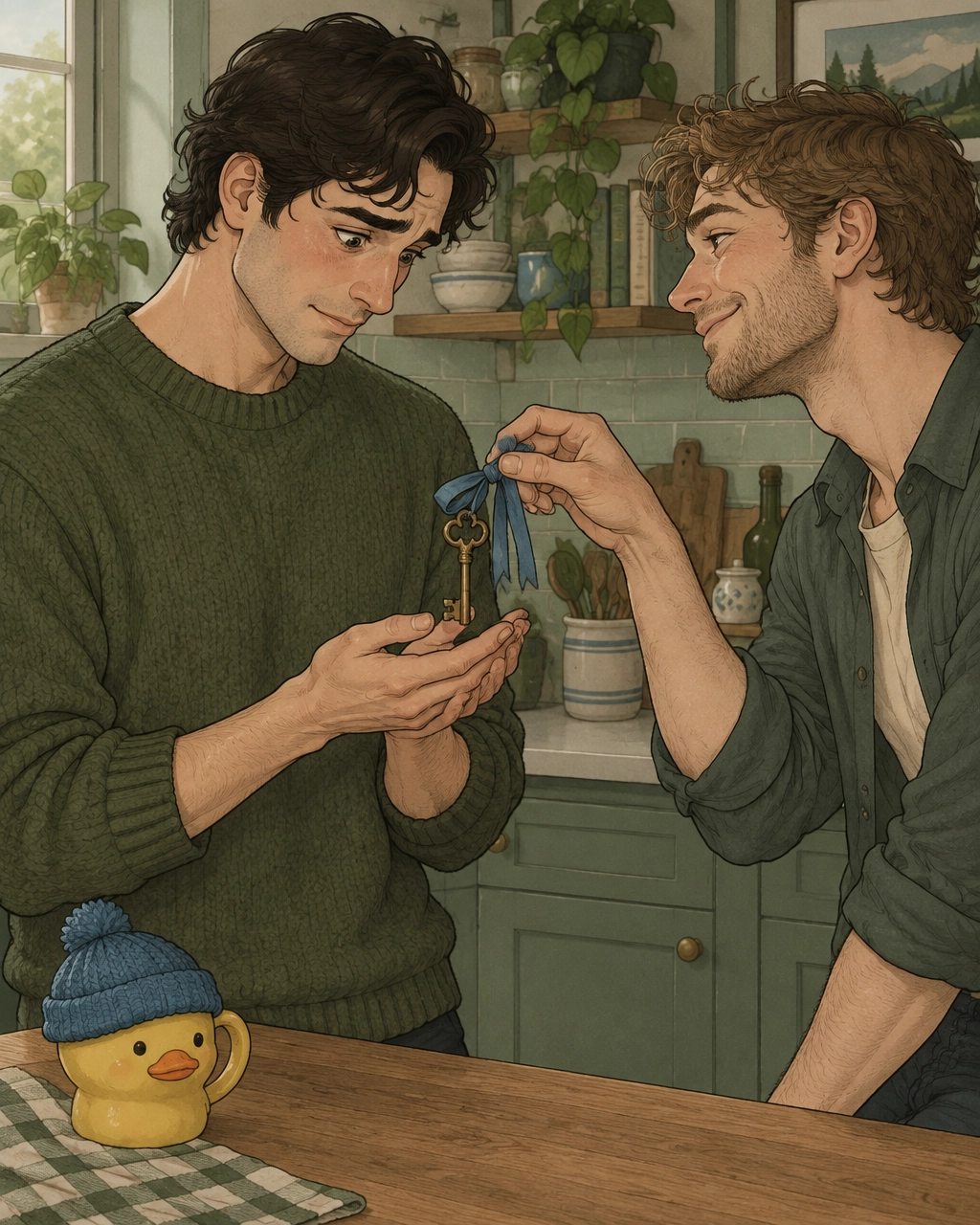
The ugly duck mug had been holding a key.
This was not, in Elias’s opinion, what the mug had been designed for.
The mug was yellow, slightly chipped at the handle, and wore a knitted blue hat that Julian had made during a winter of poor decisions and excessive confidence. It had been intended for tea. Possibly cocoa. At a stretch, a small collection of paperclips.
Not a spare key.
Elias stood in the kitchen doorway and stared at it.
Julian, who was making woodland-finish coffee, the sort with the aftertaste of bark and the emotional warmth of a tax appointment, looked over his shoulder.
“What?” he asked.
“There’s a key in the duck.”
Julian considered this. “He’s finally pulling his weight.”
The key lay on the bottom of the mug, looped with a narrow blue ribbon. It was old, brass-coloured, and scratched around the edges. The ribbon had faded in places, but it was still bright enough to make the whole thing look ceremonial.
Elias lifted it carefully.
Julian reached for the coffee. “That’ll be the old spare.”
“You have an old spare?”
“I apparently did.”
“You didn’t know?”
“I knew I had a key. I didn’t know I had a key with a backstory.”
Elias turned it over in his fingers.
Julian leaned against the counter. “You should have it.”
The sentence was casual. Almost careless.
Elias looked up.
Julian immediately noticed. “What?”
“You should have it,” Elias repeated.
“Yes.”
“You mean I should keep it?”
“That is usually what people mean when they give you a key.”
“Do they?”
“Elias.”
“I’m asking.”
Julian sighed. “You can use it to get in if I’m not here.”
Elias looked down at the ribbon again. “That’s a lot of authority for something tied to a mug.”
“It’s a front-door key, not a constitutional amendment.”
“It’s access.”
“It’s metal.”
“It’s a document.”
Julian pointed at him with the coffee spoon. “This is why I don’t give you objects.”
“You gave me the left side of the sofa.”
“I did not give you the left side of the sofa. You occupied it with the determination of a minor territorial government.”
“It has lumbar support.”
“It has a spring that threatens people.”
“It understands me.”
From the sitting room came a sharp creak.
They both looked towards the floorboard.
“Gerald,” Julian said.
“Gerald agrees with me.”
“Gerald is structurally compromised.”
The key rested between Elias’s fingers. He could feel the shallow ridges along its edge. He could imagine it in his pocket, beside his own keys, making a small private sound whenever he walked.
That was the trouble.
It was not the key itself. It was what the key suggested.
Access is not ownership
Julian returned to his coffee, but he did not drink it.
Elias knew that pause. It was the pause Julian used when he had said something simple and then realised it had travelled further than intended.
On the shelf behind him, Maurice the dramatic plant displayed his one leaf at an angle of profound accusation.
“He hates this,” Julian said.
“Maurice hates everything.”
“He’s been through a lot.”
“He has one leaf.”
“Exactly.”
Elias placed the key on the counter.
“You don’t have to give me this,” he said.
“I know.”
“You can change your mind.”
“I know.”
“You can ask for it back.”
Julian’s mouth tightened, not with anger but with recognition. “I know.”
That was the frightening part of being loved by someone who understood the question underneath the question.
Elias had spent years learning the difference between being invited in and being allowed to stay. The distinction had not always been explained kindly. Sometimes access had come with conditions. Sometimes affection had arrived carrying a hidden expiry date. Sometimes the door had opened only far enough to prove that it could close again.
Julian knew some of this. Not all of it. Elias had never made a neat list.
Theo had known more.
Elias remembered Theo carefully, as he always did, not as a rival, not as a ghost, and not as a shadow cast over anything he and Julian were trying to build. Theo belonged to another part of Elias’s life, a person loved and lost and still spoken of with care. Some memories were not warnings. Some were simply part of the house.
Julian glanced towards the drawer beneath the counter. The Luigi’s Corner takeaway menu was kept there on purpose, folded around the same crease it had carried for months.
“Do you want food?” Julian asked.
“We just had breakfast.”
“That was not food. That was woodland coffee and toast with the confidence removed.”
“Luigi’s?”
“Obviously.”
The ordinary offer softened something in Elias.
That was the strange thing about their life together. The large feelings kept arriving in small packaging. A key in a ridiculous mug. A takeaway menu in a drawer. Two men arguing about whether a plant could be dramatic when it had only one leaf.
This was the shape of their gay love story emotional journey: not one grand declaration, but a series of ordinary objects becoming impossible to ignore.
The terror of having a way out
They took the key to the sofa.
The left side belonged to Elias. Julian sat beside him, close enough that their shoulders touched but not so close that either of them had to pretend the conversation was easier than it was.
The key lay on Elias’s open palm.
“What are you afraid of?” Julian asked.
Elias gave him a look. “That you’ll ask questions with no funny answer.”
“I can stop.”
“No.”
Julian waited.
Elias rubbed his thumb over the blue ribbon. “I’m afraid that if I have this, I’ll know I can leave.”
Julian did not interrupt.
“I mean, properly leave. Not go home after dinner. Not walk around the block because Gerald is making a point. Leave when things get difficult.”
“Having a key doesn’t make you leave.”
“No. But it makes leaving possible.”
Julian looked at the key. “You think I’m giving you an exit.”
“I think you’re giving me the means to find one.”
“That’s not the same thing.”
“I know.”
The words settled between them.
The honest answer was that Julian was frightened too. Giving Elias the key meant allowing him into the spaces Julian kept private: the flat before he had put things away, the mornings when he was less charming, the drawer where he kept old receipts and one birthday card he never opened.
It meant Elias could arrive without waiting to be invited across the threshold.
It also meant Elias could leave without asking permission.
Julian had wanted to be loved without being watched for signs of departure. He had wanted to give access without making it sound like surrender. But the two things were connected in ways neither of them could neatly untangle.
“You having the key doesn’t mean I own you,” Julian said.
“I know.”
“And it doesn’t mean you owe me permanence.”
“I know.”
“It doesn’t even mean you have to come here.”
Elias looked at him. “That seems like a poor sales pitch.”
“I’m not selling you anything.”
“Good.”
“I’m offering you a badly cut piece of metal with a ribbon on it.”
“Blue ribbon.”
“Blue ribbon. Very important distinction.”
Elias smiled, but only briefly.
Julian took his hand, not the key, just his hand. “You can have access to my home without handing me ownership of your life.”
Elias looked at their joined hands.
The sentence was not a promise that nothing would change. It was not a guarantee that either of them would remain unafraid. It was, perhaps, more useful than that.
It was permission to be present without pretending presence was possession.
A key is not a promise
The load-bearing sock shelf gave a small, ominous wobble from the hallway.
Julian froze. “Don’t move.”
“I’m sitting down.”
“Then sit more responsibly.”
Elias looked towards the shelf. “Is it actually load-bearing?”
“It carries socks.”
“That is not what load-bearing means.”
“It carries the emotional weight of the household.”
“That may be true.”
They both laughed, quietly at first, then properly.
When the laughter faded, Julian kept hold of Elias’s hand.
Elias slipped the key into his pocket.
Not triumphantly. Not as if he had won something.
He put it away with the care reserved for objects that could become important, but might not yet know how.
Julian did not ask him to promise he would use it. Elias did not promise he would never use it to leave. Neither of them tried to turn the moment into a contract.
Outside, Here waited at the door.
The stray cat had developed a firm opinion about their household and appeared each day as if checking whether they had made any progress. Julian opened the door a fraction. Here looked in, judged the state of Maurice, and sat down.
“He’s not coming in,” Julian said.
“He likes the idea of coming in.”
“Relatable.”
Elias stood beside him. The key rested against his thigh through the fabric of his pocket. Julian’s shoulder touched his.
Behind them, the duck mug sat empty on the counter, its blue knitted hat tilted slightly to one side.
The door remained open for Here.
The key remained with Elias.
And for the moment, that was enough.
Why small objects matter in queer romance
The most affecting moments in character-driven queer fiction are often hidden inside ordinary rituals. A key, a mug, a shared sofa, or a badly made coffee can hold the emotional weight of an entire relationship when the characters are still learning how to speak plainly.
That is one reason MM romance unexpected places can feel so intimate. The story does not need a dramatic balcony or a perfect speech. Sometimes two men standing in a kitchen, arguing about a duck mug, can reveal more about trust than a grand declaration ever could.
For emotionally invested MM readers, the appeal lies in watching love become practical. Not easy. Not magically healing. Practical.
An emotional MM romance literary in tone can still be funny, domestic, awkward, and full of floorboards with names. Emotional depth does not require every scene to be solemn. In fact, humour often gives difficult truths somewhere safe to land.
Elias and Julian are still learning that access is not ownership, that closeness is not captivity, and that a key is not a promise.
It is only a key.
Sometimes that is the bravest place to begin.
Read with Pride
For readers looking for LGBTQ+ ebooks, gay books, MM romance, queer fiction, gay novels, and heartfelt gay fiction, explore the Dick Ferguson collection on Read with Pride.
You can also visit Read with Pride for more LGBTQ+ reading, gay book recommendations, queer authors, MM authors, and new gay releases.
Follow us on social media
Follow us on social media for more queer experiences, character-driven stories, reading recommendations, and updates from the 6 PM series:
#QueerExperiencesAndStories #MMRomance #GayRomance #QueerFiction #GayFiction #MMFiction #LGBTQPlusBooks #GayLoveStories #EmotionalMMRomance #CharacterDrivenFiction #ReadWithPride #ReadingWithPride
Three possible next instalments
-
The First Time Elias Uses the Spare Key — When Two Men Learned That Arriving Without Warning Is Not the Same as Being Expected
Elias lets himself in while Julian is out, intending to leave a note, but finds the flat in complete domestic disorder and has to decide whether being trusted includes seeing the unedited version of someone’s life. -
The Luigi’s Corner Menu with the Folded Corner — When Two Men Learned That Keeping a Choice Is Not the Same as Avoiding One
Julian discovers that Elias has memorised his usual order, and a conversation about routines turns into an honest look at what each man assumes the future will contain. -
Maurice Gets a Second Leaf — When Two Men Learned That Recovery Can Look Unimpressive and Still Count
The dramatic plant produces new growth, prompting Elias and Julian to consider the small signs of change they usually dismiss in themselves.


Leave a Reply
You must be logged in to post a comment.