

readwithpride.com
Hey there, fam! Welcome back to another deep dive into the wild, wonderful, and occasionally very "extra" world of nature. Here at Read with Pride, we spend a lot of time talking about gay romance novels and the latest MM romance books, but sometimes, the best stories are written by Mother Nature herself.
Today, we’re talking about the giants of the bird world: ostriches. Now, if you’ve ever seen an ostrich, you know they’ve got look. They’re basically the drag queens of the savannah, seven to nine feet of feathers, legs for days, and eyelashes that would make a Kardashian jealous. But beyond the aesthetic, ostriches have some seriously fascinating social structures that remind us that "traditional" family values in nature are often way more diverse than people think.
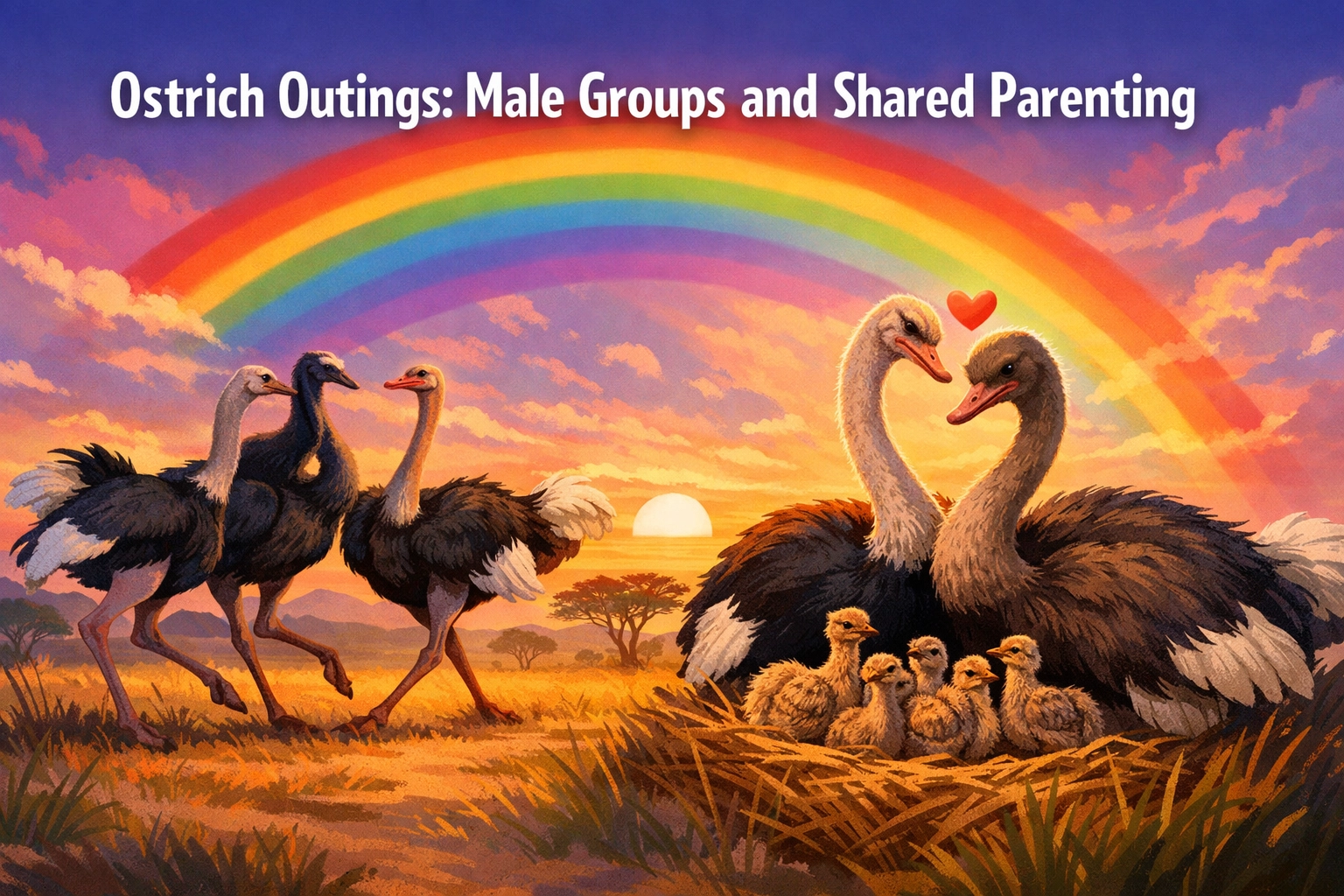
Whether it's male-heavy social groups or the ultimate "gay dad" energy of shared parenting, these birds are living their best lives. So, let’s get into the "Ostrich Outings" and see what these big birds can teach us about community and care.
The Social Scene: Not Your Average Flock
In the human world, we love a good gay book club or a night out with the guys. Ostriches feel the same way. In the wild, they don’t usually fly solo (mostly because they can’t fly at all, let’s be real). Instead, they hang out in small, tight-knit herds of about a dozen birds. During the off-season, these groups can swell to over 100 individuals.
What’s really interesting is the hierarchy within these groups. It’s not just a random collection of birds; it’s a structured society. Usually, one dominant male leads the pack. He’s the one making sure everyone stays in line and that the group stays safe from predators.
For those of us who live for MM romance tropes, this sets the perfect stage for an "enemies to lovers" or "forced proximity" storyline. Imagine two males vying for that top spot, only to realize they work better together. In reality, older males usually hold the "alpha" and "beta" positions, while the younger guys have to work their way up. It’s a classic coming-of-age arc that we see in so many queer fiction hits.

Territorial Realness and "Kantling"
When it's time to settle down, male ostriches get very serious about their space. We’re talking about territories that can span up to 19 square kilometers. To defend these borders, they don’t just peck and kick, though they can definitely do that (an ostrich kick can literally kill a lion, so don’t try them). They use ritualized displays.
One of the most famous moves is called "kantling." The male drops to his knees, spreads his wings, and rocks from side to side, showing off his feathers. He’ll also puff out his neck and make a booming sound. It’s basically a high-stakes talent show to prove who’s the boss.
In MM contemporary fiction, we often see characters marking their territory, whether it’s a literal property or just showing off to impress a love interest. The ostrich version of this is just as dramatic and twice as feathery. These displays are all about authority and establishing where you belong in the world, a theme that resonates deeply within the LGBTQ+ community.
Shared Parenting: The Ultimate "Co-Parenting" Goals
Now, let’s talk about the part that really warms our hearts: the parenting. While ostriches are polygamous (the dominant male usually mates with several females), the way they raise their kids is a total team effort.
The male starts by digging a shallow nest in the ground. Then, all the females in his group lay their eggs in that same nest. We’re talking about a communal nursery that can hold up to 50 eggs! But it’s not a free-for-all. There is always one "dominant" female who, along with the dominant male, takes on the bulk of the responsibility.

Here is the cool part: they take shifts. The female, with her brown-grey feathers that blend into the dirt, sits on the eggs during the day. The male, with his striking black feathers, takes the night shift. His dark plumage makes him nearly invisible in the moonlight, protecting the nest from hungry hyenas and jackals.
This level of shared parenting is a beautiful reminder that family isn't just one thing. It's about who shows up, who does the work, and who protects the next generation. If you’re a fan of gay romance novels featuring "found family" or "single dads," the ostrich model is basically the gold standard of co-parenting. It’s about teamwork, sacrifice, and making sure the "chicks" have the best start in life.
Why Nature is Way Queerer Than We Thought
We often hear people say that queer behavior is "unnatural." Well, the ostriches (and about 1,500 other species) would like a word. From the famous gay penguins in New York to the social bonds of bonobos, the animal kingdom is full of examples that break the binary.
In ostriches, the social bonds between males are incredibly strong. While they might compete for dominance, they also rely on each other for survival. The "alpha" and "beta" males spend more time with each other than they do with the rest of the herd. These deep, non-reproductive bonds are a huge part of what makes their society function.
At Read with Pride, we believe in celebrating all kinds of love and all kinds of structures. Whether it’s a steamy MM romance or a heartfelt story about gay love, the core message is the same: connection is what matters.

2026 Gay Books: Finding Your Own "Flock"
As we look toward the new gay releases of 2026, we’re seeing more and more authors lean into these themes of nature, community, and unconventional families. If you’re looking for something that mirrors the protective, fierce, and communal energy of our ostrich friends, here are a few tropes to look out for in your next MM romance books haul:
- Protective "Alpha" Leads: Just like the dominant male guarding the nest at night, we love a lead who would do anything to protect their partner.
- Found Family: The communal nest is the original "it takes a village" concept. Look for stories where a group of queer friends comes together to raise a child or support each other through a crisis.
- Slow Burn Rivalries: Those territorial disputes are the perfect inspiration for a slow-burn romance where two rivals eventually realize they’re on the same team.
If you’re looking to stock up your Kindle, check out our selection of LGBTQ+ eBooks. We’ve got everything from gay historical romance to the latest MM fantasy.
Final Thoughts: Stay Authentic, Stay Wild
The ostrich might seem like an odd bird, but it’s a testament to the power of authenticity. They don’t try to be anything other than what they are: giant, fast, territorial, and incredibly dedicated parents. They remind us that there is no one "right" way to build a life or a family.
So, the next time someone tries to tell you how things "should" be, just think of the male ostrich taking the night shift on a communal nest, looking fabulous in his black feathers.
Ready to find your next great read? Head over to Readwithpride.com and explore our library of gay fiction. From gay thrillers to romantic gay novels, we’ve got something for every member of the flock.
Don't forget to follow us on social media for more queer nature facts, book recommendations, and all things LGBTQ+!
- Facebook: Read With Pride
- Instagram: @read.withpride
- X (Twitter): @Read_With_Pride
Stay fabulous, stay curious, and keep reading with pride! 🌈✨
#ReadWithPride #MMRomance #LGBTQBooks #GayFiction #QueerNature #OstrichOutings #GayDads #NatureIsQueer #2026Books #MMRomanceBooks #GayRomanceNovels #FoundFamily

Leave a Reply
You must be logged in to post a comment.