

readwithpride.com
Content note: This article discusses grief, loss, rejection and healing. Please take what feels useful and leave the rest for another day.
Some grief is for a person we loved. Some is for a home we lost, a relationship that ended, or a version of ourselves we had to hide to stay safe. And some is for what we were never given the chance to have: a childhood where being queer felt ordinary, family acceptance without conditions, a public goodbye to someone we loved, or the future we once thought might be ours.
That grief counts, even when nobody else knows to name it.
For LGBTQ+ people, loss can be made heavier when other people don’t recognise the relationship, the identity, or the life we’re mourning. A partner may be called “just a friend.” Estrangement may be treated as a private disagreement instead of a profound rupture. The future we’re grieving may never have existed outside our imagination, but it mattered to us all the same.
Queer healing doesn’t require us to prove that pain is legitimate. It begins with making room for the truth: I wanted something. I needed something. I’m allowed to grieve that it didn’t happen.
Grief for the life we pictured
We often talk about grief as if it arrives with one clear cause and one clear timeline. Real grief is less tidy. It can return around birthdays, family gatherings, anniversaries, coming out milestones, or an ordinary afternoon when a song finds exactly the sore spot.
Sometimes we’re mourning possibilities rather than memories: the parent we hoped would show up for us, the safer school years we didn’t get, the relationship that couldn’t survive pressure, or the chance to grow older openly with someone we loved.
That doesn’t mean the future is closed. It means the past deserves an honest witness before we rush to the next chapter. You don’t have to turn every loss into a lesson, a triumph, or a “look how strong I am” speech. Resilience isn’t a performance review. You’re allowed to be tired, angry, relieved, tender, or all four before lunch.

When the world doesn’t recognise your loss
A 2020 qualitative study of queer and trans young adults describes chosen family as a source of care, mutual aid, and practical support. It also highlights how chosen family can meet needs that institutions don’t always know how to recognise. The study is small, and no single piece of research can describe every queer life, but it offers an important reminder: family and care aren’t defined by paperwork alone. (Read the study.)
That matters in grief. When someone outside your circle dismisses your loss, your people can help hold on to what was real. They can say your loved one’s name. They can remember the tiny, specific things: their laugh when they were trying not to laugh, the text they always sent, the way they made tea as if it were a sacred ceremony. They can sit with you without asking you to make the story easier for them.
Chosen family can include friends, partners, former partners, siblings, neighbours, community elders, and the people who became home through daily acts of care. There’s no one template. If it’s your family, it’s your family.
And support doesn’t have to look grand. It may be a meal dropped at the door, a lift to an appointment, an invitation that stays open even when you can’t answer, or someone saying, “Would you like company, a distraction, or help with the practical stuff?” Small kindnesses are not small when you’re carrying a lot.
Healing isn’t the same as forgetting
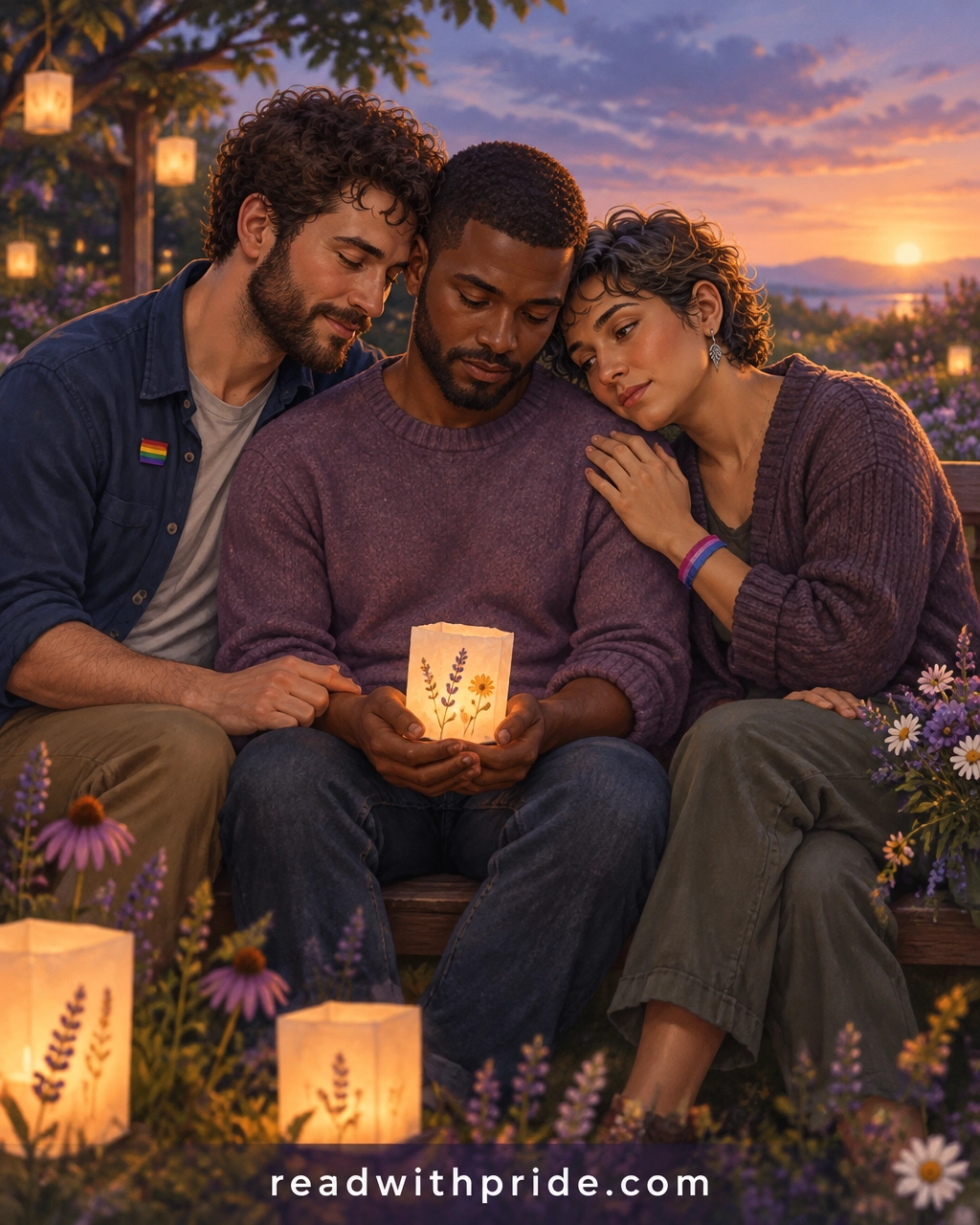
There’s no single correct ritual for grief. Some people make a playlist, light a candle, write letters, plant flowers, tell stories, or gather people for a meal. Others want privacy. Some days, the only ritual is getting through the afternoon and drinking a glass of water. That counts too.
A ritual doesn’t have to fix anything. It can simply make a little space for remembrance. Maybe you share one story about the person you miss. Maybe you mark a date with the food they loved. Maybe you create a tradition that belongs to the family you have now.
If grief is making everyday life feel impossible, reaching out to an LGBTQ+-affirming counsellor or grief support group may help. You deserve care that respects your relationships, name, pronouns, and circumstances, not a lecture about how you should feel by now.

Future visions can be small and still be real
Hope doesn’t have to mean believing that everything will work out neatly. Sometimes it means imagining one next moment that feels a little safer: a friend who will answer, a room where you can exhale, a meal you don’t have to eat alone.
Future visions can also be bigger. A world where queer elders are remembered with dignity. Where trans people receive care without having to teach every professional how to treat them. Where young people can find community before loneliness convinces them they’re the only ones. Where love doesn’t have to pass an approval test to be honoured.
Research on queer thriving and intergenerational community points toward the value of connection across generations and shared storytelling. That doesn’t mean community removes grief. It means we don’t have to make grief a solitary project. (Explore the research on queer thriving.)
The future is also built through ordinary choices: inviting someone in, asking who they want beside them, remembering the people who came before us, and making a little more room for the people coming next. These gestures aren’t a cure. They’re ways of saying: you belong in the story we’re still writing.

Stories can help us imagine what comes next
A book can’t take away grief, and it shouldn’t have to. But queer fiction can offer company: a reminder that our lives are worth telling in all their complexity, not only when they’re easy to explain.
Maybe that’s why readers seek out coming out stories, queer love stories, and narratives where people get to be complicated, desired, loved, and fully themselves. Maybe it’s why a queer book club can become more than a place to compare notes on the ending. Sometimes it’s a room where we recognise a feeling we thought we had to carry alone.
At Read with Pride, readers can explore LGBTQ+ novels, gay fiction, MM romance books, and gay romance novels alongside stories from across the wider community. Whether someone arrives looking for LGBTQ+ fiction 2026, heartfelt romance, or an oddly specific search such as “C Section 2026,” the deeper hope is often familiar: finding stories that make space for queer lives.
The future is still ours to imagine
You don’t have to be grateful for what hurt you. You don’t have to call every survival a victory. And you don’t have to know what comes next in order to deserve a future.
You can grieve what you were never allowed to have and still make room for what might be possible. You can miss someone and laugh at the same table. You can honour the past without living inside it. That is not forgetting. It is one way of carrying love forward.
If you’re in the US and need immediate emotional or crisis support, you can call or text 988. LGBTQ+ young people can also contact The Trevor Project. If you’re elsewhere, please reach out to a trusted person or local crisis support service.
Read with Pride is an LGBTQ+ ebook platform for readers looking for gay romance and MM fiction, and a home for stories that deserve to be found. Writers can also use our publishing portal to publish unlimited books free for a year, worldwide. Explore Read with Pride, follow us on Instagram and Facebook, and keep making room for the futures we’re still writing together.
#QueerHealing #LGBTQResilience #FutureVisions #ReadWithPride #QueerFiction #ChosenFamily #QueerLoveStories

Leave a Reply
You must be logged in to post a comment.