

readwithpride.com
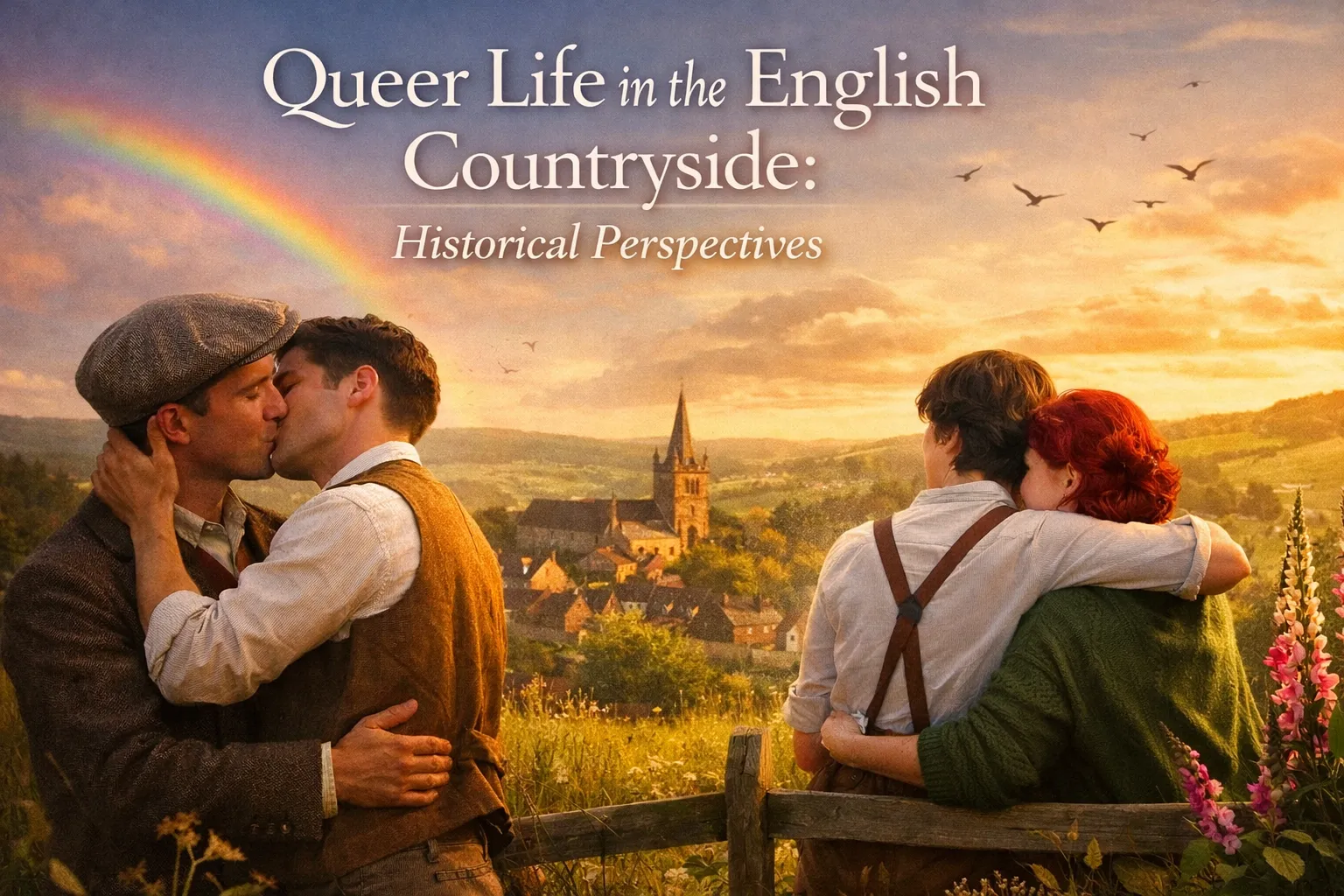
Queer history in England doesn’t only live in big-city bars, protests, and postcodes with suspiciously high numbers of rainbow flags per square metre. It also lives in market towns, seaside edges, farming villages, and those “blink-and-you’ll-miss-it” lanes where everyone knows everyone… which can be either the dream or the nightmare, depending on the decade and the neighbour.
This post is about the English countryside as both hiding place and home, a space where queer people have found privacy, peace, and sometimes a surprisingly solid community. It’s also a love letter to a very specific vibe many of us crave in queer fiction: quiet intimacy, the kind you see in MM romance novels where feelings unfold slowly over muddy boots, shared cups of tea, and the soft relief of being known.
And yes: we’ll also talk about why MM fake dating romance recommendations hit extra hard when the setting is a small town where gossip travels faster than the bus.
The countryside as cover, as comfort, as chosen life
Historically, rural England could be punishingly conservative. When your life is tied to church, family name, and the same social circles from cradle to grave, being different can feel like walking around with a spotlight on your forehead.
But that’s not the whole story.
The countryside also offered:
- space (literal distance from surveillance and social policing),
- privacy (no one watching who goes home with who, if you’re careful),
- alternative households (two “companions,” a “batchelor uncle,” a “lifelong friend”),
- and an oddly powerful tool: plausible deniability.
Sometimes queer rural life wasn’t about being loud. It was about being steady. About building a life that looked ordinary enough from a distance, while being deeply, defiantly queer up close.
That tension, between “keep it quiet” and “this is real”, is basically catnip for gay romance novels, especially the slow-burn, emotionally grounded kind.
Before “out and proud”: coded lives and rural “companionship”
If you want to understand queer rural history, you have to get comfortable with subtext. For centuries, a lot of people survived via:
- coded language (“confirmed bachelor,” “eccentric,” “devoted companion”),
- carefully curated social reputations,
- and relationships that were real but publicly framed as something else.
In villages, these arrangements could sometimes be tolerated if you were useful, discreet, or simply too established to challenge. There’s a practical side to rural communities that doesn’t always show up in stereotypes: if you fix the roof, keep the books, teach the kids, run the shop, or play the organ, people might mind their business.
In queer fiction, this often appears as the gentle conspiracy of a community that knows but doesn’t name it. That’s not always safe, and it’s not always kind, but it is historically plausible.
Rural “celebrity queers” and the power of being seen (carefully)
Even when the law and culture were hostile, some queer people created rural lives that became quietly influential, proof that you could love differently and still build something lasting.
Edward Carpenter’s rural queer orbit (and the idea of the “magnet home”)
One of the most important examples is the model of the countryside home as a gathering point: a place where queer people, artists, thinkers, and outsiders could show up, breathe, and be normal for a while. A rural household could become a soft kind of revolution, less riot, more kettle on.
That matters because queer community isn’t only clubs and marches. It’s also who you can stay with, who will feed you, and who makes room for you when the rest of the world doesn’t.
MM romance books often recreate this as the “found family farmhouse” trope: one character has a safe place (or becomes the safe place), and love grows in the gap between isolation and belonging.
Music, art, and coastal-countryside queerness
When people picture “the countryside,” they forget England has endless in-between spaces: coastal towns, marshy edges, artist villages, places that are rural-ish but culturally porous.
Creative couples and queer artistic circles found these places useful because they offered:
- room to work,
- less scrutiny than London,
- and enough visitors to avoid total invisibility.
A smaller community can also mean something powerful: your work gets known quickly. You become part of the fabric. You’re not anonymous, but you’re also not swallowed by a city.
That mix, visibility with a buffer, is a recurring theme in queer history and in gay romance novels where one character is local, the other is new, and the town slowly recalibrates around them.
Not just history: the modern English countryside and “small-town gay life now”
Let’s bring it to the present, because queer rural life in the UK today is not one single experience. It’s a patchwork.
What’s improved (a lot)
- Legal protections and social acceptance have grown dramatically compared to even the 1980s/90s.
- More schools, employers, and councils have inclusion policies.
- Community groups exist in places that would’ve been unthinkable a couple generations ago.
- Dating is easier because you’re not limited to “whoever happens to exist within five miles and isn’t your cousin’s mate.”
What’s still tricky
- visibility: being “the only gay in the village” is less of a joke when you’re actually living it.
- privacy: small places can be kind, but they can also be intense. Everyone notices everything.
- services: LGBTQ+ healthcare and support can be harder to access without travelling.
- safety: most rural areas are fine, but isolation can make any hostile situation feel bigger.
So queer rural life now often looks like a blend of:
- online community + local friendships,
- city trips for big queer events,
- and a desire to build quiet stability at home.
Which is, honestly, exactly why the “two men falling in love in a small town” setup remains so popular in MM romance books.
Finding queer community in villages and small towns (practically, not just romantically)
If you’re living rurally (or thinking about it), “community” doesn’t always mean a dedicated LGBTQ+ venue. Sometimes it means building a network through a few dependable routes:
-
Libraries and book clubs
Rural libraries are low-key community hubs. If you want a way to meet people without the pressure of nightlife, start here. Bonus: you can gently steer the conversation toward queer fiction and see who lights up. -
Sports and hobby groups with a social core
Walking groups, running clubs, allotments, choirs, local theatre. The queers are there. They’re just wearing fleeces. -
Pride-adjacent events rather than full-scale Pride
Think: film nights, talks, fundraising gigs, drag bingo in a pub function room. Not everyone wants a parade; plenty want a friendly room. -
Online-first, local-second
Facebook groups, local Discords, WhatsApp circles. Yes, it’s not as romantic as bumping into someone by a stile at golden hour. But it’s effective. -
Be the person who hosts
This is the oldest rural tradition there is: tea, biscuits, open door. A lot of queer community forms because one person decides to make it normal.
If you want queer reading to be part of that community-building, start with a stack of gay romance novels and rotate them like a secret (or not-so-secret) lending library.
For LGBTQ+ ebooks and curated reading, you can always browse readwithpride.com.
Why “quiet intimacy” hits differently in MM romance set outside the city
There’s a reason readers chase this mood.
In rural-set queer fiction, intimacy often shows up as:
- shared routines (feeding animals, closing a shop, walking the dog),
- small acts of care (fixing a gate, leaving a note, saving the last slice of cake),
- and love that’s not performative, it’s practical.
That’s the core of quiet intimacy MM romance novels: desire as something that settles in, not something that explodes.
It’s also a neat counterbalance to the narrative that queer joy must be loud to be real. Loud is great. Quiet is also real.
The small-town microscope: why fake dating is so satisfying here
Let’s talk tropes, because you asked for it (and because we love it).
If you’re hunting for MM fake dating romance recommendations, small towns are peak setting because fake dating solves a very specific rural problem: everyone asks questions.
In the countryside, you don’t just “have a date.” You have:
- a date who will be recognised by someone’s aunt,
- a date whose car will be noted outside your place,
- a date who will be assessed by the bar staff within three seconds.
So fake dating becomes:
- a shield (“stop speculating”),
- a test (“can I trust you with my reputation?”),
- and, inevitably, a trap (“why does this feel more real than my real life?”).
Other rural MM romance tropes that pair beautifully with this setting:
- forced proximity (snowed in, stuck on the farm, one spare room, oops),
- second chance (left for the city, came back for family reasons, old feelings still there),
- grumpy/sunshine (one local who hates change, one newcomer who’s too charming),
- slow burn (because privacy is limited and fear has history),
- found family (because chosen family is survival, not aesthetic).
If you’re building your 2026 TBR around vibes, “small-town slow burn + fake dating + forced proximity” is basically the holy trinity.
The countryside isn’t a monolith: regional flavour matters
Even within England, rural queer life varies a lot.
- South West & coastal rural often has pockets of artsy, alternative communities, still traditional in places, but with space for difference.
- East Anglia can feel quiet and sprawling; coastal towns sometimes offer more community than deep villages.
- The North has a strong “community knows you” culture, this can be protective, or suffocating, depending on the environment.
- Home Counties commuter-belt villages can be surprisingly mixed: traditional presentation, modern attitudes, and plenty of newcomers.
A good rural queer story (historical or contemporary) usually nails this: the landscape isn’t just scenery. It shapes the risk, the closeness, the pace of the relationship.
Reading rural queer history through queer fiction (and why it matters)
We don’t read queer rural history just to collect sad facts. We read it to notice the patterns:
- how people made lives under pressure,
- how love found loopholes,
- and how “ordinary” places were never as straight as they pretended.
And when you pick up a great rural-set MM romance book, you’re not just getting a love story. You’re getting an answer to an old question: Can I have this life here?
More often than you’d think, the answer is yes: sometimes loudly, sometimes quietly, sometimes with a whole village pretending they don’t notice while also absolutely noticing.
For more LGBTQ+ ebooks, gay romance novels, and trope-led recommendations (including small-town slow burn and fake dating), explore readwithpride.com. You can also keep up with us here:
- Facebook: https://www.facebook.com/profile.php?id=61586883027069
- X: https://x.com/Read_With_Pride
- Instagram: https://www.instagram.com/read.withpride/
Hashtags
#ReadWithPride #Readwithpride #MMRomanceBooks #GayRomanceNovels #GayRomance #MMRomance #QueerFiction #LGBTQEbooks #LGBTQRomance #SmallTownGay #RuralQueer #QuietIntimacy #FakeDating #ForcedProximity #SlowBurn #BestMMRomanceBooksOf2026 #GayBooks #GayFiction #GayLoveStories #QueerHistory

Leave a Reply
You must be logged in to post a comment.