

readwithpride.com
Why “Lavender Menace” still hits (in the best way)
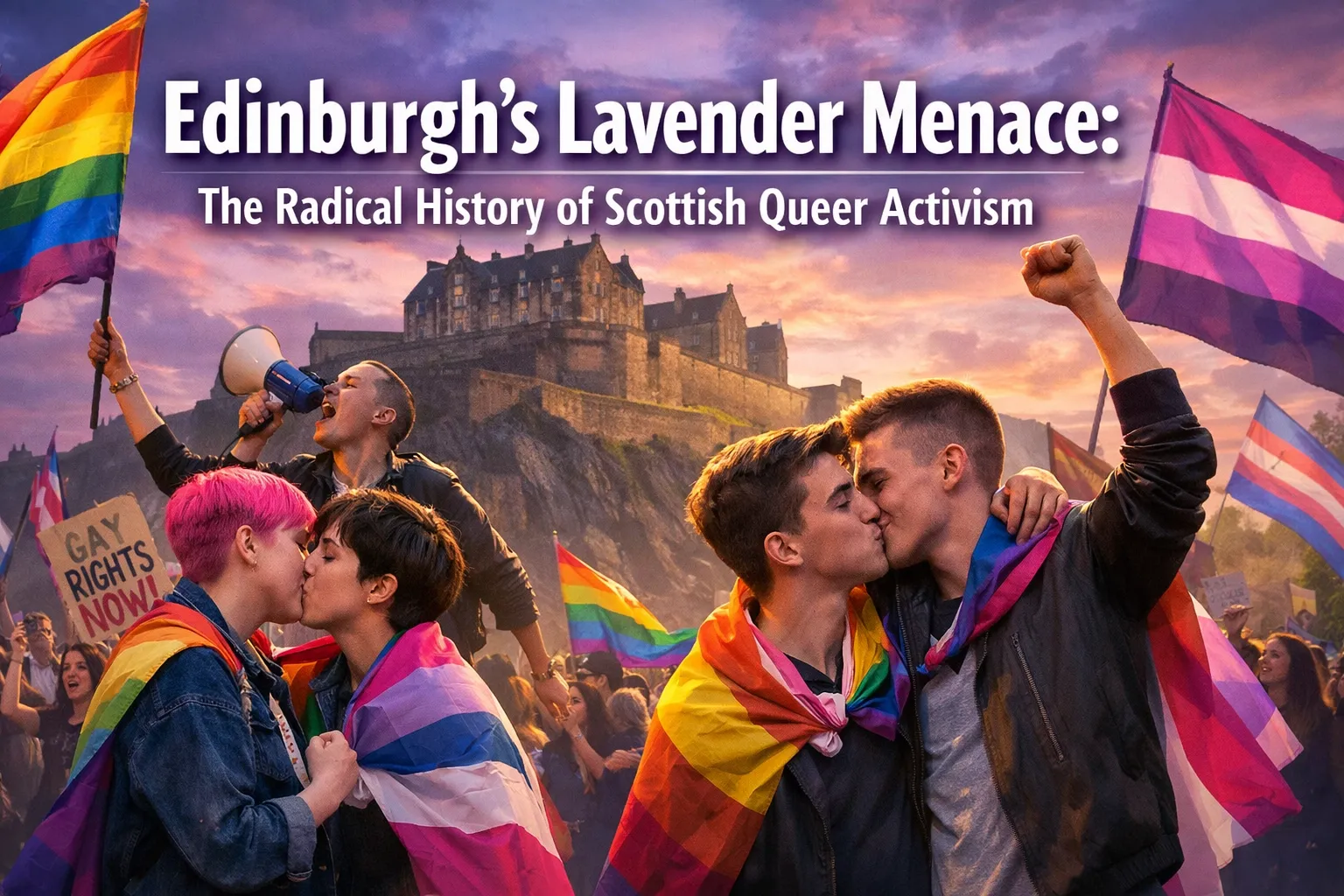
“Lavender Menace” is one of those phrases that started as a sneer and ended up as a banner. It’s cheeky, defiant, and very, very queer. And in Scotland, specifically Edinburgh, it became shorthand for something bigger than a name: a community-built, feminist-rooted, book-powered engine for change.
If you’ve ever walked into a queer bookshop (or stumbled into queer fiction online at 2 a.m. and had a full identity spiral, no judgement), you already understand the basic magic: stories create language, language creates community, and community creates pressure. Edinburgh’s Lavender Menace made that pipeline real in the 1980s, when being visible could cost you your job, your housing, your family, or your safety.
This is the radical history of Scottish queer activism through the lens of one small, brave, basement bookshop, and why it still matters if you’re here for queer history and your next batch of MM romance books.
The original Lavender Menace: direct action, not polite requests (1970)
Before it was ever a Scottish bookshop, “Lavender Menace” was a US lesbian feminist mic-drop.
In 1970, at the Second Congress to Unite Women, lesbian feminists were being treated like an inconvenient sidebar, useful when it came to labour, not so welcome when it came to openly naming lesbian lives. So activists did what activists do when they’re done being erased: they planned a direct action.
They infiltrated the conference wearing hand-dyed “Lavender Menace” T-shirts hidden under other clothing. Then they took the stage, revealed the shirts, and called people forward, turning “menace” into solidarity in real time. That protest shifted the conversation so hard that by 1971, the National Organization for Women (NOW) adopted a resolution recognising the “double oppression” lesbians faced.
It’s important context because it shows the vibe: this wasn’t assimilation politics. It was “we’re here, we’ve always been here, and you don’t get to build liberation without us.”
That spirit travelled, and eventually landed in Edinburgh.
Edinburgh, 1982: a basement bookshop becomes a lifeline
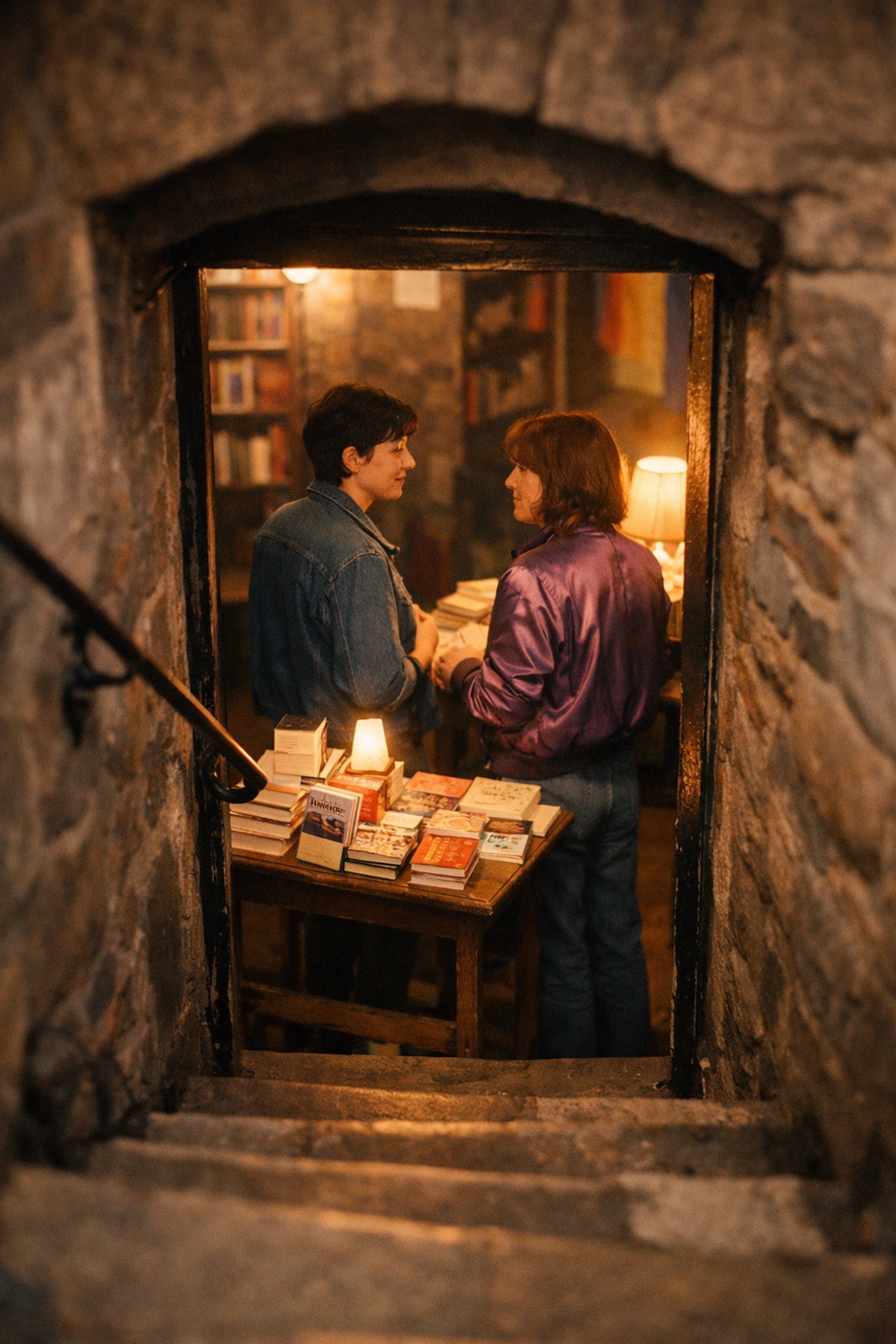
On 21 August 1982, Scotland’s first lesbian and gay bookshop opened in the basement of 11a Forth Street in Edinburgh. It was called Lavender Menace, and it was never “just a shop.”
It sold books, yes, queer fiction, non-fiction, politics, poetry, imported titles that were hard to find in the UK. But it also quietly solved problems that straight society often doesn’t notice because it doesn’t have to:
- Where do you go when you need information and can’t risk asking out loud?
- Where do you meet people without the pressure (or danger) of a bar scene?
- Where do you find stories when the mainstream shelves pretend you don’t exist?
- Where do you feel normal when everything around you insists you’re not?
Lavender Menace answered all of that with a key, a till, and a community noticeboard energy that basically said: come in, breathe out.
And because it was rooted in feminist and grassroots organising, it didn’t just “welcome” activism, it actively hosted it.
From book lists to Fringe plays: how literature became organising
Lavender Menace did the thing that great queer spaces do: it blended culture and politics so tightly you couldn’t separate them.
The shop hosted:
- author readings
- discussions and meet-ups
- book launches
- and even original short plays inspired by books during the Edinburgh Fringe
That last part is easy to gloss over, but it’s huge. When your existence is politicised, culture isn’t a luxury, it’s infrastructure. Plays and readings weren’t just “nice events.” They were how you spread ideas, how you made friends, how you built confidence, how you learned the language for what you felt.
And the shop didn’t only serve Edinburgh. It reached across Scotland with mail-order lists, an early version of “queer community, delivered.” For people in smaller towns or isolated rural areas, that mattered. If you were closeted in a place where everyone knew your mum, a discreet book order could be a first step toward self-recognition.
(Which is also why queer readers today still have that special affection for digital shelves. LGBTQ+ ebooks are private, portable, and sometimes genuinely life-saving.)
If you want to browse queer fiction and romance in a modern, no-gatekeeping way, start at readwithpride.com.
Censorship in practice: when the state decides what you’re allowed to read
If you’re thinking, “Okay but it’s just books,” welcome to the point.
LGBTQ+ bookshops in the UK didn’t just face side-eye, they faced official interference, especially around imports. Lavender Menace dealt with seizures by UK Customs and Excise, including the confiscation of books and the detention of shipments.
This wasn’t abstract. It hit finances, inventory, programming, and the psychological safety of knowing the government could literally intercept your stories.
So the shop got creative, finding ways around confiscations and supporting other queer bookshops facing legal pressure. That mix of pragmatism and solidarity is a recurring theme in queer activism: you build networks, share resources, and refuse to let the system isolate you.
And yes, it’s worth saying plainly: censorship isn’t only about “obscene content.” It’s about controlling which lives are allowed to be legible. When queer books are targeted, it’s not because they’re dangerous, it’s because they make queer people harder to silence.
Why bookshops mattered so much in the 80s (and what replaced them)
In the 1980s, queer community infrastructure in the UK often meant a patchwork:
- bars and clubs (not always safe, not always accessible)
- activist groups (powerful, but sometimes intimidating to newcomers)
- phone lines and information centres
- and bookshops, quiet, consistent, and surprisingly strategic
A bookshop let you enter without declaring your politics or your identity. You could browse, listen, learn, ask one question, and leave. It offered a gradient of visibility. That’s a big deal when visibility isn’t just bravery, it’s risk management.
Today, parts of that role are held by online spaces and publishers. That’s where Read with Pride comes in: we keep queer stories easy to find, easy to access, and built for the readers who want both comfort and challenge.
And because we’re also romance people (respectfully: very romance people), we’re not pretending that activism and desire are separate lanes. Sometimes a book doesn’t “teach” you anything political, sometimes it just shows you what you’re allowed to want.
The Lavender Menace legacy: revival, archive, and living memory
Lavender Menace didn’t stay frozen in time. The original shop later evolved (including a rename and relocation), and its spirit was revived decades later through theatre, most notably a 2017 play that reintroduced the story to new audiences.
That revival fed into something even more lasting: an archive and community organisation dedicated to preserving LGBTQ+ history and creating events space. Which is exactly what you want from a legacy, not just nostalgia, but continuity.
Because queer history doesn’t survive by accident. It survives because people save flyers, record oral histories, preserve reading lists, and insist that the “small” spaces mattered.
They did.
Scotland’s queer activism isn’t one story, it’s many regions, many realities
Edinburgh gets the spotlight here, but Scottish queer life has always been regional:
- Cities offered more anonymity and more venues, but also more policing and public scrutiny.
- Smaller towns could mean tighter community ties, but also intense social surveillance.
- Rural areas and islands often meant isolation, but also fierce chosen-family networks when people did connect.
This is why mail-order book lists, discreet community hubs, and underground networks mattered so much. They didn’t just serve “customers.” They served people who were building an identity in places where the vocabulary wasn’t available.
And yes, the UK-wide context mattered too: employment discrimination, moral panic media coverage, and the broader political climate all shaped what “being out” looked like depending on your postcode.
From radical bookshop to romance reader: the through-line we don’t talk about enough
Let’s connect this to the way people actually read now.
Queer activism and queer romance are not opposites. Romance is where a lot of us practise believing we deserve tenderness, safety, and futures. That’s not “soft”, it’s foundational.
And in the Lavender Menace tradition, books also function as:
- identity mirrors (you see yourself; you stop feeling alone)
- community signals (you recognise what others recognise)
- imagination training (you picture a life beyond survival mode)
That’s part of why certain romance niches hit so hard, especially when you’re unlearning shame.
If you’re looking for story-shaped self-recognition, a few reader-favourite lanes to explore are:
- slow burn MM romance books (because yearning is a lifestyle)
- enemies to lovers MM romance (for the “why do I hate you… oh” pipeline)
- forced proximity (trapped by weather, stuck on tour, one bed, classic for a reason)
- gay workplace romance ebooks (competence, tension, HR violations, fictionally)
- bi awakening stories (sometimes messy, often healing)
And yes, we see you if you came here via curiosity and left with a “bisexual awakening” moment thanks to fiction. That’s not rare, it’s practically a rite of passage.
Reading as resistance (and why MM romance still belongs in the conversation)
It’s tempting to treat activism as only marches, legal battles, and speeches. But Lavender Menace shows the quieter side: the work of building a culture where queer lives are documented, shareable, and worth defending.
Reading can be resistance when:
- it preserves stories that were meant to be erased
- it spreads ideas faster than institutions can contain them
- it builds empathy inside communities (including across identities)
- it offers joy when the world insists you should settle for endurance
So if you’re picking up queer fiction, queer non-fiction, or MM romance novels today, you’re participating in the same ecosystem Lavender Menace fought for: a world where queer stories are available without shame.
Want more LGBTQ+ reading rabbit holes? Browse our categories via readwithpride.com or dig through our blog hubs starting here: https://readwithpride.com/index.php/category/lgbtq-blogs-and-articles
A quick (friendly) SEO check for this post
- H1 present: Yes (single H1 title at top)
- Duplicate meta tags: Not assessable in markdown (flag for upload stage)
- Image alt / captions: Hero image present; add descriptive alt text in CMS when publishing
Find us + stay connected
- Website: readwithpride.com
- Instagram: https://www.instagram.com/read.withpride/
- X: https://x.com/Read_With_Pride
- Facebook: https://www.facebook.com/profile.php?id=61586883027069
Hashtags
#ReadWithPride #Readwithpride #Edinburgh #ScottishQueerHistory #LavenderMenace #LGBTQHistory #QueerActivism #QueerBookshops #LGBTQBooks #GayBooks #QueerFiction #MMRomanceBooks #GayRomanceNovels #GayWorkplaceRomanceEbooks #SlowBurnMMRomance #EnemiesToLoversMMRomance #ForcedProximityMMRomance #BestMMRomanceBooksOf2026 #LGBTQEbooks #GayLiterature

Leave a Reply
You must be logged in to post a comment.