

readwithpride.com
Dublin doesn’t just claim Oscar Wilde, it quietly shaped him. Before the wit. Before the velvet. Before the scandal, the trials, and the lines that still get quoted by people who’ve never actually read him (no shade… okay, a little shade). Wilde’s earliest sense of performance, class, language, and belonging started in a city that was both intimate and politically charged.
If you’re the kind of reader who devours gay romance novels for the slow burn, the longing, and the “we can’t say it out loud but we’re definitely saying it with our eyes” energy, Wilde’s Dublin years are basically that vibe in real life. This is a walk through the places that held his childhood, his returning adulthood, and the legacy Dublin keeps polishing into a gleam. And yes, we’ll tie it back to what we love at Read with Pride: MM romance books, queer fiction, and the kind of gay literature that still hits you in the chest.

Why Wilde still matters to queer readers (and why Dublin feels personal)
It’s easy to flatten Wilde into a caricature: flamboyant genius, tragic martyr, walking quote machine. But Wilde’s real power, especially for LGBTQ+ readers, is that he lived as boldly as he could in a world that punished him for it.
Even if the historical record is uneven (and it is), Wilde’s story sits at the intersection of:
- public brilliance and private risk
- desire and restriction
- wit as armor (a queer classic, honestly)
For fans of gay fiction, this is familiar territory. It’s the same emotional engine behind so many slow burn MM romance recommendations: the careful steps, the coded language, the tension between safety and truth.
And Dublin? Dublin is where that engine got its first spark, through family, education, and a city full of sharp talkers.
Merrion Square: Wilde’s childhood home and the “origin story” energy
If you want the most direct Wilde-in-Dublin moment, start at 1 Merrion Square, his childhood home. It’s a Georgian townhouse, the kind of elegant address that tells you a lot about class and expectation before you even step inside.
This house mattered because it held contradictions, something Wilde would later turn into art.
On one hand, it was a home of status and social rules. On the other, it sat in a city humming with political change and cultural pride. Wilde grew up surrounded by big minds and big opinions, and that atmosphere taught him the one skill every queer kid eventually perfects:
reading the room.
Self-guided tours and guided tours here typically frame his family history, early years, and the way the Wilde name carried weight in Dublin society. Whether you’re a literary tourist or a queer history nerd, it’s worth slowing down and letting the space do its work. You’re not just “seeing a place.” You’re feeling the pressure that produces a person.
MM romance reader translation: this is the “wealthy upbringing + suffocating expectations” setup, prime material for a gay historical romance where the softest thing in the room is the one thing nobody’s allowed to touch.
Merrion Square Park: the monument that tells the truth in two faces
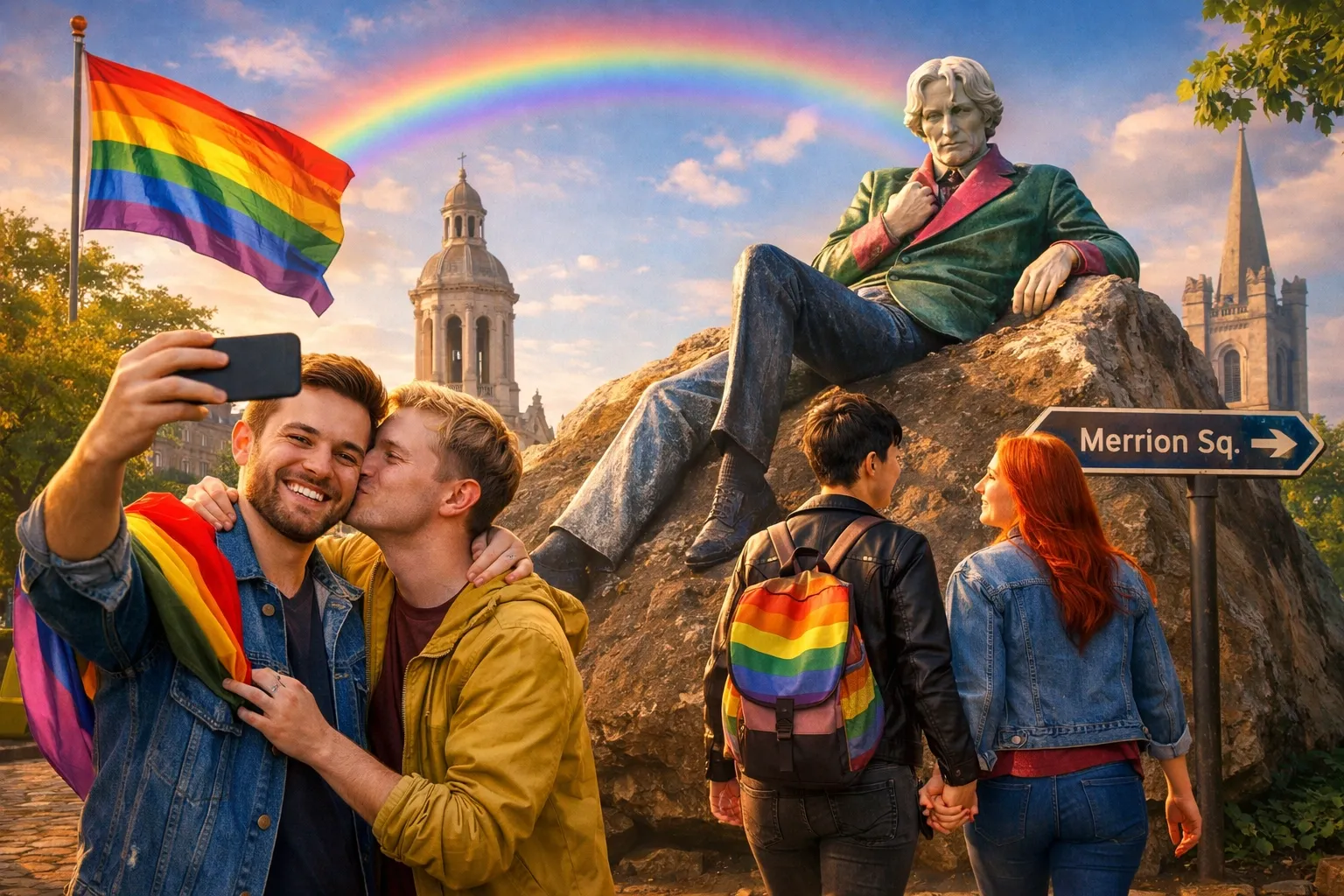
Walk a few minutes and you’ll hit the Oscar Wilde Monument at the northwest corner of Merrion Square Park, and it’s not subtle.
Wilde reclines on a quartz boulder in a smoking jacket like he’s posing for the most extra author photo shoot imaginable. But what makes this monument genuinely smart is its emotional honesty: the statue’s face is designed with a split expression, one side amused, one side sad, as if Dublin is saying, “Yes, he was hilarious. Yes, it cost him.”
The monument is actually a trio:
- Wilde reclining (the star)
- a statue of Constance, visibly pregnant (complicated, human, real)
- a torso of Dionysus, god of youth, theatre, poetry, basically patron saint of late nights and dramatic feelings
Around the monument, you’ll also see plinths with Wilde quotes selected by a wide range of public figures. It’s a nice reminder that Wilde isn’t just a school syllabus fixture. He’s a cultural nerve.
And for a modern twist: it’s part of Dublin’s Talking Statues experience, so you can literally listen to “Wilde” speak via your phone.
Queer fiction reader translation: this monument is the perfect symbol for why tragic beauty is such a strong draw in gay novels, because joy and danger have always been roommates.
St Stephen’s Green + The Shelbourne: Wilde, romance, and the public/private split
Wilde’s Dublin isn’t only childhood and monuments. It’s also the city he returned to as an adult. One key area is St Stephen’s Green, a place that still feels like a hinge between public life and private conversation.
Nearby, Wilde spent time at the Shelbourne Hotel, and it’s where he proposed to Constance Lloyd in 1883.
This moment lands strangely for many queer readers, because it doesn’t fit neatly into the “queer icon” frame. But it’s important precisely because it’s messy. Queer history isn’t a straight line (pun unavoidable). It’s layered with survival choices, social pressures, genuine affection, and sometimes, yes, contradictions.
If you read gay literature or LGBTQ+ fiction beyond the basics, you know that complexity is where the good stories live.
Slow burn MM romance lens: the tension between what you feel and what you can publicly choose is basically the classic conflict engine. The green is peaceful; the stakes are not.
The Giant’s Garden: a softer Wilde hiding in plain sight
In Merrion Square there’s also a playground called the Giant’s Garden, named after Wilde’s fairytale The Selfish Giant. It marks the area where he played as a child, and it’s an underrated stop because it reminds you Wilde wasn’t born fully formed as “Oscar Wilde, Icon.”
He was once just a kid in Dublin absorbing stories and making sense of the world.
This matters for readers because so much queer storytelling (including modern MM fiction) circles back to the idea that:
- we were always ourselves
- but we didn’t always have language for it
- and our earliest environments leave fingerprints
It’s easy to chase the drama (and Wilde delivers drama). But the Giant’s Garden is a quieter kind of pilgrimage, more “gentle reflection” than “literary selfie.”
Walking Wilde’s Dublin like an MM romance plot (yes, really)
Here’s a fun way to do a Wilde day in Dublin if you’re a trope-lover: frame it like a story arc.
1) The Setup (Merrion Square House)
A privileged, high-expectation environment. A protagonist with too much intelligence and not enough freedom. The kind of start that screams “this is going to be a slow burn.”
2) The Mask (Merrion Square Park Monument)
Public persona becomes performance. Wit becomes protection. The world applauds, but it also watches.
3) The Turning Point (St Stephen’s Green / Shelbourne)
A decision made under social gravity. Romance as something both true and constrained. The reader starts yelling “NOOO TALK ABOUT YOUR FEELINGS” at the page.
4) The Tender Flashback (Giant’s Garden)
The soft scene. The reminder of innocence. The emotional anchor.
If you love historical MM romance novels, this framing is catnip: it highlights longing, secrecy, social pressure, and the ache of a life lived in partial light.
Wilde’s literary legacy: what to reread (or read for the first time)
If Wilde’s been sitting on your “someday” list, consider this your gentle shove.
You don’t need to be a classics snob to enjoy him. His work is sharp, surprisingly modern in places, and full of that queer-adjacent tension between what’s said and what’s meant.
- Plays and satire: for the dialogue lovers and social commentary fans
- Fairy tales: for bittersweet beauty (seriously underrated)
- His most famous novel: for themes of desire, image, and consequence
Wilde’s writing also pairs well with reading gay romance novels, because both are often interested in the same thing: the cost of pretending.
If you’re building a personal “queer canon,” Wilde is less “must-read homework” and more “if you like clever + tragic + tender, you’ll get it.”
Reading Wilde through a 2026 lens: reclaiming the queer subtext
In 2026, queer readers are no longer limited to crumbs. We have shelves of LGBTQ+ ebooks, gay love stories, and MM romance books that let queer people exist without being punished by the plot.
That’s progress worth celebrating.
But revisiting Wilde is still meaningful because it shows where we came from: and why representation matters beyond “happy endings.” Wilde’s legacy is a reminder that:
- visibility has a history
- freedom has a cost
- stories shape survival
And if you’re hunting for slow burn MM romance recommendations, Wilde’s life provides that emotional blueprint: longing + restraint + danger + brilliance.
At Read with Pride, we’re big on reading pleasure-first, but we’re also honest about the fact that queer history can be heavy. Wilde’s Dublin lets you hold both: beauty and bruise: in the same palm.
If you’re visiting Dublin: a simple Wilde-friendly itinerary
If you’re planning a day that blends queer history with low-stress wandering:
- Start at Merrion Square (house area first, then park)
- Spend time at the monument: read the quotes, take it in
- Walk toward St Stephen’s Green for that classic Dublin stroll feel
- Pause near the Shelbourne and let yourself imagine the scene
- Loop back for the Giant’s Garden if you want a softer ending
And if you’re not visiting? You can still do a “Wilde day” from your sofa: read a play scene aloud (extra points for drama), then follow it with a comfort-read from your favorite MM romance authors and call it balance.
For more LGBTQ+ fiction, gay romance novels, and curated reads, browse readwithpride.com: https://readwithpride.com
If you like exploring by genre, the sitemap can help you dig around: https://readwithpride.com/blog-category-sitemap1.xml
Where Wilde meets modern MM romance (and what to read next)
Wilde isn’t an MM romance novel. But he’s part of the reason MM romance exists as a thriving space where queer desire can be centered, celebrated, and explored.
If Wilde’s Dublin put you in the mood for:
- historical MM romance with class tension
- slow burn with coded feelings
- literary, dialogue-forward queer fiction
- stories that blend tenderness with bite
…then you’re already reading in his wake.
If you want to keep that momentum going, keep an eye on our growing shelves of LGBTQ+ ebooks and gay romance books on readwithpride.com. We’re here for the classics, the new releases, and the stories that feel like coming home.
Find us and follow along:
- Website: https://readwithpride.com
- X: https://x.com/Read_With_Pride
- Instagram: https://www.instagram.com/read.withpride/
- Facebook: https://www.facebook.com/profile.php?id=61586883027069
Hashtags
#OscarWilde #Dublin #QueerHistory #LGBTQBooks #ReadWithPride #MMRomanceBooks #GayRomanceNovels #HistoricalMMRomance #SlowBurnRomance #QueerFiction #GayLiterature #LGBTQEbooks #GayBooks #BookRecommendations #BestMMRomanceBooksOf2026

Leave a Reply
You must be logged in to post a comment.