
Category: Rare Experiences | Morning Edition
The man who wrote four hundred lives
Callum Brennan came home from the night shift with the morning still caught in his coat: cold air, printer’s ink, and the stale warmth of a newsroom that had outlasted the dark. At thirty-nine, he had spent nineteen years in London and learned how to make a life fit inside a paragraph. As an obituary sub-editor, he wrote about people he had never met, often in about 250 words, with a deadline pressing close enough to feel like a hand at his back.
He could be precise and gentle. He could also be evasive. His dark hair had begun to grey at the temples; his charcoal coat, worn season after season, shone at the cuffs. When he was tired, he pressed his thumb into the corner of his left eye. His glasses came off when he needed to read something closely.
In the pocket of his coat was a small tin of blank index cards. He drafted lines on them, crossed most out, and carried the survivors around as if they might one day become useful. He could summarise strangers in a sentence. He had never managed to write a true one about himself.
That morning, in the Clerkenwell flat he shared with Isaac, he tried for lightness. He said he had written a woman’s entire life in 240 words that day, and it was the best writing he had done all year.
Isaac heard the sentence beneath the sentence: you can give strangers a better death than you will ever give me.
A wall for the ones nobody would have written down
On a Saturday in November, Isaac took him to Postman’s Park. They lived twenty minutes’ walk away, and Callum had somehow passed nineteen London years without visiting. Isaac said he wanted to show him the memorial. He didn’t say why.
The park lies off St Martin’s Le Grand, near St Paul’s Underground, in the City of London. Formed from former churchyards closed under the Burial Acts, it opened as a public garden on 28 October 1880. Its name recalls the General Post Office workers who came from the nearby headquarters to eat their lunch there, resting a while among the graves.
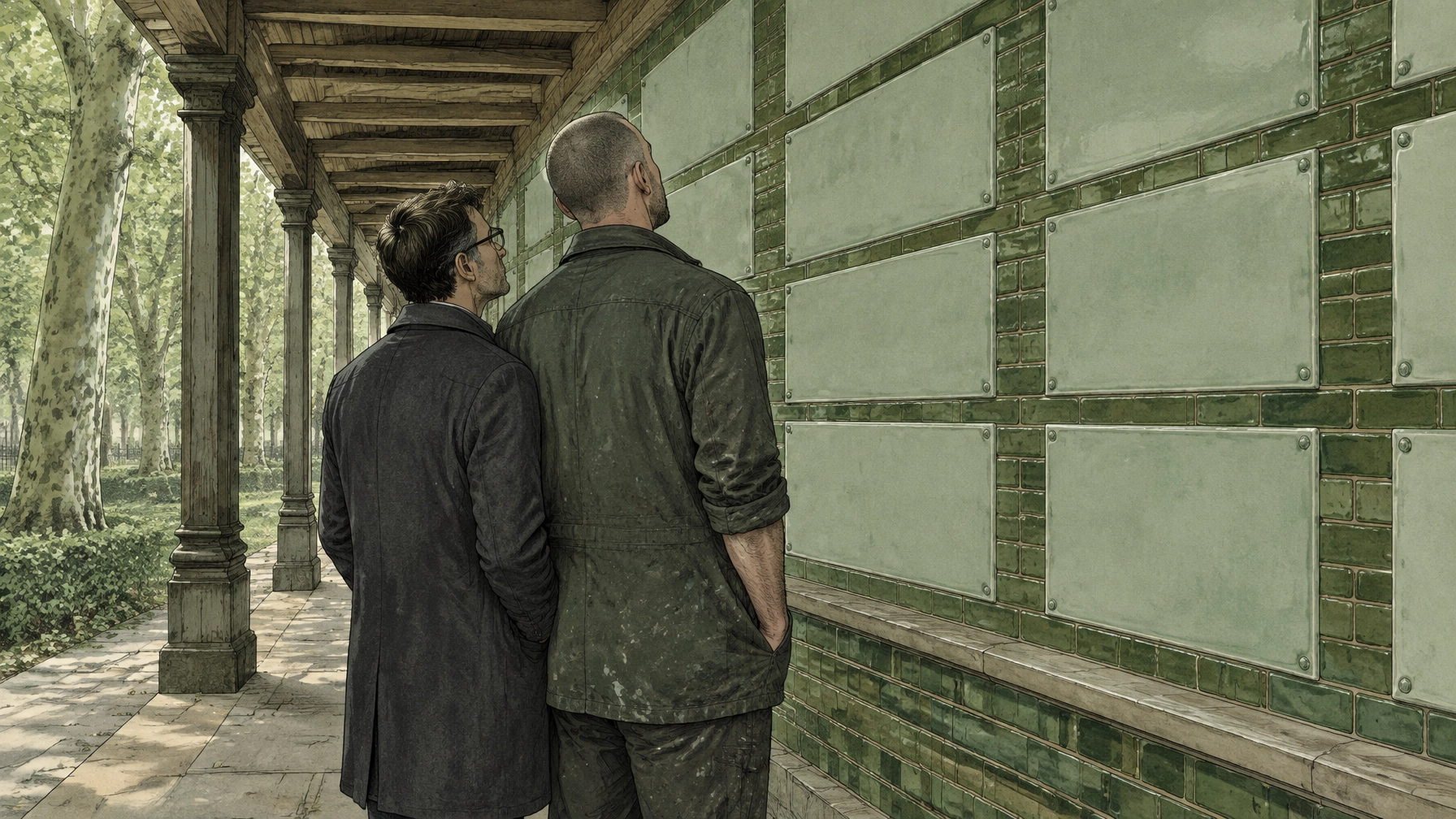
Under a timber loggia, the Watts Memorial to Heroic Self-Sacrifice gathered the names of people who died trying to save others. George Frederic Watts proposed it in an 1887 open letter to The Times, headed “Another Jubilee Suggestion”, calling for a monument to “heroism in every-day life”. It took thirteen more years to find the site and the money; the memorial was unveiled in 1900.
The wall had space for 120 ceramic tablets. Only 54 were installed, commemorating 62 people. Work proceeded fitfully and stopped in 1931 with 53 tablets in place. One more was added in 2009; the following year, interested groups concluded no further tablets would be added.
Callum looked first as an editor. He admired the craft, the brevity, the way a life was made to hold its shape in a few lines. “They cut the ‘who’ clause,” he said. “It’s good.”
Isaac watched his face, not the wall.
One sentence each
Then Callum read Alice Ayres’s tablet. She was twenty-six, a servant who died after saving three children from a fire in Union Street, Borough, in 1885. The words described her as the daughter of a bricklayer’s labourer and said she had acted “at the cost of her own young life”. Hers was one of only four tablets in place when the memorial was unveiled in 1900.
The smallness of the ceramic did not make the life small. Callum stopped reading as if he had reached a line he could not edit.
A little farther along was Leigh Pitt: a thirty-year-old reprographic operator who drowned in 2007 after saving a nine-year-old boy from a canal at Thamesmead. His tablet reads: “Saved a boy from the canal at Thamesmead, but sadly was unable to save himself.”
“Sadly,” Callum said, almost under his breath.
That word held the distance between what a person did and what it cost. Somebody at a desk had chosen it, and chosen right. Jane Michell, Leigh’s co-worker, had campaigned for two years to have his tablet made. It was unveiled in 2009, the first new one in seventy-eight years.
Callum’s work had taught him to weigh each word against space, accuracy and time. Here, the space was small, but the lives resisted the neatness of a summary. A lighterman, a policeman, a boy of eleven, a fireman: even the few words that remained were not the whole of anyone. They were a handhold, not a possession.
Isaac’s voice came quietly from beside him. “You write people into one line for a living. You’ve never written me into anything.”
Callum looked down at his hands. “Because I’d get it wrong, and then you’d have to live with my version of you.”
What Isaac had never said
They sat on a bench as the afternoon thinned. Isaac was thirty-six, tall and broad-shouldered, his close-shaved head silvered by the weak light. Paint never quite left the skin around his nails. On the inside of his right forearm, a burn scar the size of a thumbprint marked an old encounter with a glue pot. He was a signwriter and gilder; he knew how a name could be shaped and how a careful hand could make a surface speak.
His laugh was loud enough to serve as a door. People heard it and mistook it for ease. Callum had loved that laugh for four years and still sometimes stood outside it.
Eleven years earlier, Isaac’s older brother, Eamon, had drowned in the Regent’s Canal while pulling a stranger to safety. The stranger lived. Their mother kept the newspaper cutting folded in a drawer with the ironing. Isaac had once written to the City of London asking about a plaque for Eamon. A kind letter came back: no further tablets would be added.
He had not told Callum any of this before. Perhaps he had feared that Callum would turn Eamon into a sentence and mistake that for knowing him.
Callum listened. He didn’t reach for a clever line. There was no answer that could make the letter less final, or return a brother to his family, or repair the years in which Isaac had carried the grief without asking to be seen carrying it.
Some places do the work MM romance unexpected places is always promising: strip a scene down to two people and the thing they are failing to say. What follows is a gay love story emotional journey measured in small attendances rather than declarations, the kind of character-driven queer fiction that trusts a reader to hear the silence under the sentence. That is what the emotionally invested MM readers of this series keep coming back for, and it is why emotional MM romance literary in ambition rather than in label keeps returning to places like this one, where a wall of ordinary names asks you to stop editing your own life. More stories in that vein are waiting in the Read with Pride store.
The card in his pocket
At dusk, Callum took out the tin of blank cards. The small click of its lid seemed loud in the garden. He chose one and wrote Eamon’s name, then a line.
It was bad.
He crossed it out. The pencil left a dark, blunt mark. He tried again, slower, not trying to compress a whole man into a sentence. The card was still too small. The words still too few. He gave it to Isaac anyway.
Isaac read it. His face did not soften into forgiveness, and Callum did not ask it to.
“It’s not enough,” Isaac said.
“No.”
Isaac folded the card and put it in his coat pocket. The gesture was not a verdict. It was a thing carried forward, with the crease and the crossed-out first attempt still there.
After a while, he said, “Next time you get a night shift, wake me when you come in. Don’t sit in the kitchen with the light off.”
Callum nodded. He could not promise he would suddenly become fluent in the truths he had spent years avoiding. He could promise to knock, and to let Isaac wake, and to stay in the room when the words did not come easily.
They walked out as the park closed, the card folded in Isaac’s coat pocket. What they had not said remained between them. So did the standing offer to come back and say it better.
Callum Brennan, Isaac Oyelaran and their story are fictional. Postman’s Park and the Watts Memorial to Heroic Self-Sacrifice are real; the historical details and commemorated people described above refer to the real park and memorial.
Follow us on social media
Instagram: https://www.instagram.com/dickfergusonwriter
X: https://www.x.com/DickFergus94902
Facebook: https://www.facebook.com/profile.php?id=61572869844598
Read with Pride: https://readwithpride.com
#MMRomance #QueerFiction #GayRomance #ReadWithPride #LGBTQBooks #BookLovers #LiteraryFiction #MorningEdition #PostmansPark #London #RareExperiences
The Last Blockbuster in Bend, Oregon — Rare Experiences: the final store of a vanished chain, kept alive by a town that refused to let the ritual go, and two men on its closing night.
The One Square Inch of Silence in the Hoh Rain Forest, Washington — Unexpected Places: the quietest place in America, where two men find that some confessions only survive in a room quiet enough not to flinch.
The Sunken Forest of Lake Kaindy, Kazakhstan — Unexpected Places: drowned spruce trunks standing upright in a mountain lake, still holding their branches underwater, and two men learning what a thing keeps when it goes under.
Images


Leave a Reply
You must be logged in to post a comment.