

The Wood on the Flats
I set out a sign with chalk, a straightedge and a pencil worn flat on one side. I snapped a line, checked the margins, then cut the letters with a blade. The blade lived behind my right ear and the pencil behind my left. They stayed there while I slept, and one morning I found the pencil's grey mark down my cheek.
For glass, I worked from the inside. I painted the letters in reverse, then laid gold leaf over the size and brushed away what did not take. People passing outside read it the right way round. The work was exact. The smell of size and white spirit stayed in my cuffs.
I had spent eleven years in a London lettering shop, painting shopfronts and laying vinyl. Then the firm was bought by a man who wanted the name and not the hands. I packed my brushes. I did not make a scene. Two years and four months ago, I moved to March End.
My workshop was at the back of a closed butcher’s on the square. Tallow remained in the walls. I slept in the room above it, which held a mattress, a kettle and a rack of brushes drying in a row, like something hung up to be counted. I did not sign anything I made.
In October, the Church Institute hall telephoned. The pantomime needed a wood.
Sixty Pounds and a Bacon Sandwich
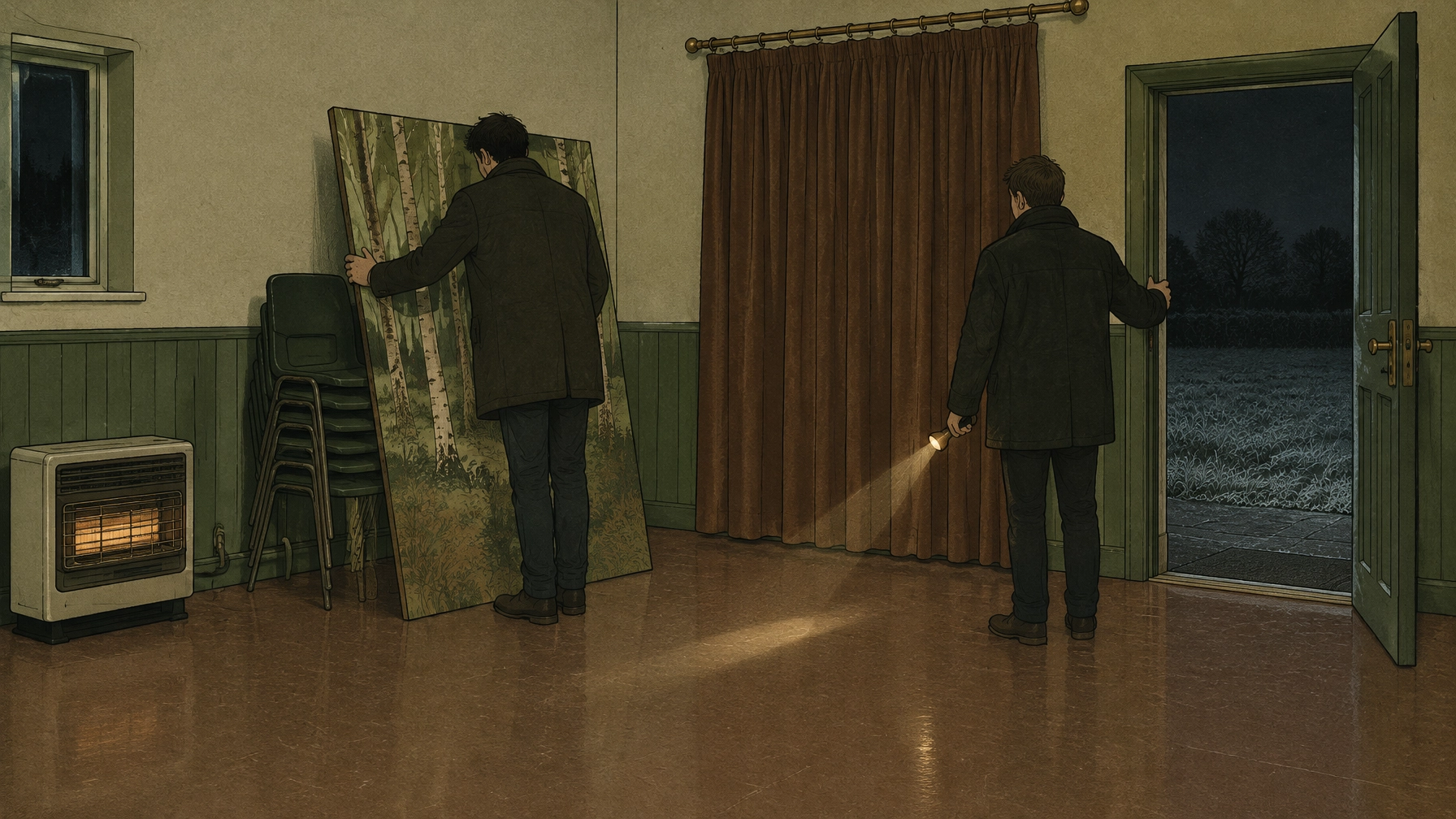
The Church Institute had a brown curtain on a brass rail, brown lino cold under thin soles, and a Calor gas heater that ticked while it gave out dry heat. The stacking chairs squeaked six at a time. Chalk dust settled into the seams of my trousers.
The panto went up in November. From the first Sunday of Advent, the hall belonged to the church. The town had to have its giant before it was allowed to sing.
Barry, the chairman, did the lights. Colin did the sound. Dean worked the follow spot. Reg was the tallest man in the society and played the giant. I was paid sixty pounds a night and a bacon sandwich. I was not a member.
They gave me a patch of floor and a list of what the scenery had to do. The wood had to stand upright, fold in two and leave the stage without taking the beanstalk with it. I measured the opening and marked the hinge line. I knew how to make a thing strong enough to last the run, and light enough to carry out after.
Six nights on the trot, then a Sunday off. I lettered a bakery in the day and came to the hall at six with the wood roped to the roof of Colin's estate car and my brushes in a bucket. By the second week the heater's tick had got into my sleep. I knew the cold of that lino through my knees before I knew any of their names.
The Drummer’s Thumb
Martin was fifty-five and a heating engineer. He played drums in the band, three men behind a net curtain at the back of the stage.
In June, I lettered the sign on his van. He watched me for four hours without speaking, then said, “You’ve got a steady hand.” I went home and could not eat.
His thumbnail was split straight down the middle from years of it. When he was about to say something that mattered, he rubbed the split with his thumb. He drummed two fingers on the steering wheel while we sat in the car park. Once, he tapped them on the back of my hand. I kept my hand where it was.
We had had five months of the hall, the car park, the back step and the dark. Neither of us had ever been inside the other’s house. I had imagined Martin’s kitchen enough times to know where I thought the kettle stood, though I had never seen it.
After a show, he took his boots off and put his socks on the mat by the van. He quartered an apple with a penknife, salted it from a twist of paper, then ate it with the engine running and the heater on. The cold vinyl of the passenger seat held the shape of my coat. He dropped the core into the door pocket.
The next show, he folded the salt paper small enough to fit beneath the handbrake. The core joined the others in the pocket. He did not offer me any apple. He never did.
Nine Hours of Forest
The last show was on Saturday. Ninety-one people sat in a hall with a hundred and ten chairs. I stood in the wing and watched Reg’s giant voice come through a microphone that whistled. A child cried in row four. The hardboard beanstalk leaned against the flats, its painted leaves catching the stage light.
The wood was two eight-by-four sheets of six-millimetre ply, hinged together. I had painted birch trunks, bracken and a low mist. I was proud of the mist. It was three layers of green-grey, laid thin enough to leave the grain beneath.
On the first night of the run the curtain had gone up on it before an actor walked on, and the hall made a noise I had not heard a hall make, a low sound that was not quite applause. I had stood in the wing and watched the front rows instead of the stage. The mist read grey from row ten and green from row two. The man in the third row leaned forward to check whether the bracken was real, and someone behind him told him to sit down.
Martin stood beside me, his shoulder against mine. He held the beanstalk steady in the dark while I kept one hand on the edge of the flat.
“Hold it,” I said.
He held it.
“Hold it. Now.”
He lowered the beanstalk as the scene changed. Nothing caught. The flat cleared the stage without catching the curtain. I counted the hours while I watched it go. Eleven days to paint. Nine hours to exist.
When the last line was spoken, the curtain fell. The audience stood. Chairs squeaked in rows as people made for the door. Martin’s fingers tapped twice against my knuckles before he went to pack his drums.
Two in the Morning, the Skip
The get-out began with screws. We took out the braces, lifted the giant’s kitchen from its marks and folded the wood flat. The beanstalk bent where the hardboard had taken a knock. The skip had been ordered for half past midnight and arrived at one.
Tea came from an urn. The drum case was zipped shut at one in the morning. Barry looked at the flats and said, “Burn it or skip it.”
I carried the wood flat out into the yard. The plywood edge cut into my palm. The cold came in where the hall door stood propped open, and the yard stones had a skin of frost.
Martin caught up with me. He put the flat of his hand on the painted branches.
“Can I have it?” he said.
“It’s only ply.”
“I know what it is. Can I have it.”
He said his front room had a chimney breast with nothing on it. He said it as he might have told me where the boiler was. I shifted my grip so the cut edge rested against my sleeve.
We loaded the flat into his van, paint side up. On the drive, frost had formed on the windscreen. Martin started the engine and switched on the heater. He quartered the apple with his penknife and shook salt from the twist of paper. Then he held one piece out to me without a word.
It was the first time.
I took it. Salt caught on my thumb.
Salt on the Apple
Martin’s house was on the Ashby road. The pebbledash was dark with frost. By the boiler sat a dog’s basket with no dog in it; the dog had been gone in March, after fifteen years.
The front room had no pictures on any wall. The chimney breast was bare. Martin and I carried the flat in and leaned it against the wall. We tried it with the mist at the bottom, then turned it over. He stood back, looked, and moved it two inches.
The kettle went on. Two mugs stood on the drainer. One was cracked and old. It had been waiting a while.
I took my boots off without being asked. My socks were wet from the yard. Martin went to check the boiler. It was cooling now, ticking in the quiet of the house.
When he came back, he turned the flat around and looked at the chalk on the back.
“What’s that grid?”
“Setting-out marks. I draw them before I paint. It keeps the letters even. For the trees, it kept the trunks where I wanted them.”
“You leave all of it on?”
“Usually. No one sees it.”
He rubbed his split thumbnail with his thumb. Then he went to the drawer by the kettle and found a pencil.
I wrote my name on the back, left to right, forwards. The letters went the wrong way for me. On glass, I wrote backwards so strangers outside could read it correctly. On the wood, my name looked like somebody else’s writing.
Martin read it once. He did not say anything about it. Then he put the pencil back in the drawer and said, “Bring your brushes Tuesday. You can finish the second coat on it.”
The paint on the lower branches was still soft. I did not know whether he had asked me to come back on Tuesday or asked me to stay until it was light. I decided not to ask.
The boiler ticked.
After the Last Shift
For readers drawn to MM romance unexpected places, a village hall and an unfinished front room can hold the quiet beginnings of a gay love story emotional journey. The small acts matter: a hand kept in place, a shared piece of apple, room made for something someone built.
That is the particular pleasure of character-driven queer fiction. It gives emotionally invested MM readers time to notice what is offered and what is still left unsaid. Readers looking for emotional MM romance literary fiction can find more stories at Read with Pride and explore the Read with Pride homepage.
Follow us on social media: Instagram, X, Facebook and Read with Pride.
#MMRomance #GayLoveStory #QueerFiction #EmotionalMMRomance #ReadWithPride #CharacterDrivenFiction #SlowBurn #GayBooks #LGBTQBooks


Leave a Reply
You must be logged in to post a comment.