

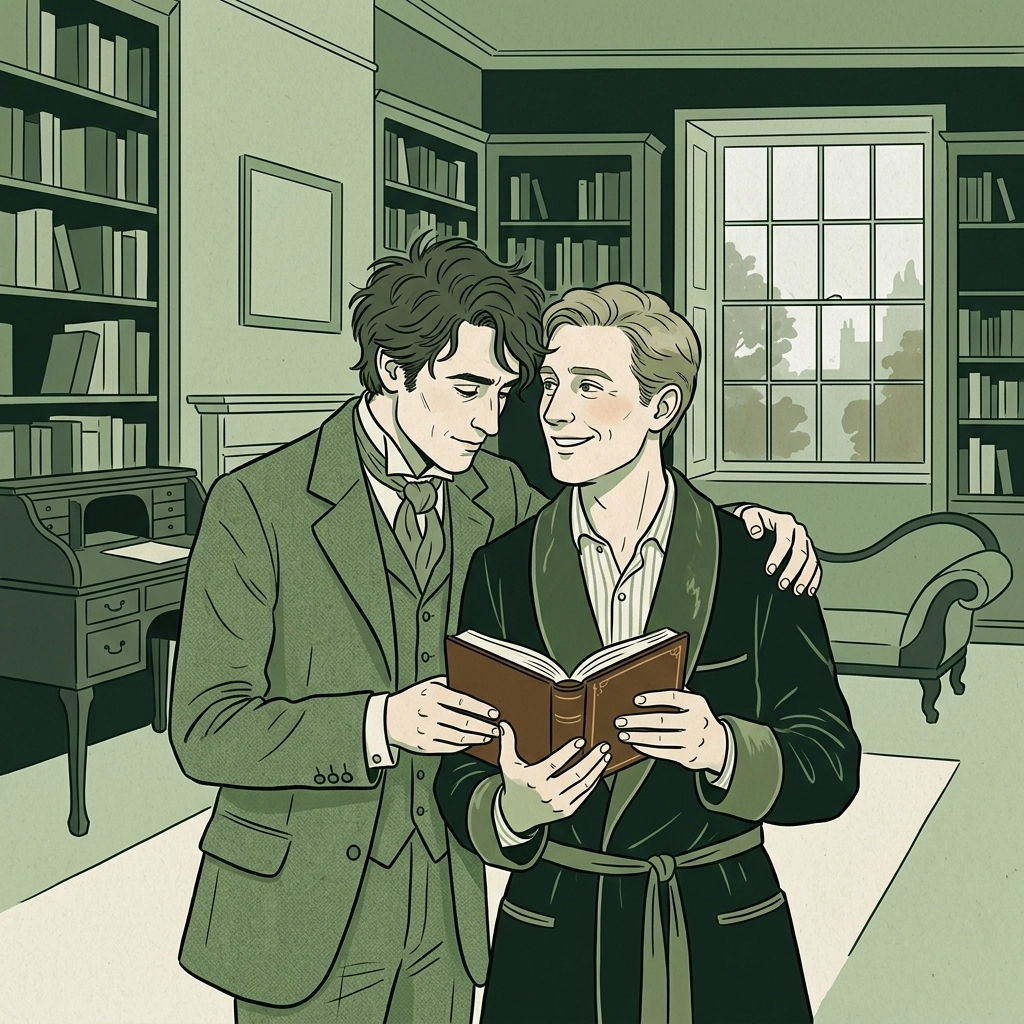
Step back with me for a moment. It is London, 1891. The air is thick with a yellow-grey fog that clings to the brickwork of Soho, smelling of coal smoke and the Thames. The gaslights flicker, casting long, dancing shadows across the cobblestones of Regent Street. In this world of stiff collars and even stiffer social codes, a secret pulse beats beneath the surface. This is the era of the Decadents, the Aesthetes, and the men who lived in the shimmering, dangerous margins of "the love that dare not speak its name."
When we think of the 1890s, our minds immediately fly to Oscar Wilde. And how could they not? He was the sun around which the queer world of London orbited, flamboyant, brilliant, and ultimately tragic. But beyond the gilded wit of the drawing rooms, there was a whole universe of gay historical romance and real-life struggle that shaped the LGBTQ+ experience as we know it today.
The Gaslit Glamour of Soho
Soho in the 1890s wasn’t just a district; it was a sanctuary. While the rest of London obsessed over Victorian morality, Soho’s labyrinthine streets offered a different kind of freedom. This was the heart of "Bohemia." If you were a man seeking the company of other men, you knew the rhythm of the streets. You knew which pubs had a back room and which cafes turned a blind eye to two men lingering too long over a single bottle of wine.
The crown jewel of this world was the Cafe Royal. It was here that Wilde famously held court, surrounded by his "panthers", the young, working-class men he adored, and his peers in the arts. To walk into the Cafe Royal was to enter a space where the rules of the outside world felt pleasantly blurry. It was a place of red velvet, gold leaf, and high-stakes flirtation.

In this atmosphere, the concept of the "Dandy" wasn't just about fashion; it was a political statement. By wearing a green carnation in his lapel, a flower that does not occur in nature, a man was signaling his allegiance to the artificial, the beautiful, and the unconventional. It was a coded language, a way of saying "I see you" in a world that demanded invisibility.
Oscar and Bosie: A Love That Defined an Era
The 1890s cannot be discussed without the intense, agonizingly beautiful, and ultimately ruinous relationship between Oscar Wilde and Lord Alfred "Bosie" Douglas. When they met in 1891, it sparked a connection that was both a muse-like inspiration and a descent into chaos.
Wilde, with his established fame and family, was captivated by Bosie’s youth, his petulance, and his aristocratic rebellion. Their love was lived out in expensive hotel rooms, in the sun-drenched alleys of Algiers, and in the very public dining rooms of London. It was a gay love story of epic proportions, filled with the kind of high-stakes drama we often seek in our favorite MM romance novels.
But their passion was framed by the looming shadow of the Marquess of Queensberry, Bosie’s father. The 1895 trials, sparked by a simple calling card and a public insult, didn't just end Wilde’s career; they sent a shockwave through the entire queer community. It was a reminder that for all the progress of the "Gay Nineties," the law remained a brutal instrument of suppression.
The Secret Intellectuals: Carpenter and Symonds
While Wilde was the public face of the era, other men were doing the quiet, revolutionary work of defining what it meant to be queer. People like Edward Carpenter and John Addington Symonds were looking toward a future where "Uranian" love, as it was often called then, could be understood as a natural, noble state.
Carpenter, living in his cottage in Derbyshire, advocated for a simpler, more honest way of living. He spoke of the "Intermediate Sex" and envisioned a world where men could love each other across class lines without shame. Symonds, meanwhile, delved into the history of Ancient Greece to provide a scholarly foundation for male-male relationships.
These men weren't just writing theories; they were living their truths in a time when doing so could lead to the gallows or the prison cell. They were the pioneers of the gay fiction and literature we celebrate today, laying the groundwork for the emotional depth we find in modern stories like Announcing The King of Spades and Broken Roses, where the weight of history meets the heat of personal passion.

The Life of the Ordinary "Invert"
We often focus on the famous names, but what about the clerk in the City? Or the soldier in the barracks? Or the footman in a grand house? For these men, the 1890s were a time of careful navigation.
They used "Polari", a secret slang that would evolve over decades, to communicate. They met in the dark corners of St. James’s Park or in the "molly houses" that still persisted in various forms. Their lives were a constant negotiation between the private self and the public mask.
There is a haunting beauty in these hidden lives. Imagine two men sharing a quiet moment in a rented room, the only light coming from the fireplace, knowing that their connection is the most honest thing in a city built on artifice. It is this specific blend of longing and resilience that fuels the best gay historical romance.
Why the 1890s Still Matter
The 1890s were a "hinge" decade. It was the end of the Victorian era and the dawn of the modern world. The trials of Oscar Wilde forced the public to acknowledge that queer people existed, even if that acknowledgment was through the lens of condemnation.
For those of us who love gay literature and MM novels, this era is a wellspring of inspiration. It teaches us about the cost of authenticity and the enduring power of love. When you read a story like Dust and Bone, you are seeing the legacy of that historical struggle, the search for connection in a world that isn't always ready to receive it.
At eBooks by Dick Ferguson, we believe in telling these stories with the lyrical weight they deserve. Whether it’s a journey through the past or a reflection on the present, our goal is to provide LGBTQ+ fiction that resonates with the soul.

If you find yourself wandering through the streets of London today, especially in the winding alleys of Soho, take a moment to listen. Beneath the noise of the modern city, you might just hear the faint echo of a witty remark, the rustle of a velvet coat, and the quiet heartbeat of a community that refused to be extinguished.
To find your next great read, visit our store at https://readwithpride.com/e-book-store/dickfergusonwriter/. Whether you're looking for the high stakes of a gay thriller or the gentle beauty of Blossoms and Reflections, we have something for every reader who wants to Read with Pride.
Follow us on social media:
- Instagram: https://www.instagram.com/dickfergusonwriter
- X (Twitter): https://www.x.com/DickFergus94902
- Facebook: https://www.facebook.com/profile.php?id=61572869844598
- Website: www.readwithpride.com
#ReadWithPride #LGBTQBooks #MMRomance #OscarWilde #GayHistory #SohoLondon #GayHistoricalRomance #QueerFiction #DickFerguson #HistoricalGayFiction #MMBooks
Hey Dick! Here are your three blog post options for tomorrow:
- "The Hidden Language of Polari: How Gay Men Spoke in Secret" – A deep dive into the fascinating slang used by the queer community to stay safe and connected.
- "From Enemies to Lovers: Why the Grumpy/Sunshine Trope Rules MM Romance" – A fun, engaging look at one of the most popular tropes in the genre and why we can't get enough of it.
- "Queer Architecture: How Spaces Shape Our Stories" – Exploring how physical locations, from secret gardens to urban lofts, influence the mood and plot of gay fiction.
Which one should I start on? 😊

Leave a Reply
You must be logged in to post a comment.