

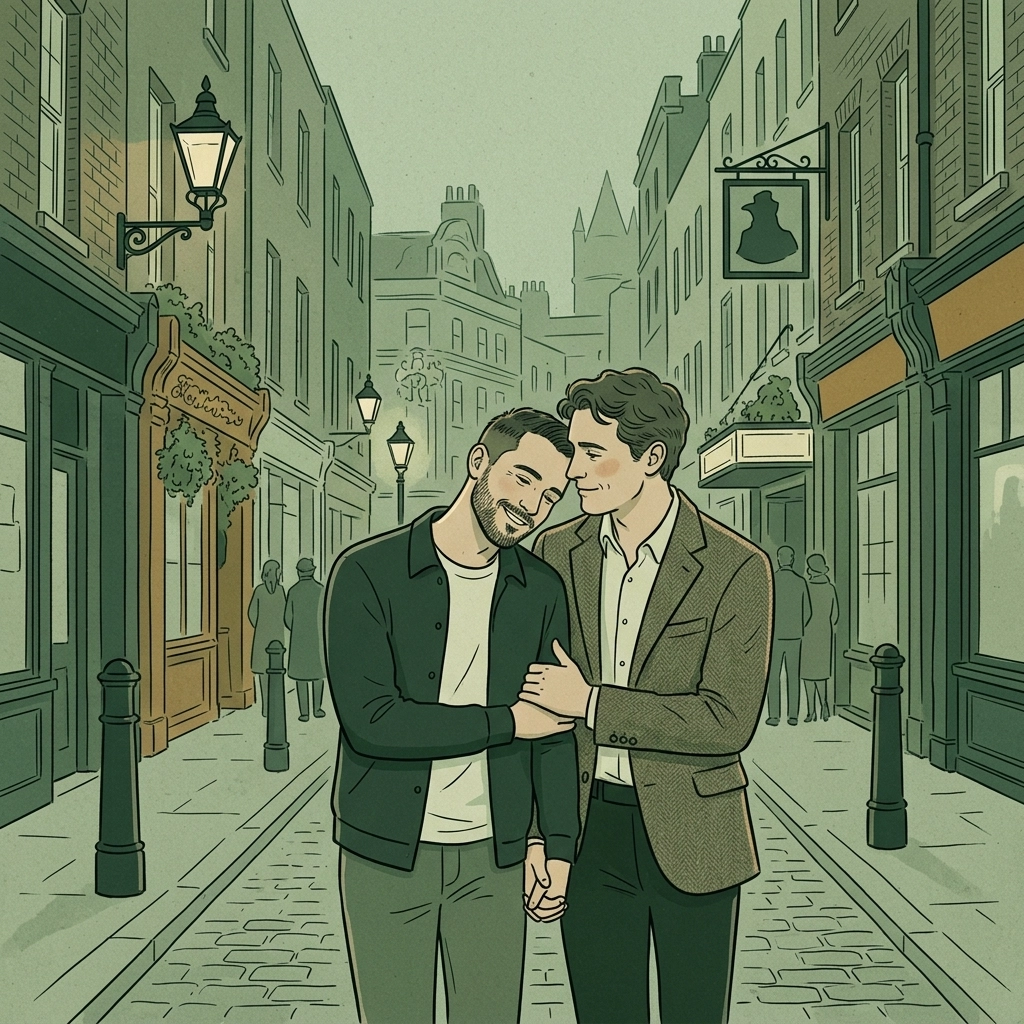
London has a way of breathing through its bricks. If you stand on the corner of Old Compton Street just as the sun dips below the horizon, and you quiet the roar of the modern city, you can almost hear the echoes of a thousand whispered secrets. This isn’t the history they taught us in school. Traditional textbooks are often sterilized, stripped of the sweat, the longing, and the defiant joy that has pulsed through Soho for centuries.
To understand Soho is to understand the heartbeat of the emotionally invested reader. It is a place built on the courage of men who loved in the shadows until they could finally step into the light. At eBooks by Dick Ferguson, we believe every story: especially the ones once considered "forbidden": deserves to be told with the weight and beauty it carries.
The Ghostly Cruising Grounds of the 1700s
Long before the neon signs of G-A-Y or the rainbow flags draped over the balconies of the Admiral Duncan, Soho was a place of clandestine meetings. In the 1600s and 1700s, when a single glance could lead to the gallows, men found ways to find one another. These weren't just "encounters"; they were acts of survival.
The "Molly Houses" of the era were more than just hidden rooms; they were sanctuaries. Imagine the scent of cheap gin and powdered wigs, the sound of men using "female" names: not out of mockery, but as a way to build a sisterhood of protection. These men were the architects of a culture that refused to be extinguished. They lived under the constant threat of the "blackmailing" gangs and the law, yet they danced. They found love in the dark corners of a city that wanted them gone.

Oscar Wilde: More Than Just a Trial
We all know the tragedy of Oscar Wilde. We know the trial, the disgrace, and the prison cell. But traditional textbooks often skip the sensory reality of his life in Soho. He wasn't just a figurehead; he was a man who lived with a fierce, hungry intensity.
Think of Kettner’s on Romilly Street. Picture Oscar, his velvet coat catching the candlelight, as he leaned in to whisper to a waiter. It wasn't just about the wit; it was about the electricity of a man living his truth in a world of stifling Victorian morality. These moments: the stolen kisses in the pantry, the long dinners at the Savoy that bled into nights of unapologetic passion: are the foundations of what we now cherish in gay historical romance. They remind us that the internal struggle of the MM romance hero isn't a modern invention; it’s an ancestral inheritance.
The Cave of the Golden Calf: A Wriggle into Freedom
By 1913, Soho birthed something radical: The Cave of the Golden Calf on Heddon Street. This was the world’s first "gay bar" in the modern sense, though it wouldn't have used that label. It was a place of "gaiety," a subterranean world where the rules of the surface didn't apply.
The police reports from 1934 are unintentionally poetic. They describe men and women "wriggling" together, bodies pressed tight in defiance of "decency." For the men who frequented the Cave, those hours underground were the only time they felt truly human. They weren't "perverts" or "criminals" there; they were lovers, poets, and friends. When we read heartfelt gay fiction today, we are touching the hem of the garment those men wore as they danced into the early hours of the morning.

The Shim Sham Club: Where Jazz Met Justice
In the mid-1930s, Soho became the site of a beautiful, messy intersectionality. The Shim Sham Club was known as "London’s miniature Harlem." It was a Black jazz venue that doubled as a queer sanctuary. In a time of rising fascism and strict racial divides, the Shim Sham was a middle finger to the status quo.
Imagine the heat of that room: the smell of tobacco smoke and expensive perfume, the thrum of a double bass vibrating in your chest. It was a place where a Black man and a white man could share a table, a drink, and a look that meant everything. The police, of course, called it a "rendezvous for perverts," but for those inside, it was a glimpse of a future where love didn't care about the color of your skin or the gender of your partner. This is the kind of emotional MM books material that stays with you: the high-angst reality of a world that fears your joy.
The Unlikely Guardians: Mafia and the Shadows
One of Soho's best-kept secrets is that its "safety" was often bought with blood and greed. After World War II, when the rest of London was still heavily policed for "indecency," Soho became a de facto safe haven because it was run by the mafia. Jewish, Albanian, and Chinese gangs controlled the clubs and the streets.
The police often stayed away to avoid gang wars, or their pockets were lined deep enough to look the other way. In this grey area of criminality, queer men found a strange, precarious freedom. They were protected by the very people the rest of society feared. It’s a paradox that makes for incredible gay thriller and gay psychological thriller narratives: the idea that sanctuary can be found in the mouth of the beast.
The Resilience of the Heart
Soho has survived everything. It survived the 1854 cholera outbreak, the Blitz, the 1999 Admiral Duncan bombing, and the creeping tide of gentrification. Every time they try to scrub Soho clean, the ghosts of the past push back.
The Admiral Duncan isn't just a pub; it’s a monument to resilience. When a bomb tore through its walls in 1999, it was meant to silence a community. Instead, it fused that community together with a strength that could never be broken. This is why we read MM novels and queer fiction. We don't just want a "happily ever after"; we want to see characters who fight through the bone-deep struggle to earn their peace.

Why We Write the Secrets
At eBooks by Dick Ferguson, we are obsessed with these hidden layers. When I write my MM romance books, I’m not just thinking about a plot; I’m thinking about the sensory details of a man’s internal world. I’m thinking about the way his hand might tremble as he reaches for another man in a Soho alleyway in 1954, or the way his heart might soar when he realizes he no longer has to hide.
Our collection of LGBTQ+ ebooks is designed for the reader who wants to feel the pulse of history and the ache of the human heart. Whether you are looking for gay historical romance, MM contemporary stories, or gay fantasy romance, you are looking for a piece of that Soho spirit: the spirit that says we are here, we have always been here, and we will never be forgotten.
If you’re looking to lose yourself in stories that honor this legacy, I invite you to explore our library. There are no simplified versions here: only the raw, beautiful truth of what it means to love with pride.
Experience the depth of MM Romance here: https://readwithpride.com/e-book-store/dickfergusonwriter/
Soho is more than a district. It is a testament. Next time you walk those streets, remember the men who came before you. Remember their laughter, their fear, and their magnificent, enduring love.
#ReadingWithPride #SohoHistory #MMRomance #GayLiterature #QueerHistory #DickFerguson #ReadWithPride #LGBTQFiction #GayBooks2026
Follow us on social media for more stories and updates:
- Instagram: https://www.instagram.com/dickfergusonwriter
- X (Twitter): https://www.x.com/DickFergus94902
- Facebook: https://www.facebook.com/profile.php?id=61572869844598
- Website: www.readwithpride.com
Dick’s Daily Blog Post Options:
- The Architecture of Longing: How the hidden tunnels of old London served as the ultimate backdrop for clandestine MM romance.
- Beyond the Ballroom: A deep dive into the "Rough Trade" culture of the 1920s and its influence on modern gay psychological thrillers.
- The Scent of Lavender and Tobacco: Exploring the sensory triggers that bring historical MM romance to life for the emotionally invested reader.

Leave a Reply
You must be logged in to post a comment.