

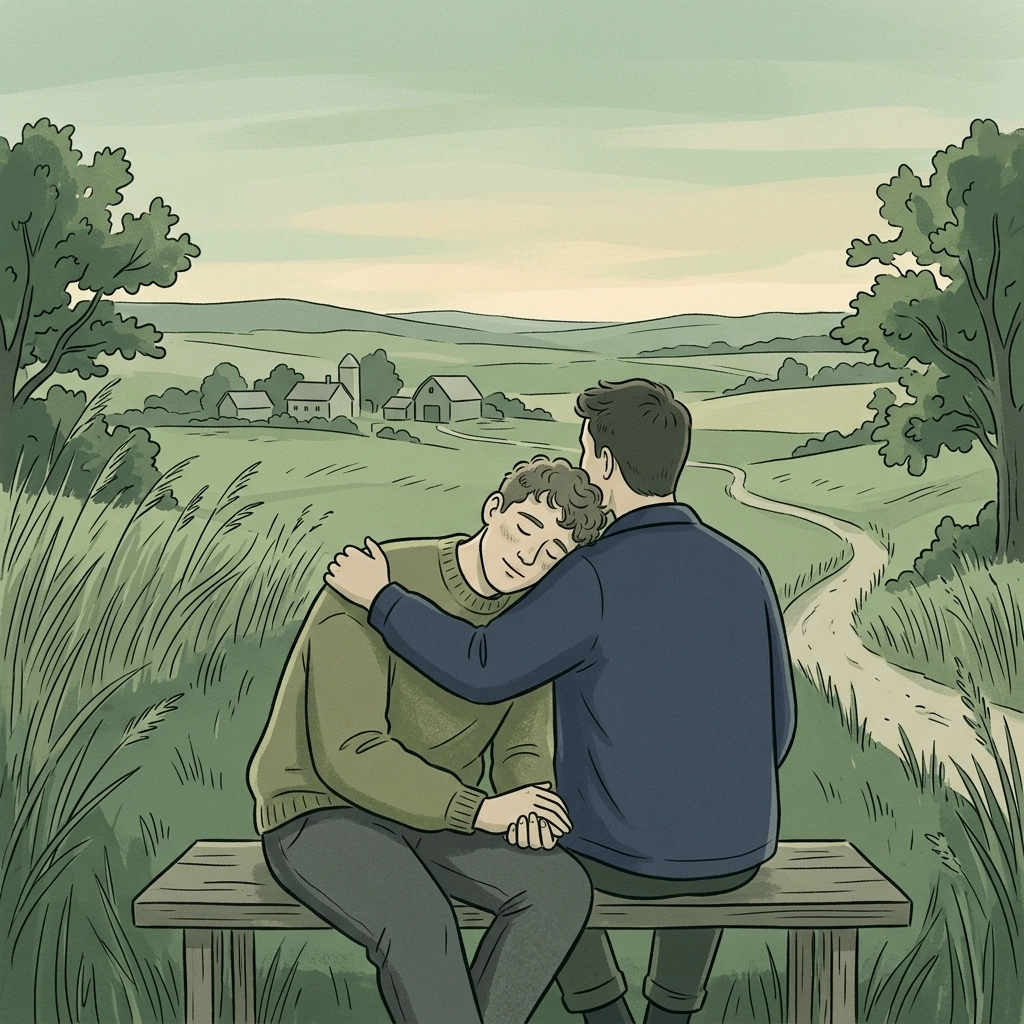
The city is a serrated edge. It carves its initials into your skin with every siren that wails at 3:00 AM, every fluorescent flicker of a subway terminal, and the relentless hum of millions of souls all trying to be heard over one another. We call it "grit." We wear it like a badge of honor: the exhaustion, the soot on our collars, the way our hearts beat in time with the frantic rhythm of a crosswalk signal.
But for many of us in the LGBTQ+ community, the city is more than just a place to work; it’s been our sanctuary. For decades, the urban landscape was the only place we could find our reflection in the windows of a crowded bar or the eyes of a stranger. We traded the quiet, often suffocating judgment of small towns for the loud, vibrant safety of the sprawl.
But what happens when the sanctuary starts to feel like a cage? What happens when the noise that once felt like a celebration becomes a barrier to the sound of your own soul: and the soul of the man standing right beside you?
The Skin of the City
I remember Silas. He was a creature of the pavement, a man whose very essence seemed woven from fiber-optic cables and double-shot espressos. We lived in a loft where the windows vibrated every time the midnight freight train rolled through the industrial district. He loved the grit. He loved the way the city never asked him to be still, because in stillness, Silas had to face the ghosts he’d brought with him from a childhood spent hiding in the shadows of a rural church.
In the city, you can outrun yourself. There is always a new gallery opening, a louder club, a more demanding deadline. But I watched him thinning out. I saw the way his eyes darted even when we were lying in bed, his nervous system tuned to a frequency of perpetual "alert." We were two men in love, living in the heart of the world, yet we were becoming ghosts to each other, our conversations reduced to logistics and the shared exhaustion of surviving the rush.
The urban grit doesn't just settle on your skin; it settles in your marrow. It creates a "low-grade fever" of the spirit. And for Silas and me, the cure wasn't another vacation to a different city. It was the terrifying, expansive void of the rural still.

The Journey to the Borderlands
We took a week. No phones, no deadlines, just a rented cabin on the edge of a loch where the only "network" was the root system of the ancient oaks.
The shift from urban grit to rural stillness is not a gentle slope; it’s a cliff. The first twenty-four hours are the hardest. When the noise stops, the internal volume spikes. Without the roar of traffic to drown them out, Silas’s anxieties became deafening. I watched him pace the wooden floorboards, his thumb twitching for a scroll wheel that wasn't there.
"It’s too quiet," he whispered that first night. "It feels like the world ended and we’re the only ones left."
That is the fear, isn't it? That in the silence, we are alone. But as an author of MM romance and queer fiction, I’ve learned that the most profound love stories don't happen in the shouting; they happen in the breath between words.
Why the Stillness Heals
Rural stillness heals because it demands presence. In the city, your attention is a commodity, pulled in a thousand directions. In the woods, or by the sea, or in the hollow of a mountain, your attention is returned to you. It is a gift you finally get to unwrap.
For the emotionally invested reader, this transition is a classic trope for a reason. It is the "forced proximity" not just with a partner, but with the self.
1. The Decompression of the Nervous System
Scientifically, we know that natural environments lower cortisol. But emotionally, it’s about the "unclenching." I saw it in the way Silas’s shoulders finally dropped an inch on the third day. He stopped looking for a clock. He started looking at the way the light hit the water. In the quiet, your body remembers it is a part of the earth, not a cog in a machine.
2. The End of Performance
In urban spaces, especially as gay men, we are often "on." We perform our identities, our successes, our resilience. The rural still doesn't care who you are. The trees don't demand a "brand." This allows the internal struggle: the "who am I when no one is watching": to finally surface. For Silas, it meant admitting he was tired. Not "I need a nap" tired, but "my soul is weary of the fight" tired.
3. Sensory Reawakening
Urban grit numbs the senses. You learn to smell only what you must and see only what is relevant. In the stillness, the sensory details are vivid. The scent of damp pine. The cold, sharp bite of the morning air. The sound of a man’s heartbeat when you lay your head on his chest in a room where the only other sound is the crackle of a woodstove. These are the details that build heartfelt gay fiction.

Finding Each Other in the Quiet
By the fifth day, the transformation was complete. We walked a trail that wound through a valley of ferns, and for the first time in years, we didn't talk about work or the news. We talked about the things we’d forgotten. Silas told me about a dream he’d had of painting again. I told him about the fear I had that I was losing my edge.
In the city, we were a "power couple." In the stillness, we were just two men, vulnerable and raw, holding hands in the middle of a vast green silence. This is why the shift matters. It strips away the armor of the grit and leaves the heart exposed. And an exposed heart is the only kind that can truly heal.
This is the essence of what I strive to capture in my gay love stories. Whether it’s the high-stakes tension of a gay psychological thriller or the slow burn of a contemporary MM romance, the setting is a character. The move from the "grind" to the "green" is a pilgrimage to the center of the self.
Bringing the Stillness Home
We eventually had to return to the brick and mortar. We had to put our shoes back on and face the sirens. But we brought a piece of the rural still back with us. We learned that silence isn't a void; it’s a reservoir.
If you’re feeling the weight of the world, if the urban grit has turned into a crust around your heart, I invite you to seek the silence. You don’t need a week in a cabin; sometimes, you just need an hour in a park with your phone turned off, or a book that transports you to a place where the soul can breathe.
My stories are written for those who feel deeply, for the readers who find beauty in the angst and the eventual peace. They are about men who fight through the noise to find each other. If you’re looking for your next journey into the heart, explore the collection.
You can find my full library of LGBTQ+ ebooks and gay novels at our store. Let these stories be your sanctuary.
Explore the stories here: https://readwithpride.com/e-book-store/dickfergusonwriter/

Deepen Your Connection
The world is loud, but your heart doesn't have to be. Whether you are navigating the complexities of a man/man relationship or seeking your own path toward healing, remember that silence matters. It is the canvas upon which we draw our most honest lives.
If you enjoyed this reflection on the healing power of the rural still, you might find resonance in my more personal works. I invite you to read more about the journeys of the heart in my latest releases.
Check out these related reads:
- Discover the raw emotion of Dust and Bone
- Go behind the scenes of my most personal romance: The King of Spades and Broken Roses
- Experience the beauty of a different kind of quiet in Blossoms and Reflections
Stay quiet, stay proud, and keep reading.
: Penny (on behalf of Dick Ferguson)
Follow us on social media for more reflections, book news, and queer literature:
- Instagram: https://www.instagram.com/dickfergusonwriter
- X (Twitter): https://www.x.com/DickFergus94902
- Facebook: https://www.facebook.com/profile.php?id=61572869844598
- Website: www.readwithpride.com
#MMRomance #GayFiction #ReadWithPride #LGBTQBooks #SilentRetreat #GayLoveStories #UrbanVsRural #EmotionalHealing #DickFerguson #QueerLiterature #MMNovels
Proactive Blog Suggestions for Dick Ferguson:
- "The Language of the Unspoken: Why Subtext is the Heartbeat of Great MM Romance" – A deep dive into how what isn't said between two men can be more powerful than any dialogue, focusing on character depth and internal tension.
- "Beyond the Rainbow: The Importance of Historical Accuracy in Gay Historical Romance" – Exploring the hidden lives of queer men in the past and how rural settings provided a different kind of freedom than the burgeoning cities of the 19th century.
- "The Architecture of Loneliness: Why Readers Crave High-Angst Gay Psychological Thrillers" – Analyzing the psychological pull of isolation and "urban grit" in the thriller genre, and how it mirrors the internal struggles of the LGBTQ+ experience.

Leave a Reply
You must be logged in to post a comment.