


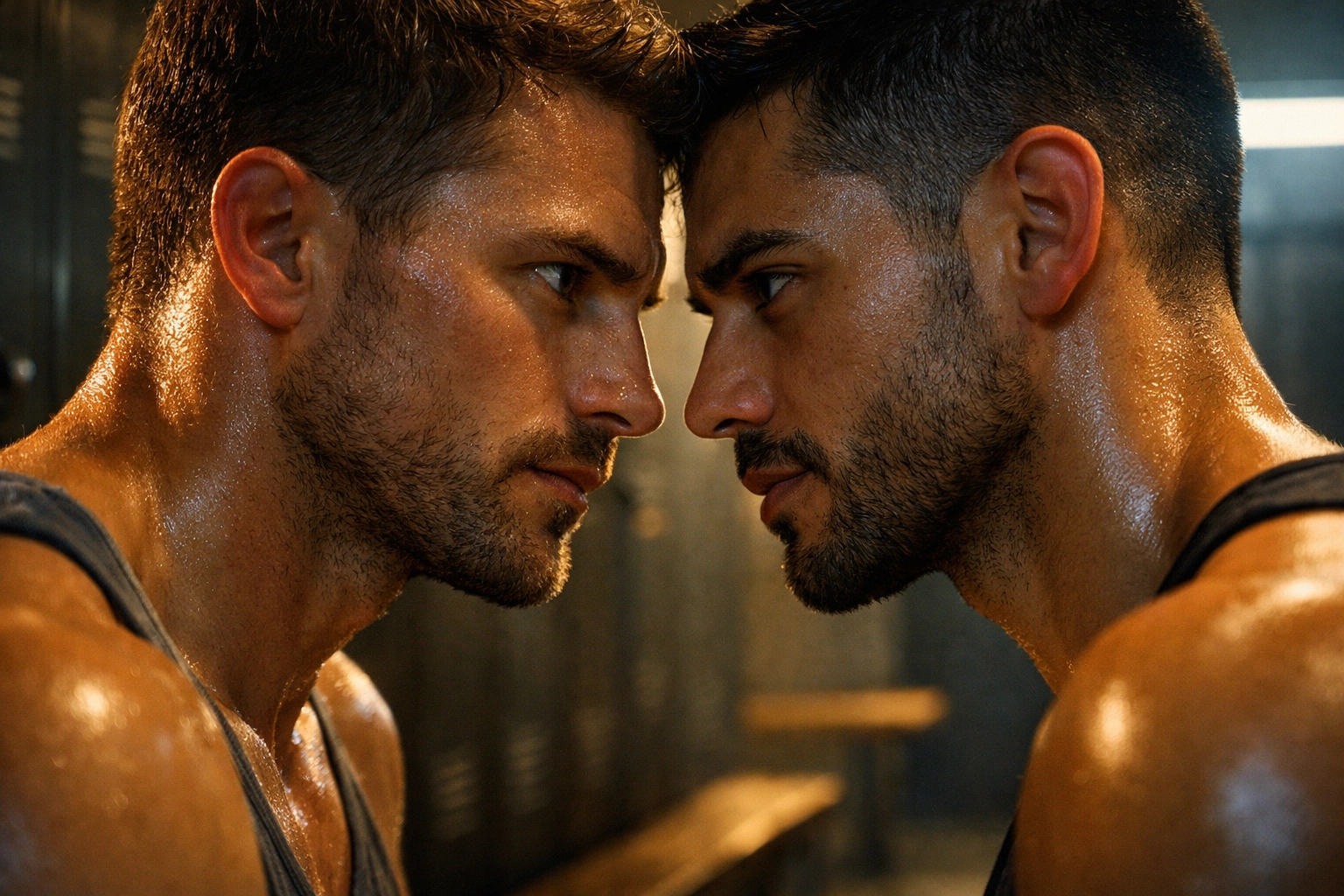
You know that moment. That split-second when eyes meet across a steamy locker room, and suddenly the world gets a little quieter, a little more electric. It's not about being creepy or predatory, it's about that instant recognition, that silent conversation that happens in the space between two glances. Welcome to story 16 of The Locker Room Chronicles, where we're diving into one of the most thrilling, nerve-wracking, and absolutely human experiences: the shared gaze.
The Science of the Look
Before we get into the juicy stuff, let's talk about what's actually happening in your brain when you lock eyes with someone. Research shows that mutual gaze creates something profound, it's not just visual, it's emotional. When two people look directly at each other, they engage in what scientists call "synchronized attention," and it literally modulates empathy. Your pupils might even synchronize with theirs, marking moments of shared attention.
Here's the thing: being the target of another person's attention is affectively stimulating. Translation? It gets your heart racing. People typically feel comfortable with eye contact lasting around 3.3 seconds, but in that brief window, you're evaluating likability, attractiveness, intelligence, basically running an entire background check with your eyeballs.

The Locker Room Context
Now take all that science and drop it into a gay locker room. Suddenly, those 3.3 seconds carry a whole different weight. You're in a semi-public space, navigating the unspoken rules of where to look and where not to look, and then, boom, someone meets your gaze and holds it just a fraction longer than necessary.
It's not the quick darting glance of someone checking out the scene. It's not the accidental eye contact followed by immediate aversion. This is different. This is the knowing glance. The one that says, "I see you seeing me, and I'm not looking away."
The thrill comes from the risk. In a space where heteronormative rules still often apply, where men are supposed to keep their eyes forward, maintain their bubble, act like statues, a shared gaze becomes an act of visibility. Of courage. Of "yeah, I'm queer and I noticed you noticing me."
The Art of the Knowing Look
There's an art to this, honestly. It's not about staring someone down or making them uncomfortable. It's about that brief, electric connection that acknowledges something shared. Maybe it's attraction. Maybe it's just recognition, a silent "hey, fellow traveler" across a crowded changing room.
The best shared gazes have layers. The first layer: initial eye contact. No big deal, happens all the time. The second layer: the return glance. Okay, now we're talking. The third layer: the slight smile, the raised eyebrow, the tiny nod that says, "Yeah, this is happening."

And then? Then you both go about your business, but the energy in the room has shifted. You're aware of each other now in a way you weren't before. When you're grabbing your towel, you know where he is. When he's heading to the showers, you feel it. It's not creepy, it's connection. It's the thrill of being seen and seeing in return.
When Eyes Speak Louder Than Words
The beauty of the shared gaze is how much communication happens without a single word. Eye contact creates a sophisticated channel of information. In regular conversation, people engage in mutual facial gaze about 60% of the time, but in the locker room, when verbal communication is minimal, those glances carry even more weight.
Research shows that direct eye contact predicts subsequent gaze-following, pairs who looked into each other's eyes were more likely to follow their partner's gaze afterward. In the locker room context, this might mean you catch his eye, he glances toward the exit, you follow. Suddenly you're both heading to the parking lot without ever having exchanged a word. Magic? No. Just the power of synchronized attention.
The Different Types of Shared Glances
Not all glances are created equal. Let's break down the taxonomy:
The Appreciative Glance: Pure aesthetic appreciation. No agenda, just "damn, you look good." Usually followed by a respectful smile and a return to whatever you were doing.
The Curious Glance: The "are you…?" glance. Trying to read someone's energy, figure out if they're family. Usually accompanied by subtle gaydar pings, noting the pride bracelet, the rainbow gym bag strap, the way someone carries themselves.
The Interested Glance: Now we're getting somewhere. This one lingers just a beat longer. There's heat in it, possibility. This glance says, "I'd like to know more."
The Invitation Glance: The boldest of all. This one includes a smile, maybe a subtle head tilt. It's an opening, a "your move" kind of look.
Navigating the Tension
Here's where it gets real: the locker room is a charged space. It's both deeply personal (you're literally naked or nearly naked) and completely public (there are other people everywhere). The shared gaze exists in this tension, this push-pull between private desire and public propriety.
The thrill partly comes from that tension. You're not supposed to look too long. You're not supposed to acknowledge attraction in a space that's theoretically non-sexual. But queerness has always existed in the spaces between rules, and the locker room is no exception.
The key is respect. A shared gaze should feel exciting for both parties. If someone doesn't return your look, if they avert their eyes or shift their body language to close off, that's your answer. Move on. The thrill is in the mutual recognition, not in making someone uncomfortable.
The Aftermath
What happens after the shared gaze is almost as thrilling as the moment itself. Sometimes it's nothing, just a nice moment of connection before you both go your separate ways. Sometimes it leads to a casual "hey" in the parking lot. Sometimes, if you're lucky and brave, it leads to an actual conversation, a phone number, a first date.
But even when it leads nowhere, there's something special about those moments of recognition. In a world where being queer still sometimes means being invisible, a shared knowing glance is a form of being seen. It's validation. It's "you're not alone" and "I recognize you" and "yeah, we're here" all rolled into three seconds of eye contact.
The Community Aspect
These moments of shared gaze actually do something bigger than just create individual thrills: they create community. Research shows that jointly attending to shared experiences with another person increases ratings on social bonding scales. Even without shared goals, just the act of synchronized attention creates connection.
In the context of gay locker room culture, these tiny moments of recognition add up. They transform what could be isolating spaces into places of potential community. Each shared glance is a small thread in the larger fabric of queer visibility and connection.

Reading the Room
Of course, timing and context matter. A shared glance at 2 PM on a Tuesday when the gym is mostly empty hits different than the same glance during peak hours when the locker room is packed. You learn to read the room, to gauge when a moment of connection is possible and when discretion is the better part of valor.
Some locker rooms have a different vibe: more open, more relaxed. Others feel more buttoned-up, more straight-identified. Part of the art is knowing where you are and what the energy allows. The thrill increases when you successfully navigate these unspoken rules, when you manage to create a moment of connection even in less welcoming spaces.
Celebrating the Small Moments
Look, we're not all living in some sexy romance novel where every locker room encounter leads to passionate encounters and happily-ever-afters. Most shared glances lead exactly nowhere: and that's okay. The point isn't the outcome. The point is the moment itself.
In a culture that still has complicated relationships with queer desire, with male intimacy, with bodies and attraction and all of it: these small moments of recognition matter. They're acts of visibility. They're practice in being brave. They're reminders that we're not alone.
So next time you're in the locker room and you catch someone's eye and they hold your gaze just a second longer than necessary: enjoy it. Feel the thrill. Let yourself be seen and see in return. It's one of the oldest, most human forms of connection, and in the context of queer culture, it's also an act of courage.
Just a glance. That's all it takes to transform an ordinary Tuesday at the gym into something electric, something memorable, something that reminds you why being part of this community is so damn special.
Explore more authentic LGBTQ+ stories and MM romance books at Read with Pride. Because every moment of connection deserves to be celebrated.
Follow us:
#ReadWithPride #MMRomance #GayRomance #LGBTQFiction #LockerRoomChronicles #QueerStories #GayFiction #MLMRomance #QueerVisibility #LGBTQCommunity #GayRomanceBooks #MMLoveStories #QueerConnection #2026GayBooks #LockerRoomCulture


Leave a Reply
You must be logged in to post a comment.