

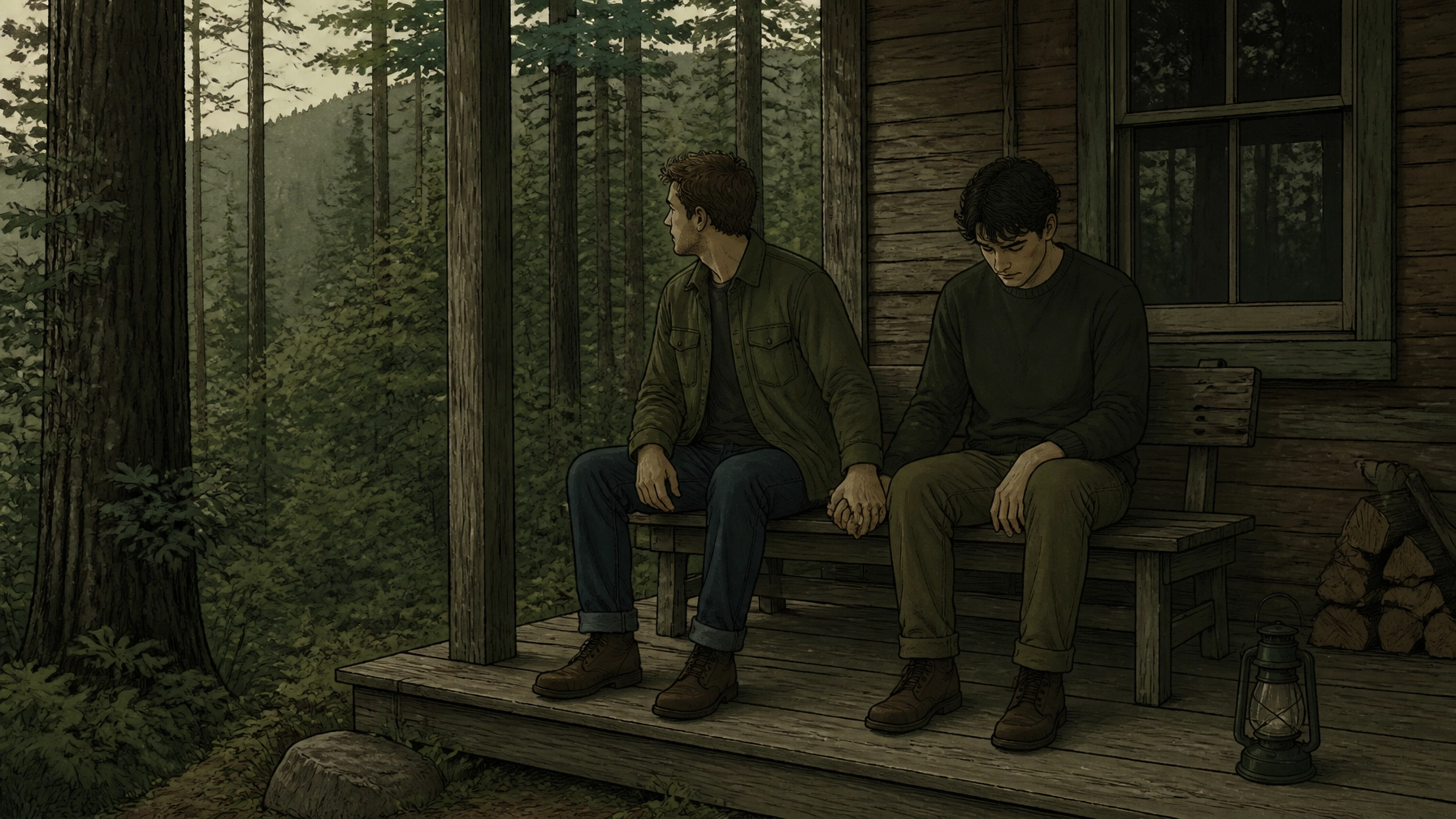
There is a specific kind of silence that only exists in the deep woods, miles away from the neon pulse of the city. In the city, silence is a vacuum, a space soon to be filled by a siren’s wail or the low thrum of a neighbor’s television. But in the rural quiet of a lakeside cabin, silence is a mirror. It doesn’t just wait; it reflects. It shows you the jagged edges of your own thoughts, the ones you usually drown out with the grit and clatter of urban life.
For many of us navigating the complex waters of MM romance and real-world queer relationships, we carry that city noise inside us. We use it as a shield. We convince ourselves that as long as we are moving, as long as we are loud or "strong," we are safe. But true connection, the kind that makes queer fiction feel like home and gay novels resonate in our marrow, requires us to step into that rural silence. It requires emotional vulnerability.
Yet, even when we want to open up, we often stumble. We make mistakes not out of malice, but out of a misplaced desire for self-preservation. If you find yourself reaching for your partner only to find a wall of glass between you, you might be making one of these seven mistakes. Here is how we fix them, together.
1. Mistake: The Fortress of Stoicism
We were raised on a diet of "strength" that looks like a granite statue. We think that to be a man, especially a gay or bisexual man who has had to fight for his place in the world, means never showing a crack. We handle our burdens alone, thinking we are sparing our partners the weight. In reality, we are just building a fortress that they can’t get into.
How to Fix It: Redefine strength. True courage isn't the absence of fear; it’s the willingness to say, "I am afraid." Start small. You don’t have to excavate your entire past in one night. Share a minor stressor, a difficult day at the office, a fleeting insecurity. When you share the small things, you're practicing for the big ones. You're telling your partner, "I trust you with the real me."
2. Mistake: The Ghosting in the Room
Have you ever been in the middle of a difficult conversation and felt yourself simply… drift away? You’re still standing in the kitchen, but your mind has retreated behind a fog. You go silent. You scroll through your phone. You withdraw. This "emotional ghosting" is often a defense mechanism against feeling overwhelmed, but to your partner, it feels like a door slamming in their face.
How to Fix It: Narrate your exit. If you feel the fog rolling in, don't just disappear. Say, "I’m feeling overwhelmed right now, and I’m starting to shut down. I need fifteen minutes to breathe, but I promise I’m coming back to finish this." This turns a rejection into a request for space, keeping the connection alive even while you’re apart.
3. Mistake: The Anger Mask
In the world of heartfelt gay fiction, we often see characters who lash out when they are actually hurting. In our own lives, anger is often the only "acceptable" emotion we feel allowed to express. It’s a secondary emotion, a jagged mask worn by a softer, more fragile feeling like shame, rejection, or grief. When we lead with anger, we invite a fight. When we lead with the feeling underneath, we invite a hug.
How to Fix It: Look beneath the surface. The next time you feel that hot flare of irritability, stop. Ask yourself, "What is the softer emotion here?" Are you angry because he was late, or are you hurt because it made you feel unimportant? Express the hurt, not the heat. "I felt really lonely waiting for you" is much harder to argue with than "You’re always late."
4. Mistake: The "Protective" Secret
We often keep things from our partners under the guise of "protection." We don’t tell them about our health scares, our financial worries, or our internal struggles with identity because we don't want to worry them. But silence doesn't protect; it isolates. Your partner can feel the tension in your shoulders; they just don't know the cause. Without the truth, they will invent a reason, and usually, they'll assume they are the problem.
How to Fix It: Bring them into the light. Even if you don’t have the solution yet, share the situation. "I’m going through something right now, and I’m still figuring out how to talk about it. I just wanted you to know it’s not about us." Giving them the "headline" prevents them from filling the silence with their own anxieties.
5. Mistake: The Performance of Perfection
We spend so much of our lives, especially in the 2026 gay books landscape where social media aesthetics dominate, trying to be the perfect partner. The perfect body, the perfect career, the perfect lover. But perfection is the enemy of intimacy. You cannot be truly known if you are only showing a curated version of yourself.
How to Fix It: Embrace the "ugly." Show the version of yourself that hasn't had coffee yet, the version that failed at a goal, the version that is unsure. In my MM novels, the most profound moments of love happen not during the grand gestures, but in the messy, tear-stained admissions of inadequacy. Authenticity is the only soil where gay love stories can truly grow.
6. Mistake: The Transactional Heart
This is the mistake of "keeping score." I was vulnerable yesterday, so it’s your turn today. Or, I shared something deep, and you didn't react the way I wanted, so I’m closing up. Vulnerability is not a currency; it’s a gift. If you treat it like a transaction, you’ll always feel cheated.
How to Fix It: Check your motive. Are you sharing to be known, or are you sharing to get a specific reaction? Real vulnerability is an act of honesty that doesn't demand a "return on investment." Fix this by sharing without expectations. Focus on the relief of being honest with yourself, rather than the control of your partner's response.
7. Mistake: Waiting for the "Right Time"
We tell ourselves we will open up when things are "stable." When the kids are older, when work slows down, when we’re on vacation. But life is never a calm sea. If you wait for the perfect moment to be vulnerable, you will wait until the relationship has withered from the lack of it.
How to Fix It: Realize that the "right time" is the moment you feel the urge to hide. Vulnerability is a muscle. You build it through small, daily repetitions in the grocery store aisle or while doing the dishes. Don't wait for the mountaintop; start in the valley.
In my journey as a writer of gay literature, I’ve found that the stories that stick with us aren't the ones where everything is easy. They are the stories of resilience, of men who look at the wreckage of their own fears and choose to reach out anyway. Whether you are a fan of popular gay books or seeking the best MM romance to lose yourself in, remember that the most beautiful story is the one you are writing in your own heart.
If you’re looking for stories that delve deep into these themes of connection, jealousy, and the raw beauty of being seen, I invite you to explore my collection.
Discover the deep emotional worlds of Dick Ferguson at the Read with Pride Store.
Vulnerability is a risk, yes. But it is the only risk worth taking.
Follow us on social media for more reflections on love, literature, and the queer experience:
#LGBTQ+ebooks #gaybooks #MMromance #gayromance #queerfiction #gayfiction #gaynovels #MMnovels #gayliterature #bestMMromance #heartfeltgayfiction #emotionalMMbooks #2026gaybooks #readingwithpride
Visual Journey of Vulnerability

The 'Tough Mask' vs. the true self: Navigating the noise of the city to find internal clarity.

Profound empathy: Choosing to stay and protect each other even when the storm hits.

The smallness of trust: Vulnerability is built in the quiet, physical moments of connection.

The Urban/Rural contrast: Moving from the noise of hiding to the clarity of being truly seen.
{“@type”:”BlogPosting”,”image”:[“https://cdn.marblism.com/ZoxrKE5XrCE.webp”,”https://cdn.marblism.com/rjKv5IlSzcM.webp”,”https://cdn.marblism.com/x7Sa-dXuFL8.webp”,”https://cdn.marblism.com/6UYA6itnSJZ.webp”,”https://cdn.marblism.com/24iNHlNdP_L.webp”],”author”:{“url”:”https://readwithpride.com/e-book-store/dickfergusonwriter/”,”name”:”Dick Ferguson”,”@type”:”Person”},”@context”:”https://schema.org”,”headline”:”7 Mistakes You’re Making with Emotional Vulnerability (and How to Fix Them in Your Relationships)”,”keywords”:”MM romance, gay romance, emotional vulnerability, LGBTQ+ fiction, gay literature, queer relationships”,”publisher”:{“logo”:{“url”:”https://readwithpride.com/wp-content/uploads/2023/10/read-with-pride-logo.png”,”@type”:”ImageObject”},”name”:”Read with Pride”,”@type”:”Organization”},”description”:”Explore the 7 common mistakes men make with emotional vulnerability in MM relationships and learn how to foster deeper intimacy and authenticity.”,”datePublished”:”2026-06-10″,”articleSection”:”Relationship Advice / MM Romance”}

Leave a Reply
You must be logged in to post a comment.