

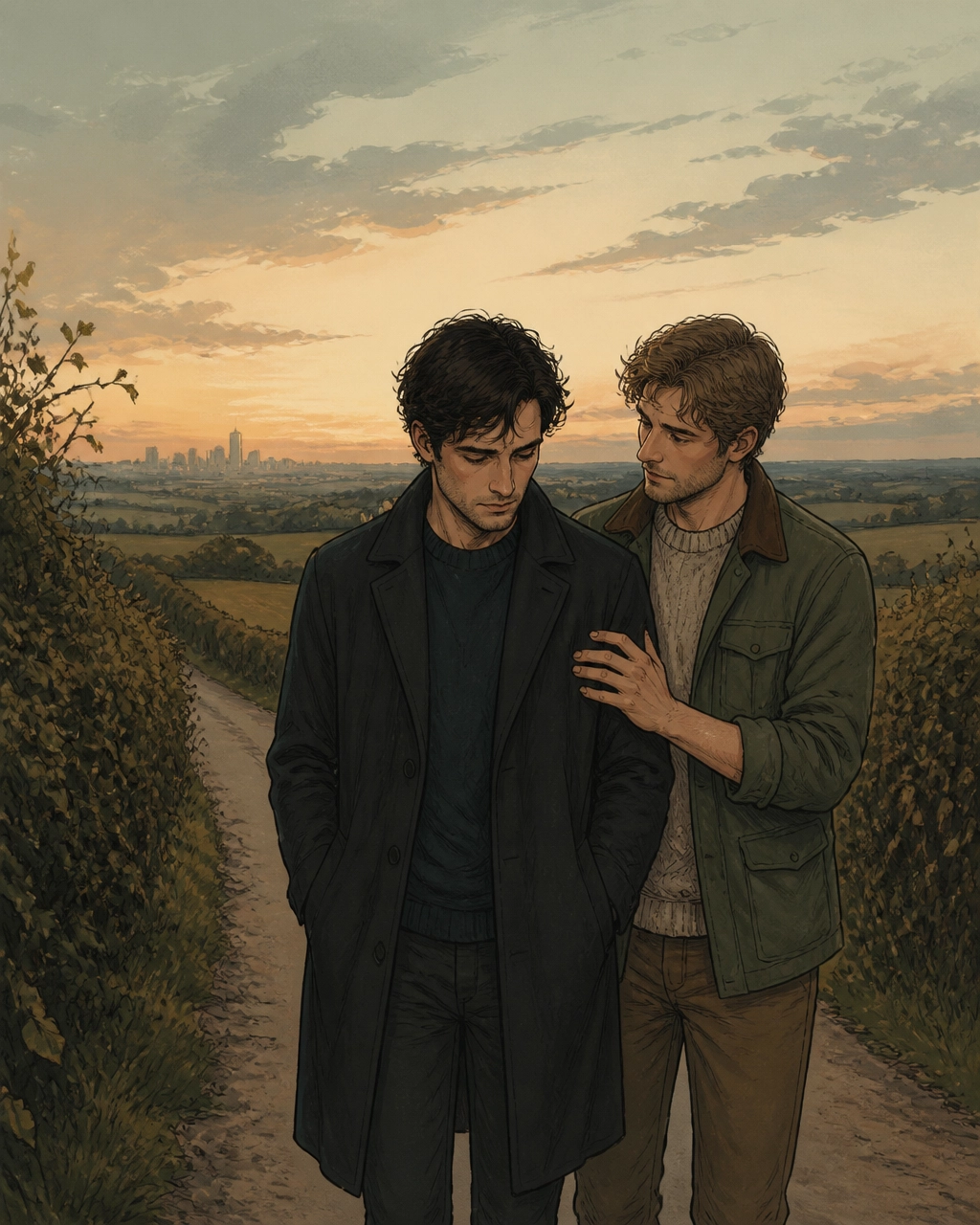
There was a time when Elias believed the city had made him.
He believed its towers had taught him ambition, its underground trains had given him stamina, and its restless, sleepless streets had sharpened him into someone worth noticing. He wore the city as if it were a second skin: dark coat, polished shoes, phone always in his hand, expression arranged into something between confidence and exhaustion.
People asked where he lived, and Elias named the district before they could ask anything else.
They understood immediately. The city was there in the clipped rhythm of his speech, in the way he crossed roads without looking, in his instinctive distrust of silence. He knew which cafés stayed open late, which streets were safe after midnight, which trains ran on time, and how to look occupied even when he had forgotten what he was working towards.
He had learned how to be present everywhere except inside his own life.
When the city becomes a kind of haunting
His leaving did not begin with a breakdown.
There was no dramatic resignation, no argument beneath the hard white lights of the office, no final walk across a bridge with rain turning the river into a sheet of broken glass. The city did not release him with ceremony. It simply continued without him.
One Tuesday evening, the lights above his office desk dimmed automatically. The building was conserving power after hours, though Elias had stayed late so often that the gesture felt personal.
He looked at his reflection in the black window.
Behind him, rows of desks sat empty. Beyond the glass, the city shone with its usual indifference: red brake lights, blue signs, pale windows stacked above one another like thousands of private lives he would never enter.
His heart was beating, but he could not feel it.
That was the frightening part. Not sadness. Not even loneliness. Only the sensation that something essential had withdrawn from him, leaving behind a body that knew how to answer emails, order takeaway, and arrive at work on time.
A week later, Jonah called.
They had known each other for three years, though the friendship had taken time to become honest. Jonah lived in a village several hours away, in a small stone house at the edge of fields that seemed to continue long after the road had ended. He had never understood Elias’s attachment to the city, but he had never mocked it either.
“You could come here for a while,” Jonah said.
Elias stared at the rain moving down his kitchen window.
“For how long?”
“Until you know.”
It was not an invitation to disappear. Jonah knew Elias too well to offer him that kind of romance. It was an invitation to stop performing.
Elias said yes because, at that moment, refusing required more energy than he had.
The countryside does not speak loudly
The train carried him out of the city in stages.
First came the familiar concrete: warehouses, car parks, tower blocks, walls covered in painted advertisements. Then the buildings lowered. The gaps between them widened. Roads became lanes. Streetlamps grew fewer.
Elias watched his reflection float across the glass, superimposed over fields and hedgerows.
He looked like a ghost travelling through a world that had not yet decided whether to admit him.
Jonah was waiting at the station. He stood beside an old car with mud along the wheel arches, hands pushed into the pockets of his jacket. When Elias approached, Jonah smiled: not broadly, not theatrically, but with the quiet relief of someone who had been keeping a light on.
“You came,” he said.
“I said I would.”
“You say a lot of things.”
Elias expected a joke. Instead, Jonah reached for his bag.
The countryside did not feel peaceful at first. It felt exposed.
There were no crowds to hide inside. No traffic to drown out thought. No architecture rising around him to suggest that his life mattered because it occupied space. The village had a shop, a pub, a church, and a collection of houses that appeared to have been placed there by people who valued practicality above beauty.
At night, the darkness gathered against the windows.
Elias kept checking his phone. He refreshed his inbox. He opened news applications, then closed them. He looked for messages from colleagues who had already begun speaking about him in the past tense.
Jonah did not ask him to relax.
He put another log on the fire and let the silence remain what it was: not an answer, but a room large enough for the truth to enter.
Learning the shape of another man’s quiet
Jonah moved through the house with an ease Elias envied.
He knew which floorboards complained. He knew how long the kettle took to boil. He knew the weather by the colour of the fields and could tell, from the sound of the wind against the chimney, whether the night would stay dry.
Elias had spent years believing that knowledge meant speed. Know the quickest route. Know the right phrase. Know when to interrupt. Know how to make yourself indispensable.
Jonah’s knowledge was slower.
It lived in his hands, in the way he repaired a loose gate hinge, kneaded bread, or stood at the kitchen window without needing to fill the view with commentary.
For the first few days, Elias mistook this quiet for emptiness.
Then one morning, Jonah found him standing outside without his phone.
“Signal’s gone,” Elias said.
Jonah looked towards the fields. “It does that.”
“I have work.”
“You left work in the city.”
“I have responsibilities.”
“You have a body,” Jonah said gently. “It’s been asking for your attention.”
Elias wanted to be angry. He wanted to accuse Jonah of turning exhaustion into a moral failure, of making simplicity sound like virtue. Instead, he looked down at his hands.
They were trembling.
Jonah did not touch him until Elias moved closer.
That was the beginning of their tenderness: not a grand declaration, but permission. Jonah’s hand at the back of his neck. Elias leaning into him with the shame of a man who had forgotten how to be held. The two of them standing beneath the grey morning, close enough to share warmth while the fields carried on beyond them.
Their relationship did not rescue Elias from himself.
It made it harder for him to abandon himself unnoticed.

The difficult honesty of staying
The village was not a sanctuary.
It had its own small cruelties and long memories. People watched from windows. Old disagreements survived the seasons. Some conversations ended when Elias entered the room, and some began because he had.
The countryside offered no magical cure for loneliness. In some ways, it made loneliness more visible. A person could walk for an hour and see no one. A bad day had fewer distractions. A restless night had no sirens to blame.
But there was a difference between being alone and being surrounded by evidence that everyone else was living more successfully.
In the city, Elias had measured himself against movement. Every person rushing past him seemed to possess a destination. Every lit office implied someone more focused, more valuable, more awake. He had mistaken velocity for purpose.
Here, his insignificance became ordinary.
The field did not care whether he was impressive. The old trees did not require an explanation for his sadness. The sky did not ask him to improve before it opened.
Jonah, too, did not need Elias to become a different man overnight.
“You don’t have to decide your whole life this week,” Jonah told him one evening at the pub.
Around them, conversation rose and fell: weather, deliveries, a tractor that had broken down near the northern road. Elias held a glass between both hands and watched the amber light move through it.
“What if I don’t want to go back?” he asked.
“Then don’t.”
“What if I do?”
“Then go back.”
Elias looked at him. “You make it sound simple.”
“It isn’t simple. It’s just not a crime.”
That sentence followed Elias home.
He had treated every choice as a verdict. Stay or leave. Succeed or fail. Become someone or disappear. Jonah seemed to understand that a life could be revised without being condemned.
For the first time, Elias allowed himself to imagine that the city had not defined him. It had only described one version of him: the version built for noise, urgency, and constant proof.
There were other versions still waiting.
A pulse is not the same as a performance
Weeks passed.
Elias began walking in the mornings. At first, he did it because Jonah asked him to. Later, he did it because his body expected the fields, the cold air, the wet grass darkening his shoes.
He learned the lane by its details: the gate that swung open in high wind, the crooked ash tree, the patch of ground where blue flowers appeared after rain. He discovered that silence was not the absence of life. It was full of small negotiations: the ticking of pipes, the movement of birds in the hedge, the soft disturbance of an animal beyond the wall.
One evening, Elias and Jonah walked until the last light thinned over the fields.
The city was still inside him. He knew that now. It had not vanished simply because he had travelled away. He still woke with the old panic. He still reached for his phone when he felt uncertain. He still carried the belief that rest had to be earned.
But the countryside had given him another rhythm to listen to.
His breathing.
His footsteps.
Jonah’s shoulder brushing against his.
The low, steady insistence of a heart that had never stopped, even when Elias had stopped paying attention.
At the edge of the field, Jonah took his hand.
“Coming back?” he asked.
Elias looked towards the house. Its single lit window glowed against the dark, modest and imperfect. Behind him, the road led towards the station, the city, the old life waiting with its familiar demands.
He thought of the man he had been there: efficient, admired, permanently absent.
Then he thought of staying: not as surrender, and not as escape, but as an act of recognition.
“I am,” he said.
Jonah’s fingers tightened around his.
They walked home slowly.
Elias did not become a new man in the countryside. He became more difficult to divide. The city ghost remained part of him: the sharpness, the ambition, the knowledge of how to survive in a place that never stopped asking for more.
But now there was something else.
A willingness to be seen without accomplishment between himself and another person. A capacity for quiet. A life measured not only in deadlines and departures, but in returning to the same kitchen, the same path, the same man’s waiting hand.
The countryside had not healed him.
It had given him enough stillness to hear where he was hurt: and enough connection to remain present while the hurt changed.
That night, his phone found one bar of signal and lost it again.
Elias noticed.
Then he turned it face down on the table.
Outside, the fields darkened beneath the evening sky. Jonah was washing two cups by the sink, humming softly to himself. The house settled around them with its old wooden sighs.
Elias listened to his own pulse.
It was not dramatic. It did not announce a transformation.
It was simply there.
And, for once, that was enough.
Read with Pride: emotionally immersive MM fiction
Stories about urban and rural life often become stories about identity: who we are when the world is loud, who we might become when it is quiet, and whether love can make room for both versions.
For readers drawn to emotionally immersive MM literary fiction, high-angst gay romance, and character-driven stories about men facing their deepest internal struggles, this kind of journey offers something more lasting than a simple escape narrative. It asks whether connection can help us recognise ourselves without pretending that pain disappears.
If you are looking for heartfelt gay fiction, emotional MM books, queer fiction, or a thoughtful gay love story shaped by atmosphere and interior conflict, explore Dick Ferguson’s work through Read with Pride.
You can also discover more LGBTQ+ ebooks, gay books, MM romance books, gay novels, queer authors, and new gay releases at Readwithpride.
Follow us on social media
Follow Dick Ferguson for more literary MM romance, gay fiction, LGBTQ+ reading recommendations, and reading with pride:
#ReadWithPride #Readwithpride #MMRomance #GayRomance #QueerFiction #GayFiction #MMFiction #LGBTQFiction #GayLiterature #GayLoveStories #EmotionalMMBooks #HeartfeltGayFiction #GayAuthors #MMAuthors #LGBTQReading #ReadingWithPride


Leave a Reply
You must be logged in to post a comment.