

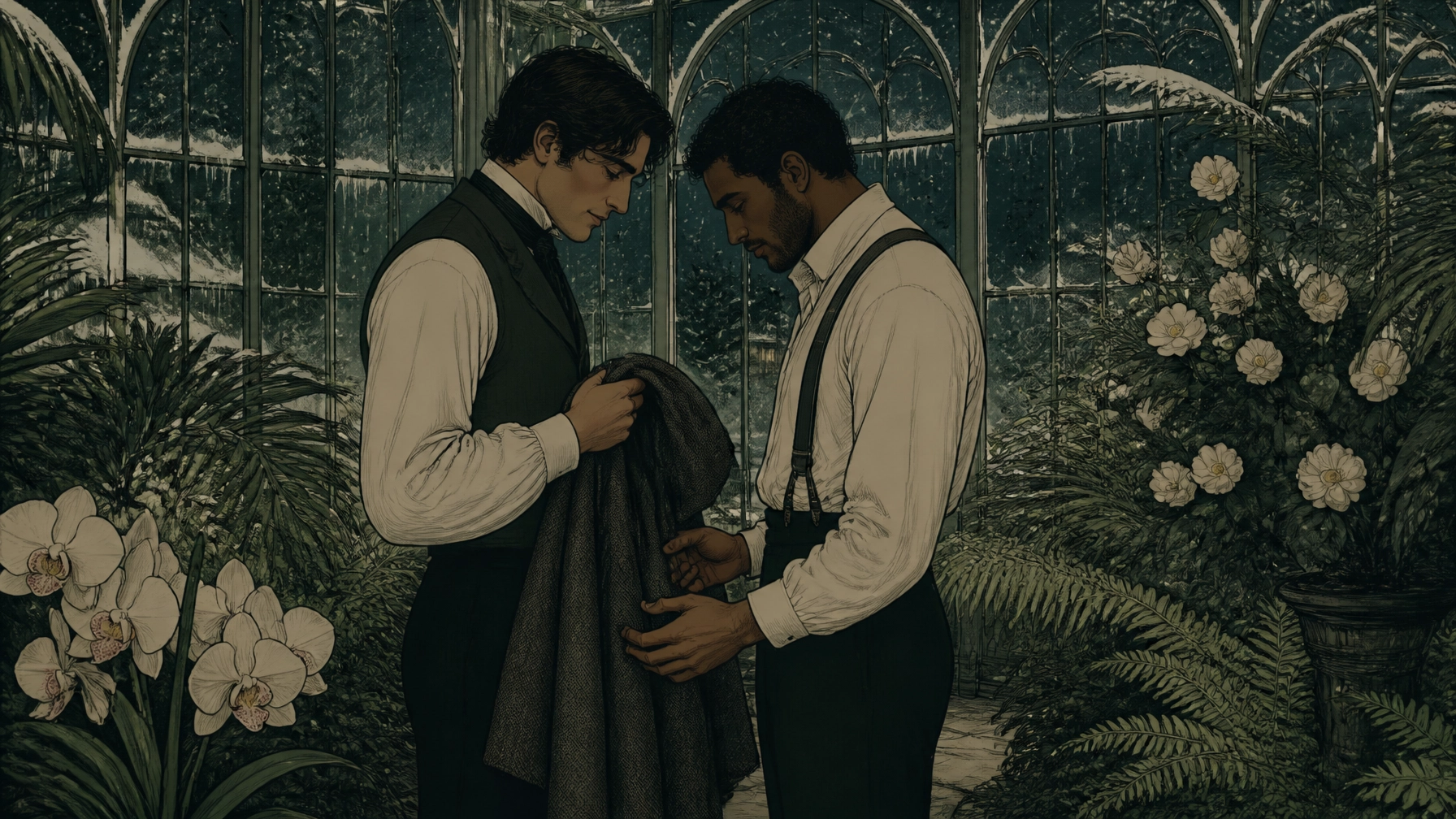
There are places we enter because we have nowhere else to go.
A railway station after the last train. A quiet café where nobody knows our name. The spare room of a friend who has learned not to ask questions until morning.
For Arthur, it was the city’s botanical conservatory.
He found it by accident on a night when winter had erased the roads, softened the streetlights and turned every familiar landmark into a pale blur. The storm had arrived with little warning. Snow struck the glass roofs in hard, frantic bursts, and the wind moved between the buildings with a voice like something grieving.
Arthur had not planned to seek shelter among the palms and winter flowers. He had planned to keep walking.
That had become his way of surviving difficult things: putting one foot in front of the other, refusing to look too closely at the wound beneath the bandage. He had left a flat filled with silence, a conversation that had failed before it began, and a future he no longer trusted himself to imagine.
Then the conservatory doors opened.
Warmth met him first. Not the dry, artificial warmth of a heated room, but something living: damp earth, leaf mould, mineral water and the faint sweetness of flowers blooming out of season. The air touched his face like a hand that did not demand anything.
Beyond the entrance, under the high dark arches of the glasshouse, winter had been kept at a distance.
A refuge beneath the glass
Julian was already there.
He sat on a wooden bench beneath a cluster of broad green leaves, his coat folded beside him and his hands wrapped around a paper cup that had long since gone cold. He looked as though he had been waiting for someone, though Arthur would later understand that Julian had been waiting for the courage to leave.
The two men noticed one another without speaking.
There was no instant transformation. No sudden certainty. No cinematic promise that everything broken could be repaired by a single glance.
There was only recognition.
Arthur saw the guarded set of Julian’s shoulders. Julian saw the exhaustion in Arthur’s face. Each man understood, in the private language of people who had spent too long concealing their pain, that the other had not come to the conservatory for its flowers.
They had come for the permission to be still.
This is where character-driven queer fiction often finds its deepest power. The romance does not begin with perfect timing or effortless attraction. It begins with two men meeting at the exact point where their defences are no longer working.
Arthur had spent years mistaking independence for strength. He had become skilled at leaving before anyone could leave him, at turning disappointment into dry humour, at calling loneliness a preference.
Julian’s struggle was different, but the shape of it was familiar. He had learned to make himself agreeable, useful and difficult to hurt. He listened carefully to everyone else and answered questions about himself with polished half-truths. His life appeared orderly from the outside. Inside, it was a room with no windows.
In the conservatory, neither man had the energy to perform.
The language of winter blooms
They began with small things.
Arthur asked whether the cup in Julian’s hands was coffee.
Julian said it had once been coffee.
Arthur smiled, and the expression seemed to surprise them both.
Outside, the storm pressed harder against the glass. Snow gathered along the roof in white ridges, filtering the moonlight until the conservatory seemed suspended somewhere beyond the city. The ordinary world disappeared. There were no unanswered messages, no family expectations, no professional obligations, no past waiting at the door.
Only the low hum of the heating system. The occasional drip from a leaf. The soft percussion of snow.
They walked through the conservatory together.
The night-blooming flowers held their petals open beneath discreet lamps. White orchids rose like small flames from the dark soil. Camellias trembled under the weight of water. Ferns unfurled in the shadows, their delicate shapes suggesting patience rather than fragility.
Arthur stopped beside a bed of winter jasmine.
“My mother grew this,” he said.
It was the first personal thing he had offered.
Julian did not respond with sympathy. He did not ask what had happened to Arthur’s mother or whether the memory was painful. He simply stood beside him and looked at the flowers.
That restraint mattered.
Empathy is not always a speech. Sometimes it is the decision not to force a door open just because someone has shown you where it is.
For emotionally invested MM readers, these moments often carry more weight than declarations. A hand hovering near another hand. A question asked gently. A silence that does not become punishment. The slow, uncertain discovery that intimacy can be built from attention.
Arthur and Julian did not fall in love because the conservatory made them different men. They began to fall in love because, for a few hours, the conservatory allowed them to stop pretending they were not afraid.

What we reveal when nobody is watching
Near midnight, the lights flickered.
The storm had damaged a power line somewhere beyond the gardens, and the conservatory dimmed until only the emergency lamps remained. Their greenish glow moved across the leaves. Shadows deepened between the paths.
Julian laughed once, nervously.
Arthur asked if he was all right.
“I’m better when I know what is expected of me,” Julian admitted.
The confession seemed to cost him.
Arthur understood. He had lived by the opposite rule: if nothing was expected, he could not fail. Between them, those two forms of fear created a fragile bridge.
Julian told him about the relationship he had ended months earlier: not because love had disappeared, but because he had disappeared inside it. He had agreed to everything until agreement became another word for vanishing.
Arthur spoke about the home he had left that evening. He had been accused of being impossible to reach. The accusation had struck deeper than he wanted to admit because part of him believed it was true.
They sat on the floor beside a raised planter, surrounded by the smell of wet stone and crushed leaves.
Their stories did not match neatly. There were no convenient parallels, no wounds shaped to fit one another. Julian’s fear of being consumed was not the same as Arthur’s fear of being abandoned.
But they listened.
That is the emotional centre of an emotional MM romance literary story: not the promise that one man will rescue the other, but the possibility that two complete, complicated people can become witnesses to one another’s lives.
Love does not erase the past. It gives the past somewhere to rest.
Solace is not the same as escape
By three in the morning, the storm had begun to weaken.
The snow still covered the city, but the glass roof had cleared in places. Above the palms, a few stars appeared. Arthur and Julian stood beneath them, close enough that their sleeves brushed whenever either man moved.
Neither wanted to be the first to suggest leaving.
The conservatory had become more than shelter. It was a temporary country with its own laws. Here, Julian did not need to be charming. Arthur did not need to be invulnerable. They could stand among flowers that bloomed in the wrong season and believe, for a little while, that timing was not destiny.
Julian reached for Arthur’s hand.
The gesture was tentative, almost formal.
Arthur looked down at their fingers, then back at Julian. He did not ask what it meant. He did not make Julian explain the courage contained in such a simple touch.
He closed his hand around Julian’s.
That was all.
And it was enough to change the shape of the night.
The conservatory did not offer them a guaranteed future. It offered no neat conclusion, no assurance that old fears would remain quiet once morning came. Outside, the city would return with its noise and demands. They would still have difficult conversations. They would still misunderstand one another. They would still carry the habits formed during years of self-protection.
But they would no longer carry them alone.

Why stories like this stay with us
The most affecting queer fiction understands that refuge is not always a permanent place. Sometimes it is a night. A conversation. A person who sees the truth and does not turn away.
For readers drawn to character-driven queer fiction, the greenhouse becomes a living metaphor. Its warmth is real, but so is the storm beyond the glass. Its flowers are beautiful, but they require care. Its walls provide protection without pretending the outside world has vanished.
This is the kind of emotional landscape that speaks to the emotionally invested reader: someone seeking more than a plot about two men falling in love. They want the ache beneath the attraction. They want the private negotiations, the fear of needing someone, the tenderness that arrives before either character is ready to name it.
They want a gay love story in which vulnerability is not treated as weakness.
They want MM novels and LGBTQ+ fiction that honour contradiction: men who can be jealous and generous, guarded and yearning, wounded and still capable of extraordinary tenderness. They want gay literature that recognises how difficult it can be to accept happiness when unhappiness has become familiar.
Arthur and Julian’s night among the winter blooms matters because it does not promise that love will make them flawless.
It promises something quieter.
That there may be a place, and perhaps a person, where the truth can survive the cold.
If you are looking for heartfelt gay fiction, emotional MM books and literary gay romance shaped by atmosphere, empathy and authentic internal struggle, explore the Dick Ferguson collection at Read with Pride. You can also discover more LGBTQ+ ebooks and queer fiction at Read with Pride, a home for stories that honour love without limits.
Follow us on social media
Follow Dick Ferguson and Read with Pride for new gay releases, MM romance books, LGBTQ+ reading recommendations, character-driven stories and reflections on queer fiction:
#ReadWithPride #Readwithpride #MMRomance #GayRomance #QueerFiction #GayFiction #MMFiction #LGBTQPlusFiction #GayLiterature #EmotionalMMRomance #CharacterDrivenFiction #GayLoveStories #LGBTQReading #GayAuthors #QueerAuthors #ReadingWithPride
Three future Morning Edition ideas
-
The Last Train to Alder House: When two estranged men share an empty railway carriage, the journey forces them to confront the goodbye neither of them survived the first time.
-
The Map Room at the Edge of the Sea: A grieving cartographer and the man who once left him discover that every map has a blank space: and some absences are invitations.
-
The Blue Hour Apartment: Two men living on opposite sides of a thin city wall begin speaking through the darkness, finding a fragile intimacy before they ever meet face to face.


Leave a Reply
You must be logged in to post a comment.