

This is the next entry in the ongoing Queer Experiences and Stories 6 PM daily series, following “The Morning Elias Told Julian the Truth”.
Sometimes the bravest question is the simplest one
By the time the afternoon arrived, Elias had already said more than he intended.
The truth he had told Julian that morning still sat between them: not like a weapon, exactly, but like something fragile they had both agreed not to disturb. It had taken Elias years to understand how exhausting it was to keep translating himself for other people. To make his fear sound reasonable. To make his hurt sound smaller. To turn every need into an apology before anyone else had the chance to reject it.
Julian had listened.
That mattered. More than Elias expected.
But listening once did not erase the old fear that speaking honestly would eventually cost him the relationship. Elias knew that fear was not entirely about Julian. It had been built elsewhere, in other rooms, during other conversations, through every moment when being vulnerable had made him feel exposed rather than held.
So he did what he had always done when uncertainty became too loud.
He went quiet.
Julian noticed.
Not because he was suddenly an expert in Elias, and not because love gave him magical insight. Julian noticed because he had begun to pay attention without trying to control the outcome.
There was a difference.
The afternoon changed when Julian stopped guessing
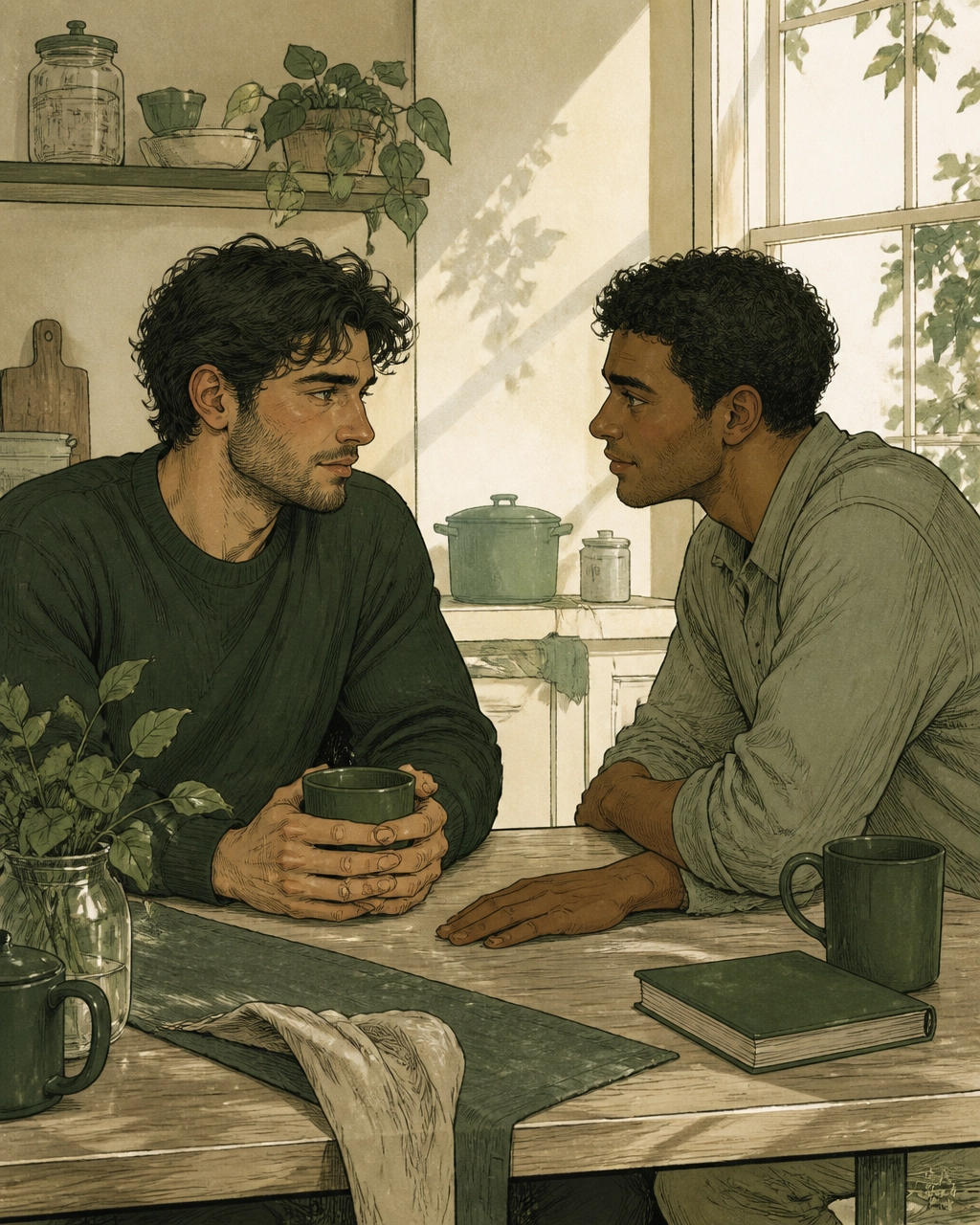
They were sitting at the kitchen table, surrounded by the ordinary evidence of a day that had not gone according to plan: two untouched mugs, a notebook Elias had opened but not used, and a window full of pale city light.
Julian looked across at him.
“What do you need?”
The question was so direct that Elias almost laughed.
Not because it was funny. Because it was terrifying.
His first instinct was to say, “Nothing.”
His second was to say, “I’m fine.”
Both answers had become automatic over the years. They were small doors Elias could close before anyone had the chance to walk through.
Julian did not rush to fill the silence.
That was what made the question different.
He did not ask what was wrong in a worried voice that demanded an immediate solution. He did not offer a list of things he could do and then become frustrated when Elias rejected them. He simply waited, allowing the question to remain open.
Elias looked down at his hands.
“I don’t know,” he admitted.
“Okay.”
Julian’s answer was soft. No disappointment. No impatience.
Elias swallowed. “I’m not used to being asked.”
Julian’s expression changed, just slightly. The tenderness in it made Elias want to look away.
“I’m not used to asking,” Julian said.
There it was: the small, difficult truth beneath the question.
Both men had been taught to perform care in different ways. Julian tried to anticipate everything, believing that if he could solve enough problems, he could prevent the people he loved from leaving. Elias tried to need nothing, believing that self-sufficiency was the closest thing to safety.
They had been calling those habits love.
Perhaps they were love. But they were also fear.
Emotional safety is built in small moments
In many queer experiences and stories, the most important turning points are not grand declarations. They are quiet moments when two men decide to stop protecting themselves from each other.
For Elias and Julian, emotional safety did not arrive as a sudden revelation. It began with permission.
Permission to pause.
Permission to answer honestly.
Permission to say, “I need reassurance,” without being accused of being dramatic.
Permission to ask for space without making distance sound like rejection.
Elias took a breath.
“I need you not to make this about fixing me.”
Julian nodded. “I can do that.”
“And I need you to tell me if you’re listening because you want to understand: or because you’re waiting for your turn to speak.”
That one landed harder.
Julian leaned back, absorbing it. Elias watched him carefully, waiting for defensiveness. Waiting for the familiar turn in the conversation, when a request became an accusation and the person who had spoken was suddenly expected to comfort the person who had been challenged.
But Julian only said, “That’s fair.”
The words were simple. Their effect was not.
Elias felt something inside him loosen.
Not disappear. Not heal all at once. Just loosen.
That was enough for the moment.
Asking for what you need is not a weakness
There is a particular kind of pressure placed on men in relationships: the expectation to be calm, capable and undemanding. Queer men can encounter that pressure alongside older wounds shaped by secrecy, rejection, bullying, invisibility or the fear of not fitting anyone’s idea of a “proper” life.
Elias knew what it was like to doubt the legitimacy of his own feelings.
Was he asking for too much if he wanted a message when Julian would be late? Was it unreasonable to need affection after a difficult conversation? Could he admit that silence sometimes made him imagine the worst?
Julian had his own questions.
Was asking for reassurance selfish? Did needing clarity make him seem insecure? Could he tell Elias that he was frightened without turning the conversation into another burden Elias had to carry?
That afternoon, they began answering those questions together.
Elias tried again.
“I need you to say what you mean,” he said. “If you need time, tell me you need time. If you’re angry, tell me you’re angry. I can handle the truth better than I can handle trying to guess it.”
Julian’s gaze stayed on him.
“I need you to believe me when I say I’m here,” he replied. “Not immediately. I know that doesn’t work like that. But I need you to let me show you.”
Elias’s chest tightened.
The request was not a demand for instant trust. It was an invitation to build trust through repetition.
That mattered too.
Care, they were learning, was not simply knowing someone’s history. It was learning how that history shaped the present: and then choosing not to punish them for the ways they had survived it.
Listening means staying with the feeling
Julian reached across the table, stopping before touching Elias.
“Can I hold your hand?”
Elias looked at him. “Yes.”
Julian’s fingers closed around his carefully.
The gesture was almost painfully gentle.
Elias spoke about the fear underneath his silence. He spoke about the shame of feeling needy. He spoke about the exhausting habit of preparing for abandonment even while being loved.
Julian did not interrupt.
He did not say, “I would never do that,” though Elias knew he wanted to.
He did not turn the conversation into a defence of his character.
Instead, he listened for the meaning beneath the words.
When Elias finished, Julian said, “You were trying to keep yourself safe.”
Elias nodded.
“And now?”
Elias stared at their joined hands.
“Now I’m trying to learn whether I can be safe with you.”
Julian’s thumb moved once across his knuckles.
“That’s the question I want to answer,” he said.
Not I can prove it today.
Not You should already know.
Just: That’s the question I want to answer.
What changes after an honest conversation?
Nothing became perfect after that afternoon.
Elias still withdrew sometimes. Julian still tried to solve things too quickly. They both carried old reflexes into new moments, and sometimes those reflexes collided.
But now they had language.
When Elias went quiet, Julian could ask, “Do you need space, or do you need me to stay close?”
When Julian became overly practical, Elias could say, “I need listening before solutions.”
When fear began disguising itself as anger, either of them could pause and ask what was really happening.
Those questions did not remove conflict. They made repair possible.
That is one of the quiet strengths of emotionally immersive MM romance: it allows love between two men to be more than chemistry or longing. It can show the difficult, tender work of becoming known. It can explore how gay love stories are shaped by the past without allowing the past to dictate the ending.
For Elias and Julian, listening was not passive.
It was an act of courage.
It meant staying present when the truth was uncomfortable. It meant asking instead of assuming. It meant accepting that love could not be measured only by intensity. Sometimes love was the patience to hear the same fear again and answer it with the same steady care.
The question they carried into evening
Later, they left the flat and walked through the city.
The air had cooled. The pavement still held the faint shine of earlier rain. Julian walked close enough that their shoulders brushed, but he did not take Elias’s hand until Elias reached for him first.
That small choice did not go unnoticed.
Neither did the way Julian looked over before crossing the road.
“What do you need now?” he asked.
Elias smiled, a little tired and a little astonished by the question.
“Dinner,” he said. “And maybe for you to stop looking at me like I’m going to vanish.”
Julian laughed under his breath. “I’ll work on that.”
“And after dinner?”
“After dinner, I’ll listen.”
Elias looked at him then.
The city moved around them: cars, footsteps, voices, the blur of strangers carrying their own private stories. But for once, Elias did not feel required to disappear inside himself.
He squeezed Julian’s hand.
“That might be enough,” he said.
Julian squeezed back.
For that afternoon, it was.
Read more emotionally immersive MM romance
If you are drawn to heartfelt gay fiction, emotional MM books, gay love stories and character-driven queer fiction, discover more of Dick Ferguson’s work through Read with Pride’s Dick Ferguson e-book store.
These gay novels and MM romance books explore vulnerability, identity, longing, jealousy, resilience and the complicated ways men learn to love one another. For readers seeking thoughtful LGBTQ+ fiction, gay romantic fiction and richly emotional MM novels, Read with Pride offers stories that make space for tenderness as well as conflict.
Three possible upcoming 6 PM stories
-
Queer Experiences and Stories: The Evening Elias Asked Julian to Stay : When Comfort Became a Choice
A quiet continuation about the difference between being physically present and emotionally available. -
Queer Experiences and Stories: The Night Julian Admitted He Was Afraid : When Strength Finally Made Room for Honesty
Julian confronts the fear beneath his instinct to protect and control every situation. -
Queer Experiences and Stories: The Morning They Made Their First Promise : When Two Men Chose Patience Over Certainty
Elias and Julian begin creating shared agreements for trust, communication and a safer future.
Follow us on social media
Follow Dick Ferguson for more queer fiction, gay book recommendations, MM romance stories and reading with pride:
#QueerExperiencesAndStories #MMRomance #GayRomance #LGBTQBooks #QueerFiction #GayFiction #MMBooks #GayLoveStories #EmotionalMMBooks #HeartfeltGayFiction #LGBTQReading #ReadWithPride #ReadingWithPride #GayAuthors #MMAuthors


Leave a Reply
You must be logged in to post a comment.