

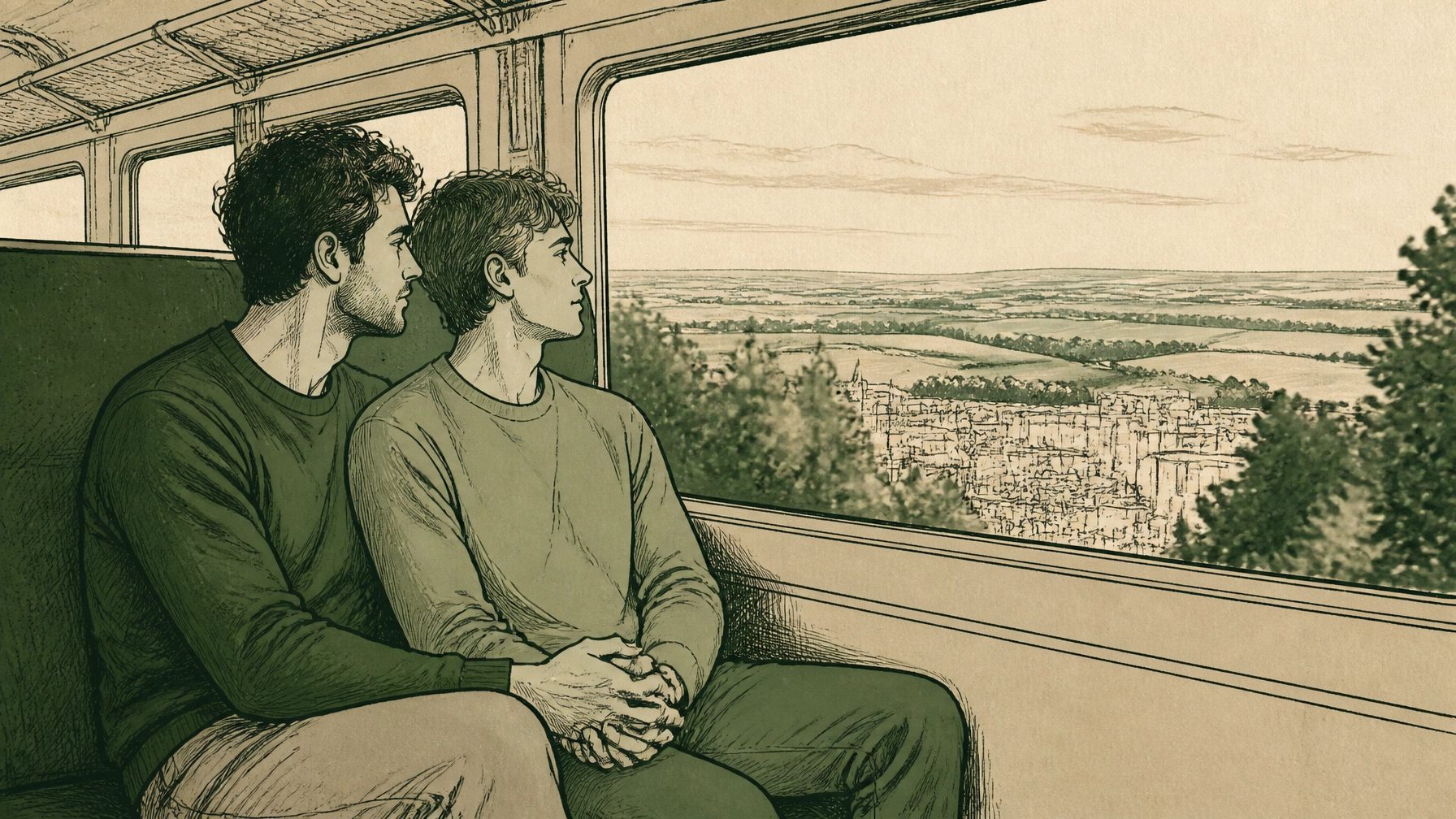
There is a particular sadness in a Sunday train.
It is not the clean, dramatic sorrow of a slammed door or a final speech delivered beneath the rain. It is quieter than that. It lives in the half-empty carriage, in the folded newspaper left behind on a seat, in the tired faces turned towards darkening windows. It is the sadness of people returning to their lives after a brief escape: and of those brave enough to leave one life behind without knowing precisely what will replace it.
For one man, the Sunday train is the last thread connecting him to the city he has spent years learning to survive.
He sits beside the window with one small case at his feet. Behind him are the crowded streets, the late-night cafés, the apartment where he learned to make himself smaller, and the office where every personal truth had to be carefully hidden beneath professional calm. Ahead lie fields, hedgerows, a railway halt with a name he has repeated silently for weeks, and a man who has promised to wait.
Not rescue him.
Not change him.
Simply wait.
That distinction matters in an emotionally immersive MM romance. Love is not a clean escape route. It does not erase the past or guarantee that a new landscape will feel like home. Sometimes, love is the person who remains present while we learn how to become honest.
The city as shelter: and as pressure
Cities often offer queer men a kind of freedom that can feel almost physical.
There are streets where nobody knows your history. Bars where two men can sit close without attracting attention. Bookshops, cafés, community spaces, and apartments filled with the reassuring evidence that you are not the only person who has ever been afraid. The city can be a shelter made of noise and movement.
But shelter is not the same as belonging.
A man may spend years surrounded by people and still feel unseen. He may know every route across town while remaining uncertain about the direction of his own life. He may date, work, laugh, and appear entirely self-possessed while carrying a private exhaustion that no one has thought to ask about.
The city in a gay love story should never be reduced to a villain. It can be liberating, creative, and full of possibility. Yet it can also become a place where reinvention turns into performance. A man may begin by choosing what to reveal and end by forgetting what he truly feels.
That is where the Sunday train begins its emotional work.
It takes him away from the familiar version of himself.
The countryside is not a cure
The country is often presented as the opposite of the city: quiet instead of loud, open instead of crowded, slow instead of urgent. In fiction, this contrast can create a powerful setting for a character-driven MM romance, but only if it is treated with honesty.
The countryside does not automatically make a man fearless.
Silence can be peaceful, but it can also make buried thoughts impossible to ignore. A small community can offer kindness and connection, yet it can also bring scrutiny. The roads may be empty, but the questions can feel close. Who was he in the city? Why has he returned? What happened to the life he was supposed to want?
For a man who has spent years protecting himself, rural stillness can feel like exposure.
There are no crowds to disappear into. No train arriving every few minutes to interrupt a difficult conversation. No convenient excuse to postpone the truth.
And then there is the other man: the one who knows the landscape, who understands the shape of its silences, who has learned that patience is not passivity. He does not demand a declaration on arrival. He does not ask the traveller to prove that leaving the city was worth the cost.
Instead, he offers a key.
A cup of tea.
A place at the table.
Sometimes the most moving gesture in a gay romance book is not a kiss. It is the quiet rearrangement of a room to make space for someone else.
What the train carries between them
The Sunday train carries more than luggage.
It carries the city man’s fear that he has waited too long. It carries the country man’s fear that he will be left again. It carries all the words they have postponed because speaking them might turn hope into something fragile and real.
Their relationship is shaped by distance, but not only geographical distance. There is the distance between wanting to be loved and believing you deserve love. There is the distance between saying “I’m fine” and allowing another man to hear the truth beneath it.
This is why emotionally invested readers respond to high-angst MM romance with a strong sense of place. The setting becomes part of the emotional architecture. The city reflects one man’s restlessness. The countryside reflects his uncertainty. The railway line connects them, but it also reminds us that connection requires movement.
Someone must choose to get on the train.
Someone must choose to wait at the other end.
Neither choice is simple.
A quiet goodbye can contain grief for the person we were, even when we are moving towards the person we hope to become.
A love story about beginning again
Beginning again rarely feels like beginning.
It feels like carrying old habits into a new kitchen. It feels like waking before dawn and listening to unfamiliar birds. It feels like reaching for your phone to return to the life you left, then remembering that the life ahead may require a different kind of courage.
For these two men, love does not arrive as certainty. It arrives as a series of small decisions.
One man admits that he is afraid the country will make him feel trapped.
The other admits that he is afraid the city has taught him to leave before anyone can leave him.
They disagree. They misunderstand one another. They sometimes turn tenderness into accusation because accusation feels safer than asking for reassurance. Their love is not polished. It has edges. Jealousy, shame, memory, and possessiveness may all surface: not as proof that the relationship is doomed, but as evidence that both men are confronting the wounds they once managed alone.
The important question is not whether they can avoid pain.
It is whether they can stop using pain as a reason to disappear.
That is the promise hidden inside the title: not a promise that everything will be easy, but a promise to remain present. To answer the difficult question. To stay for breakfast after the difficult night. To let a new home be built slowly, through repetition and trust.
Why urban and rural contrasts matter in queer fiction
Stories about queer men moving between city and country can challenge an old assumption: that authenticity is found only by escaping one place and arriving in another.
A city is not automatically free. A village is not automatically hostile. A country road cannot solve loneliness, and a crowded street cannot prevent love. What matters is how the characters experience these spaces: and how the spaces shape what they believe about themselves.
This creates room for nuanced queer fiction and literary MM romance. The conflict is not simply city versus country. It is concealment versus honesty, performance versus intimacy, isolation versus belonging.
The most affecting gay novels understand that home is not merely an address. It is the place where a man can tell the truth without preparing to be abandoned.
Sometimes home is a rural cottage with rain tapping against the glass.
Sometimes it is a city flat filled with plants, books, and the complicated history of two people trying to remain together.
Sometimes home begins on a train, in the brief moment when one man reaches across the space between them and says, without words: I am still here.
For readers who want love with emotional depth
If you are drawn to heartfelt gay fiction, slow-burn MM romance, quiet goodbyes, second chances, and stories about finding belonging after years of self-protection, this kind of journey may stay with you long after the final page.
Dick Ferguson’s novels explore the difficult terrain between desire and trust, fear and tenderness, leaving and returning. His work is written for readers who want more than a simple city boy and country boy romance trope. These are stories about men carrying complicated histories, making imperfect choices, and discovering that love can be both a risk and a place to rest.
Explore Dick Ferguson’s LGBTQ+ ebooks and emotional MM romance books on Read with Pride, and visit Read with Pride for more gay books, queer fiction, LGBTQ+ romance, gay literature, and reading recommendations.
The Sunday train keeps moving.
Outside the window, the last buildings thin into fields. The light fades over the tracks. One man closes his eyes, not because he has stopped being afraid, but because he has finally allowed himself to imagine tomorrow.
At the rural station, another man is waiting.
And this time, goodbye is not the end of the story.
It is the first promise of beginning again.
Follow us on social media
Follow us on social media for new releases, literary reflections, character-driven MM romance, and LGBTQ+ reading recommendations:
#MMRomance #GayRomance #QueerFiction #GayFiction #LGBTQBooks #GayLoveStories #MMNovels #LGBTQFiction #GayLiterature #EmotionalMMBooks #HeartfeltGayFiction #GayRomanceBooks #MMRomanceBooks #ReadingWithPride #ReadWithPride


Leave a Reply
You must be logged in to post a comment.